support
Ice plant
Delosperma cooperi
International hardiness
- USDA 5-10
- RHS H5
- AU: Warm temperate, Arid / semi-arid
Where it grows — regional guide
| Zones / rating | Regional notes |
|---|---|
USDA 5-10 | Exceptional performance in arid western and southwestern states; needs sharply drained, gravelly soil to survive wet winter freezes in the Midwest. |
| Zones / rating | Regional notes |
|---|---|
H5 (-15 to -10C) | Thrives in sunny gravel gardens and coastal cliffs across southern England; requires gritty, free-draining substrate to survive damp winters. |
| Zones / rating | Regional notes |
|---|---|
Warm temperate, Arid / semi-arid | Widely adapted across Mediterranean and semi-arid zones of South Australia, Victoria, and Western Australia; highly heat and drought tolerant. |
| Zones / rating | Regional notes |
|---|---|
USDA 5-10 (USDA scale) Canada uses its own zone system; Canadian zones run roughly one lower than USDA. | Hardy in dry interior regions of British Columbia and southern Ontario; protect from winter slush and snowmelt saturation. |
| Zones / rating | Regional notes |
|---|---|
No region-specific data yet | No region-specific data yet |
Ice plant (Delosperma cooperi), commonly known as Cooper's hardy ice plant or trailing ice plant, is a low-growing, succulent perennial subshrub in the fig-marigold family (Aizoaceae). Indigenous to the high-elevation, semi-arid grasslands and rocky plateaus of South Africa, particularly the Drakensberg mountains and the Free State, this tough groundcover has earned widespread popularity across temperate and arid regions. The common name derives from the specialized translucent, water-filled epidermal cells (bladder cells) that coat its fleshy cylindrical leaves, glistening in bright sunlight like tiny ice crystals.
In a homestead landscape or permaculture design, the ice plant is an exceptional drought-resilient living mulch and soil-protecting support species. While moisture-demanding edible groundcovers such as the strawberry require rich, regularly watered garden beds, Delosperma cooperi thrives on barren, sun-baked slopes, gravel paths, and exposed terrace edges where thin soils and searing heat cause other perennials to wither. Its high moisture content also makes it an effective component of defensible-space fire-resistant landscaping around homestead structures.
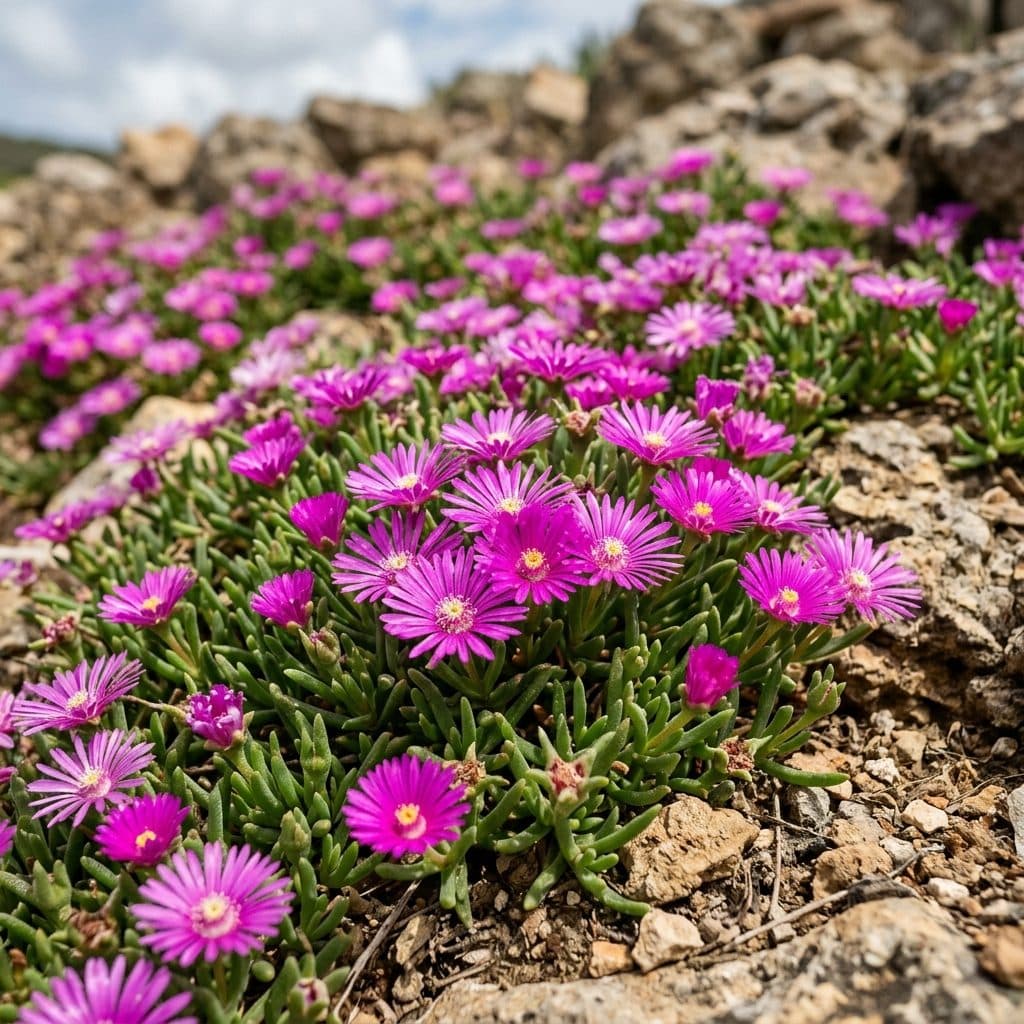
From early summer through mid-autumn, the succulent carpet is completely transformed by a profuse display of daisy-like, iridescent magenta-purple blossoms. These flowers open widely during peak midday sunshine and close at dusk, providing a rich, continuous source of nectar and pollen for honeybees, bumblebees, and native solitary pollinators throughout the hottest weeks of the growing season.
Growing ice plant
Unlike tender coastal ice plants that perish at the first touch of frost, Delosperma cooperi possesses remarkable cold-hardiness, withstanding winter minimum temperatures down to -29 °C (-20 °F) when fully dormant, making it reliable from USDA Hardiness Zones 5 through 10. The definitive factor determining winter survival is soil moisture rather than ambient temperature: plants survive severe sub-zero freezes when their root crowns remain dry, but they rot quickly if subjected to cold, soggy, saturated winter ground.
Sharply drained soil is an absolute necessity. Ice plant performs best in sandy, gravelly, or rocky soils with low fertility and a soil pH between 6.0 and 7.5. Heavy, moisture-retentive clay soils must be heavily amended with coarse grit, pumice, or expanded shale, or plants should be elevated on rockeries, raised berms, or sloping stone retaining walls where water drains rapidly away from the crowns. High soil fertility and excessive nitrogen fertilization should be strictly avoided; over-fertilized plants produce bloated, watery foliage that sprawls loosely and exhibits heightened vulnerability to fungal rot and winter kill.
Full sunlight is essential for healthy, compact growth and abundant flowering. Position plants where they receive at least six to eight hours of direct, unfiltered sun daily. In shady or overcast conditions, stems become weak, leggy, and pale, and the daisy-like blossoms remain tightly closed. Once established, ice plant is remarkably drought-tolerant, drawing upon water stored within its thick, fleshy leaves during extended rainless periods. Water newly installed transplants moderately until root systems establish; thereafter, mature plantings require little to no supplemental irrigation except during extreme, multi-week heat waves.
Propagation is remarkably simple and rapid from stem cuttings or root division. In late spring or summer, snip healthy non-flowering stem tips 5 to 7.5 cm (2 to 3 in) long. Allow the cut ends to dry and form a callous in a shaded spot for 24 hours, then insert the cuttings directly into moist, sandy potting mix or gritty garden soil. Roots form within one to two weeks without the need for rooting hormones. Established clumps can also be divided in spring as fresh green growth begins.
Space container-grown nursery plants or rooted cuttings 30 to 45 cm (12 to 18 in) apart. Individual plants grow 7 to 15 cm (3 to 6 in) tall and spread 45 to 75 cm (18 to 30 in) wide within one to two growing seasons, creating a seamless, weed-suppressing succulent blanket.
Routine maintenance is minimal. In early spring, carefully comb through the mats with gloved fingers to remove dead leaves or winter-damaged stem tips before fresh spring shoots expand. Avoid heavy mechanical shearing, which damages the succulent stems.
Harvest and uses
Because Delosperma cooperi is cultivated as an ecological living mulch, soil stabilizer, and ornamental groundcover rather than an agricultural food crop, harvesting is restricted to gathering vegetative cuttings for propagation or sharing with neighboring growers.
On sloping terrain, roadside verges, and terrace berms, the interlocking stems and fibrous root network provide effective erosion control. The prostrate stems root into the soil surface as they spread, binding sandy or gravelly topsoil against wind and heavy rain. Unlike dry woodchips or bark mulch that wash away during torrential storms or pose a seasonal fire hazard, a living mat of succulent ice plant stays anchored and acts as a green fire retardant.
The plant plays an important role in supporting biodiversity. The iridescent blossoms produce accessible pollen and nectar during midsummer when spring floral blooms have faded and summer heat sets in. A perimeter border of ice plant attracts beneficial insects that aid in pollinating nearby fruit trees and vegetable crops like garlic.
Identifying ice plant
Delosperma cooperi is identified by its prostrate succulent habit, glistening cylindrical leaves, and brilliant daisy-like flowers:
- Habit: Low-growing, sprawling, mat-forming perennial succulent subshrub reaching 7 to 15 cm (3 to 6 in) in height, with creeping, semi-woody stems that spread 45 to 75 cm (18 to 30 in) across and root at the nodes.
- Foliage: Opposite, fleshy, linear to cylindrical (terete), curved upward, measuring 2.5 to 5 cm (1 to 2 in) long and 3 to 6 mm wide. Leaf surfaces are covered in microscopic, glistening bladder cells that sparkle in sunlight. Foliage is bright green during the summer, often shifting to reddish-bronze or purplish tones in response to winter cold.
- Flowers: Solitary, daisy-like blossoms measuring 4 to 5 cm (1.6 to 2 in) in diameter, produced continuously from June through September. The corolla consists of dozens of narrow, shimmering, linear petal-like staminodes in vivid shades of magenta, violet-purple, or deep pink, surrounding a central ring of creamy-white to yellow stamens. Flowers open in direct sunlight and close tightly during overcast periods and at night.
- Fruit: Five-valved hygroscopic capsules that open when wet to release tiny seeds and close tightly when dry.
Delosperma cooperi is readily distinguished from the coastal highway ice plant (Carpobrotus edulis), which is a much larger, coarse, frost-tender succulent featuring massive three-sided leaves up to 10 cm (4 in) long and yellow flowers that cannot survive freezing continental winters. It differs from moss phlox (*Phlox subulata*) by its distinctly succulent, cylindrical leaves and glossy, multi-petaled daisy-like blossoms.
Cautions
Growers should consider the following environmental, physical, and ecological factors:
- Winter moisture and crown rot: Standing water or saturated, poorly drained soil during cold winter months is fatal to the root crown. In regions with wet winters, plant exclusively on gravel-amended slopes, rock walls, or raised beds to ensure rapid drainage.
- Confusion with invasive coastal species: Delosperma cooperi is sometimes confused with invasive coastal ice plants in the genus Carpobrotus, which aggressively displace native dune vegetation along coastlines in California and southern Europe. Delosperma cooperi does not exhibit invasive behavior in cold-temperate inland gardens, though it forms vigorous spreading colonies in dry soils. The plant is regulated in some jurisdictions; check your local list before planting.
- Physical fragility: The succulent, water-swollen stems are brittle and snap easily under foot traffic or heavy garden equipment. Plant in areas where pets and people will not walk directly across the mats.
- Animal browsing: While generally ignored by deer due to its succulent texture, hungry rabbits or ground squirrels may chew on foliage during severe summer droughts to obtain moisture.
Sources
- Royal Botanic Gardens, Kew. Delosperma cooperi (Hook.f.) L.Bolus Plants of the World Online.
- NC State Extension Plant Toolbox. Delosperma cooperi
- Plants For A Future. Delosperma cooperi - (Hook.f.) L.Bolus
- Missouri Botanical Garden. Delosperma cooperi
- Colorado State University Extension. Ground Cover Plants