support
Creeping phlox
Phlox subulata
International hardiness
- USDA 3-9
- RHS H6
- AU: Cool temperate, Warm temperate
Where it grows — regional guide
| Zones / rating | Regional notes |
|---|---|
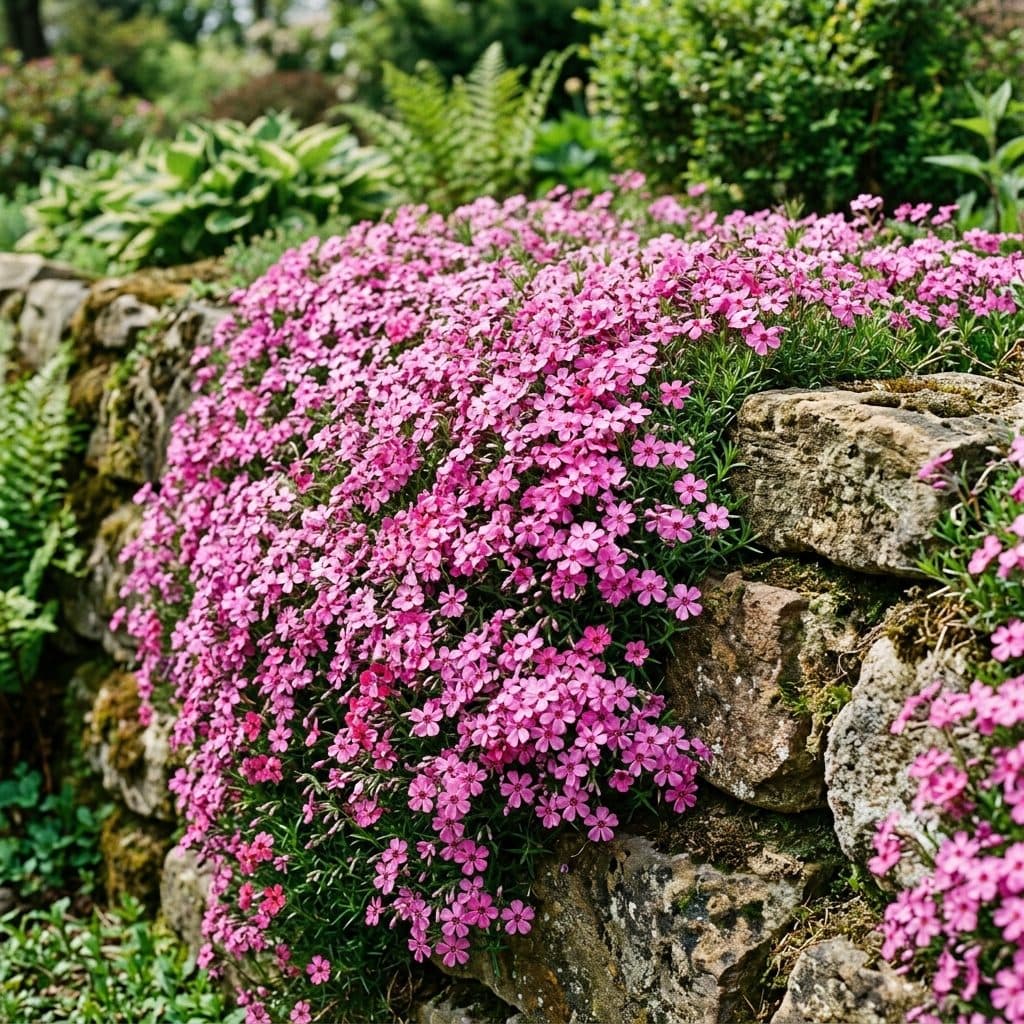
USDA 3-9 | Extremely reliable across eastern and central states; ideal for draping over stone walls, rockeries, and dry sunny slopes. |
| Zones / rating | Regional notes |
|---|---|
H6 (-20 to -15C) | Flourishes in gravel gardens and raised scree beds throughout Britain; requires sharply draining gritty soil to prevent winter rot. |
| Zones / rating | Regional notes |
|---|---|
Cool temperate, Warm temperate | Performs best in cool-temperate tablelands and mountain gardens of Victoria and Tasmania with mild summers and cold winters. |
| Zones / rating | Regional notes |
|---|---|
USDA 3-9 (USDA scale) Canada uses its own zone system; Canadian zones run roughly one lower than USDA. | Overwinters with ease across southern Canada down to Zone 3; needle-like foliage remains green beneath insulating snow. |
| Zones / rating | Regional notes |
|---|---|
No region-specific data yet | No region-specific data yet |
Creeping phlox (Phlox subulata), widely referred to as moss phlox, moss pink, or rock pink, is a low-growing, evergreen perennial subshrub in the phlox family (Polemoniaceae). Indigenous to sandy knolls, rocky ledges, and open woodland clearings across eastern and central North America, from southern Ontario and New York southward to North Carolina and westward to Michigan, this rugged groundcover is celebrated for its spectacular spring floral display. In early spring, mature mats become completely obscured beneath a dense, blanket-like canopy of five-lobed, star-shaped blossoms in brilliant shades of magenta, pink, lavender, and pure white.
In a homestead landscape or permaculture design, creeping phlox is a long-lived living mulch and soil-holding support groundcover. While edible crops like the strawberry fill low ground niches in fertile, moisture-rich garden beds, creeping phlox colonizes lean, rocky banks, retaining walls, and sunny terrace edges where harsher conditions prevail. Its creeping stems root into crevices, anchoring loose topsoil against rain erosion and suppressing annual weeds without invading surrounding root systems.
The foliage consists of small, stiff, needle-like leaves that remain evergreen through winter, forming a tactile moss-like cushion during the months when adjacent perennial plants lie dormant. Beyond its ornamental and structural roles, creeping phlox acts as an indispensable early nectar station, supplying critical forage to native bees, early bumblebees, and emerging swallowtail butterflies before summer meadows burst into bloom.
Growing creeping phlox
Creeping phlox displays outstanding cold-hardiness, withstanding winter temperatures down to -35 °C (-31 °F) across USDA Hardiness Zones 3 through 9. Its semi-woody stems and evergreen foliage persist through heavy winter freezes, particularly when blanketed under an insulating cover of snow. The species is equally resilient against summer warmth, provided humidity does not remain excessive and soil drainage remains sharp.
Sharply drained soil is the single most important cultural requirement for creeping phlox. It excels in lean, gritty, rocky, or sandy loams with a neutral to slightly acidic pH between 6.0 and 7.2. The plant has evolved on dry rangelands and rocky outcrops; heavy, water-retentive clay soils and poorly drained low spots cause root rot and crown collapse, especially during cool, wet winter months. When planting in clay-heavy homestead soils, elevate the crowns into raised rockeries, stone wall crevices, or gravel-amended berms. Nutrient-rich soils should be avoided; excessive fertility prompts rapid, floppy vegetative growth that becomes leggy and flowers sparsely.
Full sunlight is essential for maintaining dense, compact mats and maximizing flower production. Select a planting site that receives at least six hours of direct, unfiltered sunlight daily. Plants grown in partial shade develop loose, open growth and suffer from heightened susceptibility to fungal foliage issues. Once established, creeping phlox possesses remarkable drought tolerance due to its dense, fibrous root mass. Provide moderate watering during the first growing season to encourage root establishment; thereafter, supplemental irrigation is required only during severe summer dry spells.
Propagate creeping phlox by stem cuttings, crown division, or layering. Semi-ripe softwood cuttings taken in early summer after flowering root easily in moist sand or perlite. Alternatively, established mats can be divided in early autumn or early spring by digging up rooted sections and transplanting them directly into prepared ground. In garden beds, stems naturally layer and root wherever nodes contact moist soil.
Space nursery plugs or container-grown plants 30 to 45 cm (12 to 18 in) apart. Individual plants grow 10 to 15 cm (4 to 6 in) tall and spread 45 to 60 cm (18 to 24 in) in diameter within two seasons, eventually weaving together into a continuous carpet.
Pruning is essential for long-term health and aesthetics. Immediately after the spring blooming period finishes, shear the entire mat back by roughly one-third to one-half of its stem length using hedge shears. This post-bloom trimming removes spent flower heads, prevents the centers of older mats from becoming bare and woody, and stimulates fresh lateral shoots that produce an ultra-dense, mossy green cushion for the remainder of the year.
Harvest and uses
Because creeping phlox is cultivated as a perennial living mulch, soil stabilizer, and ecological resource rather than a food crop, harvesting is restricted to gathering decorative flowering cuttings and dividing vegetative propagation stock.
The dense carpet is an effective erosion control blanket along road cuts, sloping driveways, swales, and terraces. Once the canopy closes, the dense mass of evergreen needles intercepts falling raindrops, moderates soil temperature, and creates a dense root weave that locks fragile subsoil in place. It eliminates the need for repeated applications of wood mulch on sunny banks.
In early spring, when does creeping phlox bloom? Depending on latitude and elevation, flowering initiates between mid-April and early May, lasting for three to four weeks. Small flowering sprigs can be clipped with shears for delicate indoor floral arrangements, fairy gardens, or spring centerpiece bouquets.
Ecologically, the blossoms feature a long, narrow floral tube that holds nectar accessible to long-tongued pollinators. Native solitary bees, bee flies, bumblebees, and early butterflies visit the blossoms in large numbers, making a perimeter planting of creeping phlox an effective strategy for drawing pollinators to nearby early-blooming fruit orchards.
Identifying creeping phlox
Creeping phlox is recognized by its prostrate mat-forming habit, needle-like foliage, and distinctive salverform blossoms:
- Growth habit: A low, sprawling, carpet-forming evergreen subshrub reaching 10 to 15 cm (4 to 6 in) in height, spreading 45 to 60 cm (18 to 24 in) across, with prostrate, semi-woody creeping stems that root at nodes.
- Foliage: Opposite, densely crowded along stems, linear to awl-shaped (subulate), measuring 8 to 20 mm (0.3 to 0.8 in) long and 1 to 2 mm wide. The leaves are rigid, pointed, dark green, with finely ciliate margins, persisting as a green moss-like carpet through winter.
- Flowers: Produced in terminal clusters of two to four blossoms; corolla is salverform, measuring 2 to 2.5 cm (0.8 to 1 in) across, consisting of a slender tube opening into five spreading, flat petals. Each petal lobe displays a shallow notch at the outer margin. Blossom colors include deep rose-pink, magenta, lavender, violet-blue, and pure white, often with a darker, contrasting basal eye.
- Fruit: Small, three-valved, globose capsules containing tiny brown seeds, though cultivated forms set seed sparingly.
Creeping phlox is distinguished from garden phlox (Phlox paniculata) by its prostrate creeping habit, needle-shaped leaves, and early spring bloom time, whereas garden phlox is an upright 1-meter-tall herbaceous perennial blooming in late summer. It differs from woodland phlox (Phlox divaricata) by its rigid, subulate, evergreen foliage and preference for full sun and dry soils, compared to the broad, deciduous leaves and moist shade preference of woodland phlox.
Cautions
Growers should monitor several environmental, disease, and winter management considerations:
- Crown rot in wet soils: The primary cause of plant failure is crown and root rot caused by poor drainage and standing water. Soils that remain saturated during cool winter months will quickly rot root crowns, leaving dead, blackened patches in the mat. Plant only in free-draining sites.
- Powdery mildew: In humid summer regions with poor air circulation or partial shade, foliage can become infected with powdery mildew (Erysiphe species). Shearing plants back after bloom opens the canopy and significantly reduces mildew risks.
- Winter windburn: In northern zones without continuous snow cover, cold drying winter winds combined with intense winter sun can desiccate the evergreen needles, causing foliage to turn brown and straw-like by early spring. Laying evergreen boughs over exposed mats in late autumn shields foliage from wind desiccation until spring thaw.
- Animal browsing: While generally resistant to deer, hungry rabbits will occasionally browse tender young shoots in early spring.
- Regulatory note: The plant is regulated in some jurisdictions; check your local list before planting.
Sources
- Royal Botanic Gardens, Kew. Phlox subulata L. Plants of the World Online.
- NC State Extension Plant Toolbox. Phlox subulata
- Plants For A Future. Phlox subulata - L.
- Missouri Botanical Garden. Phlox subulata
- USDA PLANTS Database. Phlox subulata L.