Key takeaways
- Living ground covers between pavers soften hardscape edges, suppress weeds, and cool stone surfaces.
- Plant selections must match foot traffic levels, from heavy daily walking to light occasional stepping.
- Pathway joint soil requires a blend of coarse sand, compost, and native topsoil to prevent compaction.
- Top walkable choices include creeping thyme, blue star creeper, dwarf mondo grass, and miniature chamomile.
- Setting paver crowns slightly above plant crowns protects growing points from direct crushing.
Quick answer: The best ground cover between pavers includes low-growing, durable plants that tolerate foot traffic and recover quickly from compression. Top varieties include creeping thyme (Thymus serpyllum) and blue star creeper (Isotoma fluviatilis) for sunny paths, alongside Irish moss (Sagina subulata) and dwarf mondo grass for shaded flagstone walkways.
Stone walkways, flagstone patios, and concrete garden pavers add structure and accessibility to home landscapes. However, open gaps between stones frequently collect windblown weed seeds, requiring ongoing weeding or chemical sprays that degrade soil health.
Planting durable ground cover between pavers replaces barren gravel or weed-prone joints with living green ground covers. These low growing plants for paths soften rigid stone edges, release pleasant herbal fragrances when brushed, absorb excess rainwater, and create cool microclimates around walking surfaces.
Choosing the right steppable plants requires matching species characteristics with your specific pathway conditions, including daily foot traffic intensity, sun exposure, and joint width.
How do you choose plants between stepping stones based on foot traffic?
Not all ground covers tolerate being walked on regularly. Matching plant selections to expected foot traffic ensures long-term path health:
Heavy foot traffic paths (daily walking and main entrances)
Paths leading to front entries, compost bins, or chicken coops experience multiple daily footfalls. Plants for these zones must possess flexible stems, low growth habits (under 2 inches or 5 cm), and rapid recovery rates:
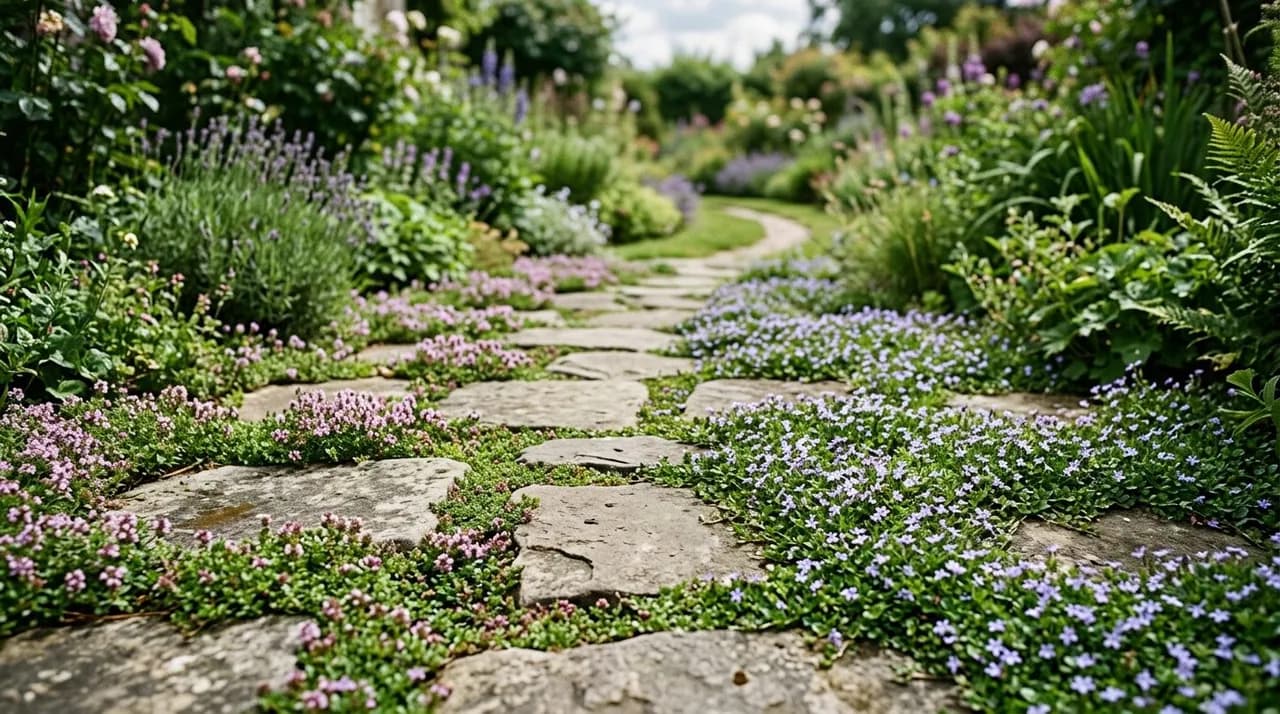
- Red creeping thyme (Thymus serpyllum 'Coccineus'): Reaches only 1 to 2 inches (2 to 5 cm) tall, forms a dense carpet, releases an aromatic herbal scent when stepped on, and produces magenta summer flowers in full sun.
- Blue star creeper (Isotoma fluviatilis): Forms a dense green mat with tiny pale blue blossoms from spring through summer. It tolerates heavy foot traffic in moist, well-drained sunny to partially shaded locations.
Moderate foot traffic (garden strolls and patio borders)
Paths through vegetable beds or side garden borders experience moderate weekly footfalls:
- Woolly thyme (Thymus pseudolanuginosus): Has silvery-grey fuzzy leaves that form a dense cushion 1 to 2 inches (2 to 5 cm) high in dry, sunny joints.
- Corsican mint (Mentha requienii): A miniature creeping mint growing under 1 inch (2 cm) tall that releases a strong peppermint fragrance when brushed. It thrives in moist, partially shaded pathway joints.
- Miniature Roman chamomile (Chamaemelum nobile 'Treneague'): A non-flowering creeping perennial that forms an aromatic, lawn-like evergreen mat under 2 inches (5 cm) tall.
Light foot traffic (secondary stepping stones and accent paths)
Occasional-use garden pathways and decorative flagstone patios:
- Irish moss (Sagina subulata) and Scotch moss (S. subulata 'Aurea'): Form bright green or golden moss-like carpets with tiny white spring flowers in cool, moist, partially shaded soils.
- Brass buttons (Leptinella squalida): Has miniature fern-like bronze-green foliage that creeps tightly between narrow stone joints.
- Dwarf mondo grass (Ophiopogon japonicus 'Nana'): A slow-growing, clumping evergreen perennial reaching 2 to 3 inches (5 to 8 cm) that handles deep shade and intermittent foot traffic.
To explore additional perennial options for broader garden areas, see our guide on ground cover for slopes.
How do you prepare soil and joints between flagstones?
Establishing healthy ground cover between flagstone requires proper joint preparation before planting. Planting directly into builder's sand or compacted road base will result in stunted, desiccated plants.
Follow this soil preparation sequence:
Step 1: Establish adequate joint width and depth
For plants to establish healthy root networks, ensure gaps between pavers are at least 1.5 to 3 inches (4 to 8 cm) wide. Clear loose stones and debris to create a soil depth of at least 3 to 4 inches (8 to 10 cm) within the joints.
Step 2: Formulate a porous root-zone soil mix
Fill joints with a custom planting blend consisting of:
- 50% screened native garden soil or mature compost
- 30% coarse horticultural sand or fine crushed granite
- 20% fine pine bark fines or perlite
This mix ensures adequate water retention and organic nutrition while preventing heavy compaction from repetitive foot traffic. For principles of organic soil conditioning, review soil amendments demystified.
Step 3: Grade pavers and plant crowns correctly
Set your paver stones so the stone surfaces sit roughly 0.5 inches (1.3 cm) above the final soil line. When inserting plant plugs, position the plant crown slightly below the top edge of the adjacent stones. This slight depression protects the plant's main structural crown from being crushed by direct shoe soles while allowing trailing foliage to creep across the stone edges.
How do you plant and establish walkable ground covers?
Planting ground covers in narrow joints requires using small propagation material instead of full-sized nursery containers:
- Use cell plugs or division: Purchase 72-cell plug trays or divide standard 4-inch pots into multiple small root plugs using a clean hori-hori garden knife.
- Space appropriately: Space plugs 4 to 6 inches (10 to 15 cm) apart along the joints. Most creeping varieties will expand and knit together into a continuous mat within three to six months of active growth.
- Water consistently during establishment: Because paving stones absorb solar heat and dry surrounding soil quickly, water young plantings daily with a gentle spray nozzle for the first three weeks until roots penetrate the cooler subsoil beneath the pavers.
How do you design pathway layout and stone spacing for comfortable walking?
Designing a walkable path with living ground covers requires coordinating stone dimensions with natural human stride lengths:
- Stepping stone stride spacing: When installing individual stepping stones, place the centers of adjacent stones roughly 20 to 24 inches (50 to 60 cm) apart. This spacing matches the average walking stride so users step from the center of one stone to the next instead of constantly treading directly on joint plantings.
- Continuous flagstone and paver walks: For continuous patios and wide garden paths, keep individual joints between 1.5 and 3 inches (4 to 8 cm) wide. Joints narrower than 1 inch (2.5 cm) limit root volume and dry out too rapidly, while gaps wider than 4 inches (10 cm) can feel unstable underfoot.
- Permeable drainage benefits: Unlike solid mortared patios or poured concrete walks that generate rapid stormwater runoff, permeable stone walkways with living ground cover joints allow heavy rainfall to infiltrate directly into the subsoil. This prevents puddling, recharges shallow soil moisture, and reduces erosion along adjacent garden beds.
How do you maintain and weed planted stone pathways?
Once established, living pathway joints require simple, routine maintenance:
- Edge and trim wandering runners: Trim aggressive foliage that obstructs path visibility or overflows onto surrounding lawns with a line trimmer or hand shears once or twice a season.
- Suppress early weed competitors: Hand-pull emerging weeds promptly during the first season. Once steppable plants form a dense, mature carpet, they outcompete incoming weed seeds naturally.
- Avoid salt and harsh chemical deicers: In cold-winter regions, avoid applying chemical rock salt (sodium chloride) to stone paths, as salt runoff burns plant foliage and damages root systems. Use coarse sand or sawdust for winter traction instead.
To integrate pathways into broader ecological landscape designs, explore our tutorials on permaculture gardening and backyard food forest layouts.