pioneer
Warrigal greens
Tetragonia tetragonioides
International hardiness
- USDA 8-11
- RHS H3
- AU: Tropical, Subtropical, Warm temperate, Cool temperate, Arid / semi-arid
Where it grows — regional guide
| Zones / rating | Regional notes |
|---|---|
USDA 8-11 | Popular warm-season spinach substitute in USDA Zones 5 to 10; thrives in summer heat, but confine to beds in California to prevent coastal dune invasion. |
| Zones / rating | Regional notes |
|---|---|
H3 (-5 to 1C) | Grown widely as 'New Zealand spinach' as a frost-tender summer annual; sow under glass in April and harvest succulent leaves through October. |
| Zones / rating | Regional notes |
|---|---|
Tropical, Subtropical, Warm temperate, Cool temperate, Arid / semi-arid | Native to coastal sand dunes and estuaries across southern and eastern Australia; highly heat-, salt-, and drought-tolerant summer perennial. |
| Zones / rating | Regional notes |
|---|---|
USDA 8-11 (USDA scale) Canada uses its own zone system; Canadian zones run roughly one lower than USDA. | Cultivated as a warm-season annual in southern Ontario, Quebec, and coastal British Columbia; sow in spring after frost danger passes. |
| Zones / rating | Regional notes |
|---|---|
No region-specific data yet | No region-specific data yet |
Warrigal greens (Tetragonia tetragonioides, historically Tetragonia expansa) is a sprawling, succulent groundcover in the ice plant family (Aizoaceae). Known variously as New Zealand spinach, Botany Bay greens, or sea spinach, the plant holds a celebrated place in Australasian ethnobotany. In 1770, botanist Sir Joseph Banks gathered the plant along Botany Bay to supply Captain James Cook's crew, warding off scurvy during their Pacific voyage. Cook transported seeds to Kew Gardens, from where it spread through European kitchen gardens as a summer alternative to conventional spinach.
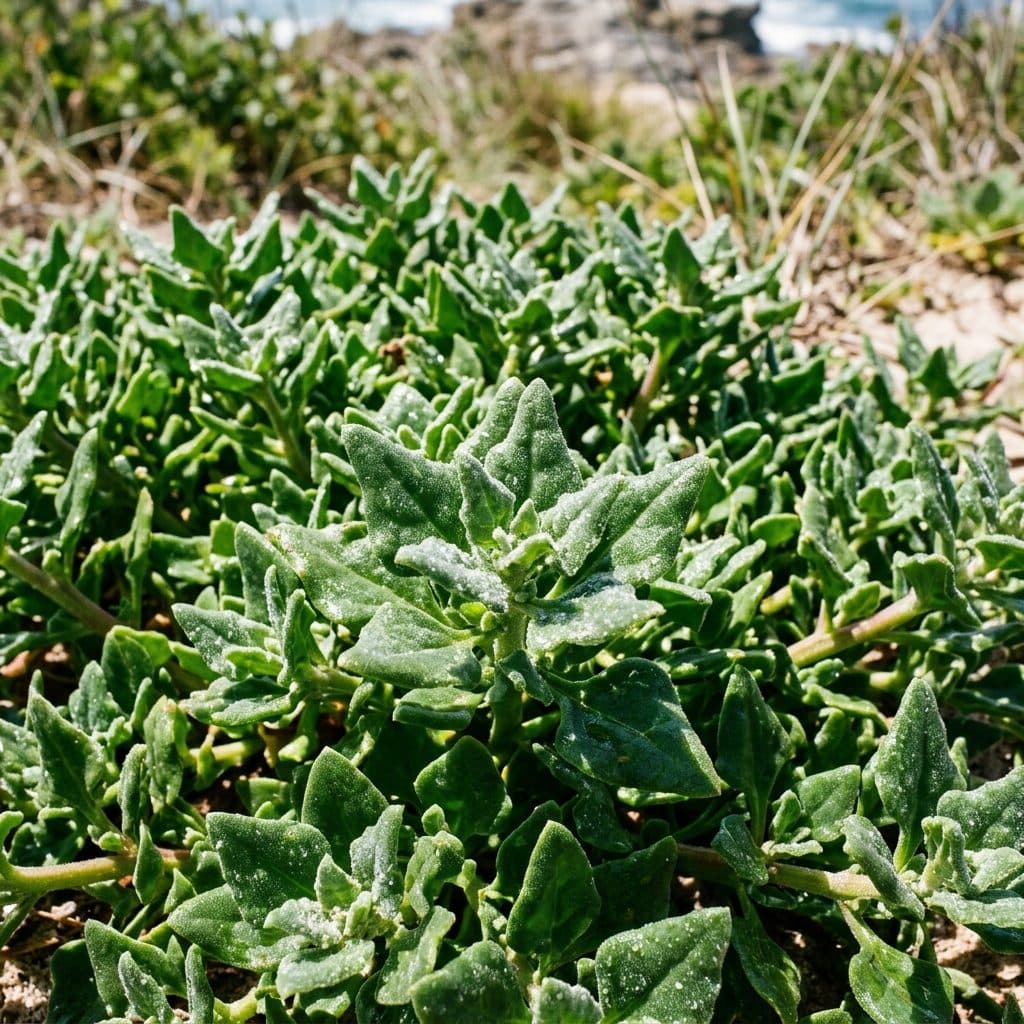
Native to coastal strandlines and sand dunes across Australia, New Zealand, and eastern Asia, warrigal greens thrives where delicate leafy vegetables fail. In permaculture homestead designs, Tetragonia tetragonioides is an effective pioneer groundcover. Its thick stems form a succulent carpet 10 to 30 cm (4 to 12 in) high that spreads 1 to 2 m (3.3 to 6.5 ft) wide. This living mulch suppresses summer weeds, reduces soil moisture evaporation, and tolerates coastal winds. It pairs naturally with other warm-season edible groundcovers like purslane and bathua.
The principal agricultural value of warrigal greens is its ability to produce succulent triangular leaves throughout summer heatwaves. While true spinach bolts to seed once temperatures rise above 24 °C (75 °F), warrigal greens accelerates vegetative production under full summer sun. When blanched to remove soluble oxalates, cooked leaves deliver a tender flavour identical to classic English spinach.
Growing warrigal greens
Warrigal greens is an adaptable plant that flourishes across coastal sands, gravelly loams, and fertile garden beds with a pH between 6.0 and 7.5. It demonstrates strong tolerance for dry, poor, and moderately saline soils. Adding well-rotted compost to the planting site increases foliage size and promotes rapid expansion.
Full sun is ideal for maximum growth and weed suppression. Plants also produce reliably in dappled afternoon shade, particularly in hot inland regions where midsummer temperatures exceed 38 °C (100 °F).
The crop is drought tolerant once established, thanks to thick succulent leaves and extensive roots. However, to produce tender leaves of prime culinary quality, provide weekly irrigation during prolonged dry spells. Plants under severe drought stress remain alive but produce smaller, tougher leaves with concentrated oxalates.
Propagation is achieved primarily from seed, though stem cuttings root readily in moist mix or water. Warrigal greens seeds possess a hard, woody, horned coat that impedes water absorption. Soak seeds in warm water for 12 to 24 hours prior to sowing to soften the pericarp.
In temperate climates, sow seeds indoors four to six weeks before the last spring frost, or direct-sow once soil warms to 15 to 20 °C (59 to 68 °F). Sow seeds 1 to 2 cm (0.4 to 0.8 in) deep. Germination takes 10 to 21 days. Because each horned capsule can contain multiple embryos, thin emergent seedlings to leave the strongest shoot.
Space individual plants 45 to 60 cm (18 to 24 in) apart in garden beds, or allow 1 m (3.3 ft) if using as a living mulch under fruit trees. In USDA Zones 8 through 11, warrigal greens behaves as a perennial groundcover. In colder zones (USDA 3 to 7), treat it as a frost-tender summer annual, harvesting heavily before autumn frosts kill the foliage.
Harvest and uses
Harvesting begins six to eight weeks after sowing. Harvest individual leaves or snip the tender terminal shoot tips (the top 7.5 to 10 cm / 3 to 4 in) using kitchen shears. Regular picking stimulates branching, producing bushier mats and preventing premature flowering.
Always select young triangular leaves; older leaves near the centre turn tough and accumulate higher levels of oxalic acid. Pick leaves in the cool of the morning. Fresh leaves keep in a sealed container in the refrigerator for up to a week.
In the kitchen, warrigal greens is a direct substitute for cooked spinach, silverbeet, or chard. It is used in quiches, spanakopita, curries, pasta fillings, and stir-fries. To freeze: blanch leaves, plunge into ice water, squeeze dry, form into portions, and freeze in airtight containers for up to twelve months.
Identifying warrigal greens
Warrigal greens is recognised by several distinctive morphological characteristics:
- Habit: Sprawling succulent groundcover forming mats 10 to 30 cm (4 to 12 in) tall and spreading 1 to 2 m (3.3 to 6.5 ft) wide.
- Stems: Thick, fleshy, trailing, pale green to reddish, covered in glistening glandular papillae.
- Leaves: Alternate, triangular to rhombic-ovate, 5 to 10 cm (2 to 4 in) long and 3 to 6 cm (1.2 to 2.4 in) wide. Foliage is thick and bright green, glistening in sunlight due to tiny epidermal water cells.
- Flowers: Small, solitary or paired yellow-green blossoms measuring 6 to 8 mm (0.24 to 0.31 in) across, arranged in leaf axils.
- Fruit and seeds: Hard, top-shaped woody capsule measuring 8 to 12 mm (0.3 to 0.5 in) across, bearing three to five prominent horn-like projections around the apex and enclosing multiple seeds.
The plant differs from true spinach (Spinacia oleracea) by its trailing succulent stems and glistening papillae, whereas true spinach forms an erect basal rosette. It differs from purslane (Portulaca oleracea) by its much larger triangular leaves and woody horned seed pods.
Cautions
Anyone harvesting and cooking warrigal greens must observe essential food-safety guidelines:
- High soluble oxalates and blanching safety: Warrigal greens contains high concentrations of soluble oxalic acid. Consuming large quantities of raw leaves can cause throat irritation, interfere with calcium absorption, and exacerbate kidney stones (calcium oxalate nephrolithiasis). Always blanch warrigal greens in boiling water for 1 to 2 minutes, then discard the blanching water completely before eating or cooking further. Never use the discarded liquid as vegetable stock.
- Invasiveness on coastal dunes: In non-native coastal areas, including parts of California and the Mediterranean, Tetragonia tetragonioides has naturalised on coastal sand dunes, displacing native strand flora. In coastal areas, confine plantings to garden beds and avoid planting near natural dunes.
- Frost sensitivity: The succulent tissues contain high water content and lack frost tolerance. A single frost below 0 °C (32 °F) turns the foliage black and water-soaked. Harvest remaining crops before the first autumn freeze.
- Garden spread: Trailing stems root at nodes. In small gardens, trim running stems periodically to prevent encroachment into neighbouring root crops.
Sources
- Royal Botanic Gardens, Kew. Tetragonia tetragonioides (Pall.) Kuntze Plants of the World Online.
- Australian Native Plants Society (Australia). Tetragonia tetragonioides
- Plants For A Future. Tetragonia tetragonioides - (Pall.) Kuntze
- Royal Horticultural Society. Tetragonia tetragonioides (New Zealand spinach)