pioneer
Autumn olive
Elaeagnus umbellata
International hardiness
- USDA 4-9
- RHS H6
- AU: Warm temperate, Cool temperate
Where it grows — regional guide
| Zones / rating | Regional notes |
|---|---|
USDA 4-9 | Regulated as a prohibited noxious weed across numerous Midwestern and Eastern states; planting is illegal or strictly prohibited in many regions. |
| Zones / rating | Regional notes |
|---|---|
H6 (-20 to -15C) | Fully hardy across RHS H6; grown occasionally in coastal or shelterbelt plantings, but prune fruit to avoid bird-mediated seed dispersal. |
| Zones / rating | Regional notes |
|---|---|
Warm temperate, Cool temperate | No region-specific data yet |
| Zones / rating | Regional notes |
|---|---|
USDA 4-9 (USDA scale) Canada uses its own zone system; Canadian zones run roughly one lower than USDA. | Naturalised in southern Ontario and parts of Eastern Canada; monitor closely to prevent displacement of native Carolinian woodland species. |
| Zones / rating | Regional notes |
|---|---|
No region-specific data yet | No region-specific data yet |
Autumn olive (Elaeagnus umbellata), also known as Japanese silverberry or autumn elaeagnus, is a vigorous, large deciduous shrub belonging to the oleaster family (Elaeagnaceae). Indigenous to temperate East Asia, including China, Korea, and Japan, the species was introduced to North America in 1830. Throughout the mid-twentieth century, government conservation agencies widely distributed autumn olive for quarry reclamation, roadside erosion control, and wildlife habitat. Today, the species is celebrated by foragers for its prolific crops of tart, nutrient-dense red berries, but is simultaneously recognised as one of the most destructive invasive woody weeds in eastern and midwestern North America.
From a physiological standpoint, Elaeagnus umbellata is an extraordinary colonising plant. Unlike leguminous nitrogen fixers that associate with rhizobia, autumn olive is an actinorhizal plant. Its roots form prolific nodules with filamentous nitrogen-fixing bacteria in the genus Frankia. This adaptation allows it to colonise impoverished, gravelly, and acidic subsoils, fixing upwards of 50 to 100 kg of atmospheric nitrogen per hectare annually. In autumn, mature bushes produce hundreds of thousands of speckled ruby-red berries that possess documented concentrations of the antioxidant lycopene up to seventeen times greater than fresh tomatoes. However, because birds devour the fruit and scatter seeds across pastures and open woodlands, cultivating autumn olive carries extreme ecological liability compared to non-invasive fruit crops like sea buckthorn, ber, or indian barberry.
Growing autumn olive
Autumn olive is exceptionally hardy across temperate and continental zones, flourishing in USDA Zones 4 to 9 and rated RHS H6. Established shrubs tolerate winter lows down to -30 °C (-22 °F) without injury and endure summer heat, prolonged droughts, and high winds with equal resilience.
The shrub demonstrates an astonishing tolerance for inhospitable soils. It thrives in sterile sands, quarry spoils, rocky clay banks, and gravel pits with pH values ranging from 4.0 to 8.0. It is highly drought-tolerant once established and possesses excellent tolerance to road salt and maritime winds. However, it cannot endure permanently waterlogged soils or swampy bottomlands where oxygen is excluded from the root zone.
Full sunlight is essential for rapid vegetative growth and heavy berry production. While autumn olive can survive under the partial shade of open woodland borders, plants under closed forest canopies become leggy and produce negligible fruit. In full sun, a single bush grows with immense speed, reaching 3 to 6 m (10 to 20 ft) in height and width within five to seven years, forming a dense, tangled, thorny thicket.
Propagation is remarkably simple: seeds germinate readily after a period of cool, moist stratification (60 to 90 days at 4 °C / 39 °F). The shrub also roots easily from semi-hardwood cuttings. Where planted in windbreaks or boundary hedges, bushes are spaced 1.5 to 2.5 m (5 to 8 ft) apart. The plant responds to severe pruning with aggressive resprouting from the root collar, quickly re-establishing a dense thicket if cut to the ground.
Harvest and uses
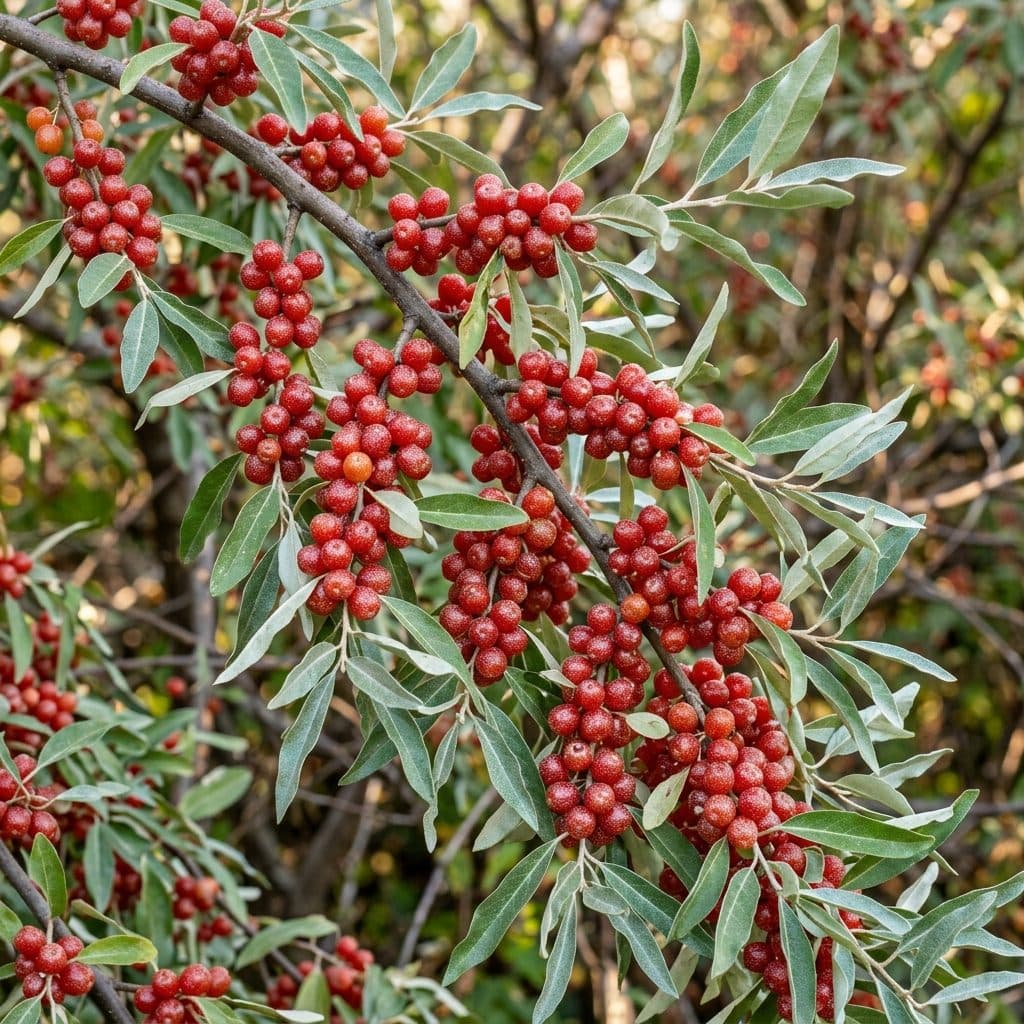
The foremost culinary and nutritional value of Elaeagnus umbellata lies in its abundant autumn fruit. The berries ripen in heavy clusters from late August through October. The fruit is a small, globose to oval pseudodrupe measuring 6 to 8 mm (0.24 to 0.31 in) across. When unripe, the berries are pale green dusted with silver scales; as they ripen, they turn speckled pink, scarlet, and finally translucent ruby-red, marked with silvery and golden flecks.
Harvest the berries by placing a clean sheet beneath the bush and shaking the branches, or strip them by hand wearing gloves to avoid spiny branch spurs. The flavour of fresh autumn olive berries is tart, sweet-sour, and intensely juicy, with an initial astringency that mellows noticeably following the first light autumn frost.
Nutritional research conducted by agricultural scientists revealed that autumn olive berries are a nutritional powerhouse. They contain exceptionally high concentrations of the carotenoid antioxidant lycopene—ranging from 15 to 54 mg per 100 g of fresh fruit, compared to roughly 3 mg per 100 g in fresh commercial tomatoes. They are also packed with vitamin C, vitamin E, essential fatty acids, and bioflavonoids. The berries are widely processed by foragers into rich jams, jellies, fruit leather, syrups, and fermented fruit wines. The small, soft central seed is edible and easily consumed along with the pulp.
Historically, the plant was utilised in shelterbelts and roadside plantings, while its actinorhizal root nodules enriched depleted subsoils with nitrogen. However, its severe ecological disruption has rendered intentional planting obsolete.
Identifying autumn olive
Elaeagnus umbellata is readily identified in the field by several unmistakable morphological characteristics:
- Habit: A large, spreading, multi-stemmed deciduous shrub reaching 3 to 6 m (10 to 20 ft) in height and width, forming dense spiny thickets. Older trunks display grey-brown bark that lightly fissures, while branchlets often terminate in short, sharp, spiny spurs.
- Twigs: Young branchlets are prominently covered in silvery-white and scattered brownish scales, giving them a speckled, reflective appearance.
- Leaves: Alternate, simple, elliptic to oblong-lanceolate leaves 4 to 8 cm (1.5 to 3 in) long and 1.5 to 3 cm (0.6 to 1.2 in) broad, with distinctly wavy (undulate) margins. The upper surface is dark green with scattered silvery scales, while the lower surface is completely covered in a dense, glistening silvery-white pelt of scales interspersed with occasional small brown or golden dots.
- Flowers: Fragrant, tubular, four-lobed flowers 1 to 1.5 cm (0.4 to 0.6 in) long borne in axillary clusters of 1 to 7 blossoms in spring (April to May). The flowers are creamy-white to pale yellowish-white and lack true petals, consisting of a four-lobed calyx tube.
- Fruit: Abundant, small, globose to oval berries 6 to 8 mm in diameter, hanging on slender stalks. The skin is bright ruby-red densely speckled with tiny silvery and golden scales. Each berry contains a single soft seed.
Autumn olive is commonly confused with Russian olive (Elaeagnus angustifolia). Russian olive is distinguished by its larger tree-like habit, narrower leaves that are silvery on both surfaces, and larger, yellow-brown, dry, mealy fruit. It is also confused with goumi (Elaeagnus multiflora), which bears larger, long-stalked, reddish-brown berries that ripen in early summer rather than autumn.
Cautions
The exceptional berry yields of Elaeagnus umbellata are completely overshadowed by its catastrophic invasive behaviour:
- SEVERE NOXIOUS WEED INVASIVENESS: Elaeagnus umbellata is officially classified as a prohibited noxious weed or regulated invasive species across dozens of US states, including Pennsylvania, Ohio, Indiana, West Virginia, Virginia, Illinois, and Wisconsin. In many jurisdictions, planting, selling, propagating, or transporting this species is strictly prohibited by law.
- Rapid ecological displacement: A single mature autumn olive bush produces up to 200,000 seeds per year. Songbirds, game birds, and mammals voraciously consume the autumn berries, dispersing viable seeds across vast distances into pastures, prairie remnants, and forest borders. Because seedlings grow with extraordinary speed and produce dense shade, autumn olive rapidly crowds out native wildflowers, grasses, and tree saplings and replaces diverse plant communities with dense monocultural thickets.
- Disruption of soil ecology: Actinorhizal nitrogen fixation fundamentally alters soil chemistry. In naturally nutrient-poor ecosystems like pine barrens and sand prairies, the nitrogen surplus introduced by autumn olive disrupts native plant adaptations and facilitates the invasion of other aggressive non-native weeds.
- Extreme eradication difficulty: Cutting or mowing bushes results in an explosion of vigorous new root sprouts from the root crown, creating an even denser thorny thicket. Effective eradication requires repeated mechanical extraction of the entire root system or targeted cut-stump applications of systemic herbicides.
- Management recommendation: Never intentionally plant autumn olive. Homesteaders seeking tart fruit should instead harvest wild naturalised bushes as a management strategy, or plant non-invasive alternatives.
- Regulatory note: Check state and local biosecurity registers before handling; planting is illegal across wide regions of North America.
Sources
- Royal Botanic Gardens, Kew. Elaeagnus umbellata Thunb. Plants of the World Online.
- Plants For A Future. Elaeagnus umbellata - Thunb.
- Missouri Botanical Garden. Elaeagnus umbellata
- USDA PLANTS Database. Elaeagnus umbellata Thunb. - Autumn Olive
- Penn State Extension. Autumn Olive (Elaeagnus umbellata)