secondary
Black elderberry
Sambucus nigra
International hardiness
- USDA 4-8
- RHS H6
- AU: Cool temperate, Warm temperate
Where it grows — regional guide
| Zones / rating | Regional notes |
|---|---|
USDA 4-8 | Grown across USDA Zones 4 to 8; European elderberry flowers earlier and produces larger, more robust berries than native American elderberry. |
| Zones / rating | Regional notes |
|---|---|
H6 (-20 to -15C) | Iconic native woodland and hedgerow shrub rated RHS H6; flowers harvested for spring cordials and cooked berries for winter immune-support syrups. |
| Zones / rating | Regional notes |
|---|---|
Cool temperate, Warm temperate | Grown in cooler tablelands of Victoria and Tasmania; can become an environmental weed along moist waterways and disturbed forest edges. |
| Zones / rating | Regional notes |
|---|---|
USDA 4-8 (USDA scale) Canada uses its own zone system; Canadian zones run roughly one lower than USDA. | Hardy in southern Ontario, Quebec, and coastal British Columbia; cold-hardy to -30 °C (-22 °F), though late spring frosts can nip emerging flower umbels. |
| Zones / rating | Regional notes |
|---|---|
No region-specific data yet | No region-specific data yet |
Black elderberry (Sambucus nigra), known simply across Europe as elder, European elderberry, or black elder, is a vigorous, multi-stemmed deciduous large shrub or small tree in the viburnum family (Viburnaceae), historically grouped within Adoxaceae and Caprifoliaceae. Native throughout Europe, western Asia, and North Africa, the species thrives in hedgerows, woodland clearings, railway embankments, and nitrogen-rich waste places. Steeped in folklore, elder was historically planted beside European homestead dairies and cottages as a protective spirit and versatile medicine chest, revered for cooling floral cordials and immune-supporting winter berry syrups. In modern permaculture design and cold-climate agroforestry, Sambucus nigra is a multi-functional powerhouse shrub that yields high-value medicinal harvests while providing dense shelterbelt screening.
Within temperate food-forest systems, black elderberry occupies an adaptable secondary-canopy or edge-stratum role. Its dense canopy, rapid annual growth, and multi-stemmed habit make it an ideal choice for perimeter hedgerows, riparian buffer strips, and windbreaks. Elder thrives when integrated near standard orchard plantings of apple and white mulberry, or beside hardy stone fruits like mountain sweet cherry. In early summer, massive flat-topped flowerheads produce an intoxicating, musky-sweet perfume that attracts hundreds of species of pollinating hoverflies, bees, and predatory insects. Later in autumn, pendulous umbels of glistening purple-black berries furnish a rich food reservoir for migratory songbirds.
Growing black elderberry
Sambucus nigra is exceptionally cold-hardy and resilient, growing vigorously across USDA Hardiness Zones 4 through 8 and maintaining an RHS hardiness rating of H6. Fully dormant mature shrubs easily withstand winter extremes down to -30 °C (-22 °F) without experiencing twig dieback. The plant requires roughly 600 to 900 hours of winter chilling below 7 °C (45 °F) to break winter rest and support even bud burst in spring. Flowering occurs in early summer (typically June in the northern hemisphere), cleanly escaping late spring frosts. While elderberry bushes tolerate light partial shade, maximum flowering, fruit set, and sugar accumulation occur in full sun exposure receiving at least six to eight hours of direct sunlight daily.
In terms of soil, black elderberry is a heavy feeder that revels in deep, fertile, moist, organically rich soils with high nitrogen content. It frequently colonises old compost sites, farmyard borders, and river terraces where nutrient levels are high. The species is highly adaptable regarding soil pH, flourishing across a broad spectrum from 5.5 to 7.5. Elder possesses shallow, fibrous, spreading root networks that require consistent moisture; in dry, sandy soils or during prolonged summer droughts, supplemental irrigation is necessary to prevent premature berry shrivelling and leaf collapse. However, soils must not remain waterlogged or stagnant for prolonged periods during the active growing season.
Propagation of Sambucus nigra is remarkably straightforward, carried out with high success rates using hardwood cuttings taken in late autumn, softwood cuttings in early summer, or fresh stratified seed. Hardwood cuttings measuring 20 to 30 cm (8 to 12 in) in length pushed into moist garden soil root reliably over winter. Selected named fruiting cultivars—such as 'Haschberg', 'Korsør', and 'Samyl'—are propagated vegetatively to ensure large flowerheads and uniform berry ripening. Space shrubs 2 to 3 m (6.6 to 10 ft) apart within garden rows or windbreaks. Elder responds vigorously to heavy pruning: cutting stems back to a low framework in late winter stimulates strong, upright shoots that produce massive flowerheads. Young plants establish rapidly and commence bearing in their second year.
Harvest and uses
Black elderberry offers two distinct, highly prized annual harvests: fragrant flowers in early summer and rich medicinal berries in late summer.
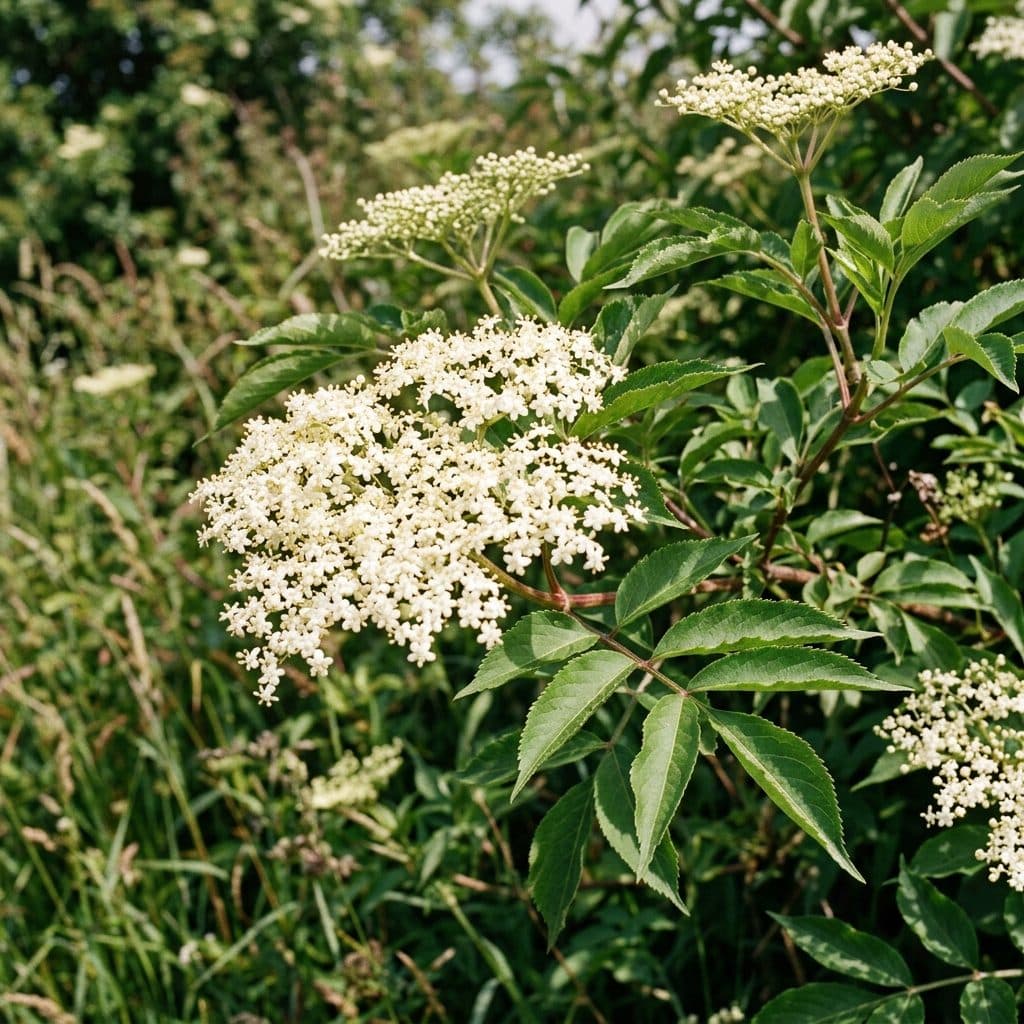
Flower harvesting occurs in June when the creamy-white corymbs are fully open, dry, and laden with fragrant golden pollen. The entire flowerhead is clipped with shears on a warm, dry morning and processed immediately:
- Elderflower cordials and wines: Flowerheads are steeped in hot sugar syrup with fresh lemons and citric acid to create traditional, exquisitely refreshing elderflower cordials, tonics, and fermented elderflower champagnes.
- Culinary fritters: Whole flowerheads are dipped in light batter and fried briefly in oil until crisp, dusted with cinnamon sugar as a historic European summer dessert.
Berry harvesting occurs from late August through September as the fruits mature into pendulous umbels of glistening purple-black berries measuring 4 to 6 mm (0.15 to 0.25 in) across. Harvest entire ripe berry clusters, strip the berries from stems using a fork, and freeze or cook them immediately.
Under no circumstances should raw elderberries be eaten fresh. Raw berries contain toxic cyanogenic glycosides that provoke severe vomiting and diarrhoea. However, thermal boiling completely neutralises these toxins, converting the fruit into a safe, delicious product. Cooked elderberries are simmered into dark, luscious elderberry syrups, spiced winter jams, rich pies blended with apples, and full-bodied country wines. A mature, well-tended bush yields 5 to 15 kg (11 to 33 lb) of berries annually.
Identifying black elderberry
Sambucus nigra is easily recognised by several definitive botanical features:
- Habit and bark: A large, multi-stemmed deciduous shrub or small tree growing 4 to 6 m (13 to 20 ft) in height with an expansive, arching, spreading crown. The bark on mature trunks is pale greyish-brown, soft, deeply furrowed, and corky, with prominent raised lenticels on younger stems. The wood is soft, and twigs contain a thick, white, spongy, soft pith inside.
- Leaves: Opposite, pinnately compound leaves measuring 15 to 30 cm (6 to 12 in) long, consisting of five to seven (rarely nine) ovate to broadly elliptic leaflets. Leaflets measure 5 to 12 cm (2 to 4.7 in) long and 3 to 6 cm (1.2 to 2.4 in) wide, with sharply serrated margins and acute tips. The foliage is dark matte green above, paler beneath, and emits an unmistakable, pungent, rank musky odour when bruised or crushed.
- Flowers: Borne in large, flat-topped, umbrella-like corymbs (cymes) measuring 12 to 25 cm (5 to 10 in) across. The tiny, five-petaled blossoms measure 5 to 6 mm (0.2 in) across, displaying a creamy-white or ivory hue with pale yellow anthers, exuding a sweet floral fragrance.
- Fruit: Small, globose, glossy purplish-black berry-like drupes hanging in heavy, drooping, wine-red-stalked clusters, containing three to five small seeds.
Black elderberry is distinguished from poisonous dwarf elder (Sambucus ebulus), which is an herbaceous perennial reaching only 1 to 2 m (3.3 to 6.6 ft) that dies back to the ground annually, has narrower leaves with up to 13 leaflets, and bears flowers with purple-tipped anthers.
Cautions
Cultivating and processing Sambucus nigra requires strict attention to several toxicological and ecological cautions:
- Cyanogenic glycoside toxicity in raw plant tissues: All vegetative parts of the elderberry plant—including roots, bark, stems, green twigs, leaves, unripened green berries, and the small raw seeds within ripe berries—contain toxic cyanogenic glycosides (predominantly sambunigrin and prunasin). When raw tissues are ingested, intestinal enzymes hydrolyse sambunigrin into poisonous hydrogen cyanide (prussic acid). Consuming raw elderberries, drinking raw elderberry juice, or chewing raw leaves causes acute cyanide poisoning, presenting as severe nausea, violent vomiting, profuse watery diarrhoea, abdominal cramps, dizziness, and profound weakness.
- Mandatory cooking requirement: Ripe purple-black berries must be thoroughly cooked by boiling or simmering for at least 15 to 20 minutes before consumption. Thermal processing completely denatures hydrolytic enzymes and volatilises hydrogen cyanide, rendering cooked syrups, cordials, and preserves completely safe for adults and children.
- Toxicity to domestic livestock: Leaves, fresh prunings, and roots are toxic to cattle, horses, sheep, goats, and dogs. Never discard elderberry clippings into pastures or livestock paddocks.
- Aggressive suckering and environmental weed liability: Black elderberry spreads rapidly via underground root suckers and bird-dispersed seeds. In moist agricultural pastures and native riparian bushland across southeastern Australia and New Zealand, escaped European elderberry is classified as an environmental weed that chokes out native vegetation. Manage suckers along garden borders.
Sources
- Royal Botanic Gardens, Kew. Sambucus nigra L. Plants of the World Online.
- USDA PLANTS Database. Sambucus nigra L.
- Plants For A Future. Sambucus nigra - L.
- North Carolina State Extension Gardener Plant Toolbox. Sambucus nigra