pioneer
Prickly pear cactus
nagphani
Opuntia ficus-indica
- punjab plains
- pothohar
- sindh coast
- balochistan highlands
International hardiness
- USDA 8-11
- RHS H3
- AU: Arid / semi-arid, Subtropical, Warm temperate
Where it grows — regional guide
| Zones / rating | Regional notes |
|---|---|
USDA 8-11 | Extensively cultivated across the American Southwest, California, and Texas; harvest tender young nopales in spring and ripe sweet tunas in late summer. |
| Zones / rating | Regional notes |
|---|---|
H3 (-5 to 1C) | No region-specific data yet |
| Zones / rating | Regional notes |
|---|---|
Arid / semi-arid, Subtropical, Warm temperate | Historically devastated millions of hectares of pastoral land; strictly regulated under biosecurity legislation in Queensland and New South Wales. |
| Zones / rating | Regional notes |
|---|---|
USDA 8-11 (USDA scale) Canada uses its own zone system; Canadian zones run roughly one lower than USDA. | No region-specific data yet |
| Zones / rating | Regional notes |
|---|---|
Punjab plains, Pothohar, Sindh coast, Balochistan highlands | Pakistan:Known locally as nagphani; excellent living fence and drought fodder across arid Pothohar and Balochistan; singe glochids before feeding pads to livestock. |
Prickly pear cactus (Opuntia ficus-indica), also known as Indian fig, mission cactus, or nopal, is an arborescent succulent in the cactus family (Cactaceae). Believed to have originated in the semi-arid highlands of central Mexico, the species was domesticated thousands of years ago by Mesoamerican peoples. Following Spanish voyages to the Americas, the plant was introduced to the Mediterranean basin, the Middle East, South Africa, and Australia. Today, it ranks among the most agronomically significant cacti on earth, providing drought-proof crops of succulent vegetable pads (nopales), sweet aromatic fruits (tunas), livestock emergency fodder, and cochineal dye habitat.
In arid permaculture systems and dryland syntropic polycultures, Opuntia ficus-indica is an indestructible pioneer biomass builder. Utilising Crassulacean Acid Metabolism (CAM), the plant opens its stomata exclusively at night, achieving astonishing water-use efficiency that generates substantial biomass on less than 300 mm (12 in) of annual rainfall. Planted along keyline contour swales alongside drought-hardy companions like aloe vera and pigeon pea, it anchors unstable slopes, arrests desertification, and forms living firebreaks. However, its microscopic barbed spines demand culinary caution, and its invasive weed potential requires strict containment in vulnerable pastoral regions.
Growing prickly pear cactus
Opuntia ficus-indica excels in arid, semi-arid, Mediterranean, and warm-temperate climates, hardy within USDA Zones 8 through 11 and rated RHS H3. Mature cladodes tolerate short-lived winter lows down to -10 °C (14 °F), provided the root zone remains dry. However, prolonged winter cold combined with saturated soil induces rotting. The species flourishes in intense desert heat exceeding 40 °C (104 °F), continuing vegetative growth when temperate crops halt development. While established plantings survive on as little as 200 mm (8 in) of annual rainfall, commercial fruit yields improve when receiving 400 to 600 mm (16 to 24 in) of moisture. Full, unhindered sunlight is mandatory; shaded plants develop elongated, weak pads and fail to bloom.
Soil requirements are modest. The cactus thrives in coarse sands, gravelly slopes, degraded volcanic clays, and limestone-based soils across a broad pH range of 6.0 to 8.5. It demonstrates notable tolerance for alkaline and moderately saline soils. Impeccable drainage is non-negotiable. Soils prone to waterlogging or perched water tables cause anaerobic root rot that causes the entire plant to topple. Avoid heavy fertilisation; excessive nitrogen produces soft, watery cladodes that are susceptible to fungal rot and freeze injury.
Propagation is remarkably simple using single cladodes (pads). Select healthy, mature one- to two-year-old pads from vigorous plants. Sever the pad at the joint with a clean knife and allow the cut surface to callous in a dry, shaded location for ten to fourteen days until a tough, whitish cork layer forms. Plant the calloused pad vertically into well-drained soil, burying the bottom third to half of the pad. Do not water for the first two weeks; premature irrigation rots unrooted cuttings. Roots emerge from the buried areoles within three to four weeks. Space plants 1 to 1.5 m (3.3 to 5 ft) apart for impenetrable security fencing, or 3 by 4 m (10 by 13 ft) apart for open fruit and fodder orchards. Plants bear harvestable nopales within six months and fruit within two to three years.
Harvest and uses
Opuntia ficus-indica provides two valuable food harvests: young vegetable pads and ripe dessert fruit.
Young pads (nopales or nopalitos) are harvested when they are 10 to 20 cm (4 to 8 in) long, tender, and snap cleanly from the parent cladode, typically during spring and early summer. Wear thick rubber gloves or use tongs to grasp the pad, severing it at the basal joint. To prepare, lay the pad flat on a cutting board and scrape away the areoles and glochids with a sharp chef's knife or vegetable peeler, then trim the outer perimeter edge. Sliced nopales are boiled, grilled, or sautéed. They have a pleasant, slightly tart green-bean flavour with a mucilaginous texture similar to okra.
The oval fruits (tunas) ripen from late summer through autumn, transitioning from green to brilliant yellow, orange, or ruby-red. Harvest using tongs, twisting the fruit gently to detach it without tearing the pad. To safely prepare tunas, singe the outer skin over a gas flame to incinerate the microscopic glochids, or roll them briskly in damp sand followed by washing. Cut off both ends of the fruit, slice the thick rind lengthwise, and peel it back to reveal the sweet, refreshing pulp. The pulp contains numerous small, hard seeds and can be eaten fresh, blended into juices, or reduced into jams and syrups.
In livestock farming, mature pads serve as vital emergency drought fodder. Burning or singeing the spines off harvested pads allows cattle, sheep, and goats to consume the succulent flesh, providing both digestible roughage and hydration during feed shortages. Mature plants yield 15 to 30 kg (33 to 66 lb) of fruit and abundant green fodder annually.
Identifying prickly pear cactus
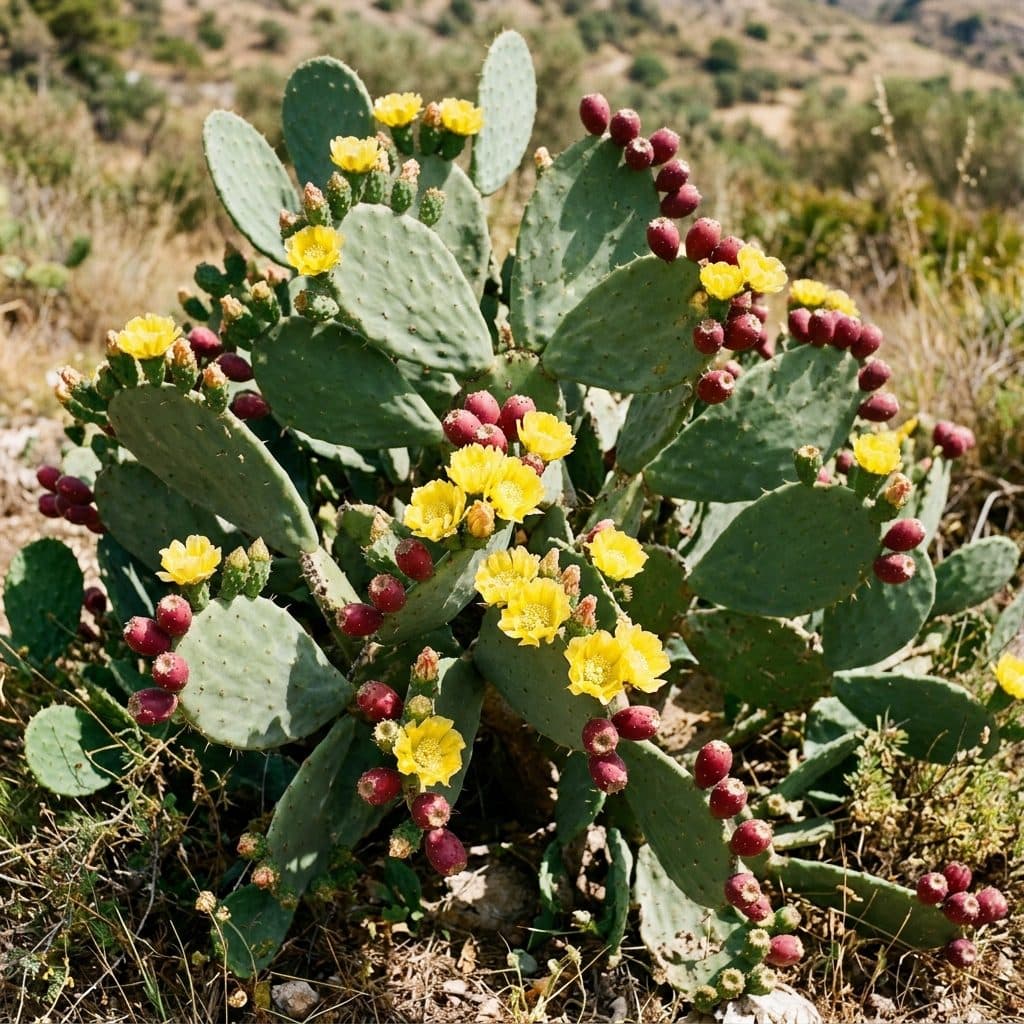
Opuntia ficus-indica is identified by its distinctive jointed architecture:
- Form: A robust, branching succulent shrub or small tree-like cactus reaching 2 to 5 m (6.6 to 16 ft) in height, often forming a thick, woody, cylindrical basal trunk up to 30 cm (12 in) in diameter on mature specimens.
- Cladodes (pads): Large, flattened, fleshy, paddle-shaped stem segments measuring 30 to 50 cm (12 to 20 in) in length, 15 to 25 cm (6 to 10 in) in width, and 1.5 to 2.5 cm (0.6 to 1 in) in thickness. The surface is glaucous green to greyish-green, coated in a thick, water-conserving waxy cuticle.
- Areoles and glochids: Small, circular, raised cushion-like structures spaced 2 to 5 cm (0.8 to 2 in) apart across the pad face. In cultivated spineless selections, long defensive spines are largely absent or reduced, but every areole contains a dense tuft of hundreds of minute, hair-like, barbed golden-brown bristles called glochids.
- Flowers: Large, solitary, showy cup-shaped blossoms measuring 6 to 10 cm (2.4 to 4 in) across, opening along the upper perimeter of terminal pads in late spring. Petals range from bright yellow to orange, surrounding a dense cluster of thigmotropic (touch-sensitive) yellow stamens.
- Fruit: An oblong, ovoid, or barrel-shaped berry (tuna) measuring 5 to 9 cm (2 to 3.5 in) long and weighing 100 to 200 g (3.5 to 7 oz), with a deeply depressed apex. The thick peel is yellow, orange, or red-purple, carrying areoles with tiny glochids.
The species is distinguished from common pest pear (Opuntia stricta) by its much larger, flatter pads, generally spineless habit, and sweeter, larger edible fruit, whereas Opuntia stricta bears vicious, long, rigid yellow spines and sour purple fruit.
Cautions
Cultivating and handling Opuntia ficus-indica involves several serious hazards:
- Barbed glochid hazard: Even "spineless" cultivars carry thousands of microscopic, hair-like bristles (glochids) in every areole. Glochids detach upon the slightest touch, penetrating skin, lips, tongue, and eyes. Each glochid possesses sharp backwards-pointing microscopic barbs that prevent easy extraction. Embedded glochids cause intense burning pain, allergic contact dermatitis, foreign-body granulomas, and secondary bacterial infections. Always wear heavy rubber gloves and use tongs when handling pads or fruit. Never bite into unpeeled fruit. Always singe or peel all areoles before culinary preparation.
- Severe invasive environmental weed risk: Opuntia species are among the most destructive invasive environmental weeds in dry pastoral regions worldwide. Dispersed by birds and livestock eating seeds, or by detached pads rooting wherever they land, plants form dense, impenetrable thickets that choke native pastures. In Australia, Opuntia historically ruined millions of hectares of grazing land. The plant is legally regulated as a biosecurity pest in parts of Australia and South Africa. Check statutory noxious weed registers before planting.
- Seed impaction (phytobezoars): The sweet fruit pulp contains hundreds of hard, bony seeds. Ingesting large quantities of whole seeds without straining can cause severe faecal impaction and intestinal obstruction (phytobezoars), requiring medical intervention.
- Wet rot vulnerability: Planting in poorly drained soils or humid, wet climates induces soft bacterial rot (Pectobacterium carotovorum) and fungal rots, causing pads to dissolve into black, foul-smelling liquid.
Sources
- Royal Botanic Gardens, Kew. Opuntia ficus-indica (L.) Mill. Plants of the World Online.
- USDA PLANTS Database. Opuntia ficus-indica (L.) Mill.
- Plants For A Future. Opuntia ficus-indica - (L.)Mill.
- Royal Horticultural Society. Opuntia ficus-indica