pioneer
Calliandra fodder shrub
Calliandra calothyrsus
International hardiness
- USDA 9-12
- RHS H1c
- AU: Tropical, Subtropical
Where it grows — regional guide
| Zones / rating | Regional notes |
|---|---|
USDA 9-12 | Hardy outdoors in frost-free South Florida and Hawaii (Zones 10 to 12); prune hedges before seeding to prevent ballistic weed escape. |
| Zones / rating | Regional notes |
|---|---|
H1c (5 to 10C) | No region-specific data yet |
| Zones / rating | Regional notes |
|---|---|
Tropical, Subtropical | Thrives in tropical and subtropical Queensland and coastal New South Wales; monitor hedgerows along riparian corridors where it can become naturalised. |
| Zones / rating | Regional notes |
|---|---|
USDA 9-12 (USDA scale) Canada uses its own zone system; Canadian zones run roughly one lower than USDA. | No region-specific data yet |
| Zones / rating | Regional notes |
|---|---|
No region-specific data yet | No region-specific data yet |
Calliandra fodder shrub (Calliandra calothyrsus), also classified botanically as Calliandra houstoniana var. calothyrsus, is a small, multi-stemmed leguminous tree or large shrub in the mimosoid clade of the legume family (Fabaceae). Native to tropical riverbanks and forest margins of Central America and southern Mexico, extending from Veracruz to Panama, the plant has become one of the most widely planted agroforestry shrubs across the humid tropics of Southeast Asia and Africa. Widely known as red calliandra or kaliandra, it is prized by smallholder farmers for its prolific yield of high-protein livestock fodder, vigorous coppicing response, rapid nitrogen fixation, and domestic fuelwood.
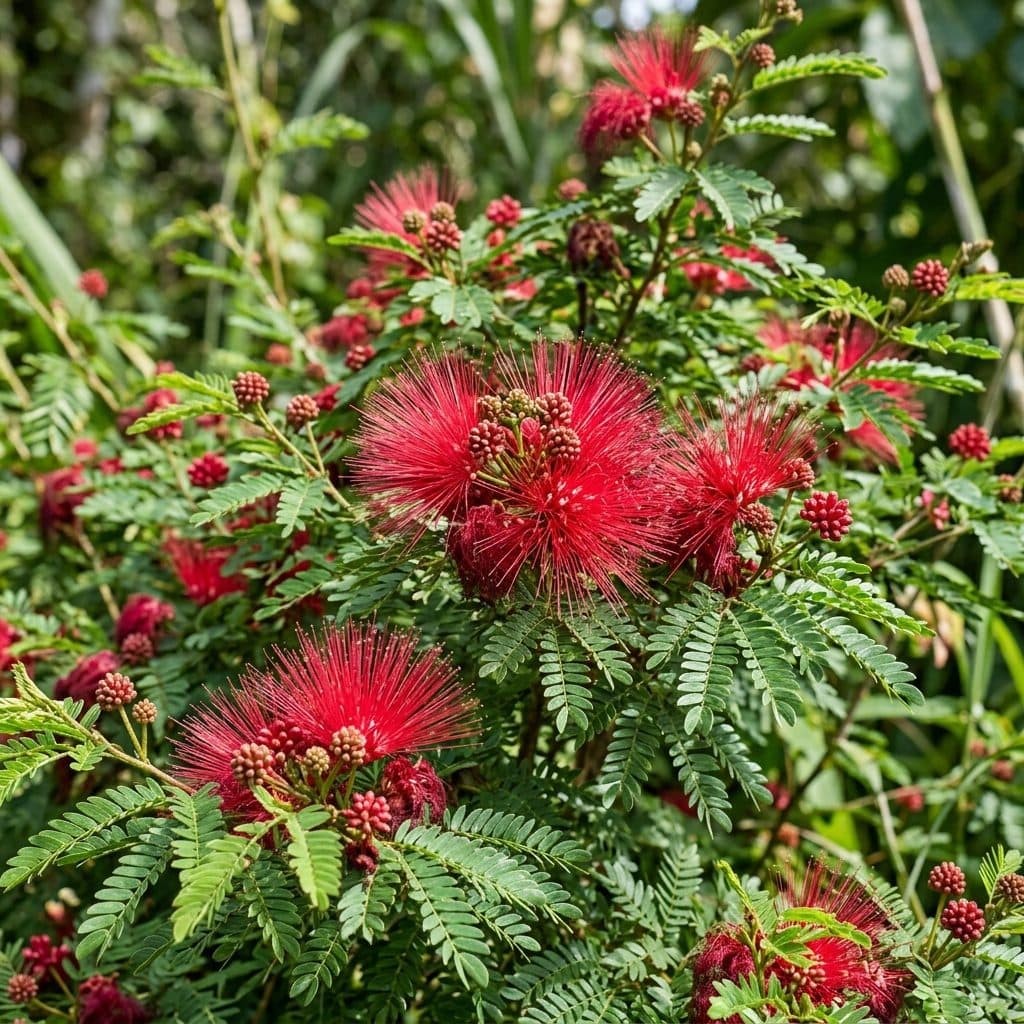
Calliandra calothyrsus regrows quickly after cutting, which suits repeated harvesting. It rapidly produces a dense network of branches clothed in finely divided, fern-like bipinnate leaves and tipped with clusters of brilliant crimson powderpuff flowers. In humid tropical environments, it nodulates abundantly with native rhizobia, fixing up to 200 kg of atmospheric nitrogen per hectare annually. For livestock homesteaders managing diverse agroforestry species like siris, orchid tree, or neem, establishing calliandra hedgerows provides a continuous supply of nutritious fodder and organic green manure while anchoring hillsides against erosion.
Growing Calliandra fodder shrub
Calliandra calothyrsus is a tropical and subtropical species that thrives in warm, frost-free environments with moderate to high rainfall. It is winter-hardy in USDA Zones 9b to 12 and rated RHS H1c. While light frost down to -2 °C (28 °F) scorches foliage and kills small twigs, established plants possess resilient root reserves and resprout from the crown in spring. Sustained freezing temperatures below -3 °C (27 °F) cause fatal root death. The shrub performs best under mean annual temperatures between 19 and 28 °C (66 and 82 °F) and annual precipitation between 1,000 and 4,000 mm (40 to 160 in), tolerating dry seasons of two to four months once established.
The species exhibits outstanding adaptability to problematic soils. It grows vigorously on acidic, infertile, low-phosphorus soils and heavy clays where other leguminous trees fail. Its extensive root system forms dual symbioses with nitrogen-fixing bacteria and mycorrhizal fungi, which access tightly bound phosphorus from acidic subsoils. However, it requires reasonable surface drainage: prolonged waterlogging or swampy soils stunt growth and encourage root rot.
Site calliandra in full sunlight. Young plants under heavy canopy shade grow spindly and produce sparse foliage. Growth is rapid: from seed, plants reach 2 to 3 m (6.5 to 10 ft) in height within six months and attain their full stature of 4 to 6 m (13 to 20 ft) within twelve months.
Propagation is straightforward from seed. The seeds possess a hard, shiny coat that delays germination if untreated. Pour near-boiling water over the seeds, allow them to soak in cooling water for twenty-four hours, and sow immediately. Germination rates exceed 85% within six to ten days. Seedlings can be raised in small nursery containers and outplanted when they reach 20 to 30 cm (8 to 12 in) in height. Direct seeding along contour lines is also successful during the rainy season.
To establish living erosion fences and contour fodder hedges, plant seedlings at close in-row spacings of 20 to 50 cm (8 to 20 in) in rows spaced 3 to 5 m (10 to 16 ft) apart. Once shrubs reach 2 m (6.5 ft) in height, cut them back to 50 to 100 cm (20 to 40 in) above the ground to promote dense basal branching.
Harvest and uses
The foremost commercial value of Calliandra calothyrsus is its exceptional yield of high-protein animal forage. The leaves and young green stems contain 20 to 24% crude protein on a dry-matter basis, alongside carotene and essential minerals. It is eagerly consumed by dairy cows, beef cattle, goats, and sheep. Feeding calliandra browse as a daily supplement to dairy cattle (roughly 4 to 6 kg (9 to 13 lb) of fresh foliage daily) substantially increases milk yield, butterfat content, and overall body condition during dry-season feed shortages.
The shrub responds to frequent coppicing with extraordinary vigour. Managed hedgerows can be cut back every six to twelve weeks during the wet season, yielding 7 to 10 tonnes of dry leaf matter per hectare annually. When used as alley-cropping green manure, the prunings decompose steadily, releasing organic nitrogen into the soil, building humus, and providing surface protection that suppresses weed competition.
On steep agricultural slopes, planting calliandra in tight contour hedgerows creates effective biological sediment traps. The dense, multi-stemmed woody crowns and fibrous root mats trap eroding soil particles washed down by tropical rains, gradually forming stable agricultural terraces over several seasons.
The woody stems harvested from coppice cutting dry rapidly and provide premium domestic firewood. The wood is dense, has a high calorific value of approximately 4,500 kcal per kg, burns with intense heat and minimal smoke, and produces high-grade charcoal. In apiculture, its bright red powderpuff blossoms flower continuously for four to six months, secreting abundant nectar that produces a dark, aromatic honey.
Identifying Calliandra fodder shrub
Calliandra calothyrsus is identified by the following distinctive botanical features:
- Habit: A small, multi-stemmed, thornless evergreen tree or large shrub reaching 4 to 6 m (13 to 20 ft) in height with a trunk diameter up to 20 to 30 cm (8 to 12 in) and smooth, pale grey-brown to whitish bark.
- Foliage: Alternate, bipinnately compound leaves 10 to 20 cm (4 to 8 in) long with 15 to 25 pairs of pinnae. Each pinna bears 30 to 60 pairs of tiny, linear-oblong, dark green leaflets measuring 5 to 8 mm long and 1 to 1.5 mm wide, resembling delicate fern foliage. The leaflets fold tightly closed in the evening and during rain.
- Inflorescences: Terminal, upright paniculate clusters bearing showy flowerheads. The flowers are dominated by hundreds of long, thread-like, brilliant red to crimson stamens measuring 4 to 6 cm (1.5 to 2.4 in) long, giving the inflorescence the appearance of an explosive crimson powderpuff.
- Fruit: Broadly linear-lanceolate, flattened, woody pods 8 to 12 cm (3 to 5 in) long and 1 to 1.5 cm (0.4 to 0.6 in) wide, with prominently thickened margins. At maturity, the dark brown pods dehisce ballistically, curling backward elastically from the tip to the base to fling 8 to 12 flattened, shiny brown seeds several metres from the plant.
It is easily distinguished from Leucaena leucocephala, which features spherical white flower heads and long, flat, non-elastic pods, and from Albizia julibrissin, which has pink flower heads and larger leaflets.
Cautions
Growers managing Calliandra calothyrsus must implement specific dietary and ecological management practices:
- High condensed tannin content: The foliage of Calliandra calothyrsus contains high concentrations of condensed tannins, ranging from 6 to 11% of dry matter. While mild tannin levels protect dietary protein from premature breakdown in the rumen, excessive tannin intake inhibits digestive enzymes and sharply reduces voluntary feed intake. Crucially, as calliandra leaves are dried or wilted over long periods, protein-tannin binding intensifies, severely lowering digestibility. Therefore, calliandra browse must be fed fresh (within three hours of cutting) or only lightly wilted. To avoid digestive complications, limit calliandra browse to a maximum of 30 to 40% of the total daily dry-matter intake of ruminants, blended with grasses or low-tannin legumes.
- Invasive weed risk in humid riparian corridors: The ballistic dehiscence of seed pods expels seeds over considerable distances. In warm, humid tropical zones with consistent moisture, Calliandra calothyrsus readily naturalises along riverbanks, roadsides, and forest clearings, forming dense thickets that displace native pioneer flora. Hedgerows must be pruned regularly to harvest biomass before seed pods mature.
- Intolerance of prolonged freezing: The plant cannot survive freezing continental winters and should not be planted outdoors in cold-temperate climates.
- Regulatory note: Regulated in some jurisdictions as a potentially invasive woody legume; verify local environmental weed declarations before establishing large-scale plantings near natural waterways.
Sources
- Royal Botanic Gardens, Kew. Calliandra calothyrsus Meisn. Plants of the World Online.
- World Agroforestry (ICRAF). Calliandra calothyrsus Meisn. Agroforestree Database.
- Plants For A Future. Calliandra calothyrsus - Meisn.
- USDA PLANTS Database. Calliandra calothyrsus Meisn.