support
Faidherbia apple-ring acacia
Faidherbia albida
International hardiness
- USDA 9-11
- RHS H2
- AU: Arid / semi-arid, Tropical, Subtropical
Where it grows — regional guide
| Zones / rating | Regional notes |
|---|---|
USDA 9-11 | Limited to frost-free arid zones in southern Arizona, southern California, and southwest Texas (Zones 9 to 11); young saplings require frost protection. |
| Zones / rating | Regional notes |
|---|---|
H2 (1 to 5C) | No region-specific data yet |
| Zones / rating | Regional notes |
|---|---|
Arid / semi-arid, Tropical, Subtropical | Suited to arid and semi-arid rangelands of Western Australia and the Northern Territory for shade and fodder; feed pods with roughage to avoid impaction. |
| Zones / rating | Regional notes |
|---|---|
USDA 9-11 (USDA scale) Canada uses its own zone system; Canadian zones run roughly one lower than USDA. | No region-specific data yet |
| Zones / rating | Regional notes |
|---|---|
No region-specific data yet | Pakistan:Thrives experimentally in arid zones of southern Punjab and Sindh; protects soil from wind erosion but watch for thorny sucker thickets. |
Faidherbia apple-ring acacia (Faidherbia albida), formerly classified as Acacia albida, is a large, deep-rooted leguminous tree belonging to the mimosoid clade of the legume family (Fabaceae). Distributed across the arid and semi-arid drylands of sub-Saharan Africa, the Sahel, the Nile valley, and the Middle East, it represents one of the most celebrated trees in arid-zone agroforestry due to an extraordinary botanical adaptation: reverse phenology.
Unlike almost all other deciduous trees in dryland ecosystems, Faidherbia albida sheds its leaves at the onset of the rainy season and remains dormant throughout the period when annual crops are grown. As rains cease and the intense dry season begins, the tree breaks dormancy, producing a canopy of feathery grey-green foliage, flowering spikes, and heavy crops of curled seed pods. This inverted growth cycle eliminates competition between the tree and understory food crops for sunlight, moisture, and nutrients. For dryland farmers operating in water-limited rangelands, cultivating Faidherbia albida alongside drought-hardy shrubs like camel thorn transforms harsh environments into productive parklands.
Growing Faidherbia apple-ring acacia
Faidherbia albida is adapted to hot, arid, and semi-arid tropical and subtropical climates. The tree is winter-hardy in USDA Zones 9 to 11 and rated RHS H2, tolerating brief winter frost down to -2 °C (28 °F) once mature. Young seedlings are vulnerable to freezing injury. The species is extraordinarily drought-tolerant, flourishing in zones with mean annual rainfall between 250 and 800 mm (10 to 31 in) and tolerating summer temperatures exceeding 45 °C (113 °F).
The tree's survival mechanism relies upon exceptional root architecture. In its first three years, Faidherbia albida allocates metabolic energy downward, driving a massive taproot 15 to 30 m (50 to 100 ft) deep to tap subterranean water tables. Consequently, the species requires deep, permeable soils such as alluvial sands, sandy loams, or gravelly floodplains. It tolerates seasonal waterlogging and mild soil salinity along dry riverbeds, but cannot thrive on shallow rock pans that prevent deep taproot descent.
Full sunlight is mandatory for seedling survival and canopy development. Propagation is achieved primarily by seed. The hard brown seeds have a water-impermeable coat that keeps them viable in the soil for a long time. To achieve rapid germination, scarify seeds by nicking the coat or immersing them in boiling water for one minute, followed by twenty-four hours of soaking in lukewarm water. Because the taproot descends so rapidly, seeds should either be direct-sown into prepared field positions at the start of the rains or raised in deep nursery tubes (at least 30 to 40 cm (12 to 16 in) deep). Outplant nursery stock within six to eight weeks before the taproot coils.
In parkland agroforestry systems, trees are established at a wide spacing of 10 by 10 m (33 by 33 ft) or 15 by 15 m (50 by 50 ft). While above-ground growth is relatively modest during early taproot establishment, growth accelerates rapidly once groundwater is reached, with trees adding 1 to 1.5 m (3.3 to 5 ft) of height annually.
Harvest and uses
The most celebrated agricultural attribute of Faidherbia albida is its fertilisation effect on understory crops. At the start of the rainy season, when farmers prepare fields for staple crops, the tree drops its entire canopy of leaves. This leaf fall deposits tonnes of nutrient-rich organic mulch onto the topsoil. Because the tree actively fixes atmospheric nitrogen in symbiosis with Bradyrhizobium bacteria throughout the dry season, the fallen leaves decompose quickly, releasing flushes of nitrogen, phosphorus, potassium, and calcium directly to emerging crops. Concurrently, the bare branches allow full sunlight to reach understory crops. Field trials across the Sahel show that grain yields grown beneath mature Faidherbia canopies are frequently double or triple those achieved in open unshaded fields.
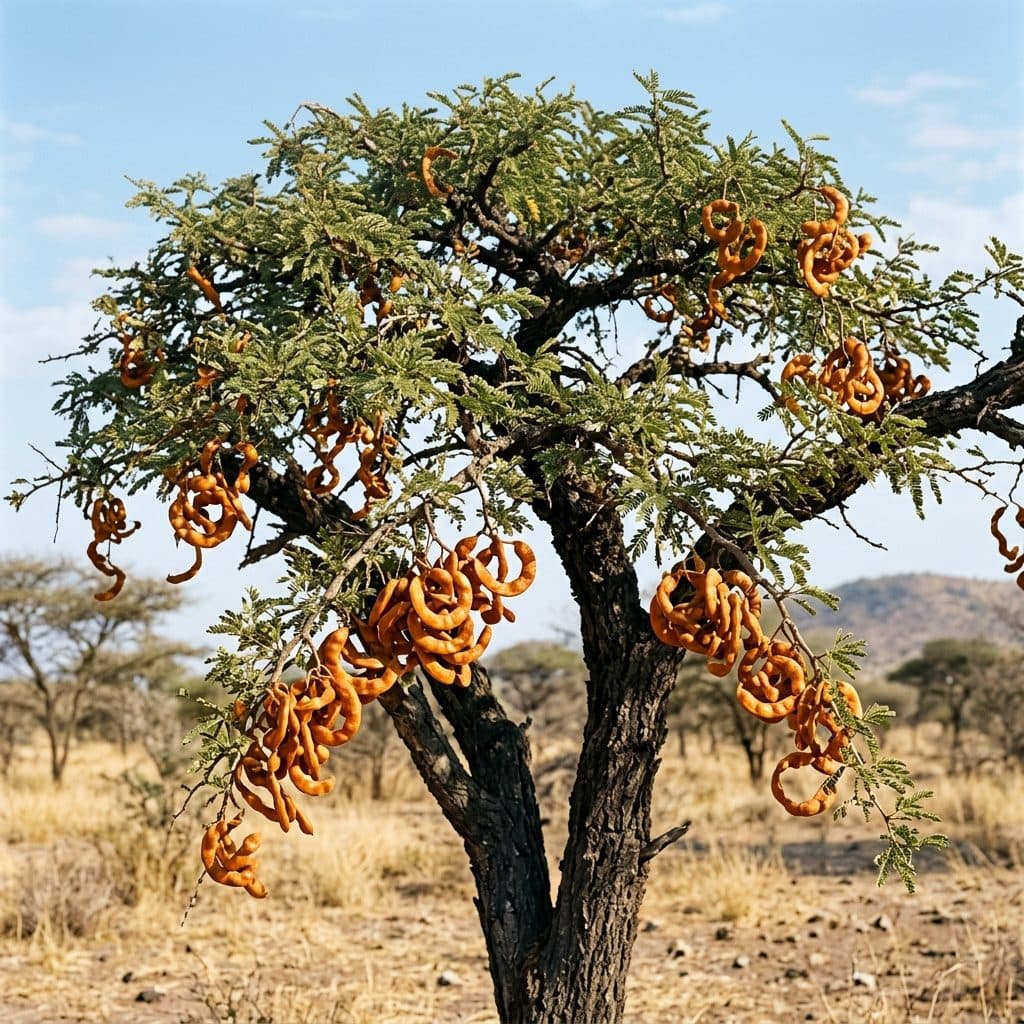
During the dry season, when annual rangelands are bare, the tree provides an indispensable feed reserve. A mature tree produces 100 to 300 kg (220 to 660 lb) of seed pods annually. The pods are visually unmistakable: bright orange to reddish-brown, thick, fleshy, and curled into circular coiled rings resembling dried apple rings. These pods contain 10 to 14% crude protein and high levels of digestible carbohydrates. Pastoralists collect the dropped pods to feed cattle, sheep, goats, and camels, or allow livestock to browse fallen pods directly.
The pale wood is relatively light, soft, and easy to carve, traditionally utilised for pestles, mortars, fencing, and light structural framing. Dead branches provide clean domestic firewood. In apiculture, the tree is invaluable: because it blooms in the middle of the dry season when few other plants are in flower, its creamy-white spicate blossoms provide an essential nectar and pollen flow for honeybees.
Identifying Faidherbia apple-ring acacia
Faidherbia albida is distinguished by several unique botanical characteristics:
- Tree habit: A medium to large deciduous tree reaching 15 to 30 m (50 to 100 ft) in height with a stout trunk up to 1.5 m (5 ft) in diameter and a rounded, spreading umbrella crown.
- Bark: Dull grey to pale whitish-grey, rough and fissured on mature trunks; young branchlets are characteristically pale, smooth, and zigzagging from node to node.
- Spines: Young twigs are armed with pairs of straight, stout spines (modified stipules) measuring 1 to 3 cm (0.4 to 1.2 in) long, positioned at the base of the leaves. The spines are pale with dark tips.
- Foliage: Alternate, bipinnately compound leaves 5 to 12 cm (2 to 5 in) long, consisting of 3 to 10 pairs of pinnae, each bearing 6 to 23 pairs of small grey-green leaflets measuring 3 to 12 mm long. The foliage has an overall silvery-blue cast.
- Inflorescences: Dense, fragrant, cylindrical spicate racemes 3 to 15 cm (1.2 to 6 in) long and 2 cm (0.8 in) broad, bearing numerous creamy-white flowers with long stamens, appearing in the dry season.
- Fruit: Highly distinctive, indehiscent, thick, fleshy pods measuring 10 to 15 cm (4 to 6 in) long and 2 to 3 cm (0.8 to 1.2 in) wide. As they mature, the pods curl and twist into tight, circular rings or coils turning bright orange, reddish-brown, or yellow-brown, resembling curled dried apple slices.
The tree is distinguished from kikar (Acacia nilotica), which features spherical golden flower heads and beaded pods, and from gum arabic tree (Acacia senegal), which bears hooked prickles in groups of three rather than paired straight spines.
Cautions
Pastoralists and land managers cultivating Faidherbia albida must heed important practical management caveats:
- Thorns and puncture hazard: The straight, rigid spines on saplings and lower branches present a hazard to bare feet, livestock hooves, and tractor tyres. Pruning trimmings should not be left scattered in pastoral walkways.
- Deep taproot sensitivity: The species relies on a single dominant taproot. If container-grown seedlings are held too long in nursery bags, the taproot coils at the base. Coiled taproots cause permanent tree instability and restrict the tree's ability to reach groundwater, leading to sudden collapse during severe drought.
- Ruminant digestive impaction: While apple-ring pods are an exceptional high-protein livestock feed, feeding ruminants exclusively on pods without adequate fibrous roughage (such as dry grass or straw) can lead to ruminal impaction or mild bloat in sheep and goats. Pods should be fed as a balanced supplementary protein concentrate.
- Bruchid beetle seed predation: Mature seeds are heavily targeted by bruchid seed weevils (Bruchidius and Caryedon species), which bore into ripening pods and destroy embryonic seed tissue. Seeds intended for planting should be collected immediately upon drop, dried in the sun, and stored in airtight containers.
- Regulatory note: Regulated in some rangeland jurisdictions as a potentially thorny coloniser of overgrazed pastures; verify local pastoral guidelines before establishing broadacre plantings.
Sources
- Royal Botanic Gardens, Kew. Faidherbia albida (Delile) A.Chev. Plants of the World Online.
- World Agroforestry (ICRAF). Faidherbia albida (Delile) A.Chev. Agroforestree Database.
- Food and Agriculture Organization (FAO). Faidherbia albida: a monograph.
- Plants For A Future. Faidherbia albida - (Delile) A.Chev.