climax
Carob
Ceratonia siliqua
International hardiness
- USDA 9-11
- RHS H3
- AU: Warm temperate, Arid / semi-arid, Subtropical
Where it grows — regional guide
| Zones / rating | Regional notes |
|---|---|
USDA 9-11 | Suited to USDA Zones 9 to 11 in California, Arizona, and the desert Southwest; monitor self-sown seedlings near sensitive coastal riparian zones. |
| Zones / rating | Regional notes |
|---|---|
H3 (-5 to 1C) | A foundational dryland crop across Spain, Italy, Portugal, and Greece; excels on stony calcareous hillsides where irrigation is unavailable. |
| Zones / rating | Regional notes |
|---|---|
Warm temperate, Arid / semi-arid, Subtropical | Widely grown in South Australia, Victoria, and Western Australia; control volunteer seedlings to prevent invasion into native bushland and woodland reserves. |
| Zones / rating | Regional notes |
|---|---|
USDA 9-11 (USDA scale) Canada uses its own zone system; Canadian zones run roughly one lower than USDA. | No region-specific data yet |
| Zones / rating | Regional notes |
|---|---|
No region-specific data yet | No region-specific data yet |
Carob (Ceratonia siliqua) is a slow-growing evergreen tree in the legume family (Fabaceae), celebrated for its sugary seed pods. Native to the Mediterranean basin, coastal southern Europe, northern Africa, and the Levant, this resilient tree has sustained rural communities for millennia as staple food and dependable famine reserve. Often called St John's bread or the locust bean tree, carob occupies a central ecological niche in arid agroforestry.
For dryland homesteaders, the carob tree is a long-lived climax canopy species. Resisting severe drought, high summer heat, stony alkaline ground, and salty maritime winds, it thrives where delicate orchard fruit trees fail. While pioneer shrubs like pigeon pea offer early shade, carob anchors the upper canopy for generations. Although in the legume family, carob does not nodulate or fix atmospheric nitrogen, relying instead on deep roots and mycorrhizal fungi to scavenge moisture.
In Mediterranean polycultures, carob trees grow alongside olive trees, hardy fig cultivars, and drought-tolerant pomegranate bushes. The pods provide high-energy feed for pantry milling and livestock rations.
Growing carob
Carob trees require a warm, sunny Mediterranean or semi-arid climate, flourishing within USDA Hardiness Zones 9 through 11 and carrying an RHS hardiness rating of H3. Mature trees withstand brief winter cold down to -5 °C (23 °F), though young saplings suffer severe dieback at -3 °C (27 °F). Unopened flower buds and setting pods are easily destroyed by late spring frosts. In temperate climates with damp, overcast summers, the tree survives as an architectural foliage specimen but fails to accumulate the thermal units necessary to ripen sweet, leathery pods.
Full sunlight is essential throughout the canopy. The species tolerates an extensive range of well-drained soils, including heavy clays, sandy loams, and fractured limestone outcroppings. It demonstrates a marked preference for calcareous substrates with a pH between 6.5 and 8.5. The primary vulnerability of Ceratonia siliqua is waterlogged ground; planting in poorly drained hollows invariably leads to root asphyxiation and devastating fungal root rots. Established trees survive on as little as 250 to 500 mm (10 to 20 in) of annual precipitation, thanks to a deep, penetrating taproot that can descend 10 to 20 m (33 to 66 ft) into fractured bedrock.
Propagation from seed requires scarification due to the impervious seed coat. Soak clean seeds in hot water at 80 °C (176 °F) for several minutes, followed by 24 hours in lukewarm water, or abrade the coat mechanically before sowing in deep taproot pots. Seedlings exhibit considerable genetic variability in vigour and sex. The species is predominantly dioecious, bearing separate male and female individuals, although polygamous and hermaphroditic cultivars also occur. Commercial growers and homesteaders generally bud or graft known cultivars onto vigorous seedling rootstocks. When planting dioecious trees, maintain a ratio of at least one male pollinator tree for every eight to ten female cropping trees, sited upwind to facilitate wind and insect pollination.
Space mature carob trees 9 to 12 m (30 to 40 ft) apart to accommodate their spreading crowns, which typically achieve a height of 8 to 15 m (26 to 49 ft) and a comparable canopy spread. Growth is deliberate during the first three to five seasons while the plant allocates energy toward subterranean taproot development. Minimal pruning is required beyond shaping a central leader and eliminating low suckers or crossed branches during early spring.
Harvest and uses
Carob trees commence light cropping five to seven years after budding, attaining substantial production by ten to twelve years. Mature, well-tended trees yield between 40 and 200 kg (88 and 440 lb) of pods annually, with exceptional veteran specimens recorded yielding over 300 kg (660 lb).
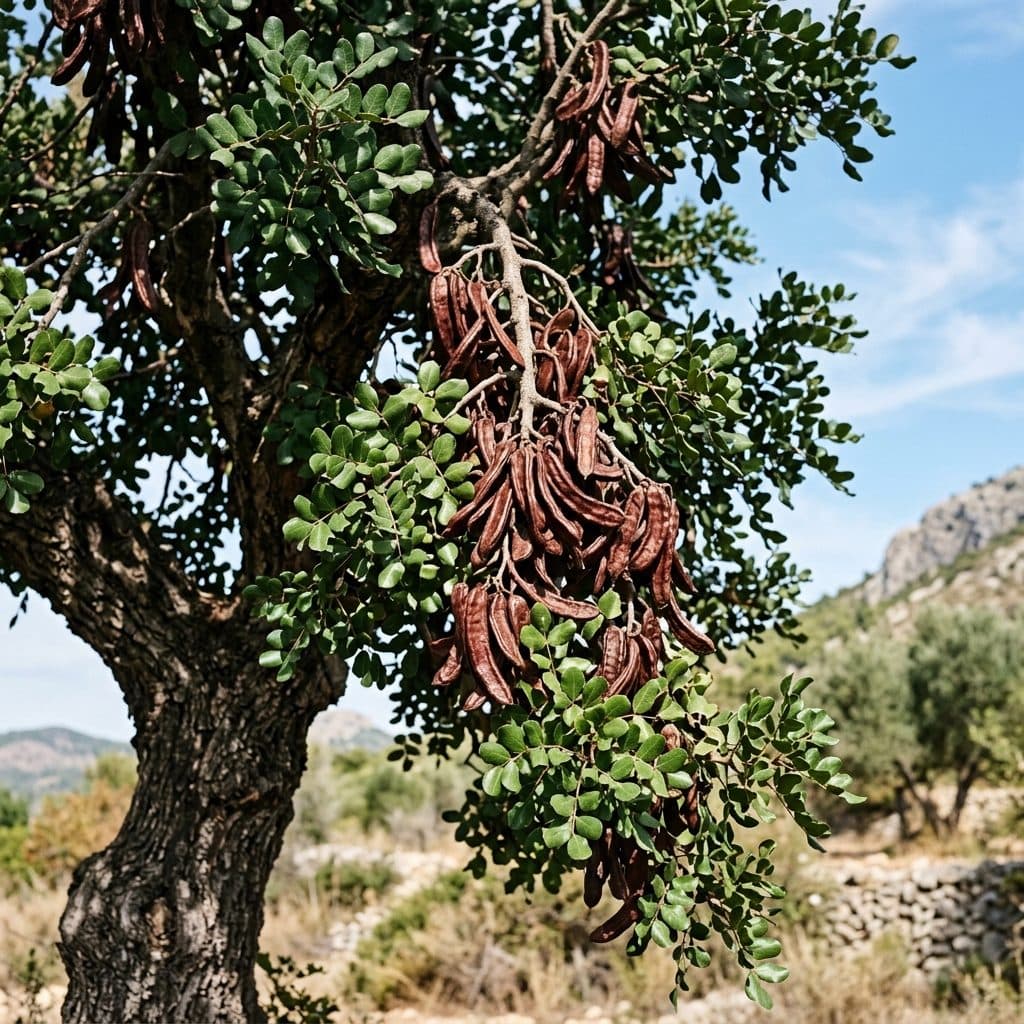
Flowering takes place in autumn, and the developing pods require a full eleven to twelve months on the tree to mature. Harvest occurs in late summer and early autumn of the following year, when the pendulous, flattened pods turn from glossy green to deep chocolate-brown, leathery, and dry. Ripe pods measure 10 to 30 cm (4 to 12 in) in length and 1.5 to 3.5 cm (0.6 to 1.4 in) in width. Collect pods promptly before autumn rains trigger mould formation on the ground, either by gentle knocking with bamboo poles onto ground tarpaulins or hand-plucking from lower scaffolding.
The harvested pods are dried in full sun for several days until their moisture content drops below 10 percent, ensuring long-term storability without spoilage. The fleshy, leathery mesocarp comprises 40 to 50 percent natural sugars (predominantly sucrose, glucose, and fructose) and is naturally free from caffeine, theobromine, and gluten.
Culinary and agricultural applications include:
- Carob powder: De-seeded and lightly toasted pods are milled into a fragrant, naturally sweet cocoa substitute used in baking, beverages, and desserts.
- Direct consumption: The sweet, fibrous pods can be chewed fresh as a field snack, taking care to spit out the rock-hard internal seeds.
- Livestock fodder: Coarsely kibbled carob pods represent an exceptional high-energy maintenance feed for cattle, horses, sheep, and goats, although their high tannin content requires blending with protein supplements.
- Locust bean gum: The hard seeds contain galactomannan endosperm, commercially extracted as a valuable natural thickening and stabilising agent (E410) in food production.
- Timber and fuel: The hard, dense heartwood finishes to a handsome pinkish-brown lustre for fine turnery, while orchard prunings furnish exceptional, slow-burning firewood.
Identifying carob
Ceratonia siliqua is recognised in the field by several distinct morphological features:
- Habit and trunk: A handsome, broad-canopied evergreen tree reaching 8 to 15 m (26 to 49 ft) in height, often developing a thick, gnarled, multi-furrowed trunk with rough, brownish-grey bark.
- Leaves: Alternate, pinnately compound foliage measuring 10 to 20 cm (4 to 8 in) in length, bearing two to five pairs of thick, leathery, elliptic to round leaflets. Leaflet margins are entire, glossy dark green on the adaxial surface, and distinctly paler matte green beneath.
- Inflorescences: Small, apetalous blossoms clustered in dense, cylindrical racemes measuring 5 to 15 cm (2 to 6 in) long, borne directly on older wood and scaffold branches (cauliflory). Male racemes display prominent yellow stamens with a strong, distinctive musky odour; female racemes feature a curved, greenish-yellow pistil.
- Fruit: Large, flattened, straight to slightly curved legume pods, 10 to 30 cm (4 to 12 in) long, with thickened margins and a tough, leathery texture. They ripen to a deep reddish-brown or dark chocolate hue, containing ten to fifteen very hard, flattened, ovate seeds embedded in sweet pulpy septa.
Carob is readily distinguished from honey locust (Gleditsia triacanthos) by its absence of formidable trunk thorns and its evergreen, leathery foliage. It differs from false acacia (*Robinia pseudoacacia*) by lacking papilionaceous pea-like blossoms, possessing thicker leaves, and bearing far larger, non-splitting sugary pods.
Cautions
Prospective growers should observe several environmental and physical factors before establishing carob:
- Invasiveness and ecological weed status: While prized within its native Mediterranean range, Ceratonia siliqua has escaped cultivation and naturalised across temperate and subtropical regions of southern Australia (including South Australia, Victoria, and Western Australia) and coastal California. Frugivorous birds, foxes, and livestock feed on the sweet pods and disperse viable seeds into native woodlands, riparian reserves, and coastal scrub, where seedlings compete aggressively with indigenous flora. The species is regulated in some jurisdictions; check your local list before planting.
- Dental and choking hazard from seeds: Raw carob seeds are extremely hard and smooth. Ingesting whole pods without de-seeding presents a severe risk of tooth breakage for people and choking in livestock. Whole pods must be kibbled or coarsely crushed before being fed to horses or cattle.
- Tannin astringency in immature pods: Green, unripened carob pods contain concentrated concentrations of soluble condensed tannins that provoke digestive discomfort and astringency if ingested before physiological maturity.
- Root system infrastructure hazard: The extensive, vigorous root system of Ceratonia siliqua can penetrate cracked masonry, lift light paving, and invade sub-surface drainage lines. Maintain a minimum planting buffer of 10 to 15 m (33 to 49 ft) away from domestic foundations and septic drain fields.
Sources
- Royal Botanic Gardens, Kew. Ceratonia siliqua L. Plants of the World Online.
- Feedipedia (INRAE, CIRAD, AFZ, FAO). Carob (Ceratonia siliqua)
- Plants For A Future. Ceratonia siliqua - L.
- Royal Horticultural Society. Ceratonia siliqua (carob)
- USDA PLANTS Database. Ceratonia siliqua L., St. John's-bread