pioneer
Black locust
Robinia pseudoacacia
International hardiness
- USDA 4-8
- RHS H6
- AU: Cool temperate, Warm temperate
Where it grows — regional guide
| Zones / rating | Regional notes |
|---|---|
USDA 4-8 | Native to the Appalachians and Ozarks; heavily regulated or restricted as an invasive exotic in several Midwest and Northeast states due to clonal thickets. |
| Zones / rating | Regional notes |
|---|---|
H6 (-20 to -15C) | Hardy across RHS H6; planted in shelterbelts and timber plots, but monitor root suckers and keep away from horse pastures due to severe toxalbumin poisoning. |
| Zones / rating | Regional notes |
|---|---|
Cool temperate, Warm temperate | Naturalised across south-eastern Australia where root suckering threatens native grasslands and bushland; plant only in strictly managed woodlots. |
| Zones / rating | Regional notes |
|---|---|
USDA 4-8 (USDA scale) Canada uses its own zone system; Canadian zones run roughly one lower than USDA. | No region-specific data yet |
| Zones / rating | Regional notes |
|---|---|
No region-specific data yet | No region-specific data yet |
Black locust (Robinia pseudoacacia), also called false acacia, is a fast-growing deciduous hardwood tree in the legume family (Fabaceae). Native to the Appalachian Mountains and the Ozark Plateau of North America, the tree is cultivated across Europe, Asia, and Australasia. Black locust is valued for rot-proof heartwood, high fuel density, nitrogen-fixing capabilities, and fragrant honey flowers, but it also demands careful management.
The biology of Robinia pseudoacacia is defined by colonising vigour. As an early-successional pioneer, it establishes on disturbed mineral ground, gravelly banks, and subsoils where companion plants like fourwing saltbush or groundnut find purchase. Its roots associate with nitrogen-fixing rhizobia, converting atmospheric nitrogen into soil fertility at rates of 75 to 150 kg per hectare annually. For homesteaders, the species has durable structural lumber and fence posts that endure in wet soil for decades without chemical treatment. However, because it reproduces relentlessly via root suckering, growers must manage its capacity for ecological disruption and livestock toxicity carefully.
Growing black locust
Black locust is a cold-hardy, drought-resilient hardwood adapted to temperate and continental climates. It is fully hardy in USDA Zones 4 to 8/9 and rated RHS H6, tolerating winter minimums down to -30 °C (-22 °F). It requires warm summers to achieve its maximum growth rate and set seed, flourishing from sea level up to 1,500 m (5,000 ft).
Soil tolerance is broad, with one critical limitation: drainage. The tree grows exceptionally well on coarse sands, rocky gravels, limestone ridges, and quarry reclamation spoils with pH values ranging from 4.6 to 8.2. It tolerates moderate soil salinity and urban air pollution. However, it cannot tolerate dense, waterlogged soils. In poorly drained clays with high winter water tables, root aeration fails, leading to stunted growth and fungal root rot. Full sunlight is mandatory: black locust cannot endure overhead shade, preventing it from invading closed-canopy mature forests.
The growth rate of Robinia pseudoacacia is among the fastest of cold-hardy hardwoods. A sapling adds 1 to 1.5 m (3.3 to 5 ft) of height annually during youth, reaching 10 to 15 m (33 to 50 ft) in ten years. Mature trees attain 15 to 25 m (50 to 80 ft) in height with an irregular crown and a trunk diameter of 60 to 90 cm (24 to 35 in).
Propagation is accomplished by seed, root cuttings, or coppice shoots. The hard-coated seeds remain viable in soil for decades. To achieve uniform germination, scarify seeds by nicking the coat or immersing them in boiling water for one to two minutes, followed by a twenty-four-hour soak. Direct-drill scarified seed in spring or raise seedlings in deep nursery tubes. For timber production, plantations are established at a spacing of 2 by 2 m (6.5 by 6.5 ft) or 2.5 by 2.5 m (8 by 8 ft).
The tree possesses extraordinary coppicing vigour. When felled at ground level during winter dormancy, a mature stump produces coppice sprouts that grow 2 to 3 m (6.5 to 10 ft) in a single season. Managing these regrowth shoots on a ten- to fifteen-year coppice rotation yields recurring harvests of straight, rot-resistant posts and firewood indefinitely.
Harvest and uses
Black locust is celebrated globally for timber durability. The heartwood is dense, heavy, fine-grained, and olive-green to golden-brown, turning russet upon exposure to light. It is naturally infused with antifungal flavonoids, notably robinetin and taxifolin. As a consequence, untreated black locust heartwood exhibits superior rot resistance, lasting thirty to fifty years in direct ground contact. It is harvested for vineyard posts, boundary fence posts, outdoor decking, and sill plates, avoiding chemical preservatives near herb beds containing garlic chives.
As firewood, black locust ranks among the finest in the world. Seasoned wood possesses an air-dry density of roughly 720 to 800 kg per cubic metre (45 to 50 lb per cubic foot) and generates approximately 27 to 29 million BTUs per cord. The wood splits cleanly, dries relatively quickly, and burns with a long-lasting, steady, smokeless flame that leaves a hot bed of coals.
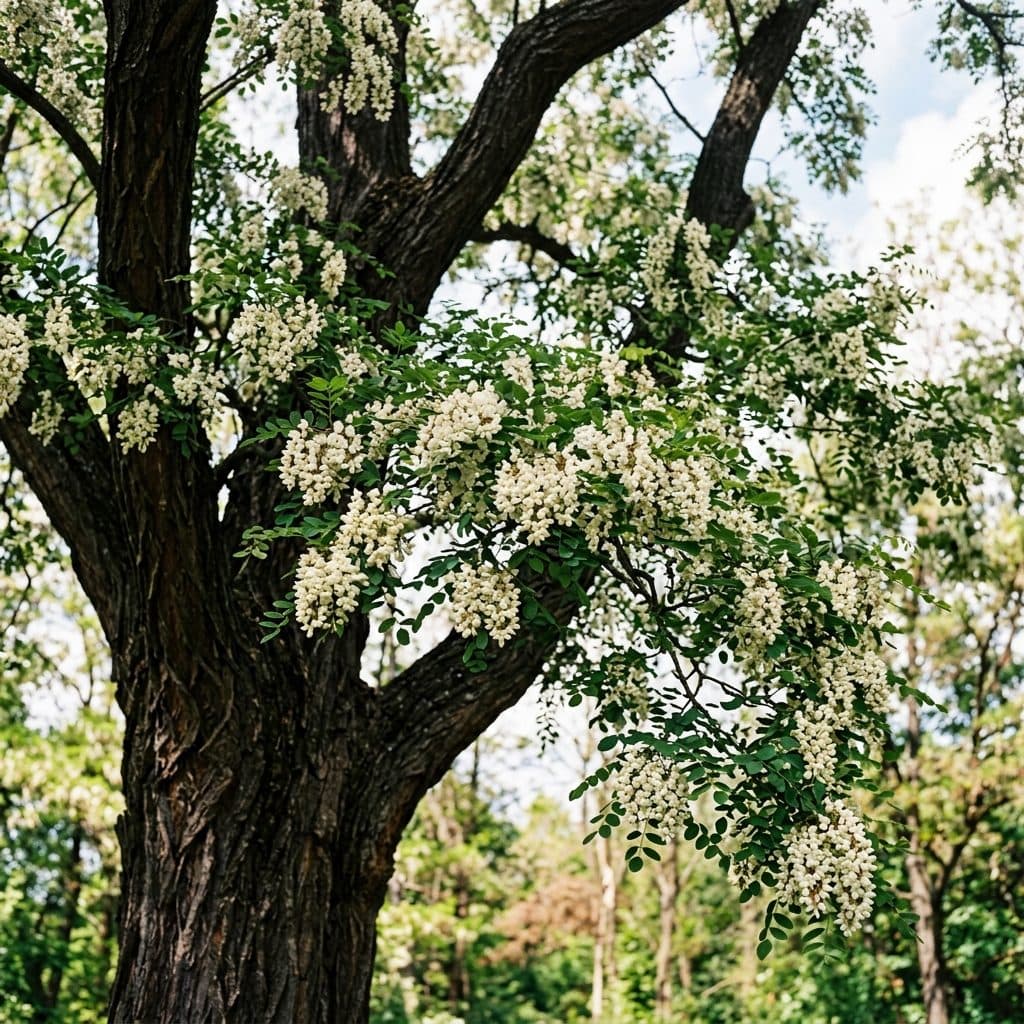
The tree is also a premier resource for apiculture. In late spring, black locust erupts into dense racemes of fragrant white blossoms. The flowers produce a heavy flow of water-white, low-acid nectar with high fructose content, yielding clear "acacia honey" that resists crystallisation for years.
In permaculture systems, black locust functions as a fertility builder. Pruned leafy branches break down quickly, depositing nitrogen and organic matter into topsoil. While leaves, bark, and seeds are poisonous, the fragrant flower petals are edible. In rural Europe and Appalachia, fresh spring flower clusters are battered and fried as sweet floral fritters.
Identifying black locust
Robinia pseudoacacia can be identified using the following botanical markers:
- Bark and trunk: Mature trunks display thick, deeply furrowed, dark grey-brown bark with interlacing fibrous ridges that form a rope-like or diamond-shaped crisscross pattern.
- Stems and thorns: Young twigs and vigorous root suckers are ribbed, greenish-brown, and armed with paired, sharp, stiff stipular thorns measuring 1 to 2 cm (0.4 to 0.8 in) long at the base of each leaf. Thorns are absent on older woody limbs.
- Leaves: Alternate, odd-pinnately compound leaves 15 to 35 cm (6 to 14 in) long, consisting of 7 to 21 oval to oblong leaflets measuring 2.5 to 5 cm (1 to 2 in) long. Leaflets are dull dark blue-green above and paler beneath, with tiny bristle-like mucronate tips.
- Flowers: Drooping axillary racemes 10 to 20 cm (4 to 8 in) long bearing 15 to 30 fragrant, pea-like white flowers measuring 1.5 to 2.5 cm (0.6 to 1 in) across, each with a pale yellow blotch on the standard petal.
- Fruit: Smooth, flat, dark brown, papery seed pods 5 to 10 cm (2 to 4 in) long and 1 to 1.5 cm (0.4 to 0.6 in) wide, containing 4 to 8 small, kidney-shaped, dark brown seeds that persist on winter branches.
Black locust is distinguished from honey locust (Gleditsia triacanthos), which bears large branched thorns on the trunk, smaller bipinnate leaflets, and massive twisted leathery pods lacking nitrogen-fixing root nodules.
Cautions
The exceptional qualities of Robinia pseudoacacia are accompanied by severe hazards that require safeguards:
- Aggressive root suckering and invasiveness: Black locust expands via extensive lateral root suckers that travel dozens of metres. When the parent trunk is cut or damaged, the root system erupts into hundreds of thorny root sprouts. Outside its native range, the species forms dense clonal thickets that invade grasslands, savannas, and forest margins. It shades out native sun-loving forbs and enriches soil with excessive nitrogen, facilitating invasions of exotic weeds. It is listed as an invasive alien species of Union concern in Europe and regulated as an invasive exotic in several US states, including Massachusetts, Wisconsin, and Minnesota. Never plant black locust near native prairie remnants or conservation boundaries. Manage groves with regular mowing.
- Severe systemic livestock toxicity: Every part of Robinia pseudoacacia—specifically the inner bark, roots, foliage, twigs, and seeds—is poisonous to livestock and humans. The only exception is the petal tissue of the cooked flowers. Toxicity is driven by the potent toxalbumins robin and phasin, alongside the toxic glycoside robinin. Horses are exceptionally vulnerable: chewing on bark or grazing wilted foliage causes acute colic, cold sweats, uncoordinated gait, cardiac arrhythmias, paralysis, and death. Cattle and sheep also suffer acute poisoning. Never plant black locust within or adjacent to livestock paddocks or horse pastures.
- Wood brittleness and thorn hazards: Upper branches are brittle and prone to shattering during heavy ice storms. The sharp stipular thorns on young growth puncture vehicle tyres and cause painful skin lacerations.
- Pest liability: Older trees are susceptible to the locust borer beetle (Megacyllene robiniae), whose larvae tunnel through heartwood, causing structural wind-snap. The locust leafminer (Odontota dorsalis) frequently skeletonises foliage in midsummer.
Sources
- Royal Botanic Gardens, Kew. Robinia pseudoacacia L. Plants of the World Online.
- Plants For A Future. Robinia pseudoacacia - L.
- Missouri Botanical Garden. Robinia pseudoacacia
- USDA Forest Service. Robinia pseudoacacia L. - Black Locust
- USDA PLANTS Database. Robinia pseudoacacia L. - Black Locust