support
Honey locust
Gleditsia triacanthos
International hardiness
- USDA 3-9
- RHS H6
- AU: Cool temperate, Warm temperate
Where it grows — regional guide
| Zones / rating | Regional notes |
|---|---|
USDA 3-9 | Native to the central and eastern states; select thornless cultivars such as inermis for homestead planting to eliminate severe puncture hazards. |
| Zones / rating | Regional notes |
|---|---|
H6 (-20 to -15C) | Fully hardy across RHS H6; thrives in deep fertile loams, but plant thornless inermis selections to prevent severe puncture injuries. |
| Zones / rating | Regional notes |
|---|---|
Cool temperate, Warm temperate | Declared a restricted invasive plant in Queensland and New South Wales; check biosecurity regulations and plant only non-invasive selections. |
| Zones / rating | Regional notes |
|---|---|
USDA 3-9 (USDA scale) Canada uses its own zone system; Canadian zones run roughly one lower than USDA. | No region-specific data yet |
| Zones / rating | Regional notes |
|---|---|
No region-specific data yet | No region-specific data yet |
Honey locust (Gleditsia triacanthos), also called sweet bean or thorny locust, is a rugged, fast-growing deciduous hardwood tree in the legume family (Fabaceae). Native to the rich bottomlands, river valleys, and moist upland slopes of central and eastern North America, the tree is widely cultivated across temperate regions worldwide. Revered by silvopastoralists and agroforesters for its sweet, highly nutritious seed pods, decay-resistant timber, and airy foliage that casts light dappled shade, honey locust is a cornerstone tree for homestead animal feeding and shelter systems.
An essential botanical fact distinguishes Gleditsia triacanthos from many of its leguminous relatives: it belongs to the caesalpinioid clade of Fabaceae and does not fix atmospheric nitrogen. Unlike black locust or clover, honey locust roots do not form symbiotic rhizobial nodules. Its agroecological value lies instead in its deep mineral-mining taproot, dynamic leaf litter cycling, rapid biomass accumulation, and prolific production of sugar-rich pods that fall during late autumn and winter when pasture grasses go dormant. Companion crops like white mulberry and olive flourish nearby without suffering root competition.
Growing honey locust
Honey locust displays remarkable climatic hardiness, flourishing across USDA Zones 3 through 9 and rated RHS H6. Fully dormant mature specimens withstand winter temperatures down to -35 °C (-31 °F) without branch injury, yet tolerate sweltering summer heat exceeding 40 °C (104 °F). It requires an annual frost-free period of at least 120 days to mature its heavy seed pods.
The species accommodates an exceptionally broad spectrum of soils. It prospers in heavy clay loams, rich alluvial bottomlands, rocky limestone hillsides, and coarse sandy gravels across a pH range of 5.5 to 8.2. It exhibits outstanding tolerance to high soil alkalinity, moderate salinity, and seasonal spring waterlogging, surviving weeks of temporary flooding during river surges. Once the taproot anchors into subsoil strata, established trees withstand prolonged severe drought. Full sunlight is mandatory; the tree possesses low shade tolerance and requires open canopy positions to grow vigorously.
Growth is rapid during youth, with seedlings regularly adding 60 to 90 cm (24 to 35 in) of height each year. Mature trees reach 15 to 25 m (50 to 82 ft) in height with an open, spreading, vase-shaped crown 12 to 18 m (40 to 60 ft) across. Propagation from seed is highly effective. The hard, waterproof seed coat requires scarification: soak seeds in concentrated sulphuric acid for one hour or immerse in boiling water and allow them to soak for twenty-four hours before spring sowing. For homestead planting, growers typically propagate superior high-sugar or thornless selections via chip budding or whip-and-tongue grafting onto seedling rootstocks. Space orchard trees at 8 by 8 m (26 by 26 ft) to allow maximum light interception.
Harvest and uses
The signature yield of Gleditsia triacanthos is its massive crop of strap-like seed pods. Mature grafted cultivars begin bearing within four to six years, producing 50 to 150 kg (110 to 330 lb) of pods per tree annually. The pods ripen to a deep mahogany brown in late autumn, falling gradually through early winter.
The leathery pods contain a thick, sweet, translucent pulp with a sugar content of 25 to 35 percent and a crude protein content of 10 to 14 percent across the whole pod. Pods provide prime winter fodder for cattle, sheep, goats, and pigs, who consume them eagerly off the ground. The seeds inside have hard coats; when ingested whole, some pass through the digestive tract undigested, so milling or crushing dry pods into meal improves digestive nutrient uptake. For humans, the sweet pulp of fresh autumn pods can be chewed raw or steeped to brew rustic sweet syrups, while roasted seeds serve as a traditional caffeine-free coffee substitute.
The heartwood of honey locust is dense, heavy, and coarse-grained, displaying an attractive reddish-brown to golden-orange hue. It possesses high natural rot resistance in soil contact, lasting fifteen to twenty-five years as untreated fence posts, railway sleepers, bridge timbers, and outdoor construction framing. As firewood, it ranks among the best North American species, with an air-dry density of 700 kg per cubic metre (44 lb per cubic foot) and high heat yield, burning cleanly with minimal smoke and forming long-lasting coals.
Identifying honey locust
Gleditsia triacanthos can be recognised with certainty through the following diagnostic features:
- Bark and trunk: Young trunks display smooth, dark greyish-brown bark with conspicuous horizontal lenticels. Mature bark breaks into long, narrow, recurved plates with deep vertical fissures, peeling slightly at the edges.
- Thorns: Wild-type trees produce massive, sharp, woody, branched thorns 5 to 20 cm (2 to 8 in) long, emerging directly from the main trunk and branches. Thorns are single at first, branching into three sharp prongs (triacanthos) or forming dense defensive clusters up to 30 cm (12 in) long. Thornless cultivated varieties (G. triacanthos f. inermis) lack trunk thorns entirely.
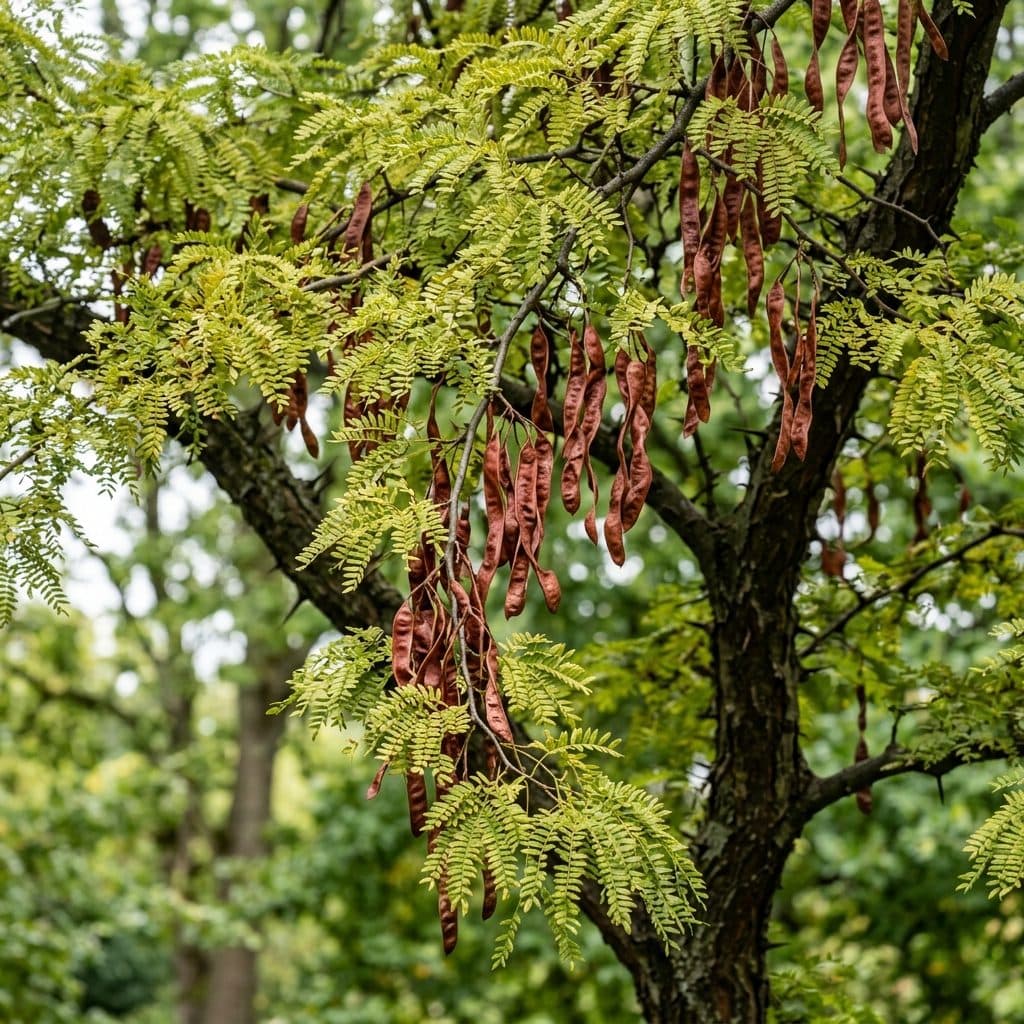
- Leaves: Alternate, pinnately or bipinnately compound leaves 15 to 25 cm (6 to 10 in) long, often bearing both arrangements on the same tree. Foliage contains 20 to 30 small, lanceolate-oblong leaflets measuring 1.5 to 3 cm (0.6 to 1.2 in) long. The leaflets turn brilliant golden-yellow in autumn and cast light, lace-like shade that allows turfgrass to thrive beneath.
- Flowers: Inconspicuous, small, greenish-yellow flowers grouped in drooping axillary racemes 5 to 10 cm (2 to 4 in) long, opening in late spring. Flowers are polygamo-dioecious and emit an intense honey-like fragrance that attracts native pollinators.
- Fruit: Large, flattened, twisted, ribbon-like seed pods 20 to 45 cm (8 to 18 in) long and 2.5 to 3.5 cm (1 to 1.4 in) wide, turning dark reddish-brown to maroon-black. Each pod houses 10 to 20 hard, oval, compressed brown seeds embedded in sweet pulp.
The species differs sharply from black locust (Robinia pseudoacacia), which has small paired stipular spines, large pea-like white flowers, short flat papery pods, and nodulating nitrogen-fixing roots.
Cautions
Before planting honey locust, growers must address several significant agricultural and safety concerns:
- Fierce thorn hazards in wild stock: The branched woody thorns of wild-type honey locust are formidable, capable of puncturing heavy work boots and tractor tyres, and causing deep, painful puncture wounds that readily turn septic. In pasture settings, thorns can blind or injure livestock. Homesteaders must plant exclusively verified thornless cultivars (forma inermis) such as 'Millwood', 'Calhoun', or 'Shademaster'.
- Invasive potential and biosecurity listing: In Australia, Gleditsia triacanthos is an aggressive declared restricted invasive plant in Queensland and parts of New South Wales, where livestock and feral animals disperse seeds into fertile river catchments, forming thorny thickets that choke native waterways. It is also monitored as an emerging invasive exotic in parts of Central Europe and South Africa. Always check state and regional weed declarations before establishing new plantings.
- Livestock digestive impaction: While pods are excellent livestock feed, feeding ruminants exclusive diets of high-sugar honey locust pods without adequate coarse, fibrous roughage can induce ruminal acidosis, carbohydrate overload, and acute ruminal impaction. Always provide free-choice hay or coarse pasture roughage alongside pod feeding.
- Lack of nitrogen fixation: Do not plant honey locust under the mistaken assumption that it provides soil nitrogen to companion plants; it lacks root nodules and does not fix atmospheric nitrogen.
Sources
- Royal Botanic Gardens, Kew. Gleditsia triacanthos L. Plants of the World Online.
- USDA PLANTS Database. Gleditsia triacanthos L. - Honeylocust
- Missouri Botanical Garden. Gleditsia triacanthos
- NC State Extension Gardener Plant Toolbox. Gleditsia triacanthos
- Plants For A Future. Gleditsia triacanthos - L.