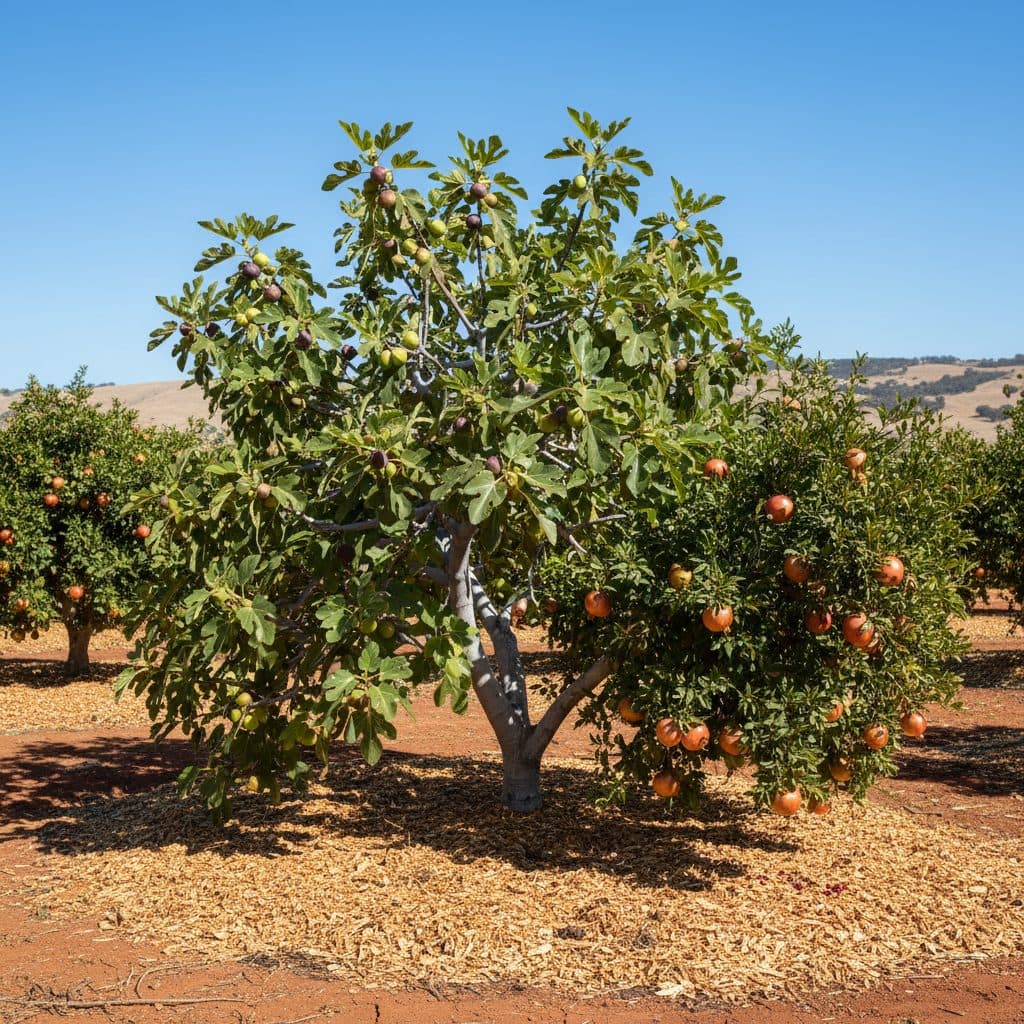
Key takeaways
- Choose climate-adapted species such as figs, pomegranates, olives, and jujubes for dry Australian conditions.
- Integrate native bush foods like quandong for genuine dryland resilience; finger lime copes with dry spells once established but needs afternoon shade and supplementary water through extreme heat.
- Water deeply during the first two establishment summers to encourage root systems to penetrate deep subsoil layers.
- Apply thick organic coarse woodchip mulch 10 cm deep to suppress evaporation and maintain root zone cool.
- Plant in contoured swales or passive water-harvesting basins to capture every millimetre of rainfall.
Quick answer: Establishing drought tolerant fruit trees in Australia relies on selecting species naturally adapted to hot, dry Mediterranean and arid climates. Fig, pomegranate, olive, jujube, black mulberry, and native bush foods like quandong thrive under minimal irrigation once their root systems are established through deep basin watering, heavy woodchip mulching, and contour earthworks.
Water availability is one of the most defining factors of gardening and orcharding across the Australian continent. From the hot, dry summers of southern and western Australia to the unpredictable rainfall patterns of the inland plains, establishing a productive home orchard requires species that can withstand intense heat and extended dry spells without sacrificing fruit quality or tree longevity.
Selecting drought tolerant fruit trees allows you to produce abundant, fresh fruit while significantly lowering your garden's water requirements. Unlike water-hungry stone fruits and apples that require constant summer irrigation, drought-hardy fruit trees possess physiological adaptations—such as waxy leaves, deep taproots, reduced leaf surface areas, and efficient stomatal control—that allow them to flourish in dry Australian conditions.
Success with water-wise fruit trees depends on matching species to your regional climate, establishing deep root systems during early growth, and capturing natural surface runoff through thoughtful earthworks and heavy mulching.
Top resilient fruit tree species for Australian climates
Several traditional Mediterranean and subtropical species deliver outstanding drought hardiness alongside heavy fruit production across Australian gardens:
- Fig (Ficus carica): Figs are among the toughest fruit trees available. Their extensive, fibrous root systems forage deeply for subsoil moisture. Varieties such as Brown Turkey, White Genoa, and Black Genoa produce two crops per year (a breba crop in early summer and main crop in late summer) even in lean, rocky soils.
- Pomegranate (Punica granatum): Naturally adapted to arid and semi-arid conditions, pomegranates thrive in poor, rocky, alkaline, or saline soils. Varieties like 'Wonderful' and 'Gissarskii Rozovyi' yield deep-red fruit that ripens through autumn heat without splitting when watered steadily.
- Olive (Olea europaea): Highly suited to Mediterranean climate zones (South Australia, Victoria, south-west Western Australia). Olives feature small, leathery leaves with silver undersides that reflect intense sunlight and minimise transpiration. Dual-purpose cultivars like Manzanillo and Kalamata provide both table fruit and rich oil. Olive is bird-spread and has naturalised widely in southern Australia. Feral olive is a declared or environmental weed in South Australia, Victoria and NSW, and African olive is a Weed of National Significance. Check your state and local council declared-plant list first, keep dropped fruit picked up, and do not plant within seed-spread distance of bushland.
- Jujube (Ziziphus jujuba): Also known as the Chinese date, the jujube is virtually indestructible in dry, hot Australian climates. It handles temperatures above 40°C, thrives in poor alkaline soils, and bears crisp, sweet fruit resembling miniature apples that dry naturally into sweet date-like treats on the branch.
- Loquat (Eriobotrya japonica): An evergreen subtropical tree that bears sweet, aromatic yellow-orange fruit in early spring. Its broad, leathery leaves and tough constitution make it an excellent windbreak and drought-hardy orchard canopy tree. Loquat self-seeds readily from bird-dropped fruit and is listed as an environmental weed in parts of eastern Australia. Check your local council list, and avoid planting near bushland or waterways.
- Black and White Mulberry (Morus nigra and Morus alba): Morus nigra (black mulberry) is extremely vigorous, deep-rooted, and the preferred garden choice, producing heavy crops of sweet berries in spring and summer while tolerating hot, dry winds. Morus alba is listed as an environmental weed in parts of Australia — check your state and council list before planting it, and prefer M. nigra or a sterile/fruitless-free named cultivar.
For broader landscape integration strategies, explore our guide to designing an edible drought tolerant landscape.
Native Australian water-wise fruit trees
Integrating native bush food species into your home orchard brings evolutionary advantages: these plants have adapted to Australian soils and climate extremes over millions of years:
- Australian Finger Lime (Citrus australasica): Native to rainforest margins of subtropical eastern Australia, finger limes demonstrate surprising drought tolerance once established, though they benefit from dappled afternoon shade in extreme summer heat. They produce slender cylindrical fruit filled with tangy, caviar-like citrus vesicles that burst with flavour.
- Quandong (Santalum acuminatum): The iconic native peach of arid and semi-arid inland Australia. The quandong is a hemiparasite that requires a host plant (such as native grasses, acacia, or saltbush) to attach its root haustoria to. It produces bright red, tart fruits prized for jams, chutneys, and pies.
- Midyim Berry (Austromyrtus dulcis): A hardy, low-growing coastal shrub producing sweet, speckled berries with a pleasant ginger-nutmeg flavour, highly tolerant of sandy soils, coastal salt winds, and dry spells. As a myrtle, it sits under myrtle rust pressure in humid eastern Australia — inspect new growth for bright yellow pustules, and buy from a nursery that manages the disease.
To review regional hardiness across diverse woody species, see our comprehensive guide on drought tolerant trees and shrubs by zone.
Soil preparation and deep planting strategies
While drought-tolerant trees are hardy once mature, poor planting practices will permanently stunt their root development.
Avoid digging smooth, glazed planting holes in heavy clay soils, which create a "bathtub effect" where water stagnates and rots roots during winter rains. Instead:
- Roughen the sides and base of the planting hole with a garden fork to allow roots to penetrate the surrounding soil.
- Incorporate modest amounts of aged compost. Add gypsum only where a simple dispersion test shows the clay is sodic — on non-sodic soils it will not improve structure.
- Plant the tree so the root flare sits slightly above ground level to prevent collar rot.
- Construct a wide watering basin (bund) 15 cm high around the drip line of the tree to direct rainwater and irrigation straight down into the root zone.
In sloping landscapes, plant your trees along contoured earthworks. Using swale and berm tree planting captures rainfall runoff, holding water in the landscape where tree roots can access it months after rain has stopped.
Establishment irrigation and summer mulching
The most critical period in the life of a drought-tolerant fruit tree is its first two summers. A young sapling in a nursery pot has a small root ball that cannot access deep subsoil moisture on its own.
Establishment watering protocol:
- Year 1: Water deeply once a week during warm weather (20 to 30 litres per tree), and twice weekly during extreme heatwaves above 35°C. Always water slowly at the base to encourage roots to grow downward rather than staying near the surface.
- Year 2: Taper watering to once every two weeks during dry summer months.
- Year 3 onwards: Established trees generally require irrigation only during prolonged summer droughts or when sizing up their fruit crop.
Apply a 10 cm layer of coarse organic woodchip or arborist mulch over the entire root zone, keeping the mulch 10 cm clear of the trunk to prevent fungal bark rot. Coarse woodchips shade the soil, keep the root zone noticeably cooler on hot days, and substantially cut evaporation from the soil surface.
Canopy management and heatwave protection
Managing tree canopies during severe Australian heatwaves protects both tree health and harvest yields:
Prune fruit trees to maintain a compact, open canopy that allows airflow while providing enough interior leaf shade to protect fruit from sunburn. For pomegranates and figs, training into a multi-stemmed vase or low branching bush reduces trunk sunscald.
During extreme summer heatwaves where temperatures exceed 38°C for consecutive days, provide temporary overhead shade cloth (30% to 50% green or white knitted shade mesh) to prevent leaf scorch and fruit drop. Whitewashing exposed trunks with diluted non-toxic white interior latex paint prevents bark cracking caused by intense reflected ground heat. For comprehensive orchard heatwave tactics, consult our guide on protecting fruit trees in heatwaves.