secondary
Quandong
Santalum acuminatum
International hardiness
- USDA 9-11
- RHS H2
- AU: Arid / semi-arid, Warm temperate
Where it grows — regional guide
| Zones / rating | Regional notes |
|---|---|
USDA 9-11 | Suitable for arid and desert regions in southern Arizona, southern California, and Texas; must be established with compatible perennial host species. |
| Zones / rating | Regional notes |
|---|---|
H2 (1 to 5C) | No region-specific data yet |
| Zones / rating | Regional notes |
|---|---|
Arid / semi-arid, Warm temperate | Indigenous to the arid and semi-arid southern interior of Australia; requires host plants like wattles or saltbush to thrive in cultivation. |
| Zones / rating | Regional notes |
|---|---|
USDA 9-11 (USDA scale) Canada uses its own zone system; Canadian zones run roughly one lower than USDA. | No region-specific data yet |
| Zones / rating | Regional notes |
|---|---|
No region-specific data yet | No region-specific data yet |
The quandong (Santalum acuminatum, historically Fusanus acuminatus) is a small evergreen tree in the sandalwood family (Santalaceae). Often called the desert quandong, sweet quandong, or native peach, the species is native to the Australian arid zone. For tens of thousands of years, Indigenous peoples across central and southern Australia have gathered quandong fruit as an essential survival staple, utilising the tart, vitamin-rich flesh fresh or sun-dried, while extracting medicinal oils from the deeply sculpted woody stones.
Distributed across semi-arid woodlands and sandplains of inland Australia, the quandong is an obligate root hemiparasite. While its pale olive-green foliage possesses chlorophyll and carries out independent photosynthesis, its roots form specialised haustoria. These structures attach directly to the roots of neighbouring host plants—most notably nitrogen-fixing legumes such as native wattles, including relatives like the gum arabic tree, as well as saltbushes and grasses—extracting water and dissolved mineral nutrients from the host's vascular system.
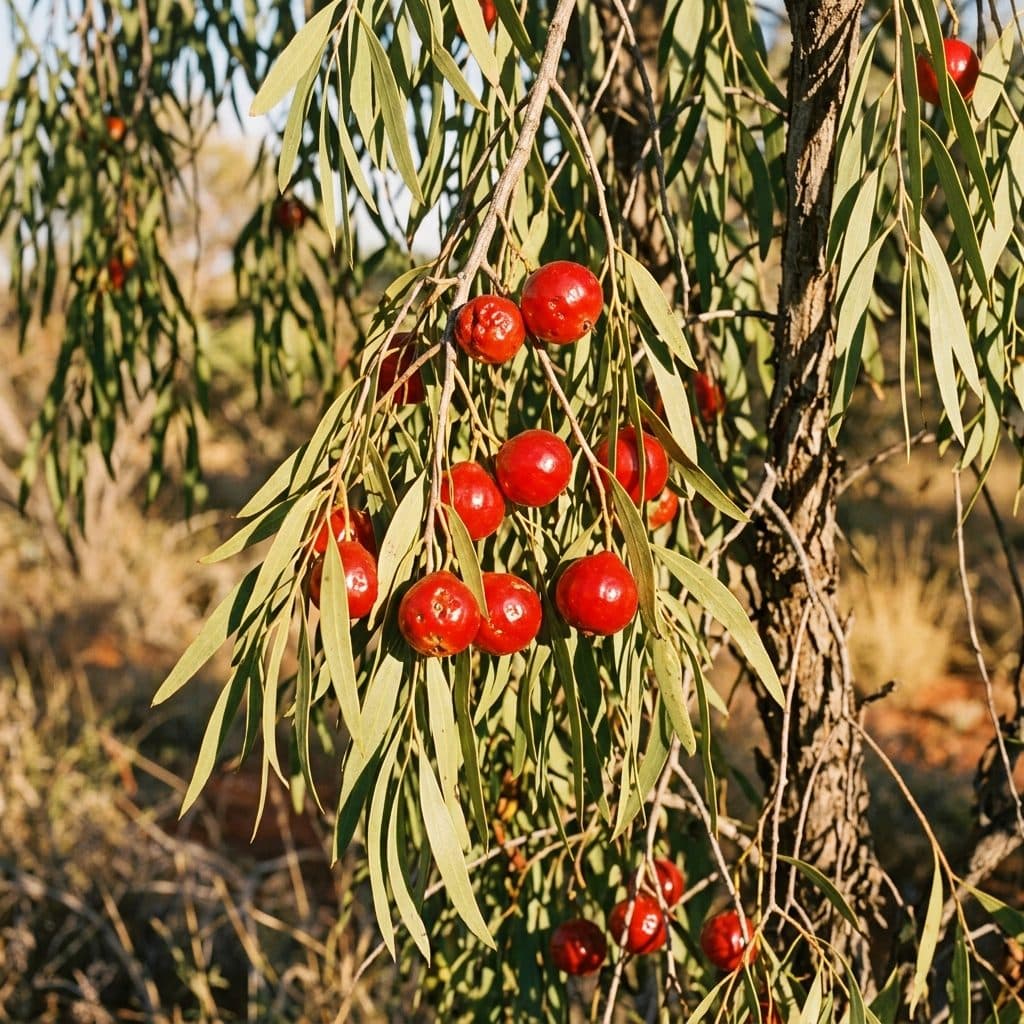
In homestead arid-zone orchards, growing quandongs offers an opportunity to produce high-value fruit in dry, low-fertility landscapes where conventional stone fruits fail. The brilliant scarlet fruits hang in clusters against drooping foliage, delivering twice the vitamin C of an orange. Fleshy cultivars produce a bold, tart flavour reminiscent of rhubarb, peach, and sour cherry, pairing naturally with dryland orchard crops like pomegranate.
Growing quandongs
Cultivating quandongs successfully requires understanding their hemiparasitic nature. Growing a quandong in isolation without compatible host roots invariably results in yellowing foliage, stunted vigour, and tree death within two to three years.
The tree requires deep, coarse, well-drained sandy or gravelly loams with a neutral to slightly alkaline pH between 6.5 and 8.0. Heavy clay soils or low-lying sites prone to standing water must be avoided; the root system is exceptionally sensitive to fungal root rot caused by Phytophthora cinnamomi.
Quandongs demand full sunlight and thrive in regions with intense summer heat and low humidity. While mature trees tolerate heat exceeding 45 °C (113 °F) and light winter frosts down to -3 °C (27 °F), young seedlings require protection from freezing cold during their first winter.
Establishing an orchard planting begins with host selection. In Australian plantings, prostrate species like creeping saltbush (Atriplex semibaccata) serve as initial nursery hosts in pots. For permanent orchard establishment, pair each quandong tree with one or two long-term companion hosts planted 1 to 2 m (3.3 to 6.5 ft) away. Ideal permanent hosts include native wattles (Acacia victoriae or Acacia ligulata) and native perennial grasses.
Propagation from seed is challenging due to seed dormancy. The woody endocarp must be cracked carefully in a vise, and the kernel treated before sowing in sandy seed mix at 20 to 25 °C (68 to 77 °F). Germination takes four to twelve weeks. Once seedlings emerge, introduce a potted host plant into the container immediately so haustorial connections form before field planting.
Field planting is best performed in autumn or early winter. Handle the root ball with care, as breaking roots disrupts haustorial junctions. Space trees 4 to 6 m (13 to 20 ft) apart within rows spaced 6 to 8 m (20 to 26 ft) apart, incorporating perennial host trees in adjacent planting stations.
Apply supplementary drip irrigation once every two to three weeks during flowering and fruit sizing to substantially increase fruit size and yield. Avoid overhead watering, which encourages foliar fungal blight. Minimal fertiliser is required; the tree benefits indirectly when its legume host fixes nitrogen. Light pruning after harvest removes dead wood.
Harvest and uses
Quandong trees begin bearing fruit three to four years after planting, reaching commercial production at eight to ten years, with mature trees yielding 10 to 25 kg (22 to 55 lb) of fruit annually. Fruits ripen in late winter and spring in warmer inland regions, or during summer in southern temperate districts.
Ripening is signalled when the firm green skin turns glossy yellow, then orange, and finally vivid scarlet-red. Harvest fruits by hand when fully coloured and slightly soft to the touch. The fleshy outer pericarp separates easily from the spherical pitted stone inside.
Fresh quandong flesh can be used immediately or dried for long-term preservation. Traditionally, fruits were dried whole in the sun or halved and pressed into cakes that remained edible for years; dried fruit rehydrates readily in water.
In contemporary cooking, quandongs are prized for pies, crumbles, jams, sauces, and chutneys. The tart flesh pairs with poultry and game meats, and makes striking sorbets and glazes.
The inner kernel inside the hard stone contains over 25 percent protein and 60 percent complex oils, historically roasted as a nourishing food or crushed into topical pastes for joint inflammation and skin ailments.
Identifying quandongs
The quandong tree possesses distinct botanical traits adapted to arid environments:
- Habit: Small evergreen tree or tall shrub reaching 2 to 6 m (6.5 to 20 ft) in height, often with a weeping branching habit and dark, rough, tessellated bark.
- Leaves: Opposite, simple, lanceolate to falcate (sickle-shaped), 3 to 9 cm (1.2 to 3.5 in) long and 3 to 10 mm (0.12 to 0.4 in) wide. Foliage is olive-green, leathery, and tapers to a curved point.
- Flowers: Inconspicuous four-petalled greenish-brown or cream blossoms measuring 2 to 3 mm (0.08 to 0.12 in) across, arranged in terminal pyramidal panicles in late summer and autumn.
- Fruit: Fleshy, spherical drupe measuring 2 to 4 cm (0.8 to 1.6 in) in diameter. The smooth, glossy skin turns from green to bright scarlet when ripe.
- Stone and kernel: Beneath the 3 to 5 mm (0.12 to 0.2 in) layer of fleshy pulp lies a large, spherical, deeply pitted woody endocarp enclosing a single white, oily kernel.
The sweet quandong is distinguished from the bitter quandong (Santalum murrayanum) by its bright red fruit and edible sweet-tart flesh, whereas the bitter quandong bears brownish-red fruit with intensely bitter, inedible pulp. It differs from the native sandalwood (Santalum spicatum), which produces brownish-green fruit with a thin, non-fleshy rind valued for its fragrant timber.
Cautions
Cultivating and processing quandongs requires awareness of parasitic biology and food safety:
- Hemiparasitic dependency: Never plant a quandong as an isolated specimen. Without a living host to tap into via haustoria, the tree will fail to establish and decline. Always install perennial host plants such as wattles or saltbush alongside the tree.
- Kernel cyanogenic compounds: While the oily kernel within the stone is a traditional food and medicine, raw kernels contain cyanogenic glycosides in variable quantities. Raw kernels should not be consumed in large amounts. Always roast or cook kernels thoroughly before eating to deactivate cyanogenic constituents.
- Root disturbance: The haustorial connections linking quandong roots to host roots are delicate. Disturbing the soil or roughly handling nursery containers severs these connections, causing desiccation and tree setback.
- Soil drainage and Phytophthora: Quandong trees have zero tolerance for waterlogged soils or heavy wet clays, quickly succumbing to collar and root rot. Plant only in freely draining sand, gravel, or raised earthen beds.
- Wildlife browsing: Young quandong foliage is relished by kangaroos, rabbits, goats, and feral camels. Erect sturdy wire tree guards around young plantings until trees grow beyond grazing height.
Sources
- Royal Botanic Gardens, Kew. Santalum acuminatum (R.Br.) A.DC. Plants of the World Online.
- Australian National Botanic Gardens. Santalum acuminatum - Growing Native Plants
- Australian Native Plants Society (Australia). Santalum acuminatum
- Plants For A Future. Santalum acuminatum - (R.Br.) A.DC.