pioneer
Casuarina she-oak
Casuarina equisetifolia
- sindh coast
- punjab plains
International hardiness
- USDA 9-11
- RHS H1c
- AU: Tropical, Subtropical, Warm temperate, Arid / semi-arid
Where it grows — regional guide
| Zones / rating | Regional notes |
|---|---|
USDA 9-11 | Prohibited Category 1 invasive weed in Florida; strictly illegal to introduce or plant due to severe destruction of native beach ecosystems. |
| Zones / rating | Regional notes |
|---|---|
H1c (5 to 10C) | No region-specific data yet |
| Zones / rating | Regional notes |
|---|---|
Tropical, Subtropical, Warm temperate, Arid / semi-arid | Native to the coastal tropics and subtropics of northern and eastern Australia; a keystone frontline tree on ocean foredunes. |
| Zones / rating | Regional notes |
|---|---|
USDA 9-11 (USDA scale) Canada uses its own zone system; Canadian zones run roughly one lower than USDA. | No region-specific data yet |
| Zones / rating | Regional notes |
|---|---|
Sindh coast, Punjab plains | Pakistan:Widely planted along the Sindh coast and Punjab plains for frontline windbreaks, coastal shelterbelts, and saline land reclamation; watch for storm toppling in loose sands. |
Casuarina she-oak (Casuarina equisetifolia), known as beach she-oak, whistling pine, or Australian pine, is a fast-growing evergreen hardwood tree in the she-oak family (Casuarinaceae). Indigenous to the coastlines of northern and eastern Australia, Southeast Asia, and the southwestern Pacific, the species has been introduced to maritime coasts across Africa, the Americas, and the Indian subcontinent. Celebrated for its tolerance to marine salt spray, gales, shifting sands, and heat, it is utilised as a frontline coastal windbreak tree alongside coastal pioneers like grey mangrove and desert cotton.
Physiologically, Casuarina equisetifolia is an extraordinary specialist in extreme maritime environments. Although it superficially resembles a weeping pine tree, it is a flowering plant. Its true leaves are reduced to microscopic scales, while photosynthetic functions are carried out by slender, jointed, needle-like green branchlets. Its root system forms dual symbioses with actinorhizal bacteria in the genus Frankia, allowing it to fix nitrogen in nutrient-barren sand, as well as mycorrhizal fungi that absorb scarce trace minerals. For coastal homesteaders, casuarina forms an impenetrable shield against oceanic gales. However, outside its native range, the tree's aggressive seed production, allelopathic leaf litter, and rapid spread make it one of the most destructive invasive plants in subtropical coastal ecosystems.
Growing Casuarina she-oak
Casuarina equisetifolia is a tropical and warm-subtropical maritime species, thriving in USDA Hardiness Zones 9 to 11 and rated RHS H1c. While mature trees endure brief drops to -2 °C (28 °F), young foliage suffers freezing injury at 0 °C (32 °F). Prolonged temperatures below -3 °C (27 °F) cause severe crown dieback. The tree performs best under mean annual temperatures between 22 and 32 °C (72 and 90 °F) and annual precipitation between 700 and 3,000 mm (28 to 120 in), though its deep root system grants it extreme drought tolerance.
Soil adaptability is exceptional in coastal forestry. The tree thrives in nutrient-barren dunes, coral sands, shell gravels, and alkaline alluviums with pH levels ranging from 5.0 to 9.5. It possesses exceptional tolerance to aerosol sea salt, brackish groundwater, and seawater overwash, tolerating moderate soil salinity where common crops fail. However, the species requires reasonable drainage and cannot survive in stagnant, permanently flooded swamps.
Site casuarina in full sun: it cannot endure overhead shade. Under full solar radiation, its growth rate is among the fastest of hardwoods, adding 2 to 3 m (6.5 to 10 ft) of height annually during youth. Trees attain mature heights of 15 to 30 m (50 to 100 ft) with an open crown and a straight trunk diameter of 50 to 100 cm (20 to 40 in).
Propagation is carried out primarily by seed. The tiny winged seeds mature within cone-like fruit and germinate readily without chemical pretreatment within two to three weeks when sown in moist sandy loam. Seedlings develop rapidly in nursery containers and are ready for outplanting within three to four months. To establish a coastal shelterbelt, plant trees at an in-row spacing of 2 to 3 m (6.5 to 10 ft) in rows spaced 3 to 4 m (10 to 13 ft) apart perpendicular to onshore winds.
Harvest and uses
Casuarina equisetifolia provides several critical infrastructural and forestry resources:
- Frontline coastal windbreaks and shelterbelts: Planted along beach margins, casuarina creates a semi-permeable green barrier that absorbs storm energy and traps airborne sea salt. By moderating wind velocities, shelterbelts allow inland homesteaders to cultivate sensitive horticultural crops and fruit orchards directly behind coastal dunes.
- Supreme domestic firewood and charcoal: The wood of Casuarina equisetifolia is celebrated as premier firewood. The wood is dense and heavy, with a specific gravity ranging from 0.85 to 1.05. It splits cleanly, seasons quickly, burns with immense heat without sparking, and produces negligible smoke. It generates an exceptional calorific value of roughly 4,900 to 5,000 kcal per kg, leaving a long-lasting bed of coals. It also produces commercial-grade charcoal.
- Heavy structural timber: The heartwood is dark reddish-brown, extremely hard, and fine-textured. It resists decay and marine borers when continuously submerged under salt water, historically harvested for marine pilings, wharf timbers, and structural poles.
- Sand dune stabilisation: Frankia actinorhizal nodules fix 50 to 100 kg of nitrogen per hectare annually in sterile beach sand. The lateral root network anchors shifting dunes against wind erosion, stabilising shorelines.
Identifying Casuarina she-oak
Casuarina equisetifolia is identified by the following unique botanical markers:
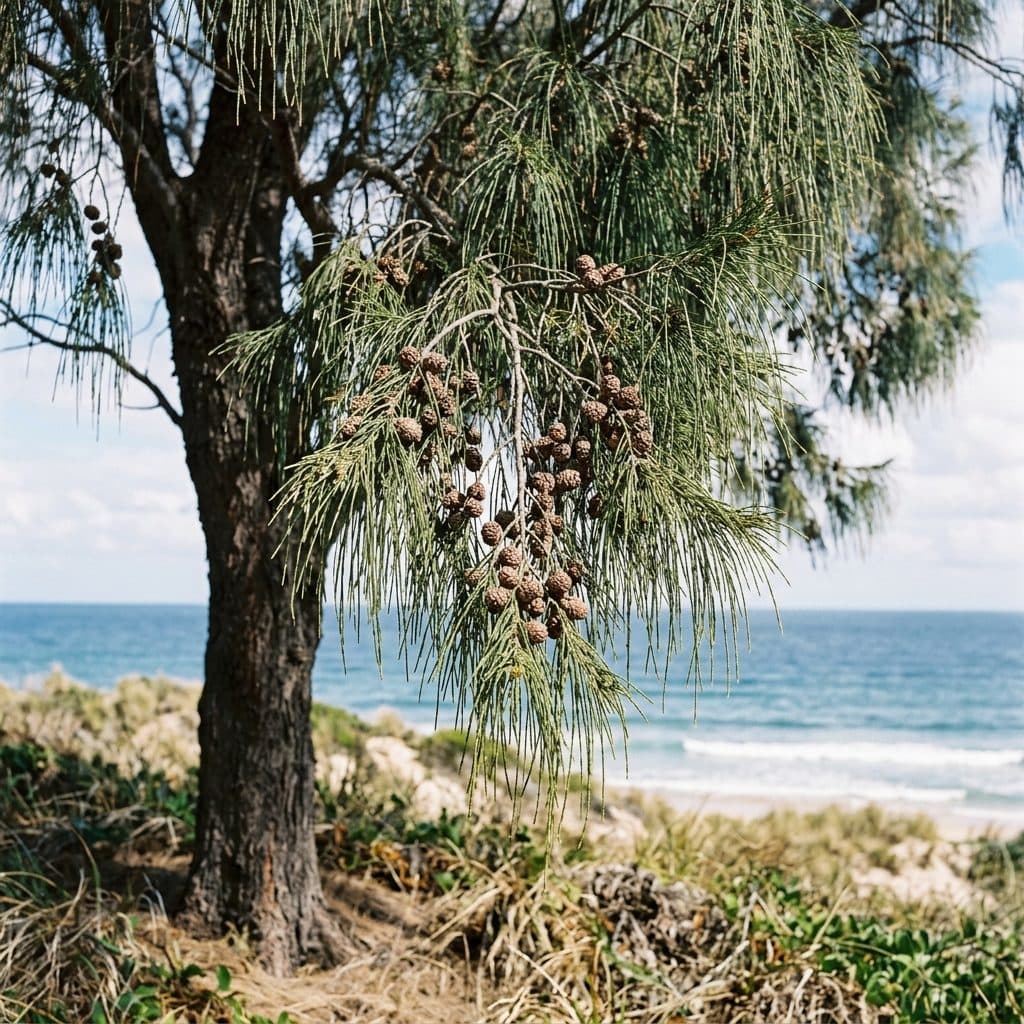
- Habit: A tall, slender evergreen tree reaching 15 to 30 m (50 to 100 ft) in height, with an open, weeping crown. The bark is dark greyish-brown to reddish-brown, rough, furrowed, and peels in long, narrow, vertical flakes.
- Branchlets (cladodes): The apparent needles are actually slender, jointed, drooping green photosynthetic branchlets measuring 15 to 30 cm (6 to 12 in) long and roughly 1 mm in diameter. The branchlets are cylindrical with fine grooves and break apart easily at joints.
- Leaves: True leaves are reduced to tiny, tooth-like triangular scales arranged in a tight whorl of 6 to 8 teeth at each joint along the branchlet.
- Inflorescences: Usually monoecious. Male flowers form slender cylindrical spikes 1 to 4 cm (0.4 to 1.6 in) long at the tips of green branchlets, shedding wind-borne pollen. Female flowers form small, reddish, rounded heads on short lateral stalks.
- Fruit: Woody, cylindrical to subglobose, cone-like infrutescences measuring 1 to 2.5 cm (0.4 to 1.0 in) long. The surface is composed of pointed bracteoles that open at maturity to release hundreds of tiny winged seeds measuring 5 to 7 mm long.
The tree is readily distinguished from true pines (Pinus species), which have true needle leaves in bundles and large woody cones, and from river she-oak (Casuarina cunninghamiana), which features 8 to 10 teeth per leaf whorl and grows along freshwater river courses.
Cautions
Outside its native Australian range, Casuarina equisetifolia poses severe ecological hazards:
- SEVERE INVASIVE WEED THREAT: Casuarina equisetifolia is one of the most destructive invasive alien plants across subtropical coastlines. In Florida, it is officially designated as a prohibited Category 1 invasive exotic pest plant, where planting, transporting, or cultivating it is illegal under state law. It is similarly invasive throughout the Bahamas, Hawaii, the Caribbean, and coastal areas of the Gulf of Mexico.
- Allelopathy and sterile monocultures: Fallen branchlets form a thick, acidic carpet that decomposes slowly. These needles leach allelopathic compounds that completely prevent the seed germination of native dune plants like sea oats (Uniola paniculata). In a few years, diverse beach communities are transformed into sterile monocultures.
- Destruction of sea turtle and crocodile nesting habitats: Dense casuarina thickets on foredunes disrupt nesting behaviours of endangered loggerhead and green sea turtles, as well as the American crocodile. The canopy shades the beach, lowering sand temperatures and skewing turtle hatchling sex ratios, while dense underground root mats physically prevent female turtles from excavating nests.
- Storm hazard and beach erosion: Despite being promoted for windbreaks, casuarina trees possess a shallow root system in loose sand. During storm surges and gale winds, mature trees topple en masse, tearing away sections of sand dune and accelerating beach erosion. Fallen trees block coastal evacuation routes and damage buildings.
- Allergic rhinitis: During spring flowering, trees release clouds of airborne pollen that trigger severe allergic rhinitis and asthma in coastal residents.
- Regulatory note: Prohibited in multiple jurisdictions; verify state and local invasive species regulations before planting.
Sources
- Royal Botanic Gardens, Kew. Casuarina equisetifolia L. Plants of the World Online.
- Plants For A Future. Casuarina equisetifolia - L.
- USDA PLANTS Database. Casuarina equisetifolia L.
- University of Florida IFAS Extension. Australian Pine, Casuarina equisetifolia
- World Agroforestry (ICRAF). Casuarina equisetifolia L. Agroforestree Database.