pioneer
Empress tree
Paulownia tomentosa
International hardiness
- USDA 5-9
- RHS H5
- AU: Warm temperate, Subtropical, Cool temperate
Where it grows — regional guide
| Zones / rating | Regional notes |
|---|---|
USDA 5-9 | Regulated or prohibited invasive weed across the Mid-Atlantic and Southeast (Zones 5 to 9); produces millions of wind-blown seeds that colonise native forests. |
| Zones / rating | Regional notes |
|---|---|
H5 (-15 to -10C) | Grown across Britain rated RHS H5; often coppiced annually to produce dramatic 60 cm (24 in) architectural foliage for ornamental and mulching borders. |
| Zones / rating | Regional notes |
|---|---|
Warm temperate, Subtropical, Cool temperate | Cultivated in timber plantations in New South Wales and Victoria; requires strict containment to prevent invasive wind-dispersed seed spread into native bushland. |
| Zones / rating | Regional notes |
|---|---|
USDA 5-9 (USDA scale) Canada uses its own zone system; Canadian zones run roughly one lower than USDA. | No region-specific data yet |
| Zones / rating | Regional notes |
|---|---|
No region-specific data yet | No region-specific data yet |
Empress tree (Paulownia tomentosa), also commonly known as princess tree, foxglove tree, royal paulownia, or kiri tree, is an exceptionally fast-growing, large deciduous hardwood tree belonging to the empress-tree family (Paulowniaceae). Indigenous to central and western China, the tree has been cultivated across East Asia for thousands of years. Historically in ancient China and Japan, an empress tree was planted upon the birth of a daughter; by the time of her marriage, the fast-growing tree was felled and crafted into her dowry furniture, wooden chests (tansu), and musical instruments like the koto. In modern permaculture and agroforestry, Paulownia tomentosa is widely recognised as the fastest-growing temperate hardwood on Earth, producing lightweight, rot-resistant blonde timber alongside immense volumes of carbon-rich, velvety leaf mulch.
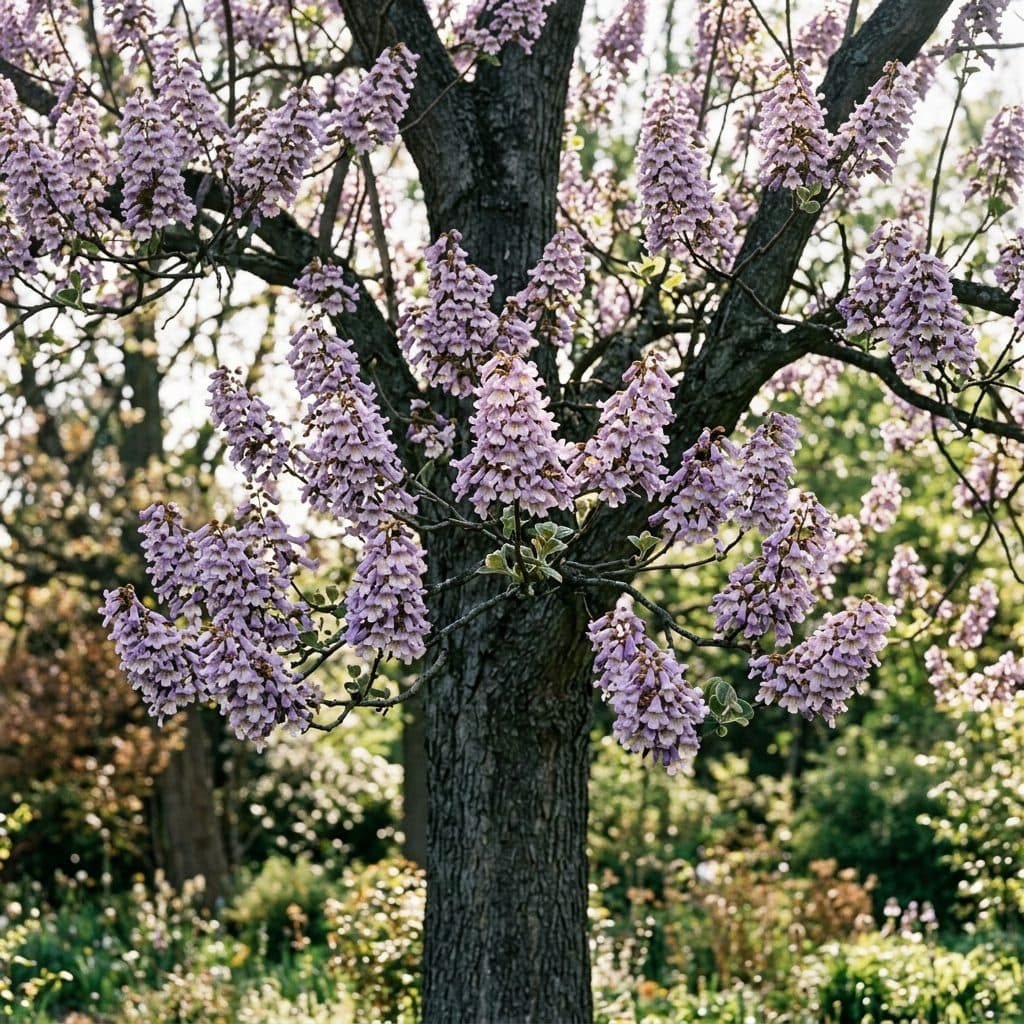
Within agroforestry systems and syntropic food forestry, empress tree is an aggressive, fast-cycling pioneer tree. Its massive, plate-like leaves act as solar collectors that generate staggering amounts of biomass, which homesteader systems pollard or coppice regularly to mulch heavy-feeding companion trees such as walnut, white mulberry, and native oaks like green oak. In mid-spring, before leaves emerge, the tree is smothered in magnificent upright pyramids of fragrant, pale violet-blue foxglove-like flowers that supply an intense nectar flow to honeybees. However, its explosive reproductive capacity and fierce ecological invasiveness demand extreme vigilance and management.
Growing empress tree
Paulownia tomentosa exhibits remarkable environmental adaptability, growing vigorously across USDA Hardiness Zones 5 through 9 and holding an RHS hardiness rating of H5. Dormant mature trunks easily withstand winter drops down to -20 °C (-4 °F) without structural damage. However, because floral buds form in late summer and overwinter exposed on terminal twigs, unseasonable midwinter drops below -15 °C (5 °F) or late spring freezes can destroy dormant flower buds without injuring the tree itself. The species thrives under intense summer heat, performing best in full sun exposure receiving at least eight hours of direct sunlight daily; shading stunts growth and causes severe lower limb dieback.
Soil adaptability is virtually unmatched among temperate timber trees. Empress tree thrives in an astonishing range of substrates, including degraded subsoils, sterile gravel bars, dry sandy banks, quarry reclamation sites, and heavy clays, spanning a wide pH spectrum from 5.0 to 8.0. The sole non-negotiable requirement is adequate drainage: trees cannot tolerate stagnant, anaerobic waterlogged soils, which quickly induce root asphyxiation and collar rot. Established trees possess deep, sturdy taproots that extract water from deep aquifers, conferring exceptional drought tolerance once rooted. Because of its intense nitrogen uptake and metabolic rate, young trees respond dramatically to generous organic compost applications, capable of growing 3 to 5 m (10 to 16 ft) in height within a single growing season.
Propagation is remarkably simple, carried out via seed, root cuttings, or dormant hardwood cuttings. The minute, winged seeds germinate readily on moist, exposed mineral soil under bright light within 10 to 14 days without requiring cold stratification. For timber plantations and controlled homestead mulching beds, growers almost exclusively propagate selected clones using root cuttings measuring 10 to 15 cm (4 to 6 in) long and 2 cm (0.8 in) thick planted vertically in spring. Space trees 4 to 5 m (13 to 16 ft) apart for timber production, or 2 to 3 m (6.6 to 10 ft) apart for high-density coppice mulch banks. For annual mulch production, the entire tree can be stooled (coppiced) flush to the ground every winter, triggering the emergence of single, giant vegetative shoots with massive leaves measuring up to 60 cm (24 in) across. Commercial timber trees reach sawlog maturity within 10 to 15 years.
Harvest and uses
Empress tree offers two principal homestead harvests: premium lightweight hardwood and prolific organic leaf mulch.
The timber of Paulownia tomentosa—often referred to as "the aluminium of timber"—is uniquely valuable:
- Lightweight hardwood: The wood has an exceptionally low density (air-dry density of approximately 260 to 300 kg per cubic metre [16 to 19 lb per cubic foot]), being nearly as light as balsa yet retaining the structural strength and dimensional stability of a true hardwood.
- Workability and stability: The pale, blonde wood features an attractive silky grain, resists warping and cracking, holds nails securely, and has a remarkably high ignition temperature (roughly 420 °C [788 °F]), making it naturally fire-resistant. It is prized globally for surfboards, musical soundboards, lightweight veneers, beehives, wooden carvings, and insulating crates.
In permaculture systems, the foliage is harvested as a high-volume organic mulch. The enormous leaves are rich in nitrogen, potassium, and trace minerals, resembling legume foliage in nutrient content. When coppiced or pollarded in mid-summer, the leaves decompose rapidly on garden beds, feeding soil worms and building rich topsoil humus. A mature timber tree yields 0.5 to 1.5 cubic metres (18 to 53 cubic feet) of high-grade timber at felling, while coppice stools yield 15 to 25 kg (33 to 55 lb) of dry-weight mulch biomass per stool annually.
Identifying empress tree
Paulownia tomentosa can be reliably identified across all seasons by several distinctive botanical features:
- Habit and trunk: A large, fast-growing deciduous tree reaching 12 to 20 m (40 to 65 ft) in height with an expansive, broad, rounded crown. The bark is pale greyish-brown with smooth, shallow vertical furrows and orange inner fissures. Young branches are stout, olive-brown, covered in prominent white lenticels, and possess a characteristic hollow or chambered white pith.
- Leaves: Opposite (or occasionally whorled in threes), simple, giant cordate (heart-shaped) leaves measuring 15 to 35 cm (6 to 14 in) long and wide on mature trees, reaching up to 60 cm (24 in) on juvenile or coppiced shoots. Margins are entire or shallowly three-lobed. The upper surface is dark matte green and lightly hairy, while the lower surface is densely blanketed with soft, velvety, pale brownish hairs (tomentose). Petioles are long, hollow, and sticky-pubescent.
- Flowers: Borne in dramatic, upright, pyramidal terminal panicles measuring 20 to 30 cm (8 to 12 in) long before leaf emergence in spring. The showy, foxglove-like tubular blossoms measure 5 to 7 cm (2 to 2.8 in) long, displaying a soft pale violet or lilac exterior with yellow throat striping, emitting a rich, vanilla-like perfume.
- Fruit: Ovoid, woody, pointed capsules measuring 3 to 4 cm (1.2 to 1.6 in) long, persisting on bare winter branches, splitting into two valves to release thousands of tiny, paper-winged seeds.
Empress tree is easily distinguished from southern catalpa (Catalpa bignonioides), which has whorled leaves with an unpleasant odour when crushed, white summer flowers with purple spots, and long, pencil-like cylindrical seed pods.
Cautions
Cultivating Paulownia tomentosa carries severe ecological, infrastructural, and agronomic hazards that require strict scrutiny:
- High-priority ecological invasiveness: Paulownia tomentosa is a severe, officially classified noxious weed and invasive exotic species across much of the eastern and mid-Atlantic United States (banned or restricted in multiple states including Connecticut, and aggressively regulated in Virginia, Tennessee, and North Carolina). A single mature tree produces up to 20 million microscopic, winged seeds annually, which drift miles on wind currents and colonise disturbed forests, rocky river cliffs, roadsides, and waterways, where they displace native forest communities. Check local invasive species regulations before planting; introduction is prohibited or strongly discouraged in many jurisdictions.
- Explosive coppice and stump resilience: Felling or burning mature trees stimulates violent stump sprouting and root suckering, with shoots growing up to 5 m (16 ft) in a single season. Eradicating established trees mechanically is nearly impossible without persistent, multi-year root removal. To prevent invasive seeding, homesteaders who cultivate the tree for mulch must coppice it annually to prevent the tree from ever producing flower buds or seed capsules.
- Brittle wood and storm hazard: Phenomenally rapid growth produces soft wood with hollow pith and low shear strength. Branches and scaffold limbs are brittle, snapping easily under heavy snow, ice loads, or gale-force winds. Never plant empress trees within falling distance of houses, utility wires, driveways, or livestock barns.
- Invasive root competition: The extensive, aggressive surface root network vigorously saps moisture from nearby gardens, cracks concrete pathways, and infiltrates sewage pipes.
Sources
- Royal Botanic Gardens, Kew. Paulownia tomentosa (Thunb.) Steud. Plants of the World Online.
- USDA PLANTS Database. Paulownia tomentosa (Thunb.) Steud.
- Plants For A Future. Paulownia tomentosa - (Thunb.)Steud.
- North Carolina State Extension Gardener Plant Toolbox. Paulownia tomentosa
- Missouri Botanical Garden. Paulownia tomentosa