pioneer
Tithonia Mexican sunflower
Tithonia diversifolia
International hardiness
- USDA 9-11
- RHS H1c
- AU: Tropical, Subtropical
Where it grows — regional guide
| Zones / rating | Regional notes |
|---|---|
USDA 9-11 | Perennial in USDA Zones 9 to 11 (Florida, Gulf Coast, Hawaii); prohibited or treated as an invasive exotic pest plant in South Florida. |
| Zones / rating | Regional notes |
|---|---|
H1c (5 to 10C) | No region-specific data yet |
| Zones / rating | Regional notes |
|---|---|
Tropical, Subtropical | Declared noxious weed across Queensland and New South Wales; planting is strictly discouraged or prohibited due to invasive smothering of bushland. |
| Zones / rating | Regional notes |
|---|---|
USDA 9-11 (USDA scale) Canada uses its own zone system; Canadian zones run roughly one lower than USDA. | No region-specific data yet |
| Zones / rating | Regional notes |
|---|---|
No region-specific data yet | No region-specific data yet |
Tithonia Mexican sunflower (Tithonia diversifolia), also known across the tropics as tree marigold or shrub sunflower, is a vigorous, semi-woody perennial shrub belonging to the sunflower family (Asteraceae). Native to Mexico and Central America, the species has naturalised extensively across the humid and sub-humid tropics of Africa, Asia, Australia, and the Pacific. The plant is known for its enormous golden-yellow daisy blossoms, rapid vegetative growth, and its ability to extract tightly bound minerals from impoverished soils, and it is widely used in regenerative agriculture as a biomass accumulator.
Botanically and agronomically, Tithonia diversifolia is distinct from the common annual sunflower (Helianthus annuus). Rather than producing a single massive seed head, it forms a dense, multi-stemmed woody clump reaching 2 to 4 m (6.5 to 13 ft) in height within a single growing season. The plant's deep fibrous root network secretes organic acids and enzymes that solubilise mineral phosphorus and potassium from stubborn clay particles. Its lush foliage stores these essential nutrients in readily available organic forms, making it an exceptional green manure for heavy-feeding vegetables like okra. However, because the plant produces thousands of wind-borne seeds and roots effortlessly from stem fragments, growers must manage it under strict containment to prevent it from invading natural ecosystems.
Growing Tithonia Mexican sunflower
Tithonia diversifolia is adapted to warm, frost-free tropical and subtropical climates, growing as a perennial shrub in USDA Zones 9 to 11 and rated RHS H1c. In colder temperate climates (USDA Zones 5 to 8), it can be cultivated as a fast-growing summer annual: while winter frost kills above-ground stems, seeds or spring cuttings grow rapidly, flowering and yielding biomass before autumn frost. The species thrives under mean annual temperatures between 18 and 30 °C (64 and 86 °F) and annual rainfall between 1,000 and 3,000 mm (40 to 120 in), though its deep root system grants it endurance through dry seasons lasting three to five months.
Soil adaptability is one of the shrub's defining traits. It establishes aggressively on degraded, nutrient-depleted, acidic oxisols, skeletal gravels, and abandoned field margins where many crops fail. Full sun is essential: the shrub demands direct solar radiation to achieve maximum photosynthetic velocity and branch proliferation. In partial shade, plants become spindly, produce weak stems with wide internodes, and yield substantially less foliar biomass.
Propagation is remarkably easy, carried out almost entirely by vegetative stem cuttings. While seeds germinate readily, cuttings establish far more rapidly. Select mature semi-woody stems roughly 2 to 3 cm (0.8 to 1.2 in) in diameter. Sever them into cuttings 20 to 30 cm (8 to 12 in) long, each bearing four to six nodes. Insert the cuttings directly into moist soil at a 45-degree angle, burying two-thirds of the cutting with at least two nodes below ground. Cuttings root within five to seven days and produce leafy shoots within two weeks.
To cultivate tithonia as a dedicated green manure bank or contour hedgerow, space cuttings 30 to 50 cm (12 to 20 in) apart within the row. Once plants reach 1.5 to 2 m (5 to 6.5 ft) in height, cut them back to 30 to 50 cm (12 to 20 in) above ground to encourage dense multi-stemmed regrowth. In established stands, coppicing can be repeated every six to eight weeks during the rainy season, yielding three to five heavy flushes of biomass each year.
Harvest and uses
The foremost agricultural utility of Tithonia diversifolia is its role as a high-potency organic green manure and chop-and-drop mulch. Agronomic research across sub-Saharan Africa and tropical Asia confirms that the tender green leaves and succulent young shoots contain exceptionally high nutrient concentrations on a dry-matter basis: 3.5 to 4.0% nitrogen, 0.35 to 0.45% phosphorus, and 3.5 to 4.5% potassium. Unlike woody shrubs whose leaves decompose slowly, fresh tithonia biomass breaks down rapidly in warm, moist soil. When incorporated into planting beds or applied as a top-dress mulch around demanding annuals, it releases a balanced surge of plant-available nutrients within two to three weeks, raising crop yields without synthetic fertilisers.
Homesteaders also brew liquid fertiliser tea by steeping chopped tithonia leaves in water. Pack a container two-thirds full with crushed leaves, top with clean water, cover loosely, and allow the mixture to ferment for seven to fourteen days, stirring occasionally. Strain the pungent liquid and dilute it one part tea to three parts water. Applied as a root drench, this tea delivers an immediate potassium and phosphorus boost to flowering and fruiting crops.
In traditional medicine, bitter decoctions of tithonia leaves have been utilised in ethnomedicine across Africa and Asia for fevers and skin inflammations. Phytochemical studies have isolated sesquiterpene lactones that exhibit antimicrobial and anti-inflammatory activity.
In cut-and-carry livestock farming, fresh tithonia foliage is supplementary protein forage for goats and cattle, containing 18 to 22% crude protein. Because the leaves contain bitter compounds, animals require a gradual adaptation period before consuming it readily.
Identifying Tithonia Mexican sunflower
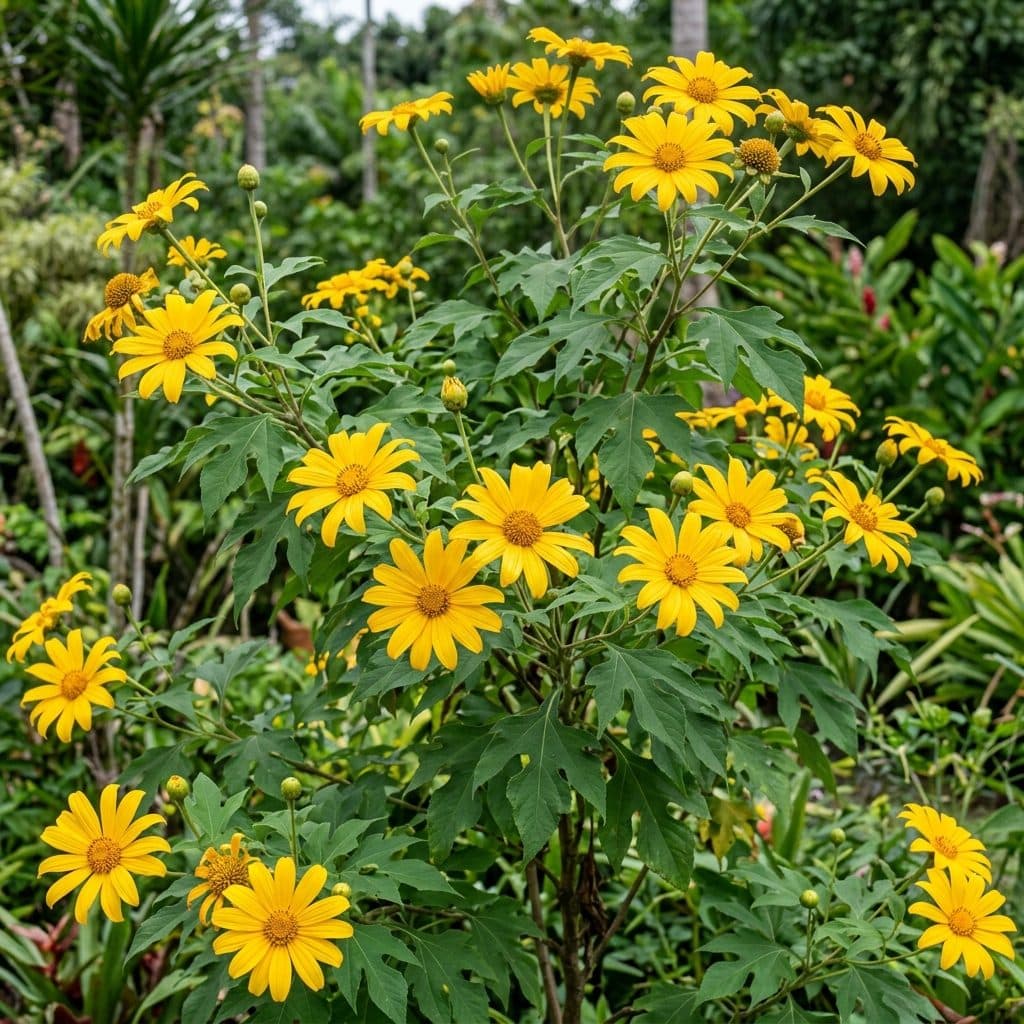
Tithonia diversifolia is identified by the following distinctive botanical features:
- Habit: A vigorous, multi-stemmed perennial shrub reaching 2 to 4 m (6.5 to 13 ft) in height, forming dense woody clumps up to 3 m (10 ft) across.
- Stems: Main stems are woody at the base, while upper branchlets are hollow, quadrangular or ridged, and covered in soft, pale hairs.
- Leaves: Alternate, simple, large leaves measuring 10 to 30 cm (4 to 12 in) long and 5 to 20 cm (2 to 8 in) broad, supported by winged petioles. The leaves are characteristically deeply 3- to 5-lobed with coarsely serrate margins. The upper leaf surface is dark green, while the lower surface is covered in soft glandular hairs that impart a pungent aroma when crushed.
- Inflorescences: Solitary or clustered in terminal corymbs on long, swollen peduncles 10 to 30 cm (4 to 12 in) long. The flower heads are large and daisy-like, measuring 8 to 15 cm (3 to 6 in) across.
- Florets: Each flower head features 10 to 14 large, brilliant golden-yellow ray florets measuring 4 to 7 cm (1.5 to 2.8 in) long, surrounding a dense central disc of fertile yellow-orange tubular disc florets.
- Fruit: Dark brown, quadrangular, ribbed achenes measuring 5 to 7 mm (0.2 to 0.3 in) long, tipped with a pappus of stiff awns and small scales.
The plant is readily distinguished from common sunflower (Helianthus annuus), which is an annual herb with large, cordate, unlobed leaves and massive solitary heads up to 30 cm (12 in) across, and from Tithonia rotundifolia, which has smaller, bright orange-red flowers and ovate, unlobed leaves.
Cautions
Despite its remarkable soil-enriching virtues, Tithonia diversifolia poses severe ecological hazards that require strict containment:
- Severe invasive weed threat: Tithonia diversifolia is an aggressive environmental weed in the tropical and subtropical world. It is an officially declared noxious weed in Australia (prohibited or restricted in Queensland and New South Wales), listed as a Category 1 invasive alien weed in South Africa, and classified as an invasive exotic pest plant in Florida (FLEPPC Category 2). It readily escapes cultivation, invading roadsides, riparian banks, forest edges, and disturbed pastures, where it forms dense monocultures that completely suppress native vegetation.
- Dual mechanism of spread: A single mature shrub produces tens of thousands of lightweight, awned seeds that disperse over vast distances on wind, water, and animal coats. The plant also spreads vegetatively: discarded stem trimmings, broken branches, and pruning residues root with extreme ease wherever they contact moist soil.
- Allelopathic suppression: Root exudates and decomposing leaf residues contain potent allelopathic sesquiterpene lactones that leach into topsoil, inhibiting seed germination and seedling growth of neighbouring native plants.
- Containment protocols: Never plant Tithonia diversifolia near natural waterways, conservation areas, or bushland borders. If cultivated for chop-and-drop green manure on an enclosed homestead, harvest shrubs before flower buds open to prevent seed set. Never dispose of pruning trimmings in waterways; dry them completely in the sun or chop them directly into compost piles.
- Regulatory note: Regulated in multiple jurisdictions as a prohibited weed; check local biosecurity registers before acquiring or planting.
Sources
- Royal Botanic Gardens, Kew. Tithonia diversifolia (Hemsl.) A.Gray Plants of the World Online.
- Plants For A Future. Tithonia diversifolia - (Hemsl.) A.Gray
- CABI Digital Library. Tithonia diversifolia (Mexican sunflower) CABI Compendium.
- University of Florida IFAS Assessment. Tithonia diversifolia