Key takeaways
- Straw mulch significantly reduces soil temperature and evaporation, saving up to 35% irrigation water in dry climates.
- Wood chips offer long-lasting moisture retention and weed suppression, decomposing slowly over 2-5 years.
- Shredded leaves provide excellent nutrient return and soil improvement, breaking down within 6-12 months.
- Pine straw is effective for acid-loving plants, maintaining soil moisture and offering a unique aesthetic.
- A 2-4 inch layer of mulch is generally recommended for optimal moisture conservation and weed control.
- Regular monitoring with a soil moisture meter helps optimize irrigation schedules under mulch.
Quick answer: Mulch significantly reduces soil temperature, conserves up to 35% irrigation water by preventing evaporation, and suppresses weeds, making it a critical strategy for drought-resilient gardening in arid US regions.
In places like the high desert of Arizona, where summer temperatures regularly exceed 100°F and annual rainfall might be less than 10 inches, conserving every drop of water is critical for garden success. Mulching is one of the most effective strategies for battling drought and heat, directly impacting soil moisture and plant health. By covering the soil surface, mulch reduces evaporation, moderates soil temperatures, and suppresses weeds that compete for water.
Choosing the right mulch material can make a significant difference in how much water your garden retains, how quickly it warms up in spring, and how well it withstands the stresses of a changing climate. This article compares four common mulch types (straw, wood chips, leaves, and pine straw) to help you select the best option for your specific growing conditions and goals.
Straw: an affordable, effective moisture shield
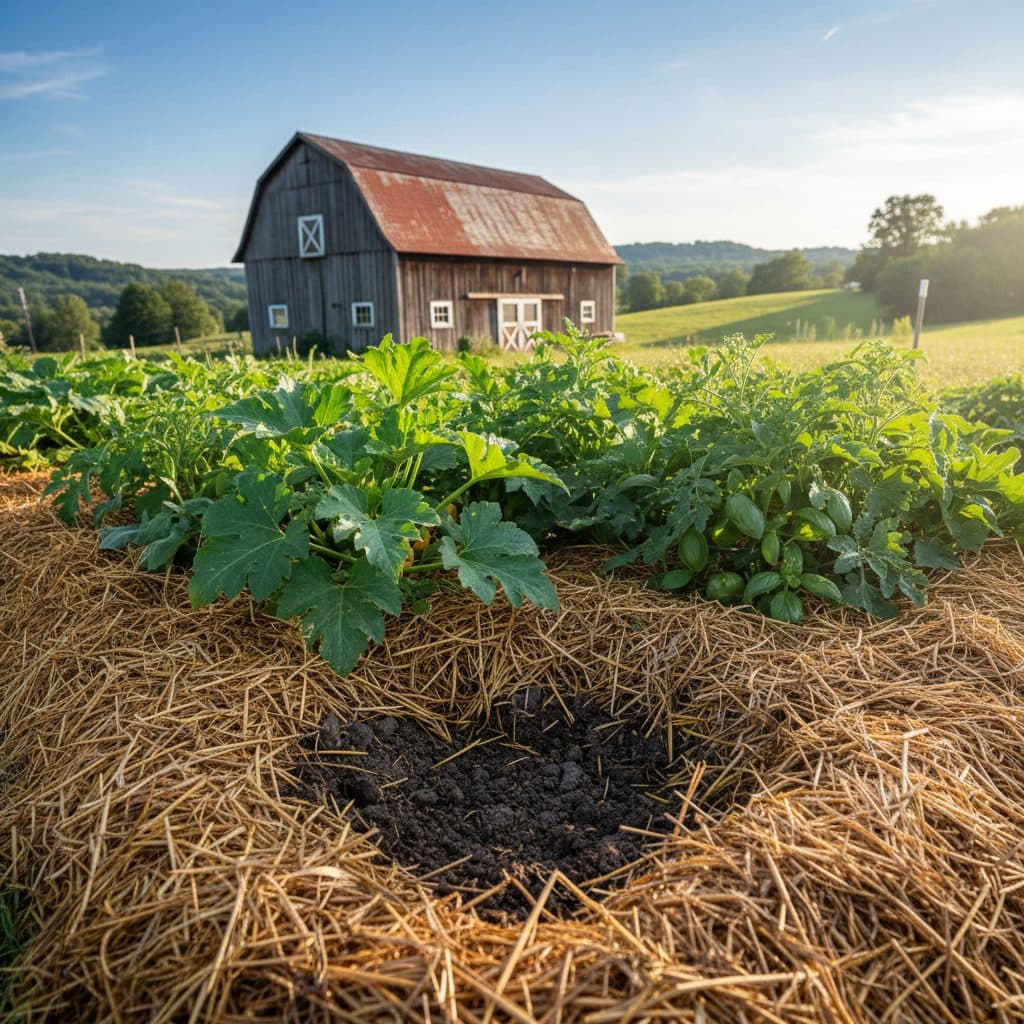
Straw, particularly wheat or oat straw, is an excellent choice for moisture retention, especially in vegetable gardens and annual beds across USDA zones 4-9. Its light color reflects sunlight, which helps to keep soil temperatures cooler. Research from 2011 showed that straw mulch can reduce air temperature near the ground by as much as 10°F during hot periods [1]. This cooling effect directly translates to less water evaporation from the soil surface. Furthermore, straw’s loose structure allows for good air exchange while still blocking sunlight from reaching the soil.
straw’s water-saving power and soil benefits
Studies in arid regions, like those in China, have demonstrated that straw mulch can increase soil moisture content by 15-35% and reduce irrigation water consumption by 20-35% compared to unmulched plots [4]. This substantial water saving is a major benefit for growers in drought-prone areas such as California’s Central Valley or the Texas Panhandle. Beyond water retention, straw slowly breaks down, adding organic matter to the soil and improving its structure over time. A typical application uses a 3-6 inch layer, which compacts down to 2-3 inches over a few weeks. The carbon-to-nitrogen ratio of wheat straw is approximately 30:1, meaning it decomposes at a moderate rate and doesn’t heavily deplete soil nitrogen [3].
- Reduces evaporation: Keeps soil moist for longer periods.
- Moderates soil temperature: Protects roots from extreme heat and cold.
- Suppresses weeds: Blocks light, preventing weed seed germination.
- Adds organic matter: Improves soil structure as it decomposes.
- Affordable and readily available: Often found at local farm supply stores for about $5-10 per bale.
Wood chips: long-lasting moisture and weed control
These straw points carry into this section, too.
Wood chips are a popular, durable mulch choice for perennial beds, trees, and shrubs across all USDA zones. Their chunky nature creates air pockets that insulate the soil, keeping it cooler in summer and warmer in winter. This insulation reduces temperature fluctuations, which can stress plant roots. While they don’t reflect as much light as straw, their density provides excellent moisture retention. A 3-4 inch layer of wood chips can significantly reduce water loss from the soil surface, making them ideal for xeriscaping in arid regions like the American Southwest.
applying wood chips for maximum effect
When applying wood chips, aim for a depth of 2-4 inches, keeping them a few inches away from plant stems and tree trunks to prevent moisture buildup and potential rot. Wood chips decompose slowly, often lasting 2-5 years, which means less frequent reapplication compared to straw or leaves. This longevity makes them a cost-effective option over time, despite a higher initial cost per cubic yard (often $20-50 for bulk delivery). While some gardeners worry about nitrogen depletion, this is generally only an issue if chips are tilled into the soil; surface application causes minimal nitrogen tie-up. For monitoring soil moisture under a thick layer of wood chips, a soil moisture meter can be very helpful, indicating when to water deeply and less frequently.
- Excellent longevity: Lasts 2-5 years, reducing reapplication frequency.
- Superior weed suppression: Blocks light effectively, preventing most weeds.
- Good insulation: Protects roots from temperature extremes.
- Aesthetic appeal: Provides a clean, finished look to garden beds.
- Slow decomposition: Gradually adds organic matter to the soil.
Leaves: nutrient-rich moisture and soil builder
That work on wood chips sets up what follows here.
Shredded leaves are a free, readily available mulch option for many US gardeners, especially in regions with deciduous trees like the Northeast or Pacific Northwest. They excel at improving soil health while retaining moisture. When applied as a 2-3 inch layer, shredded leaves form a dense mat that effectively suppresses weeds and reduces evaporation. As they break down, leaves return valuable nutrients to the soil, mimicking the natural processes of a forest floor. This makes them particularly beneficial for enriching depleted soils in new garden beds or for boosting established perennial plantings.
maximizing leaf mulch benefits
To prevent matting and ensure good air circulation, it’s best to shred leaves before applying them. A leaf shredder or even a lawnmower with a bagging attachment can accomplish this quickly. Whole leaves can sometimes form an impenetrable layer that sheds water rather than allowing it to penetrate, especially in areas with heavy rainfall. Shredded leaves decompose within 6-12 months, contributing significantly to the soil’s organic matter content. This decomposition enriches the soil with micronutrients and improves its water-holding capacity, which matters for gardens in sandy soils found in parts of Florida or the Mid-Atlantic. For gardeners looking to build soil over time, incorporating leaves is a highly effective strategy, often costing nothing but labor. Consider combining leaves with living mulches or cover crops for year-round soil protection.
- Free and abundant: Easily collected in autumn in many regions.
- Rich in nutrients: Returns essential minerals to the soil.
- Improves soil structure: Increases organic matter and water retention.
- Excellent weed suppression: Forms a dense barrier when shredded.
- Composts in place: Breaks down relatively quickly, feeding the soil.
Pine straw: aesthetic and acidifying mulch
This builds directly on leaves.
Pine straw, or pine needles, is a popular mulch choice in the Southeastern US, particularly in USDA zones 7-10, where pine forests are abundant. It offers a distinct aesthetic and is particularly well-suited for acid-loving plants like azaleas, rhododendrons, and blueberries. Pine straw forms a loose, interlocking mat that allows water to penetrate easily while still suppressing weeds and reducing evaporation. Its light weight makes it easy to spread, and it doesn’t compact as much as some other mulches, maintaining good air circulation around plant bases. A 3-4 inch layer is effective for moisture retention.
pine straw’s pH impact and benefits
While often touted for its acidifying properties, pine straw’s impact on soil pH is generally mild and gradual, lowering pH by perhaps 0.5 to 1.0 points over several months or years. This makes it a gentle option for maintaining slightly acidic conditions rather than drastically altering them. Pine straw typically lasts 1-2 years before needing replenishment, offering moderate longevity. It’s often sold in bales, with a single bale covering about 50 square feet at a 3-inch depth, usually costing $5-10 per bale. For gardeners in the Pacific Northwest or the Southeast, where acidic soils are common, pine straw is an excellent choice for maintaining optimal conditions for specific plant varieties. Using a 3-in-1 soil pH, moisture, and fertility meter can help monitor soil conditions when using pine straw.
- Aesthetically pleasing: Provides a natural, tidy look.
- Mildly acidifying: Beneficial for acid-loving plants.
- Good water penetration: Allows rainfall to reach the soil easily.
- Resists compaction: Maintains good soil aeration.
- Moderate longevity: Lasts 1-2 years before needing refreshing.
General mulching strategies for drought resilience
Those pine straw habits matter here as well.
Regardless of the mulch material you choose, proper application matters most for maximizing its benefits, especially in regions facing increasing heat and drought. A consistent mulch layer of 2-4 inches is generally recommended for most garden beds. This depth is sufficient to suppress weeds, insulate the soil, and significantly reduce evaporation without suffocating plant roots. In USDA zone 9 and hotter climates, a slightly thicker layer, up to 6 inches, might be beneficial around mature trees and shrubs to further moderate extreme soil temperatures. Always ensure mulch is pulled back a few inches from the base of plants and tree trunks to prevent moisture-related issues like rot or pest harborage.
monitoring and maintaining your mulch layer
Regularly check the soil moisture beneath your mulch layer, especially during dry spells. You can do this by hand or with a soil moisture meter. Even with mulch, plants will need water, but likely less frequently and more deeply. In Jega, Nigeria, research showed that mulching combined with ridge-tie techniques significantly improved soil moisture retention and maize growth [5]. This principle applies broadly to US gardens facing similar climatic challenges. Over time, organic mulches will decompose and need replenishment. Aim to top up your mulch layer annually or biennially to maintain the desired depth and continue reaping its benefits for soil health and water conservation. This practice is a cornerstone of climate-resilient gardening, helping your plants thrive through challenging conditions.
- Maintain depth: Keep a consistent 2-4 inch layer for optimal benefits.
- Avoid plant bases: Pull mulch back 2-3 inches from stems and trunks.
- Monitor moisture: Check soil moisture regularly, especially during dry periods.
- Replenish as needed: Top up organic mulches annually or biennially.
- Combine strategies: Consider pairing with living mulches or cover crops for enhanced resilience.
Comparison of Mulch Materials for Moisture Retention
Feature | Straw | Wood Chips | Shredded Leaves | Pine Straw |
|---|---|---|---|---|
Moisture Retention | Excellent (15-35% increase) | Very Good | Excellent | Good |
Longevity | 6-12 months | 2-5 years | 6-12 months | 1-2 years |
Weed Suppression | Very Good | Excellent | Very Good | Good |
Nutrient Contribution | Moderate | Low (slow release) | High | Low |
Soil Temperature Control | Excellent (cooling) | Very Good (insulation) | Good | Good |
Cost (per bale/cu yd) | $5-10/bale | $20-50/cu yd | Free (DIY) | $5-10/bale |
Best Use | Vegetables, annuals | Perennials, trees, shrubs | Any garden bed, soil building | Acid-loving plants, aesthetics |
Water Savings: Straw mulch can increase soil moisture by 15-35% and reduce irrigation needs by 20-35% in dry regions [4].
Temperature Control: Straw mulch can lower ground-level air temperature by up to 10°F during hot periods, protecting plant roots [1].
Mulch Depth: A 2-4 inch layer of mulch is generally recommended for effective moisture retention and weed control in most garden beds.
Frequently asked questions
How deep should I apply mulch for moisture retention?
For most garden beds, a consistent layer of 2-4 inches of mulch is ideal for effective moisture retention and weed suppression. For larger trees and shrubs, especially in hot climates, a 3-6 inch layer can provide even better insulation and water conservation.
Does mulch really save water?
Yes, absolutely. Mulch significantly reduces water evaporation from the soil surface, with studies showing savings of 20-35% in irrigation water when using materials like straw [4]. It also moderates soil temperature, further reducing water loss.
Will wood chips deplete nitrogen from my soil?
When wood chips are applied as a surface mulch, they generally do not cause significant nitrogen depletion in the soil. Nitrogen tie-up primarily occurs if fresh wood chips are mixed into the soil, where microorganisms consume nitrogen to break down the carbon-rich material. A 3-4 inch surface layer is safe.
How often do I need to reapply mulch?
The frequency of reapplication depends on the type of mulch. Organic mulches like straw and shredded leaves typically need to be topped up annually, as they decompose within 6-12 months. Wood chips last longer, usually 2-5 years, while pine straw needs refreshing every 1-2 years.
Can I use pine needles if I don’t have acid-loving plants?
Yes, you can. While pine needles are often used around acid-loving plants because of their mild acidifying effect, this impact is usually gradual and minimal (often less than 1.0 pH point change over time). They still provide good moisture retention and weed suppression for a wide range of plants in many USDA zones.
References
- Effect of Air Temperature and Humidity near the Ground under Moisture Conserving Irrigation of Straw Mulch (2011). Effect of Air Temperature and Humidity near the Ground under Moisture Conserving Irrigation of Straw Mulch.
- Mulch, straw, baskets and sod (pathway vector) (2017). Mulch, straw, baskets and sod (pathway vector).
- Table 1: Properties of wheat straw mulch. (2023). Table 1: Properties of wheat straw mulch..
- Effects of straw mulch and buried straw on soil moisture and salinity in relation to sunflower growth and yield (2014). Effects of straw mulch and buried straw on soil moisture and salinity in relation to sunflower growth and yield.
- Influence of Mulch and Ridge-tie on Soil Moisture retention and early growth of maize at Jega, Kebbi State, Nigeria (2017). Influence of Mulch and Ridge-tie on Soil Moisture retention and early growth of maize at Jega, Kebbi State, Nigeria.
- USDA Natural Resources Conservation Service (2024). USDA Natural Resources Conservation Service.