Key takeaways
- Nitrogen-fixing plants enrich permaculture soils, reducing the need for synthetic fertilizers.
- Chop-and-drop is a technique where plant biomass is cut and left on the soil surface; green material from nitrogen fixers is low in carbon relative to nitrogen, so it breaks down fast and releases nutrients quickly.
- Legumes like clover, alfalfa, and specific trees such as black locust are effective nitrogen-fixers across USDA zones 3-9.
- Integrating nitrogen-fixers into plant guilds and food forest layers improves overall system resilience and productivity for decades.
- Regular chop-and-drop cycles, often 2-4 times per growing season, build soil organic matter steadily over years.
Quick answer: Nitrogen-fixing plants enrich permaculture soils by converting atmospheric nitrogen into a usable form, reducing the need for synthetic fertilizers. Techniques like chop-and-drop release this stored nitrogen and build soil organic matter, increasing system resilience and productivity.
In many parts of the United States, from the fertile valleys of California to the humid plains of the Midwest, soil fertility is a constant concern for growers. Conventional agriculture often relies on synthetic nitrogen fertilizers, which are expensive and carry environmental drawbacks. However, permaculture offers a different path, one that harnesses natural processes to build soil health over time. A core strategy involves nitrogen-fixing plants, which can significantly reduce or even eliminate the need for external nitrogen inputs.
Through a symbiotic relationship with soil bacteria, these plants convert atmospheric nitrogen into forms neighboring plants can absorb. In food forests and plant guilds across USDA zones 3 through 9, regular chop-and-drop distributes this nitrogen and builds soil organic matter over time, improving water retention and soil structure.
The science of nitrogen fixation and its permaculture value
Nitrogen is essential for plant growth and a component of chlorophyll and proteins, yet atmospheric nitrogen (N₂) is unavailable directly to most plants. Nitrogen-fixing plants, primarily legumes, form a symbiotic relationship with specific soil bacteria, often Rhizobium species, housed in nodules on their roots. These bacteria convert N₂ gas into ammonia (NH₃), a process called biological nitrogen fixation, which plants can then absorb. This natural process can contribute 50 to 200 pounds of nitrogen per acre annually to agricultural soils, a substantial input for any growing system.
How nitrogen-fixers feed your soil
In a permaculture system, especially a developing food forest, nitrogen-fixers act as living fertilizer factories. They continuously enrich the soil, making nutrients available to neighboring plants in a guild or across a larger planting. For instance, in a young orchard in USDA zone 6, planting clover or vetch as a groundcover can supply 30 to 60 pounds of nitrogen per acre in the first year, significantly boosting the growth of young fruit trees. This reduces reliance on external inputs meaningfully over a five-year period. The benefits extend beyond nitrogen, as these plants also improve soil structure and hold soil on moderate slopes.
- Increased soil fertility: Provides essential nitrogen for plant growth.
- Reduced fertilizer costs: Minimizes or eliminates the need for bought-in synthetic nitrogen.
- Improved soil structure: Root systems improve aeration and water infiltration.
- Soil biodiversity: Supports beneficial soil microbes and insects.
- Erosion control: Groundcovers stabilize soil on moderate slopes.
The chop-and-drop technique: building soil biomass
Chop-and-drop is a permaculture technique where you cut plant material (stems, leaves, small branches) and leave it on the soil surface as mulch. This practice mimics natural forest processes, where falling leaves and decaying wood constantly replenish the soil. For nitrogen-fixers, chop-and-drop releases nitrogen stored in plant biomass to neighboring roots and adds organic matter to the soil. A well-managed chop-and-drop system builds soil organic matter steadily, though gains are slow; measurable increases in garden soil typically take several years of consistent mulching to show up on a soil test.
Implementing chop-and-drop effectively
Timing matters when managing chop-and-drop. For annual nitrogen-fixers like vetch or clover, cutting them down just before they go to seed maximizes nitrogen transfer to the soil and prevents unwanted reseeding. For perennial shrubs and trees, pruning can occur 2-4 times during the growing season, especially when they show vigorous growth. Choose what you commit to that cycle with care: repeated cutting is what drives black locust to sucker and escape, and Siberian pea shrub self-seeds freely and is listed as invasive across the upper Midwest and northern prairie states. The goal is to create a thick layer of mulch, typically 4 to 6 inches deep, around your desired plants. This layer suppresses weeds, conserves soil moisture, and slowly releases nutrients, feeding the soil food web. Consider reading our guide on secondary years — pruning, chop-and-drop, the patient grove for more detailed strategies.
- Select mature plants: Choose plants that have accumulated substantial biomass and nitrogen.
- Cut at the base: Use sharp pruners or loppers to cut stems close to the ground, leaving enough to regrow.
- Distribute evenly: Spread the chopped material as a mulch layer, 4 to 6 inches thick, around target plants.
- Repeat as needed: Perform chop-and-drop 2-4 times per growing season for vigorous species.
- Observe soil health: Monitor soil organic matter and moisture levels, adjusting frequency as necessary.
Choosing the right nitrogen-fixers for your USDA zone
These chop-and-drop technique points carry into this section, too.
Selecting appropriate nitrogen-fixing plants is critical for success, as species vary widely in their hardiness, growth habits, and nitrogen contribution. For example, in colder climates like USDA zones 3-5, cold-hardy options include Siberian pea shrub (Caragana arborescens) and black locust (Robinia pseudoacacia) — both effective, both problem plants. Siberian pea shrub grows 10 to 15 feet tall and self-seeds freely enough to be listed as invasive across the upper Midwest and northern prairies; black locust is a fast-growing nitrogen fixer that suckers hard from the roots and is listed outside its native range. Check your state invasive plant list before either goes in the ground. In warmer regions, such as USDA zones 7-9, clovers such as crimson and white clover thrive; autumn olive (Elaeagnus umbellata) is the usual suggestion for that slot but is a bird-dispersed invasive that is prohibited or regulated in a number of states. To explore more options, consider our article on cold-hardy nitrogen fixers for zones 2-6.
Species for different permaculture roles
Nitrogen-fixers can fill various roles within a permaculture design. Groundcovers like white clover (Trifolium repens) are ideal for pathways and understory plantings, fixing 50 to 150 pounds of nitrogen per acre and crowding out weeds once the stand closes. Shrubs can provide mid-story nitrogen, edible berries, and wind protection at 6 to 10 feet tall. Both goumi (Elaeagnus multiflora) and autumn olive are bird-dispersed Elaeagnus, and autumn olive is prohibited or regulated in a number of states; goumi is listed less often but seeds into nearby woodland the same way. Check your state invasive plant list before planting either. Black locust can form a canopy-layer nitrogen fixer where it is legal and can be contained. Honey locust (Gleditsia triacanthos), often listed alongside it, is a legume but does not nodulate and fixes no nitrogen at all; plant it for light shade, pods and timber, not for fertility. When planning your system, aim for a diversity of species that mature at different rates and occupy various layers to ensure continuous nitrogen cycling and biomass production for decades. The USDA National Agroforestry Center highlights the benefits of such integrated systems.
- Groundcovers: White clover, crimson clover, vetch (fix 50-150 lbs N/acre).
- Shrubs: 6-15 ft nitrogen-fixing shrubs — check your state invasive plant list first, as Siberian pea shrub and autumn olive are listed or prohibited in parts of the US, and goumi spreads by bird-dropped seed the same way.
- Small Trees: Black locust, where it is legal in your state and can be contained. Honey locust does not fix nitrogen despite being widely listed as though it does, and mimosa (Albizia julibrissin), while it does fix, is a listed invasive across much of the South and should not be planted.
- Annuals: Fava beans, cowpeas (excellent for quick nitrogen boosts).
- Perennials: Alfalfa, lupine (long-term soil builders).
Integrating nitrogen-fixers into permaculture design
That work on choosing right nitrogen-fixers sets up what follows here.
Successful permaculture design involves thoughtful placement of plants to create mutually beneficial relationships, often organized into guilds or food forest layers. Nitrogen-fixers are central to this strategy. In a typical food forest in USDA zone 7, a canopy layer might include black locust, a mid-story layer could feature goumi or Siberian pea shrub, and a groundcover of white clover. This multi-layered approach maximizes space utilization and ensures continuous nitrogen cycling throughout the system. For more on structuring these systems, refer to our guide on a permaculture garden plan: zones, guilds, and a first-year layout.
Designing plant guilds with nitrogen support
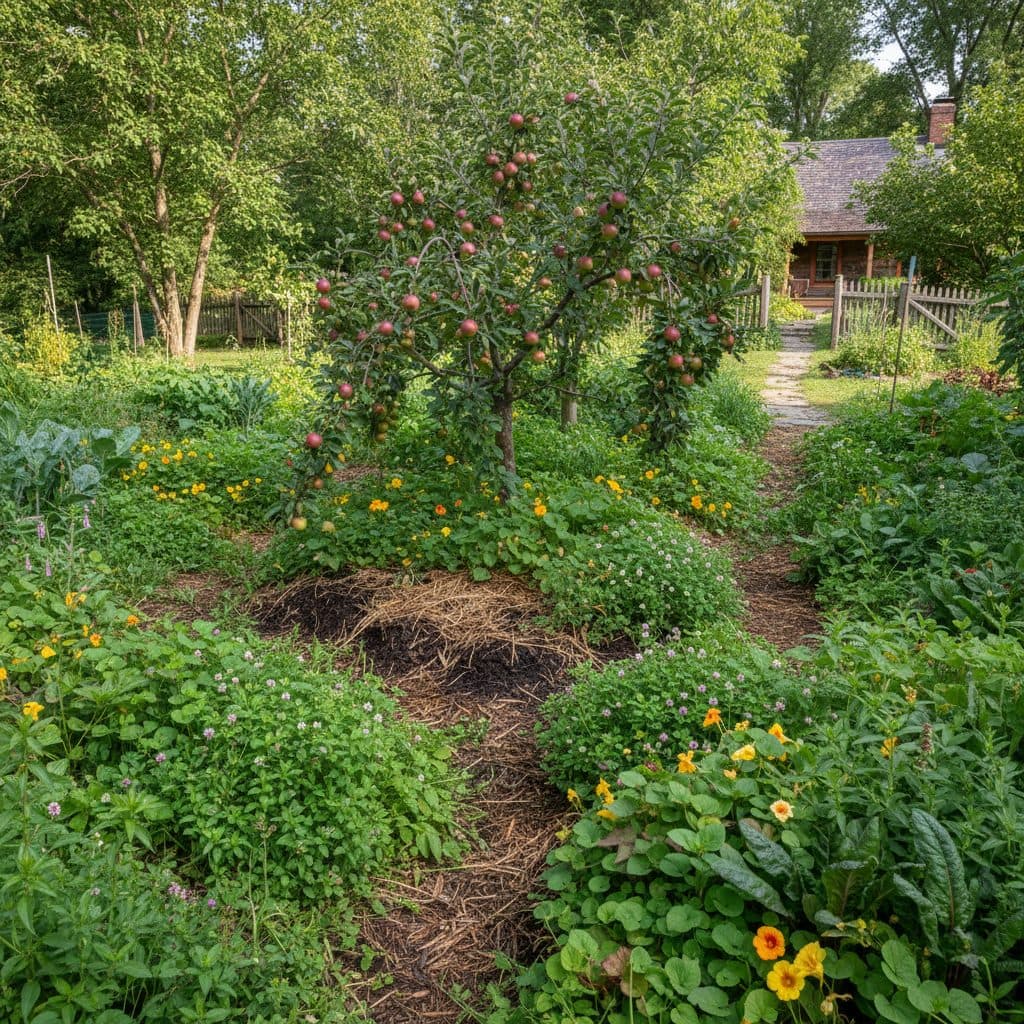
A plant guild is a group of plants that support each other’s growth, and a nitrogen-fixer is often the ‘engine’ of the guild. For example, an apple tree guild in USDA zone 5 might include an apple tree (the central element), sterile Bocking 14 comfrey (dynamic accumulator — choose Bocking 14 over seed-setting common comfrey, Symphytum officinale, and use the leaves as mulch only, since comfrey's pyrrolizidine alkaloids are hepatotoxic), daffodils (pest deterrent), and a nitrogen-fixing groundcover like white clover. The clover provides 50 to 150 pounds of nitrogen per acre, feeding the apple tree and other guild members. The chop-and-drop of comfrey and clover biomass further builds soil organic matter over time. This integrated approach reduces the need for external inputs and creates a more resilient, productive ecosystem that can last for decades.
- Canopy layer: Large nitrogen-fixing trees like black locust provide long-term benefits.
- Mid-story layer: Nitrogen-fixing shrubs offer nitrogen and edible yields — choose a species that is legal and non-invasive where you garden.
- Understory/Groundcover: Clovers, vetch, or alfalfa fix nitrogen and crowd out weeds.
- Support species: Integrate with dynamic accumulators and pest deterrents for complete guilds.
- Zone planning: Match species to your specific USDA zone for optimal growth and nitrogen fixation.
Long-term benefits and practical considerations
The long-term benefits of integrating nitrogen-fixers and practicing chop-and-drop extend beyond immediate nutrient provision. Over time, these practices significantly increase soil organic matter, improving soil structure, water infiltration, and nutrient retention. Healthy soil, rich in organic matter, holds noticeably more plant-available water than degraded soil, which reduces irrigation demand in drier climates like the Southwest. This moisture retention helps plants withstand dry spells. The EPA’s Soak Up the Rain initiative notes that healthy soil absorbs stormwater runoff.
Managing your nitrogen-fixing system
While nitrogen-fixers offer clear benefits, species selection requires care. Black locust spreads aggressively by root suckers, and cutting it sets the suckering off; the chop-and-drop cycle described above provokes a thicket of shoots over a wide radius rather than controlling one. Do not plant it on a small lot or near a boundary; it suckers just as hard in zone 4 as in zone 8, and it is listed as invasive or noxious in a number of states outside its native Appalachian and Ozark range. Its bark, foliage and seeds contain a toxalbumin that is poisonous to horses, other livestock and people, so keep prunings out of any grazed area. Others, like autumn olive, are considered invasive in some regions, so always check local regulations before planting. Regular observation of plant health and soil conditions will guide your chop-and-drop schedule. Aim for 2-4 chop cycles per year for vigorous species. The goal is to create a self-sustaining system that requires minimal external inputs, builds soil health for decades, and yields abundant food and biomass.
- Soil organic matter: Builds steadily under continuous mulch, improving soil structure.
- Water retention: Improved soil holds more plant-available water, reducing irrigation demand.
- Reduced erosion: Groundcovers and mulches protect soil from wind and water damage.
- Enhanced biodiversity: Supports a thriving soil food web and beneficial insects.
- Long-term sustainability: Creates a resilient system that can produce for 30+ years with minimal inputs.
Common Nitrogen-Fixers for US Permaculture Systems
Plant Species | USDA Zones | Growth Habit | Nitrogen Contribution (lbs/acre/year) |
|---|---|---|---|
White Clover (Trifolium repens) | 3-9 | Groundcover | 50-150 |
Crimson Clover (Trifolium incarnatum) | 6-9 | Annual Groundcover | 70-150 |
Alfalfa (Medicago sativa) | 3-9 | Perennial Herb | 100-200 |
Siberian Pea Shrub (Caragana arborescens) | 2-7 | Large Shrub/Small Tree | 40-80 |
Goumi (Elaeagnus multiflora) | 4-8 | Shrub | 30-60 |
Black Locust (Robinia pseudoacacia) | 3-9 | Large Tree | 50-100 |
Soil Carbon Storage: Building soil organic matter locks carbon into the ground, a benefit beyond the fertility gain.
Water Savings: Improved soil organic matter reduces irrigation needs in arid regions.
Fertilizer Reduction: Nitrogen-fixing plants reduce the amount of synthetic nitrogen a system needs.
Frequently asked questions
How quickly do nitrogen-fixers start benefiting the soil?
Many annual nitrogen-fixers like clover or vetch can begin contributing usable nitrogen within 2-3 months of germination. Perennial species like black locust may take 1-2 years to establish a significant root system and start fixing substantial amounts of nitrogen, often 50 to 100 pounds per acre annually.
Can I use nitrogen-fixers in raised beds or containers?
Yes, nitrogen-fixers can be very effective in raised beds and large containers. Using smaller species like white clover or bush beans can provide nitrogen for companion plants. Ensure containers are at least 15 gallons for shrubs or small trees to allow for adequate root development and nitrogen fixation.
Are there any nitrogen-fixers I should avoid?
Some nitrogen-fixing plants, such as autumn olive, Siberian pea shrub or black locust, are invasive or prohibited in parts of the US, and autumn olive escapes well north of zone 6 — it is a problem across New England and the upper Midwest as well as the South. Always check with your local extension office or state invasive species list before planting, especially for species known to spread aggressively or outcompete native plants, which can happen over 10-20 years.
How often should I chop-and-drop nitrogen-fixers?
The frequency of chop-and-drop depends on the plant’s growth rate and your climate. For vigorous species like comfrey or fast-growing clovers, you might chop 3-4 times per growing season. For woody shrubs or trees, 1-2 times per year is often sufficient, usually in late spring and mid-summer, aiming to remove 50 to 75 percent of new growth.
Does chop-and-drop attract pests or diseases?
Proper chop-and-drop, using healthy plant material and spreading it thinly (4-6 inches deep), generally does not attract pests or diseases. In fact, it can create habitat for beneficial insects and improve soil health, which naturally suppresses many issues. Avoid chopping diseased plant material, and ensure good air circulation around plants to prevent fungal issues in humid climates, especially in areas with over 60 inches of annual rainfall.
What is the ideal carbon-to-nitrogen ratio for chop-and-drop material?
For optimal decomposition and nutrient release, a carbon-to-nitrogen (C:N) ratio between 20:1 and 30:1 is ideal. Nitrogen-fixing plants often have a lower C:N ratio, making them excellent ‘green’ material. Mixing them with ‘brown’ materials like wood chips (which can have a C:N ratio of 100:1 or more) helps balance the decomposition process to ensure consistent nutrient availability over 6-12 months.