Key takeaways
- Soil compaction restricts root growth, water infiltration, and nutrient uptake, leading to reduced plant vigor and yields.
- Traditional tilling can temporarily alleviate compaction but often destroys soil structure, reduces organic matter, and harms beneficial soil life.
- Cover crops naturally break up compaction with their deep root systems, adding organic matter and improving soil aggregation over time.
- Broadforking offers a non-inversion method to aerate soil to depths of 10-18 inches, preserving soil layers and microbial networks.
- Regular soil testing for pH, organic matter, and nutrient levels helps diagnose compaction and guide amendment strategies.
- Combining cover crops with broadforking provides a powerful, sustainable approach to build healthy, resilient garden soil.
Quick answer: Compacted soil can be sustainably remediated using cover crops with deep root systems and broadforking, which aerates the soil without destroying its structure, leading to improved organic matter and overall soil health.
In many home gardens across the US, from the heavy clay soils of the Midwest to the sandy loams of the Southeast, soil compaction is a common and often underestimated problem. Gardens in USDA zone 6 often struggle to produce even basic vegetables, with plant roots unable to penetrate more than 4-6 inches deep. This dense, airless environment chokes out beneficial soil organisms, reduces water infiltration, and makes it tough for plants to access the nutrients they need to thrive. Over time, this leads to diminished yields and a cycle of frustration for gardeners.
For decades, the standard advice for compacted soil involved heavy tilling, often with a powerful machine. While a tiller might seem like a quick fix, breaking up clods and loosening the top 6-8 inches of soil, it comes with significant drawbacks. It can destroy the intricate soil structure, deplete organic matter, and interrupt the vital microbial communities that underpin a healthy garden ecosystem. Better, more sustainable methods work with the soil to build organic matter measurably over the long term [3].
Understanding soil compaction and its impact
Soil compaction occurs when soil particles are pressed together, reducing the pore space between them. This can be caused by heavy foot traffic, machinery, or even rainfall impacting bare soil. In a healthy soil profile, about 50% of the volume should be pore space, split between air and water. When compaction reduces this to 30% or less, plant roots struggle to grow, oxygen becomes scarce for beneficial microbes, and water infiltration slows significantly. A heavily used path can compact soil to a density that restricts root growth to less than 3 inches.
Diagnosing compaction in your garden
Diagnosing compaction is the first step toward remediation. You can perform a simple ‘screwdriver test’ by pushing a long screwdriver into the soil. If it’s difficult to push past 6 inches, you likely have compaction. A more precise method involves digging a small pit, about 12-18 inches deep, and observing the soil layers. Look for a hardpan layer (a dense, impenetrable zone often 4-8 inches below the surface). You can also use a soil moisture meter to check how quickly water penetrates different layers. Regularly monitoring your soil’s condition provides valuable insights into its health and guides your efforts.
- Reduced water infiltration, leading to runoff and erosion.
- Limited root growth, stressing plants and reducing nutrient uptake.
- Decreased oxygen availability for beneficial soil organisms.
- Increased susceptibility to drought and nutrient deficiencies.
- Lower crop yields and overall plant vigor.
The problem with conventional tilling
For generations, turning over the soil with a tiller was considered standard practice, especially in gardens with heavy clay or compacted areas. The immediate result looks promising: a fluffy, seemingly well-aerated seedbed. However, this superficial improvement often comes at a cost to long-term soil health. Tilling indiscriminately mixes soil layers, bringing subsoil to the surface and burying nutrient-rich topsoil. This process can destroy the delicate network of fungal hyphae and bacterial colonies that form the soil food web, which is essential for nutrient cycling and disease suppression.
Long-term consequences of aggressive tillage
Repeated tilling, particularly with heavy machinery, can lead to the formation of a 'tillage pan' (a compacted layer just below the depth of the tiller blades, typically 6-8 inches down). This hardpan is often worse than the original compaction because it’s created by the very tool meant to fix the problem. The USDA Natural Resources Conservation Service notes that continuous tillage accelerates the breakdown of soil organic matter, leaving soil more prone to future compaction and erosion [6]. Furthermore, tilling exposes organic matter to oxygen, accelerating its decomposition and releasing carbon dioxide into the atmosphere. This is why methods that respect the soil’s natural structure are preferable.
- Destroys soil aggregates, leading to loss of structure.
- Reduces soil organic matter content over time.
- Interrupts beneficial microbial and fungal networks.
- Forms a compacted ’tillage pan’ below the tilled layer.
- Increases soil erosion and nutrient runoff.
Cover crops: the living solution to compaction
Cover crops are non-cash crops grown specifically to improve soil health and loosen compacted ground naturally. Their root systems are powerful natural tools for breaking up compacted soil. Deep-rooted species, like daikon radish or tillage radish, can penetrate dense layers up to 24 inches deep, creating channels that improve aeration and water infiltration. As these roots decompose, they leave behind organic matter and open pathways for subsequent crop roots to follow.
Selecting and managing cover crops
Choosing the right cover crop depends on your climate, soil type, and gardening goals. For severe compaction, brassicas like tillage radish (Raphanus sativus) are excellent due to their taproots. For adding nitrogen and improving overall soil structure, legumes such as field pea, crimson clover, or hairy vetch are highly effective, fixing up to 150 pounds of nitrogen per acre [6]. Growers in USDA zone 5 often plant a mix of winter rye and crimson clover in the fall. The rye’s fibrous roots hold soil in place, preventing erosion over winter, while the clover adds nitrogen. For more guidance on species and timing, refer to cover crops for the home garden: best species, timing, and termination. Research shows that cover crops can increase soil organic matter by roughly 0.2% to 0.5% annually, improving soil aggregation and water holding capacity [1, 3].
- Deep roots penetrate compacted layers, creating pathways.
- Adds significant organic matter as roots and tops decompose.
- Increases beneficial microbial activity and diversity [5].
- Suppresses weeds and reduces soil erosion.
- Some species (legumes) fix atmospheric nitrogen, reducing fertilizer needs.
Broadforking: precise, low-impact aeration
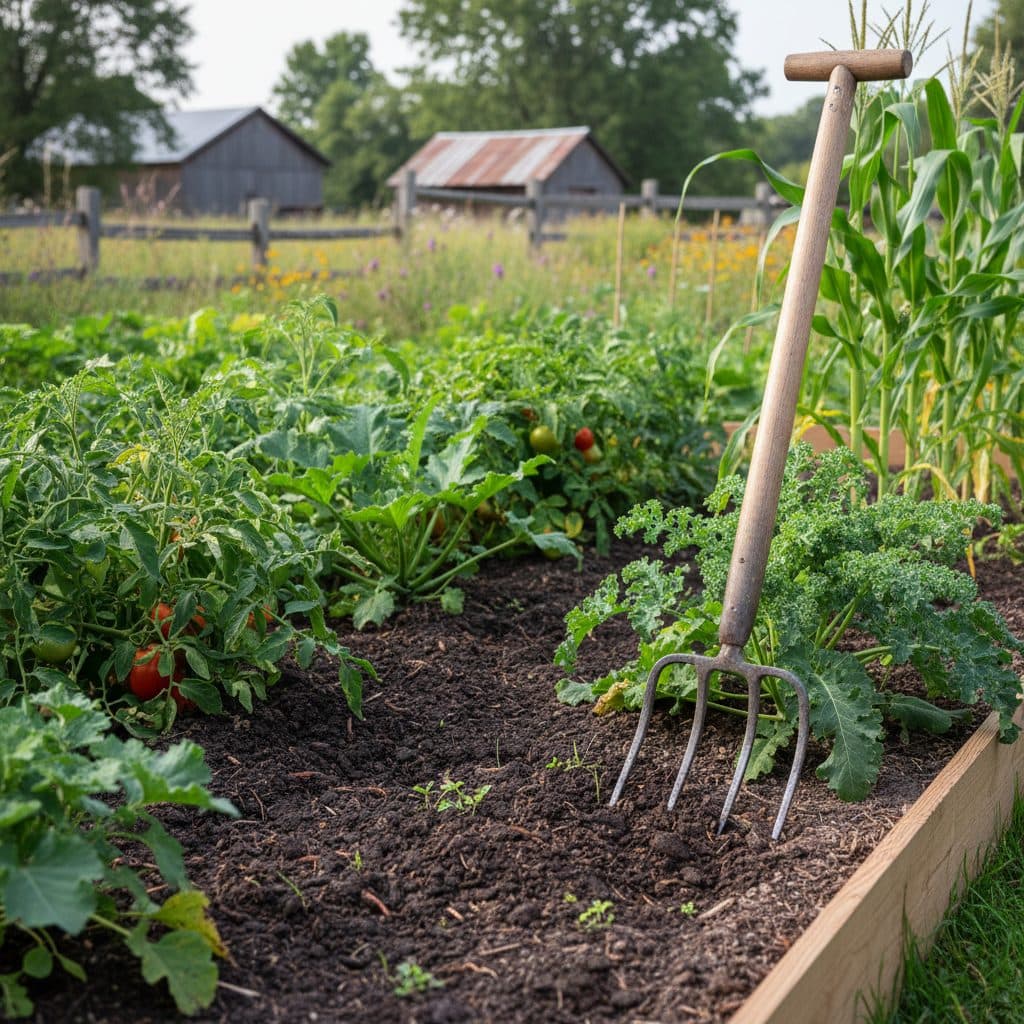
A broadfork provides immediate aeration without the disruption of a tiller. It is a manual tool with sturdy tines, typically 10-18 inches long, and a wide handle that loosens soil deeply without inverting the soil layers. This preserves the soil structure, fungal networks, and microbial layers that support soil health. It is particularly useful in raised beds and permanent pathways, where compaction can be a recurring issue.
The broadforking technique
To broadfork, you stand on the crossbar, pushing the tines into the soil to their full depth. Then, you rock the handles back and forth, gently loosening the soil. The tool creates fissures and air pockets without turning the soil over. This improves drainage and lets plant roots follow the fissures deeper than they could reach before. For best results, broadfork when the soil is moist but not wet (typically a few days after a good rain or irrigation). A sturdy wooden-handle garden fork serves a similar purpose for smaller areas. Broadforking a 100 square foot bed typically takes about 20-30 minutes and provides aeration for an entire growing season.
- Aerates soil deeply (10-18 inches) without inversion.
- Preserves soil structure and microbial life.
- Improves water and air penetration.
- Reduces physical effort compared to digging.
- Ideal for permanent beds and no-till systems.
Integrating cover crops and broadforking for optimal results
The most effective strategy for breaking up compacted soil and building long-term soil health often involves combining cover crops with broadforking. This synergistic approach addresses both the physical and biological aspects of soil degradation. You might start by broadforking a severely compacted area to immediately improve aeration and drainage, creating a more hospitable environment for cover crop seeds. For example, in a garden plot in USDA zone 7 with a hardpan at 8 inches, broadforking in the spring can prepare the ground for a summer cover crop like buckwheat or sunn hemp.
A phased approach to soil improvement
After broadforking, planting a mix of cover crops (such as a legume for nitrogen and a grass for fibrous roots) further improves soil structure. The cover crop roots grow into the channels created by the broadfork, extending aeration and adding organic matter at deeper levels. When it is time to plant main crops, terminate the cover crop by cutting it at the soil line and leaving the residue as mulch. Time the cut carefully, because grasses like winter rye regrow vigorously if cut before they flower. This 'chop and drop' method protects the soil surface, suppresses weeds, and feeds the soil food web. Over several seasons, this combination improves soil tilth and water holding capacity [4].
- Broadfork first to open channels for cover crop roots.
- Plant diverse cover crop mixes for varied root structures.
- Chop and drop cover crop residue to build organic matter.
- Repeat the cycle annually for continuous soil improvement.
- Observe significant improvements in soil tilth within 2-3 years.
Soil testing and amendments for long-term health
Regardless of your compaction strategy, regular soil testing is fundamental to understanding your garden’s needs. A comprehensive soil test, usually available through your local university extension office for $15-$30, provides data on pH, nutrient levels (nitrogen, phosphorus, potassium, and micronutrients), and often, organic matter content. For instance, many soils in the Pacific Northwest tend to be acidic (pH 5.5-6.0), requiring lime amendments, while some arid regions can have alkaline soils. Knowing your soil’s baseline helps you make informed decisions about amendments, preventing over-application and ensuring plant health.
Interpreting results and applying amendments
Once you have your soil test results, you can tailor your amendment strategy. If your organic matter is below 3-5%, consistent application of compost is essential. For pH adjustments, elemental sulfur can lower pH in alkaline soils, while agricultural lime raises it in acidic soils. Always follow recommended application rates: for example, applying 5 pounds of lime per 100 square feet can raise pH by 0.5 units in some loamy soils. You can monitor changes with a 3-in-1 soil pH, moisture & light meter. Remember that building soil health is a continuous process, not a one-time fix. Over time, these practices will lead to a more resilient garden that requires less intervention and produces more abundant harvests.
- Submit soil samples to a reputable lab every 2-3 years.
- Analyze pH, macronutrients (N-P-K), and micronutrients.
- Assess organic matter percentage for overall soil health.
- Apply amendments like compost, lime, or sulfur based on recommendations.
- Monitor soil moisture and light levels for optimal plant growth.
Comparing tilling, cover cropping, and broadforking for compaction
Feature | Tilling | Cover Cropping | Broadforking |
|---|---|---|---|
Immediate Compaction Relief | High (top 6-8 inches) | Low to Medium (over time) | High (to 10-18 inches) |
Long-Term Soil Structure | Degrades, creates hardpan | Improves significantly | Preserves and improves |
Organic Matter Contribution | Accelerates organic matter breakdown | Increases by 0.2-0.5% annually | Minimal direct contribution |
Impact on Soil Life | Destructive | Supports biodiversity | Minimal disturbance |
Equipment/Labor | Heavy machinery, fuel | Seeds, some management | Manual tool, physical labor |
Cost (per 100 sq ft) | $20-$50 (rental/fuel) | $5-$15 (seeds) | $0 ongoing after a one-time tool purchase |
Soil Organic Matter: Healthy garden soils typically have 3-5% organic matter, which can increase by 0.2-0.5% annually with cover crops [4].
Root Penetration: Deep-rooted cover crops like tillage radish can break through compacted layers up to 24 inches deep, improving aeration.
Water Infiltration: Compacted soil may absorb less than 0.5 inches of water per hour, while healthy soil can absorb 2-3 inches per hour.
Frequently asked questions
How long does it take for cover crops to break up compacted soil?
Significant improvements in soil structure and organic matter can be observed within one to two growing seasons, especially with deep-rooted species. For example, a single season of tillage radish can penetrate hardpans up to 24 inches deep, creating channels for future root growth.
Can I use a broadfork in heavy clay soil?
Yes, a broadfork is effective in heavy clay soils, but use it when the soil is moist and not saturated. Attempting to broadfork very wet clay can lead to smearing, while dry clay will be too hard to penetrate effectively. Aim for a moisture content where a squeezed handful of soil crumbles easily, typically a few days after a 1-inch rain.
What is the ideal organic matter percentage for garden soil?
For most vegetable gardens, an ideal organic matter content ranges from 3% to 5%. Soils in some regions, like the fertile Midwest, can naturally exceed 6-8%, while sandy soils might start below 1%. Regular additions of compost and cover cropping can help increase this percentage by 0.2% to 0.5% annually [4].
How often should I broadfork my garden beds?
For severely compacted beds, broadforking once a year, typically in spring or fall, can provide substantial benefits. As soil health improves, you might reduce this to once every two or three years, or only as needed in specific problem areas. Many no-till gardeners find that after several years of cover cropping and mulching, broadforking becomes less necessary.
Do cover crops really eliminate the need for fertilizer?
While nitrogen-fixing legumes can significantly reduce the need for synthetic nitrogen fertilizers (potentially adding 50-150 pounds of nitrogen per acre [6]), they don’t eliminate the need for all nutrients. A comprehensive soil test will still be necessary to identify any deficiencies in phosphorus, potassium, or micronutrients that cover crops alone may not fully address.
References
- Cover Crops and Soil Health (2018). Cover Crops and Soil Health.
- Cover Crops and Soil Health (2019). Cover Crops and Soil Health.
- How Cover Crops Have Improved Soil Productivity (2018). How Cover Crops Have Improved Soil Productivity.
- Cover Crops’ Effect on Soil Quality and Soil Health (2021). Cover Crops’ Effect on Soil Quality and Soil Health.
- The role of cover crops in improving soil biological health (2026). The role of cover crops in improving soil biological health.
- USDA Natural Resources Conservation Service (2024). USDA Natural Resources Conservation Service.