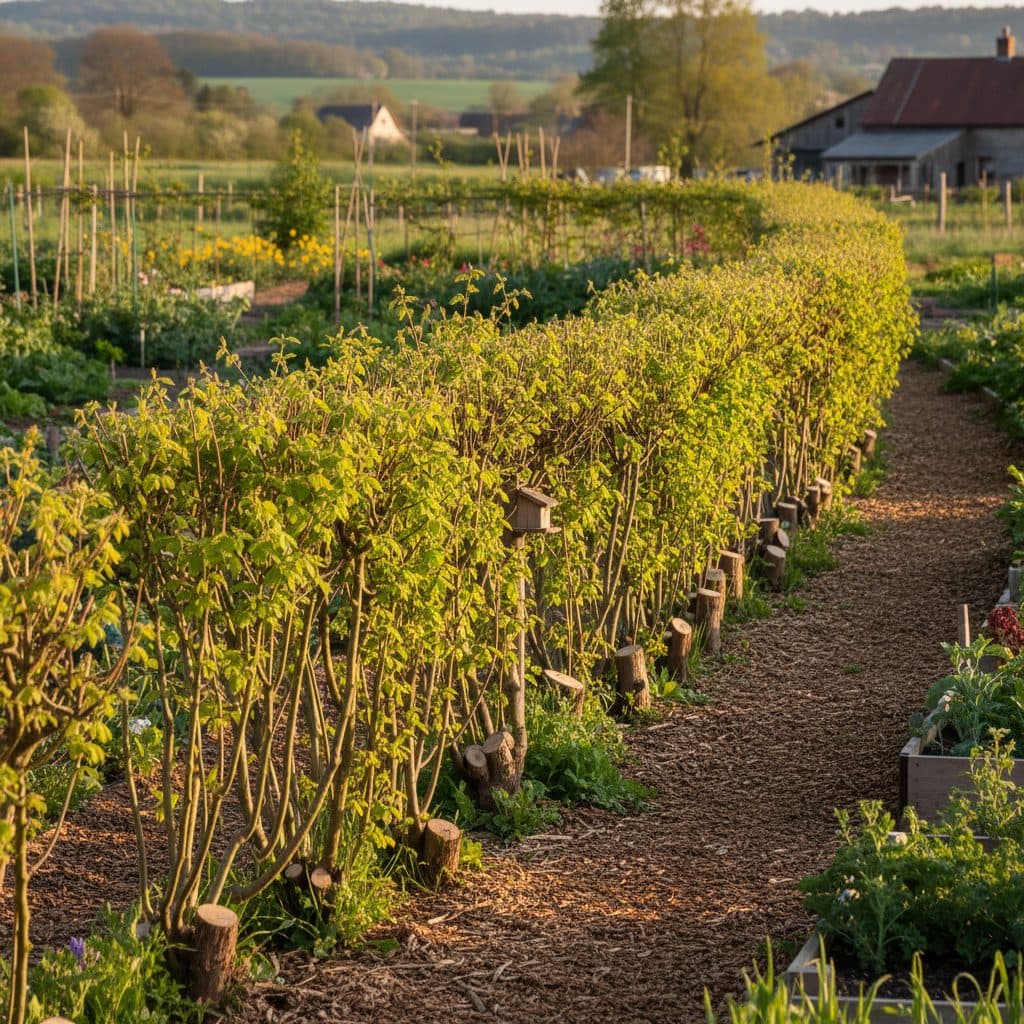
Key takeaways
- Coppice hedges provide a renewable source of wood products like poles, stakes, and biomass for mulch, reducing reliance on external inputs.
- Species like hazel, willow, and dogwood are excellent choices for coppicing, offering varied cutting cycles and product types.
- Integrating coppice hedges into permaculture designs enhances biodiversity, creates beneficial insect habitat, and improves microclimates.
- Proper planning for plant selection, spacing, and cutting cycles helps maintain a productive and long-lived coppice system.
- Deer readily browse the tender regrowth on freshly cut stools, so plan to protect young coppice with fencing or tree tubes for the first year or two after each cut.
- These hedges contribute to soil health by providing organic matter for mulch and supporting a diverse root system.
Quick answer: Coppice-and-craft hedges provide a renewable source of wood products like poles, stakes, and biomass by regularly cutting trees or shrubs to encourage vigorous regrowth. This ancient technique supports biodiversity, improves soil health, and reduces reliance on external inputs for garden materials.
A well-designed landscape can cut work and raise yields at the same time. One technique that consistently delivers on both fronts is the establishment of coppice-and-craft hedges. These living fences and biomass factories, primarily composed of hazel, willow, and other woody plants, offer a sustainable way to produce materials right on your property, year after year. Instead of buying stakes for trellises or bags of mulch for garden beds, you can grow them yourself.
A mature coppice hedge provides a steady supply of poles for garden structures, wood for basketry, and nutrient-rich biomass for mulching, while supporting the ecological function of your land. For instance, a 50-foot hedge of fast-growing willow can yield a significant amount of material annually, often 100 pounds or more of fresh growth, suitable for various uses. This approach fits permaculture principles by integrating productive elements into a resilient, low-maintenance system.
Understanding the coppice system
Coppicing is an ancient woodland management technique, documented for centuries in Europe and adapted globally, where trees or shrubs are cut back to ground level, or near to it, on a regular cycle. This encourages vigorous regrowth from the 'stool' (the base of the plant), producing multiple stems. This method differs from pollarding, where cuts are made above browse height, typically 6-8 feet from the ground. The practice of coppicing has been used for millennia, providing a sustainable source of wood for fuel, fencing, and crafts [2]. In a modern permaculture context, it’s about creating a renewable resource right where you need it.
The benefits of regular cutting
Regular cutting, typically every 1-20 years depending on the species and desired product, keeps the plant in a juvenile, highly productive state. This cycle can significantly increase the total biomass yield over time compared to letting a tree grow to maturity and harvesting it once. For instance, a well-managed hazel coppice in USDA zone 6 can produce useful poles for 50 years or more from the same stool. The dense regrowth also creates a distinct microclimate within the hedge, offering shelter and slowing wind on the leeward side. This can be particularly beneficial for protecting sensitive garden areas or young fruit trees from harsh weather conditions. The continuous root system helps stabilize soil, especially on slopes, preventing erosion and building soil organic matter over decades.
- Provides a renewable source of wood products.
- Supports biodiversity by creating diverse habitats.
- Improves soil health through root systems and leaf drop.
- Reduces external inputs for garden materials.
- Creates sheltered microclimates for other plants.
Selecting the right species for your hedge
The success of a coppice-and-craft hedge hinges on selecting appropriate species that thrive in your local conditions and provide the materials you need. For most US growers, especially in USDA zones 4-8, several species stand out. Hazel (Corylus americana or Corylus avellana) is a top choice, producing straight poles suitable for bean poles, pea sticks, and light fencing, along with edible nuts. Its cutting cycle is typically 5-10 years for poles. Another excellent option is willow (Salix spp.), known for its rapid growth and flexible stems, ideal for basketry, living structures, and biomass. Some willow varieties can be harvested annually or every 2-3 years for whips 6-10 feet long.
Beyond hazel and willow
Beyond these staples, consider other woody plants that offer diverse benefits. Redosier dogwood (Cornus sericea) provides the attractive red winter stems used for crafts and coppices happily every 2-4 years. Do not substitute flowering dogwood (Cornus florida): it is a slow-growing understorey tree with grey-brown twigs rather than coloured whips, it is already under pressure from dogwood anthracnose across much of its range, and cutting it to the ground on a short cycle will simply kill it. Elderberry (Sambucus canadensis), common across many US states, offers fruit (cook it before eating, as raw and unripe berries and all the green parts contain cyanogenic glycosides) plus soft wood suitable for chipping into mulch on a 2-3 year cutting cycle. Note the trade-off: a stool cut hard gives you little or no fruit the following season, so rotate sections if you want both. Black locust (Robinia pseudoacacia) is the species people reach for when they want nitrogen fixation and rot-resistant posts, and it is the one to think hardest about. Outside its native mid-Atlantic and Appalachian range it is listed as invasive or noxious in many states, and cutting is precisely what sets it loose: a coppiced or damaged stump throws vigorous root suckers that come up many feet from the stool, so a coppice rotation turns a hedge line into a thicket you spend years chasing. Its bark, foliage and seeds are also toxic to horses and other livestock, so it must not go near a paddock or anywhere prunings could be reached by stock. Check your state noxious-weed list before planting it, and if you only want the fertility, a native shrub such as New Jersey tea (Ceanothus americanus) fills that role in a hedge without the escape risk. When planning your permaculture garden plan, consider the specific needs of your zone and the desired end products. A diverse hedge with 3-5 different species provides a wider range of materials, supports ecological resilience, and attracts beneficial insects [1].
- Hazel (Corylus spp.) for straight poles and nuts.
- Willow (Salix spp.) for flexible whips and biomass.
- Dogwood (Cornus spp.) for colorful stems and crafts.
- Elderberry (Sambucus canadensis) for berries and mulch.
- Black locust (Robinia pseudoacacia): nitrogen fixation and durable wood, but invasive outside its native range, spreads aggressively by root suckers once cut, and toxic to horses and livestock. Check your state noxious-weed list first.
Designing and managing your coppice hedge
Effective design and management maintain a productive coppice hedge. Consider its placement within your permaculture zones; a hedge often fits well in Zone 2 or 3, providing a transition between more intensively managed areas and wilder spaces. Plant spacing determines yield: for a dense hedge that yields many smaller poles, plant species like willow or hazel 1-3 feet apart. If you’re aiming for larger diameter poles over a longer cycle, a 4-6 foot spacing might be more appropriate. When establishing new plants, ensure consistent moisture during the first year; a soil moisture meter can help monitor this. Once established, coppice stools are remarkably resilient, often living for over 50 years.
The art of the cut
The first cut is usually made 1-5 years after planting, depending on the species and desired stem size. Cut in the dormant season (late winter to very early spring, before the buds break) so the stool regrows hard on stored root reserves; cutting in full leaf in summer throws away the season's growth and can kill a young stool outright. Subsequent cuts should be clean and angled slightly to shed water, preventing rot on the stool. Always cut stems 1-6 inches above the ground to encourage vigorous regrowth. Rotate your cutting areas if you have a long hedge, harvesting a section each year to ensure a continuous supply of materials. For example, a 300-foot hedge could be divided into 10 sections, with 30 feet harvested annually on a 10-year rotation. This rotational system is a hallmark of traditional coppice management [2]. Deer can be a challenge, as they often browse tender new shoots [5]. While no plant is entirely deer-proof, selecting deer resistant plants or employing temporary fencing for the first year or two can help protect young stools.
- Plant spacing of 1-6 feet, depending on desired product.
- First cut typically 1-5 years after planting.
- Cut stems cleanly 1-6 inches above ground level.
- Implement a rotational cutting system for continuous yield.
- Protect young regrowth from deer browse, especially in the first year.
Utilizing coppice products: poles, mulch, and habitat
The versatility of coppice products makes them incredibly valuable in a permaculture system. The most obvious output is wood for poles and stakes. Hazel and straight-growing willow varieties provide excellent material for trellises in your food forest, supports for climbing beans, or even temporary fencing. These poles are strong, lightweight, and completely free. Beyond structural uses, many coppiced species, especially fast-growing ones like willow and elderberry, produce a large volume of biomass. This can be chipped or shredded to create high-quality, nutrient-rich mulch for garden beds, suppressing weeds, retaining soil moisture, and slowly releasing nutrients as it decomposes. A 20-foot section of willow hedge can easily produce 50 pounds of green mulch annually.
Ecological benefits and beyond
Coppice hedges provide ecological benefits alongside harvestable wood products. They create dense habitat for birds, small mammals, and beneficial insects, acting as reservoirs for parasitoids that help control cereal aphids in organic agriculture [1]. This integration of short rotation coppice into agricultural landscapes is recognized for its ecological value [3]. The flowers of some coppiced species, like willow, provide early spring nectar for pollinators. The dense growth also forms effective windbreaks, protecting more delicate plants and structures. For growers dealing with heavy soils, willow copes well with clay and wet ground and opens up compaction over time. Site it carefully, though: willow roots range aggressively in search of water and are a routine cause of blocked drains, invaded septic leach fields and lifted paving. Keep a willow coppice well clear of pipes, drain fields, foundations and neighbouring boundaries, and check what species you are buying; several of the fast willows sold for basketry are non-native and naturalize readily along waterways. The continuous cycle of cutting and regrowth maintains shelter and habitat across the property.
- Poles and stakes for trellises, fences, and garden supports.
- Biomass for nutrient-rich mulch and soil amendment.
- Habitat for beneficial insects, birds, and small wildlife.
- Windbreaks to protect gardens and reduce evaporation.
- Material for basketry, wattle fencing, and other crafts.
Comparison of common coppice species
Species | Typical Cutting Cycle | Primary Uses | USDA Zones |
|---|---|---|---|
Hazel (Corylus spp.) | 5-10 years | Poles, stakes, nuts | 4-8 |
Willow (Salix spp.) | 1-3 years | Whips for basketry, biomass, living structures | 2-9 |
Dogwood (Cornus spp.) | 2-4 years | Decorative stems, light crafts, mulch | 3-8 |
Elderberry (Sambucus canadensis) | 2-3 years | Berries, mulch, light poles | 3-9 |
Black Locust (Robinia pseudoacacia) | 10-15 years | Durable posts, nitrogen fixation; invasive outside its native range, suckers hard once cut, toxic to horses | 4-8 |
Coppice Yield: A 50-foot coppice hedge of fast-growing willow can yield over 100 pounds of fresh growth annually, suitable for various uses.
Microclimate Benefit: Coppice hedges slow the wind on their leeward side, sheltering nearby garden areas.
Frequently asked questions
What is the ideal cutting cycle for coppice hedges?
The ideal cutting cycle varies significantly by species and desired product. Fast-growing willows for basketry might be cut annually or every 1-3 years, while hazel for garden poles typically needs 5-10 years to reach a useful size. Some species for larger timber can be on a 15-20 year cycle.
Can coppice hedges attract pests to my garden?
While any plant can host insects, coppice hedges, especially those with diverse species, are known to attract beneficial insects. For example, research on organic cereal systems has found that leys and short rotation coppice hedges can act as reservoirs for parasitoids of cereal aphids [1]. That work does not quantify a benefit to a home garden, so treat a nearby coppice hedge as a plausible boost to natural pest control rather than a guaranteed reduction.
How much space do I need for a productive coppice hedge?
A productive coppice hedge can be established in a relatively small area. Even a 20-foot section planted with fast-growing species like willow can yield a significant amount of biomass annually, often 50 pounds or more, suitable for mulch or crafts. For larger poles, more space and a longer cutting cycle are needed.
Are there any specific tools required for coppicing?
For coppicing, you’ll need sharp hand tools like loppers or a pruning saw for smaller stems, or a bow saw or chainsaw for larger diameter wood. Making clean, angled cuts 1-6 inches above the ground protects the health and longevity of the stool, which can live for over 50 years.
What are the best coppice plants for clay soil?
Many coppice species tolerate or even thrive in clay soil. Willow (Salix spp.) is particularly well-suited, as are some dogwood varieties (Cornus sericea). These plants help improve clay soil structure over time through their extensive root systems, which can penetrate 3-5 feet deep.
References
- The potential of leys and short rotation coppice hedges as reservoirs for parasitoids of cereal aphids in organic agriculture (2001). The potential of leys and short rotation coppice hedges as reservoirs for parasitoids of cereal aphids in organic agriculture.
- Coppice forestry — an overview (1992). Coppice forestry — an overview.
- The integration of short rotation coppice in Belgian agricultural landscapes: Guidelines and strategies for managing short rotation coppice cultures (2024). The integration of short rotation coppice in Belgian agricultural landscapes: Guidelines and strategies for managing short rotation coppice cultures.
- Growth stages and microclimate in coppice and high forest (1992). Growth stages and microclimate in coppice and high forest.
- The interaction of deer and vegetation in coppice woods (1992). The interaction of deer and vegetation in coppice woods.
- USDA Natural Resources Conservation Service (2024). USDA Natural Resources Conservation Service.