Key takeaways
- Edible hedges like loquat, pineapple guava, and blackberry provide significant food yields and ecological benefits in warm climates.
- Permaculture principles, including zones and guilds, optimize the placement and productivity of fruiting hedges.
- Loquat wood is hardy to USDA zone 8, but the flowers and young fruit are killed in the upper 20s Fahrenheit, so dependable crops belong to zones 9-10.
- Pineapple guavas (Feijoa sellowiana) tolerate temperatures down to 10°F and offer attractive, edible flowers and fruit.
- Blackberries (Rubus spp.) are highly adaptable, with many cultivars thriving in USDA zones 5-9 and yielding 10-20 pounds per plant.
- Proper site assessment, soil preparation, and ongoing care determine whether an edible hedge system stays productive and long-lived.
Quick answer: Edible and fruiting hedges, such as loquat, pineapple guava, and blackberry, thrive in the Southeast and warm zones, providing significant food yields and ecological benefits within a permaculture design. They offer diverse harvests, improve soil health, and create habitat for beneficial insects.
In the humid, warm climates of the American Southeast, from coastal Georgia to central Florida, growers are increasingly looking beyond traditional row crops to perennial systems. One effective strategy involves establishing edible and fruiting hedges, which can define property lines, provide windbreaks, and produce substantial food yields. These living fences contribute significantly to the resilience and biodiversity of a permaculture design, often outperforming annual plantings in terms of long-term return with less labor.
Integrating species like loquat, pineapple guava, and blackberry into your yard can transform it into a productive food forest. These plants are well-suited for USDA zones 8-10, where they can thrive with minimal intervention once established. A well-planned edible hedge system can yield hundreds of pounds of fruit per acre, while also improving soil health and providing habitat for beneficial insects over many years.
the role of edible hedges in permaculture design
Edible hedges are a cornerstone of resilient permaculture systems, especially in regions like the Southeast where perennial plants grow vigorously. They serve multiple functions, from providing food and biomass to acting as windbreaks and privacy screens, while also supporting biodiversity. In a typical permaculture design, hedges often define Zone 2 or 3, areas requiring less frequent human interaction than Zone 1 (the home garden) but more than Zone 4 (managed woodland) or Zone 5 (wilderness). A well-designed hedge can reduce wind speed by up to 50% for a distance of 10-15 times its height, protecting more delicate annual crops.
integrating hedges into food forests and guilds
Integrating edible hedges into a food forest involves careful consideration of plant guilds, where different species support each other’s growth and health. For instance, nitrogen-fixing plants can be incorporated into a hedge row, enriching the soil for fruit-bearing shrubs and small trees. Blackberries, for example, can be underplanted with sterile Bocking 14 comfrey (Symphytum x uplandicum ‘Bocking 14’) or yarrow, both of which make bulky chop-and-drop mulch and shade out weeds. Choose Bocking 14 rather than common comfrey (Symphytum officinale), which sets seed and self-sows; either way comfrey regrows from root fragments, so plant it where you intend it to stay. It is mulch, not food or fodder — its pyrrolizidine alkaloids are hepatotoxic. This approach makes better use of the same ground than a single-species row. For more on structuring these systems, consider exploring resources on permaculture design.
- Windbreak function: Can reduce wind speed by up to 50% for roughly 10-15 times the hedge's height downwind.
- Soil stabilization: Deep root systems hold soil on slopes that would otherwise wash.
- Habitat creation: Provides shelter for beneficial insects and birds, which take on part of your pest control.
- Biomass production: Generates organic matter for mulching, which slows evaporation from the soil surface.
- Yield diversification: Offers a variety of fruits, extending harvest seasons from spring through fall.
loquat (eriobotrya japonica): a southeast staple
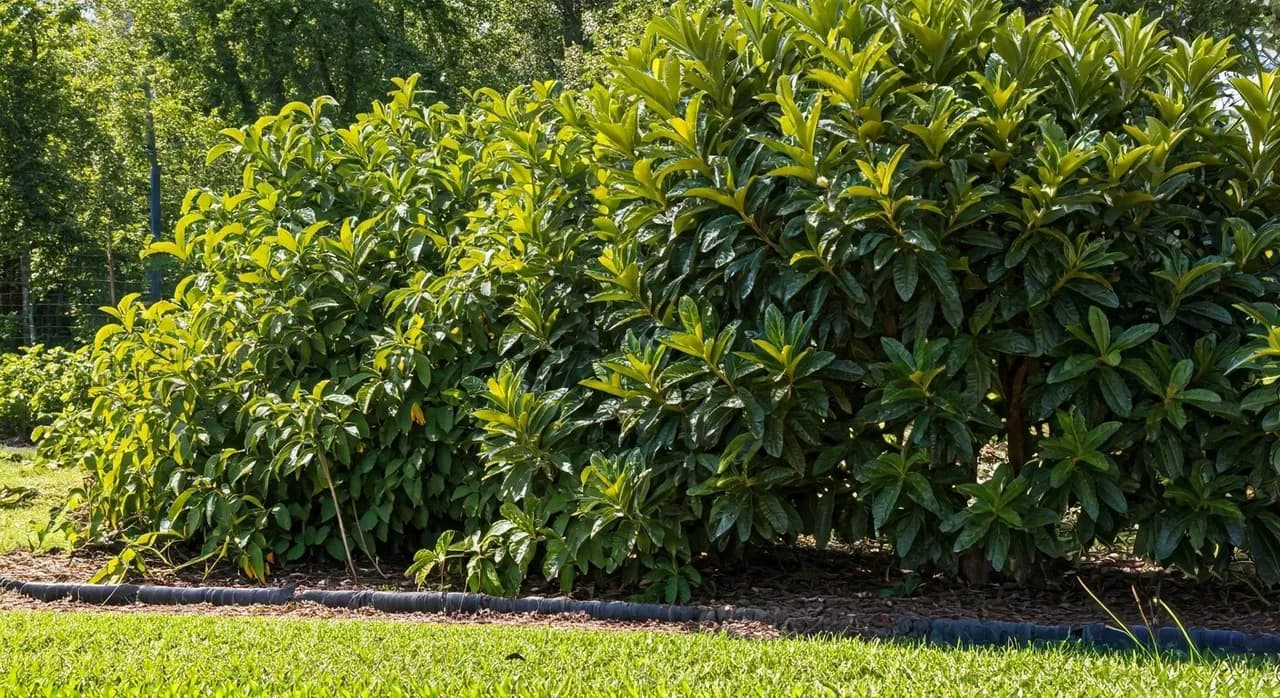
The loquat, often called Japanese plum, is an excellent choice for edible hedges in USDA zones 8-10, thriving across much of the Southeast. This evergreen tree or large shrub can reach heights of 15-20 feet, with a spread of 10-15 feet, making it suitable for a substantial hedge. Loquat wood is notably cold-hardy for a subtropical fruit, with established trees surviving into the low teens Fahrenheit. The crop is far more tender than the tree: loquat flowers in autumn and carries developing fruit right through winter, and both the flowers and the young fruit are killed in the upper 20s Fahrenheit. In USDA zone 8 the tree will live but the crop is lost in many winters; dependable annual harvests belong to zones 9 and 10. They produce sweet, tangy, apricot-like fruits in late winter or early spring, a time when few other fruits are available. Where the crop survives the winter, a mature tree can carry a heavy early-spring harvest at a time when little else is ripe.
cultivation and care for loquat hedges
Before planting loquat in Florida, check current state and county guidance — it is flagged as an invasive species there, because birds carry the seed into hammocks and natural areas, and some counties discourage new plantings. Where it is appropriate, plant young trees 8-10 feet apart for a dense screen, and expect to manage fire blight: loquat is quite susceptible in the humid Southeast, so cut blighted shoots well below the visible damage, in dry weather, sanitizing tools between cuts. They prefer full sun and well-drained soil, though they are quite adaptable to various soil types, including sandy loams common in Florida. During the first two years especially, regular watering through dry periods helps the tree establish, at about 1-2 inches of water per week. Pruning can shape the plants into a hedge, encouraging bushier growth and facilitating fruit harvest. Fertilize annually with a balanced organic fertilizer, such as fermented soybean meal, at a rate of 1-2 pounds per plant for optimal fruit production.
- Hardiness: The tree tolerates temperatures down to about 10°F (USDA zone 8); the flowers and developing fruit do not, and are killed in the upper 20s.
- Mature size: Grows 15-20 feet tall and 10-15 feet wide.
- Fruit yield: A heavy late-winter to early-spring crop from a mature tree in zones 9-10.
- Sunlight: Requires at least six hours of direct sun daily.
- Watering: Needs 1-2 inches of water weekly during establishment.
pineapple guava (feijoa sellowiana): a resilient choice
Pineapple guava, also known as feijoa, is an outstanding, often overlooked, fruiting shrub for edible hedges in the Southeast and other warm zones (USDA zones 8-10). It’s an evergreen plant that can reach 10-15 feet tall and wide, forming a dense, attractive hedge with silvery-green foliage. Beyond its tasty, aromatic fruit, pineapple guava produces striking white and crimson flowers with edible petals that have a sweet, slightly spicy flavor. These flowers appear in late spring, followed by the fruit in autumn. The plant is remarkably drought-tolerant once established and can withstand temperatures as low as 10°F, making it more resilient than many other subtropical fruiters.
planting and maintaining pineapple guava hedges
For a thick, productive pineapple guava hedge, space plants 5-8 feet apart, and plant at least two different named cultivars. Many feijoa cultivars set poorly with their own pollen and nearly all crop better with a second variety nearby, so a hedge grown from a single clone can flower spectacularly year after year and give you very little fruit. They perform best in full sun but tolerate partial shade, with noticeably lighter fruit set in the shade. Well-drained soil is preferred, but they adapt to a range of soil conditions, including clay. Minimal pruning is required for established plants, primarily to maintain shape and remove any dead or crossing branches. Young plants benefit from 1 inch of water per week during their first year. Fruit typically ripens in October and November in the Southeast, falling to the ground when ready for harvest. Consider using a soil moisture meter to ensure proper watering.
- Cold tolerance: Survives temperatures down to 10°F.
- Mature size: Typically grows 10-15 feet tall and wide.
- Edible parts: Both fruit and flower petals are consumed.
- Drought tolerance: High once established, needing noticeably less water than most fruit trees.
- Fruit season: Harvests occur in autumn, usually October-November.
blackberry (rubus spp.): productive and protective
Blackberries are a versatile and highly productive option for edible hedges, particularly in USDA zones 5-9, which cover a broad range of climates within the Southeast. Many varieties are vigorous growers, forming dense thickets that can deter unwanted traffic while providing abundant fruit. Cultivars like ‘Ouachita’ and ‘Natchez’ are thornless and perform exceptionally well in Southern climates, yielding 10-20 pounds of fruit per plant in a good season. They are relatively fast-growing, with canes reaching 5-10 feet in length in a single season, making them ideal for quickly establishing a protective barrier.
managing blackberry hedges for maximum yield
For a productive blackberry hedge, plant canes 3-5 feet apart. They require full sun for best fruit production, needing at least six hours of direct sunlight daily. Blackberries thrive in well-drained, slightly acidic soil with a pH between 5.5 and 6.5. Pruning is essential for managing growth and maximizing yield; primocanes (first-year canes) produce fruit in their second year (floricanes) and then die. Removing spent floricanes after harvest — on an established plant that is roughly half the standing canes — opens up the crown and directs the plant’s energy into this year’s primocanes. Training canes along a trellis or wire system helps manage their sprawling habit and improves air circulation, which lowers the risk of cane and fruit diseases in humid weather. For general permaculture gardening techniques, including managing such systems, see permaculture gardening: no-dig beds, guilds, and zones.
- Hardiness: Many cultivars thrive in USDA zones 5-9.
- Yield: 10-20 pounds of fruit per plant annually.
- Growth rate: Canes grow 5-10 feet in length per season.
- Soil pH: Prefers slightly acidic soil (pH 5.5-6.5).
- Pruning: Remove every spent floricane after harvest — on an established plant, roughly half the standing canes.
designing your edible hedge system
Effective permaculture design starts with a thorough site assessment, understanding sun exposure, prevailing winds, and soil conditions. For edible hedges, consider their eventual size and spread; a loquat hedge might require a 10-foot wide planting strip, while blackberries can be managed in a 4-foot wide space with trellising. Placing hedges along contours or as part of a swale system can significantly improve water retention and distribution, especially on sloping ground. Swales are level ditches on contour: they intercept sheet flow from the slope above, hold it, and let it soak in instead of running off. Size them for the storms your site actually gets and always build in a level spillway at a safe end — a swale that fills past its capacity in a heavy rain will breach its berm and cut a gully, which is the opposite of what you dug it for. Once your hedge is established, a working swale can meaningfully cut supplemental watering in dry spells.
incorporating plant guilds and zones
When designing your hedge, think in terms of plant guilds. For example, a loquat hedge could be underplanted with sterile Bocking 14 comfrey (for chop-and-drop mulch — not for eating, as comfrey's pyrrolizidine alkaloids are hepatotoxic) and calendula (for beneficial insect attraction), creating a diverse, self-sustaining planting. Consider the permaculture zones: a frequently visited blackberry hedge might be in Zone 2, close to the house, while a larger, less-managed loquat hedge could be in Zone 3. Mapping these zones helps optimize placement for ease of access and management. For detailed guidance on planning, refer to a permaculture garden plan: zones, guilds, and a first-year layout.
- Site assessment: Evaluate sun, wind, and soil before planting.
- Spacing: Allow 5-10 feet between hedge plants for mature growth.
- Swale integration: Plant on the downhill berm of a swale, where infiltrating water reaches the root zone.
- Guilds: Combine fruiters with nitrogen fixers or dynamic accumulators.
- Zone placement: Position hedges in Zone 2 or 3 for optimal interaction.
Comparison of Edible Hedge Species for the Southeast
Feature | Loquat (Eriobotrya japonica) | Pineapple Guava (Feijoa sellowiana) | Blackberry (Rubus spp.) |
|---|---|---|---|
USDA Hardiness Zone | 8-10 | 8-10 | 5-9 (cultivar dependent) |
Mature Height (ft) | 15-20 | 10-15 | 5-10 (canes) |
Yield per Plant (lbs/year) | 50-100 | 20-50 | 10-20 |
Sunlight Needs | Full Sun | Full Sun to Partial Shade | Full Sun |
Drought Tolerance | Moderate | High (once established) | Moderate |
Primary Harvest Season | Late Winter/Early Spring | Autumn | Summer |
Loquat Yields: In zones 9-10 a mature loquat carries a heavy crop in late winter and early spring, when little else is ripe. In zone 8 the tree survives but the crop is frozen out in many winters.
Blackberry Spacing: Blackberry canes should be spaced 3-5 feet apart in a hedge for optimal production, yielding 10-20 pounds per plant.
Swale Effectiveness: A swale sized for your site and fitted with a level spillway slows runoff and infiltrates it where hedge roots can reach, cutting supplemental watering in dry spells.
Frequently asked questions
What USDA zones are best for these edible hedges?
Loquat and pineapple guava thrive in USDA zones 8-10, while many blackberry cultivars are suitable for USDA zones 5-9. These ranges cover much of the American Southeast, allowing for diverse planting options.
How much fruit can I expect from a mature loquat hedge?
In zones 9 and 10, a single mature loquat in a hedge can carry a heavy crop, and a row of several trees proportionally more. In zone 8 expect the tree to thrive but the crop to be lost in many winters, since the fruit develops right through the cold months.
Are there thornless blackberry varieties suitable for hedges?
Yes, several thornless blackberry cultivars, such as ‘Ouachita’ and ‘Natchez’, perform very well in the Southeast. These varieties can produce 10-20 pounds of fruit per plant and are much easier to manage in a hedge setting.
How far apart should I plant pineapple guava for a dense hedge?
For a dense and effective pineapple guava hedge, space individual plants 5-8 feet apart. This allows for good air circulation while ensuring the hedge fills in to create a solid barrier over 2-3 years.
What are the water requirements for establishing these hedges?
During their first year, newly planted hedges generally require 1-2 inches of water per week, either from rainfall or irrigation. Once established, pineapple guava is particularly drought-tolerant, reducing water needs by up to 50%.
References
- Wild Edible Plants (2025). Wild Edible Plants.
- Dietary and Medicinal Significance of Wild Edible Fruiting Plants (2025). Dietary and Medicinal Significance of Wild Edible Fruiting Plants.
- USDA Natural Resources Conservation Service (2024). USDA Natural Resources Conservation Service.