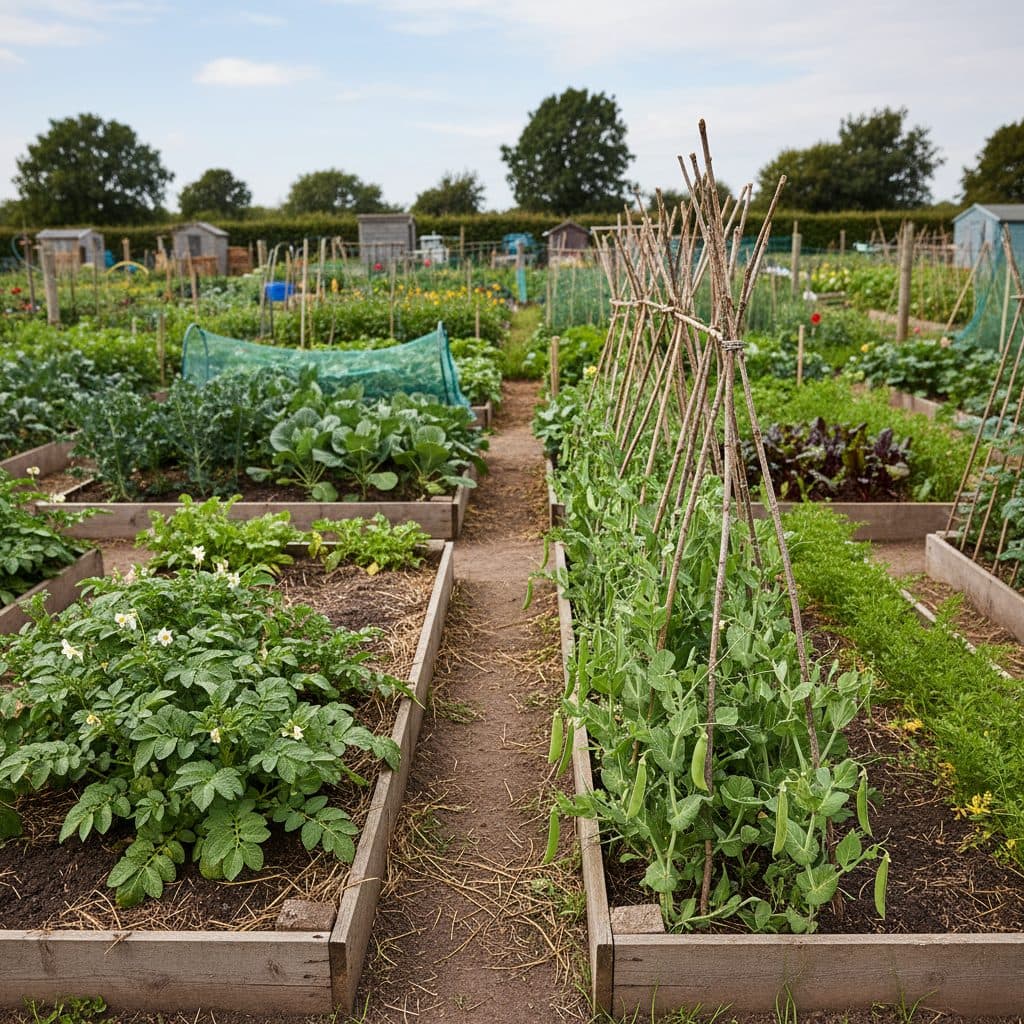
Key takeaways
- Rotate botanical plant families across separate beds to disrupt life cycles of soil-borne pests and diseases.
- Group crops into four rotation groups: nightshades, legumes and alliums, brassicas, and roots and umbellifers.
- Add heavy manure or garden compost ahead of hungry potatoes and brassicas, but avoid manuring before root crops.
- Apply garden lime before planting brassicas on acid plots to raise soil pH and suppress clubroot.
- Adopt a three-bed rotation plan if allotment space is limited by combining root crops with legumes and alliums.
Quick answer: A crop rotation allotment system involves moving vegetable plant families through a structured sequence across three or four beds year by year. On UK plots, separating brassicas, potatoes, legumes, and root crops prevents soil pest buildup such as potato cyst nematodes and clubroot, while optimizing soil fertility without excess synthetic inputs.
Managing an allotment plot in the UK offers rewarding harvests of fresh vegetables, but growing the same crops in the same soil season after season rapidly depletes specific soil nutrients and invites chronic pest infestations. Implementing a structured crop rotation allotment strategy is the most effective cultural practice for maintaining soil vitality and securing reliable yields year after year.
When related crops occupy the same ground continuously, specialized pests such as potato cyst nematodes (Globodera spp.) and soil-borne pathogens such as clubroot (Plasmodiophora brassicae), a slime-mould-like protist rather than a true fungus, multiply in the root zone. Furthermore, heavy-feeding crops extract uniform nutrient profiles, exhausting the topsoil and encouraging stubborn weed populations adapted to specific cultivation routines.
By dividing your plot into distinct growing zones and shifting botanical families annually, you break pathogen life cycles, balance nutrient extraction, and align soil amendments with each crop family's distinct feeding requirements.
Why crop rotation matters on UK allotments
Allotment plots often possess decades of cultivation history, which means soil-borne spores and pests can linger beneath the surface. Practicing vegetable crop rotation uk growers rely on provides three distinct biological benefits:
- Disease and Pest Suppression: Soil-borne pathogens frequently require specific host plants to complete their reproductive cycles. Shifting host families away from infected soil for three to four years causes dormant pest populations and fungal spores to starve and decline. Rotation slows build-up but does not clear either of the two worst allotment problems: clubroot resting spores survive up to 20 years and potato cyst nematode cysts decline only about 30% a year. Once you have them, combine rotation with resistant cultivars, raised pH for clubroot, and strict boot and tool hygiene.
- Nutrient Management: Different vegetable families make unequal demands on soil nutrition. Leafy brassicas consume large quantities of nitrogen, while fruiting nightshades demand potassium and phosphorus. Rotating heavy feeders after nitrogen-fixing legumes prevents severe nutrient imbalances.
- Soil Structure and Weed Control: Deep-rooting crops like parsnips break up compacted subsoil, while dense potato canopies suppress persistent annual weeds through ground shading.
For a broader conceptual foundation on rotation principles across domestic gardens, review our guide to crop rotation home garden plans.
The traditional 4-bed crop rotation plan
The four-bed rotation is the classic UK allotment system. It divides the main vegetable plot into four equal quadrants or raised beds, moving each group forward one bed each spring.
+-------------------------------------------------------------------------------+
|                       CLASSIC 4-BED ALLOTMENT ROTATION                        |
|                                                                               |
|   BED 1: Potatoes & Nightshades   -------->   BED 2: Legumes, Alliums & Salads|
|   (Heavy manure, deep tillage)                (Moderate compost, lime-free)   |
|                 ^                                           |                 |
|                 |                                           v                 |
|   BED 4: Roots & Umbellifers      <--------   BED 3: Brassicas                |
|   (No fresh manure, low nitrogen)             (Garden lime, high nitrogen)    |
+-------------------------------------------------------------------------------+
+-------+-------------------------------+-------------------------------+-------------------------------+
| Bed | Plant Families | Key Crops Included | Soil Preparation & Manure |
+-------+-------------------------------+-------------------------------+-------------------------------+
| Bed 1 | Solanaceae (Nightshades) | First/second early potatoes, | Heavy autumn compost or rotted|
| | | maincrops, tomatoes | manure; slightly acidic soil |
| Bed 2 | Fabaceae & Amaryllidaceae | Peas, broad beans, runner | Moderate compost; light bone |
| | | beans, onions, garlic, leeks | meal for phosphorus; the |
| | | | legumes themselves fix nitrogen|
| Bed 3 | Brassicaceae (Cabbage family) | Cabbage, kale, broccoli, | Garden lime in winter; firm |
| | | Brussels sprouts, cauliflowers| soil; high nitrogen top-dress |
| Bed 4 | Apiaceae & Amaranthaceae | Carrots, parsnips, beetroot, | Un-manured soil; fine tilth; |
| | | Swiss chard, celeriac | avoids split and forked roots |
+-------+-------------------------------+-------------------------------+-------------------------------+Bed 1: potato rotation and nightshades
Potatoes are the cleaning crop of the allotment. Preparing ground for potatoes involves incorporating generous amounts of well-rotted farmyard manure or garden compost in late winter. As potatoes grow, regular earthing up and their dense canopy smother weeds and loosen heavy clay soil.
Keep maincrop potatoes strictly to a four-year cycle to prevent potato cyst nematode populations from building up to damaging thresholds.
Bed 2: legumes and alliums
Following potatoes, the soil remains rich in organic matter but less excessively fertile. Peas, runner beans, and broad beans host symbiotic Rhizobium bacteria in their root nodules, which capture atmospheric nitrogen and convert it into plant-available forms.
Interplant or follow legumes with alliums (onions, shallots, garlic, and leeks). Alliums thrive in the open, friable ground left by the previous potato crop and benefit from the gentle soil fertility without suffering from the bulb rot that fresh manure causes.
Bed 3: brassica rotation and liming
Brassicas are demanding nitrogen feeders that thrive following nitrogen-enriching legumes. However, brassicas require firm soil to anchor their heavy root systems against winter gales, making the undisturbed legume bed ideal.
In late winter before planting brassicas, test your soil pH. If your soil tests below pH 6.5, apply agricultural lime to raise the pH toward 7.0 to 7.5. Alkaline conditions significantly inhibit the germination of clubroot resting spores. Keep two rules in mind when liming: never lime and manure the same ground in the same season, as lime reacts with fresh manure and drives off nitrogen as ammonia; and lime only the brassica bed to its tested requirement, because high pH raises common scab risk when that bed later rotates into potatoes and can induce manganese or boron deficiency on light soils. To protect tender young cabbages from bird damage, deploy overhead netting as outlined in our guide on how to stop pigeons eating plants.
Bed 4: root vegetables and umbellifers
Carrots, parsnips, and beetroot conclude the cycle. Root vegetables require soil with fine tilth and modest, balanced fertility.
Never add fresh manure or rich compost directly before sowing root crops. High levels of un-decomposed organic matter and excess nitrogen cause taproots to fork, split, and produce excessive foliage at the expense of straight, uniform roots. To maintain correct spacing during sowing, refer to our practical instructions on seedling care thinning spacing direct sowing.
Adapting to a 3-year crop rotation plan
If your allotment plot is small or contains permanent beds, a 3 year crop rotation provides a streamlined alternative. In a three-bed system, you combine the legume and root groups into a single shared section:
+-------------------------------------------------------------------------------+
|                       STREAMLINED 3-BED ROTATION PLAN                         |
|                                                                               |
|       BED 1: Potatoes & Nightshades (Heavy compost / organic matter)          |
|                               |                                               |
|                               v                                               |
|       BED 2: Legumes, Alliums & Roots (Peas, beans, onions, carrots, parsnips)|
|                               |                                               |
|                               v                                               |
|       BED 3: Brassicas (Limed soil / firm ground / nitrogen demand)           |
+-------------------------------------------------------------------------------+
In Bed 2, divide the space so that peas and beans occupy one half (receiving moderate compost) while un-manured carrots and parsnips occupy the other half. The following season, Bed 3 rotates into Bed 1 for heavy autumn manuring.
For feeding container-grown or raised-bed crops alongside your rotation beds, learn how organic amendments compare in our breakdown of vermicompost vs regular compost worms win.
Crops excluded from the standard rotation
Not every vegetable fits neatly into an annual rotation cycle. Certain crops remain in position for multiple seasons or tolerate varied soil conditions:
- Perennial Vegetables: Asparagus beds crop for 15 to 20 years. Rhubarb needs lifting and dividing every five or six years, and globe artichokes are best replaced from offsets every three to four years. Situate permanent beds along the northern boundary of your allotment, where their shadow falls off the plot rather than across your annual beds.
- Cucurbits and Sweetcorn: Courgettes, winter squash, pumpkins, and sweetcorn are versatile feeders. They can be tucked into any spare pocket in Bed 1 or Bed 2 where generous compost has been applied.
- Salad Leaves and Radishes: Fast-maturing catch crops (lettuces, rocket, radishes) occupy ground for only four to eight weeks. Sow them as quick intercrops between slow-growing brassicas or early potatoes. Protect early and late salad successions with horticultural fleece to ensure continuous cropping.
Practical tips for keeping allotment rotation records
Maintaining an accurate record of where each family grew is essential for successful long-term rotation.
Draw a simple map of your allotment beds in a notebook or keep a digital sketch on your phone. Label each bed with its current crop family, the date of sowing or planting, and any soil amendments applied (such as compost, manure, or garden lime). Label permanent wooden pegs at the corner of each bed with the current year's group to prevent confusing bed allocations during early spring digging.