Key takeaways
- Install sturdy 15 mm to 20 mm mesh netting over rigid support hoops as the only reliable pigeon barrier.
- Keep netting stretched drum-tight and pinned continuously to the ground to prevent bird entanglement.
- Protect high-risk crops including brassicas (kale, cabbages, broccoli), pea shoots, and young salad seedlings.
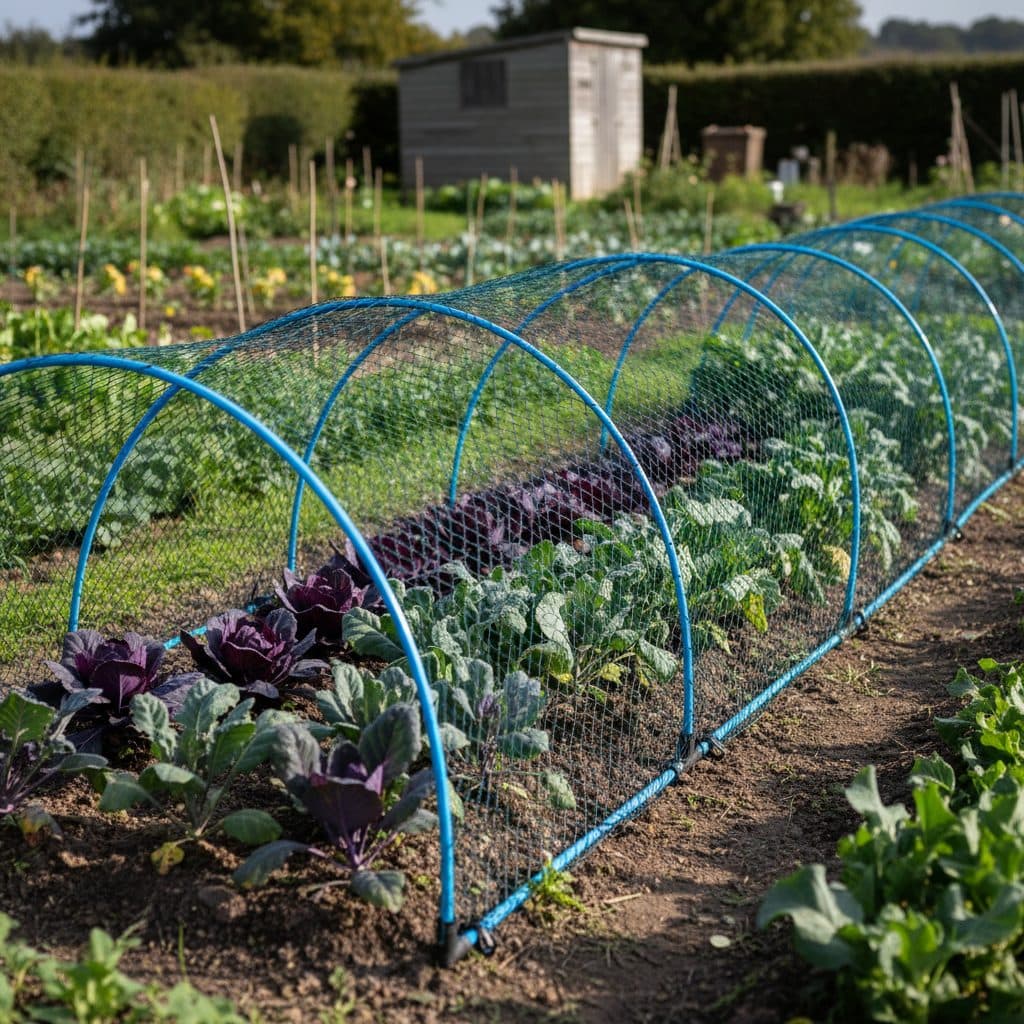
- Construct low-cost DIY tunnel frames using 20 mm blue water pipe slotted over rebar ground stakes.
- Recognise that visual and auditory scarers provide only temporary relief due to rapid bird habituation.
Quick answer: The only permanent way to stop pigeons eating plants on UK allotments is physical exclusion using taut, rigid mesh netting (15 mm to 20 mm mesh) erected over sturdy hoops or timber crop cages. Pigeons quickly habituate to visual scarers, making well-anchored overhead netting essential for protecting brassicas, peas, and tender seedlings.
Ask any UK allotment holder or vegetable gardener to name their most persistent, destructive pest, and the answer is rarely a slug or an insect—it is the common wood pigeon (Columba palumbus). With their heavy bodies, sharp beaks, and voracious appetites, a small flock of pigeons can strip an entire bed of autumn cabbages, winter kale, or spring peas down to bare, shredded stalks in a single afternoon.
Finding out how to stop pigeons eating plants requires understanding that visual gimmicks, reflective tapes, and plastic owl decoys offer only fleeting protection. Wood pigeons are intelligent, observant birds that quickly learn artificial scarers pose no genuine threat.
Implementing wildlife-safe physical barriers—such as taut mesh netting, robust crop cages, and rigid cloches—ensures your brassicas and tender greens survive to maturity while keeping wild birds safe from injury or entanglement.
Why pigeons target UK brassicas and allotment crops
Pigeons are herbivores with a strong preference for high-protein, moisture-rich foliage, especially during late winter and early spring when wild food sources are scarce.
+-------------------------------------------------------------------------------+
|                       UK PIGEON TARGET VULNERABILITY MATRIX                   |
|                                                                               |
|   HIGH RISK (100% Protection Required):                                       |
|   --> Brassicas: Kale, Cabbage, Cauliflower, Broccoli, Brussels Sprouts       |
|   --> Legumes: Emerging Pea Shoots, Broad Bean tips                           |
|                                                                               |
|   MODERATE RISK (Seasonal Vulnerability):                                     |
|   --> Soft Fruit: Strawberries, Cherries, Redcurrants, Gooseberries           |
|   --> Salad Crops: Young spinach, chard, lettuces                             |
|                                                                               |
|   LOW RISK (Rarely Targeted):                                                 |
|   --> Alliums: Onions, Garlic, Leeks | Nightshades: Potatoes, Tomatoes        |
|   --> Root Crops: Carrots, Parsnips  | Cucurbits: Courgettes, Squash          |
+-------------------------------------------------------------------------------+
Brassica leaves contain high levels of protein and vital minerals that sustain pigeons through cold months. Furthermore, young seedlings possess delicate stems that pigeons easily snip off at ground level.
For integrating bird-netted beds into a structured plot rotation, consult our guide on crop rotation allotment.
The gold standard: physical exclusion with rigid mesh netting
Physical exclusion is the only method that guarantees complete crop safety against wood pigeons. However, how you construct and tension your netting matters immensely.
+-------------------------------------------------------------------------------+
|                       WILDLIFE-SAFE NETTING CRITERIA                          |
|                                                                               |
|   1. MESH SIZE:       15 mm to 20 mm square (Blocks beaks, allows pollinators)|
|   2. TENSION:         Drum-tight (Bounces birds off without snagging claws)   |
|   3. ANCHORING:       Pegged continuously to the ground with zero gaps        |
|   4. RIGID CLEARANCE: Netting held 10 cm above the tallest plant foliage      |
+-------------------------------------------------------------------------------+
+-------------------+---------------------------+-------------------------------------------------------+
| Netting Type | Mesh Size & Material | Assessment & Recommendation |
+-------------------+---------------------------+-------------------------------------------------------+
| Rigid Knitted Mesh| 15 mm to 20 mm Polyethylene| RECOMMENDED: Sturdy, UV-stable, holds tension cleanly |
| Fine Insect Mesh | 0.8 mm to 1.3 mm Micromesh| RECOMMENDED: Dual protection (pigeons + cabbage white)|
| Tangly Monofilament| Fine nylon bird netting | FORBIDDEN: High wildlife entanglement risk for birds |
| Wire Weldmesh | 25 mm Galvanised Steel | EXCELLENT: Permanent, indestructible for walk-in cages|
+-------------------+---------------------------+-------------------------------------------------------+Wildlife safety and entanglement prevention
Under the Wildlife and Countryside Act 1981 it is an offence to intentionally kill or injure a wild bird, so netting that traps or injures birds carries a legal risk as well as being cruel. Loose, floppy, or fine monofilament netting is dangerous because birds can become hopelessly tangled in slack folds.
Always use rigid, knitted polyethylene mesh (15 mm to 20 mm) stretched drum-tight over a solid frame. Press down on the netting with your palm — if it gives more than a few centimetres or drops into slack folds, re-tension it. Tight netting acts like a trampoline: when a pigeon lands on it, it simply bounces off safely without getting caught.
Building a low-cost DIY hoop tunnel for allotments
You do not need to purchase expensive commercial fruit cages to protect your crops. Building a custom hoop tunnel using agricultural water pipe is cheap, durable, and takes less than an hour:
+-------------------------------------------------------------------------------+
|                       DIY MDPE PIPE HOOP CAGE DESIGN                          |
|                                                                               |
|              [Taut 18 mm Green Mesh Netting Stretched Over Hoops]             |
|                   .---------------------------------------.                   |
|                  /                                         \                  |
|                 |    20 mm Blue Water Pipe (MDPE) Hoops     |                 |
|                 |                                           |                 |
|   ===|==========|===========================================|==========|===   |
|     [40 cm rebar stake driven 20 cm into soil on either side of bed]          |
+-------------------------------------------------------------------------------+
Materials needed:
- 20 mm Blue MDPE water pipe (cut into 2.2-metre lengths)
- 10 mm steel rebar stakes (cut into 40 cm pins)
- 18 mm knitted green bird netting or heavy horticultural fleece
- Heavy-duty metal ground pegs
Construction steps:
- Drive two rebar pins 20 cm into the ground on opposite sides of your 1-metre wide vegetable bed.
- Slot one end of the 20 mm MDPE pipe over the rebar pin, bend the pipe into a smooth arch, and slot the other end over the opposing pin.
- Repeat arches every 1.2 metres along the length of the bed.
- Run a taut horizontal timber batten or wire across the top crest of the hoops to prevent sagging.
- Drape the 18 mm mesh netting over the frame, stretch it tight at both ends, and secure the edges continuously to the soil using metal ground pegs.
For seed-starting and direct-sowing spacing guidelines beneath low tunnels, explore seedling care thinning spacing direct sowing.
Walk-in fruit and brassica cages
For large allotment plots, building a permanent walk-in timber cage provides exceptional growing convenience:
- Dimensions: Construct a timber frame 1.8 to 2.0 metres high using 50 x 50 mm treated timber posts set in ground spikes.
- Mesh Installation: Clad the sides in 20 mm rigid galvanised wire mesh or heavy-duty knitted netting, and hang a hinged timber door.
- Benefits: Eliminates the need to crawl under low tunnels; allows you to weed, harvest, and stake tall Brussels sprouts and purple sprouting broccoli with ease.
To explore how full-height protected structures compare, check our guide on what to grow in a polytunnel.
Why visual and auditory scarers fail: the habituation trap
Gardeners often try low-effort scaring devices before resorting to netting:
- Hanging Compact Discs & Reflective Flash Tape: Reflective surfaces flash in the breeze, startling birds for a few days at most. Within a week, pigeons realise the light causes no harm and graze directly beneath them.
- Plastic Owl and Hawk Decoys: Stationary decoys work only briefly unless moved to a new position every day or two. Otherwise, pigeons quickly learn they are inanimate objects and will even perch on the decoy's head.
- Hawk Kites: Flying hawk kites tethered to flexible poles offer moderate deterrence because their erratic movement mimics a predator in flight. However, on calm, windless days, the kite hangs limp and loses all effectiveness.
Visual deterrents can buy you a few days while you build permanent netting, but they should never be relied upon as a long-term solution.