Key takeaways
- Direct solar dehydrators use direct sunlight on food, offering faster drying in arid climates like Arizona.
- Indirect solar dehydrators heat air in a separate collector, providing more even drying and better quality for humid regions.
- A specific collector-to-drying-area ratio is often recommended for efficient indirect designs.
- Consider your local humidity, average daily sunlight hours, and desired food quality when choosing a design.
- Simple direct dehydrators can be built for under 100 dollars, while indirect models might cost 200 to 500 dollars.
- Proper ventilation, with adequate vent area per square foot of drying space, matters for both types.
Quick answer: Direct solar dehydrators are simpler and faster, ideal for arid climates, while indirect models offer more even drying and better food quality, suited for humid regions. The optimal design for a USDA zone 6 homestead depends on local climate, budget, and the specific foods to be preserved.
For homesteaders across the United States, preserving the harvest is a yearly ritual, and solar dehydrators offer a sustainable, low-cost method. From the humid summers of Georgia to the dry heat of California’s Central Valley, harnessing the sun’s energy can extend the life of fruits, vegetables, and herbs without relying on grid power. Choosing the right dehydrator design, however, depends heavily on your local climate conditions and the specific foods you plan to dry.
Understanding the differences between direct and indirect solar dehydrators is key to building a system that performs well year after year. A poorly chosen design in a high-humidity environment, for example, might lead to moldy produce and wasted effort, while an over-engineered system in an arid region can be an unnecessary expense. This guide will walk you through the principles, advantages, and drawbacks of each type, helping you decide which design is best suited for your homestead’s needs, whether you’re in USDA zone 3 or zone 10.
Understanding solar dehydrators
Solar dehydrators use the sun’s energy to remove moisture from food, preventing spoilage and concentrating flavors. This ancient preservation technique is experiencing a resurgence among homesteaders looking to reduce their energy footprint and process their harvests without relying on grid power. The core principle involves raising the temperature of the food and the surrounding air, while simultaneously allowing moisture-laden air to escape through ventilation. A temperature range of 100°F to 140°F is generally considered ideal for most fruits and vegetables so enzymes are deactivated without cooking the food and allowing for safe, long-term storage for many items.
While the concept is simple, the execution varies significantly between the two main types: direct and indirect solar dehydrators. Each design channels solar radiation differently, impacting drying speed, food quality, and suitability for various climates. For instance, a simple box dehydrator might work well in the dry, sunny conditions of northern Arizona, where humidity often drops below 30% in the afternoon, but struggle with the persistent 70% humidity found in coastal Oregon. Understanding these fundamental differences is the first step toward building a successful solar drying system for your homestead, whether you’re drying apples or medicinal herbs, and aiming to preserve a significant amount of produce per batch.
The two main approaches to solar drying
The primary distinction lies in how sunlight interacts with the food. Direct solar dehydrators expose food directly to sunlight, relying on the sun’s rays to heat the food and the air around it. This method is straightforward and often less expensive to build, requiring fewer materials and simpler construction techniques. Many homesteaders can construct a basic direct unit for under 100 dollars. In contrast, indirect solar dehydrators separate the solar collection area from the drying chamber. Air is heated in a dedicated solar collector and then circulated through the drying chamber, where it absorbs moisture from the food. This separation offers greater control over drying conditions and can lead to more consistent results, especially for delicate produce or in less ideal weather. Both types require adequate airflow to carry away moisture, with sufficient vent area per square foot of drying tray often recommended for efficient operation [2]. Without this, moisture can condense, leading to mold.
- Adequate sunlight exposure, ideally 6 to 8 hours of direct sun daily.
- Sufficient temperatures, consistently above 100°F for several hours.
- Proper ventilation to remove humid air, preventing mold growth.
- Protection from insects and dust, using fine mesh screens.
- Food cut into uniform pieces, typically one-quarter to one-half inch thick.
Direct solar dehydrators: simplicity and speed
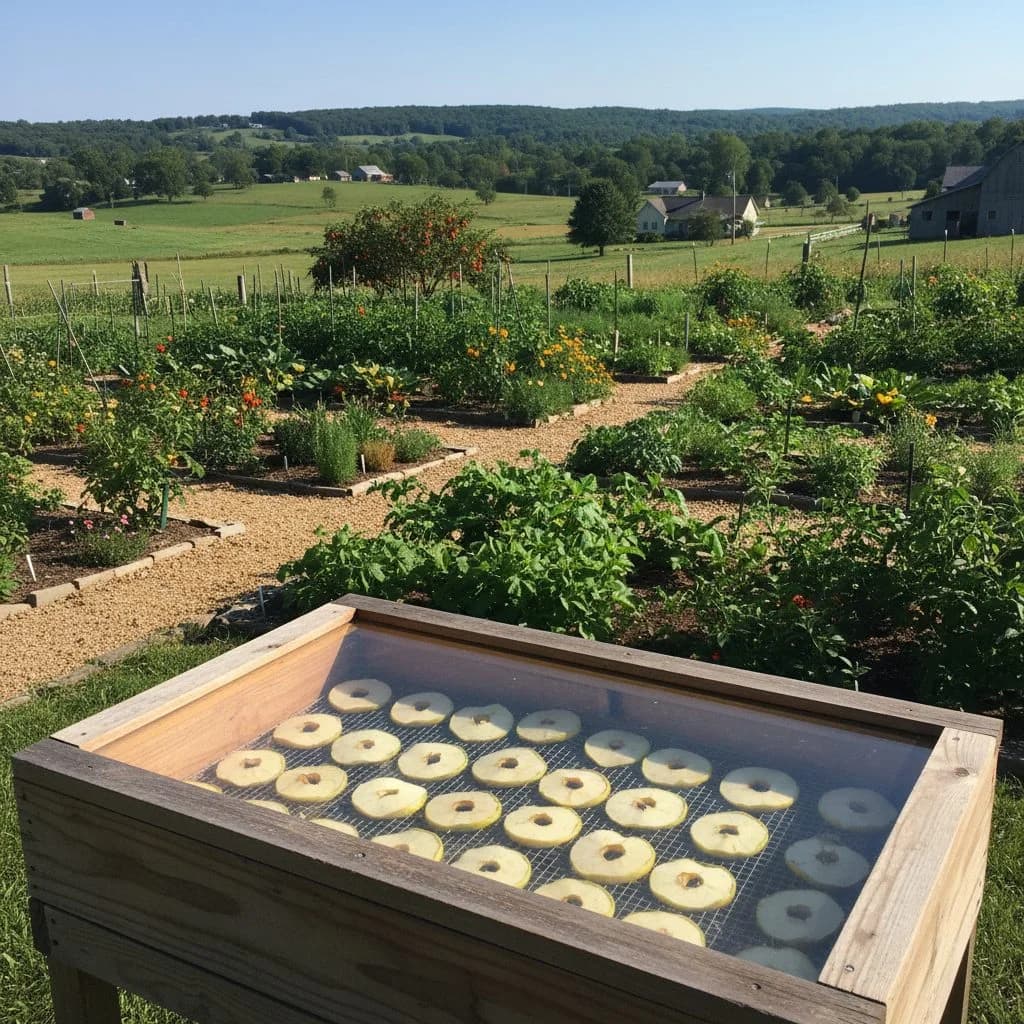
Direct solar dehydrators are the simplest form of solar food preservation, often resembling a basic box with a transparent lid. In these designs, the food trays are placed directly under a clear cover, such as glass or polycarbonate, allowing sunlight to strike the food directly. This direct exposure heats both the food and the air within the chamber, driving off moisture. The simplicity of construction means that many homesteaders can build an effective direct dehydrator for under 100 dollars, using readily available materials like plywood, old window panes, and screening. A design from 1978, for example, detailed a direct dehydrator capable of drying 10 to 15 pounds of fruit in two to three days in sunny conditions [1], making it a quick solution for a small harvest.
These dehydrators excel in climates with abundant sunshine and low humidity, like the high desert regions of New Mexico or the arid plains of eastern Colorado, where summer humidity frequently drops below 25%. In such environments, the sun’s intensity can quickly raise internal temperatures to 130°F or higher, rapidly dehydrating produce. However, the direct exposure to UV light can sometimes bleach the color of certain foods, like tomatoes or peppers, though this rarely affects nutritional quality. Overheating is another concern; temperatures exceeding 150°F can cook the food instead of drying it, so monitoring is important. Many direct designs incorporate adjustable vents or prop-up lids to manage internal temperatures, especially during peak sun hours between 11 AM and 3 PM.
Advantages and limitations for homestead use
The primary advantage of direct dehydrators is their low cost and ease of construction. They are an excellent entry point for homesteaders new to solar food preservation, allowing for a small investment to test the method. For example, a basic box design can be assembled in a weekend with minimal tools. However, their performance can be inconsistent in areas with fluctuating weather or high humidity, such as the Gulf Coast states where humidity levels often exceed 70% for days at a time. In these conditions, drying times can extend significantly, from two days to five days, increasing the risk of spoilage or mold. For those interested in off-grid power solutions, a direct dehydrator gives a completely passive approach, requiring no electrical components, unlike some advanced indirect systems that might incorporate small fans – you can learn more about entirely passive systems at https://agripure.org/articles/off-grid-living. This makes them ideal for remote cabins or emergency preparedness kits.
- Arid and semi-arid climates, like Nevada or inland California.
- Foods that tolerate direct sun, such as herbs, peppers, and some fruits.
- Homesteaders seeking a very low-cost, simple build.
- Situations where occasional bleaching of food color is acceptable.
- Processing smaller batches of produce, typically under 20 pounds.
Indirect solar dehydrators: control and quality
Indirect solar dehydrators represent a more refined approach to solar food preservation, offering greater control over the drying process and often resulting in higher quality dried produce. These systems typically consist of two main components: a separate solar collector and a drying chamber. The collector, often a glazed box with a dark absorber plate, heats air, which then rises and flows into the drying chamber containing the food. This design prevents direct sunlight from hitting the food, protecting delicate colors and nutrients, and reducing the risk of scorching. Studies have shown that indirect dehydrators can maintain more consistent temperatures, often within a 10°F to 20°F range, compared to direct models so more uniform drying across all trays [3].
The separation of the heat source from the food allows for more even drying and better temperature regulation, which is particularly beneficial in humid climates like Florida or the Pacific Northwest. In these regions, where ambient humidity can hover around 80% or higher during summer months, the consistent flow of pre-heated, dry air is critical for efficient moisture removal. A well-designed indirect system might incorporate an optimal collector-to-drying-area ratio so ample heated air is available for drying even large batches of produce. While more complex to build and potentially costing 200 to 500 dollars for materials, the investment often pays off in improved food quality and reduced spoilage rates, especially for high-value crops.
Designing for efficiency and even drying
Key design considerations for indirect dehydrators include the size and angle of the solar collector, the insulation of the drying chamber, and the efficiency of air circulation. The collector should be angled to maximize sun exposure, typically matching the local latitude for year-round use or steeper for winter sun to capture lower-angle rays. Many designs incorporate a small, low-power DC fan to assist airflow, especially on cloudy days or for dense loads of produce. These fans can often be powered by a small solar panel, making the entire system off-grid capable. For more on solar panels, see the solar panels for off-grid living article. The drying chamber should be well-insulated to retain heat, using materials like one-inch rigid foam, and multiple trays should be spaced to allow for uniform air movement, typically 3 to 4 inches apart. For example, a system tested in India achieved effective drying temperatures, demonstrating its efficiency.
- Humid climates, such as the Southeastern US or coastal regions.
- Delicate foods that benefit from indirect heat, like herbs, berries, and thin fruit slices.
- Homesteaders prioritizing consistent quality and even drying.
- Processing larger volumes of produce, often 20 pounds or more.
- Those willing to invest more time and resources into construction for better performance.
Choosing the right design for your climate
Deciding between a direct and indirect solar dehydrator boils down to a careful assessment of your local climate, the types of food you want to preserve, and your budget for materials and construction time. For homesteads in the arid Southwest, like Arizona or southern Utah, where annual rainfall is often less than 15 inches and sunshine is plentiful for 300+ days a year, a direct solar dehydrator is often the most practical and cost-effective choice. Its simplicity and rapid drying capabilities align perfectly with these dry, sunny conditions, for quick processing of large quantities of tomatoes, squash, and herbs. You can build a functional unit for less than 100 dollars, making it an accessible project for many, often completed in a single weekend.
Conversely, if your homestead is located in a region with high humidity, such as the Mississippi Delta or the temperate rainforests of the Pacific Northwest, an indirect solar dehydrator will likely yield far superior results. In these areas, where humidity can consistently exceed 60% during the growing season, a direct dehydrator might struggle to remove moisture effectively, leading to mold or spoilage within 48 hours. The controlled airflow and consistent temperatures of an indirect system, often reaching 130°F even on partly cloudy days, are critical for successful drying in such challenging conditions. While the initial build cost might be higher, ranging from 200 to 500 dollars, the improved food quality and reduced waste justify the investment over several seasons.
Factors beyond humidity and sun
Beyond just humidity and sun exposure, consider the specific foods you plan to dry. Delicate herbs, light-colored fruits like apples, or sensitive medicinal plants often benefit from the gentler, indirect heat that prevents nutrient degradation and color loss. For example, drying basil in a direct dehydrator in Texas might result in bleached, brittle leaves, while an indirect system would preserve its green color and aromatic oils for up to 12 months. Also, think about the scale of your operation. If you’re processing hundreds of pounds of apples from an orchard, an indirect system with a larger collector and drying chamber, perhaps with a 20 square foot collector, will be more efficient than multiple small direct boxes. For those considering integrating solar into other aspects of homesteading, such as https://agripure.org/articles/solar-for-tiny-homes or even https://agripure.org/articles/solar-livestock-water-heaters, the principles of solar collection and heat transfer are broadly applicable to many off-grid solutions.
- Average daily humidity during harvest season, especially if above 50%.
- Number of clear, sunny days available for drying, ideally 6 to 8 hours daily.
- Types of produce—delicate vs. sturdy, color sensitivity.
- Desired batch size, from 5 pounds to 50 pounds.
- Budget for materials, ranging from 50 dollars to 500 dollars.
Direct vs. Indirect Solar Dehydrators
Feature | Direct Solar Dehydrator | Indirect Solar Dehydrator |
|---|---|---|
Sunlight Exposure | Directly on food | Heats air in separate collector |
Best Climate | Arid, low humidity (e.g., Arizona, <30% RH) | Humid, fluctuating (e.g., Florida, >60% RH) |
Drying Speed | Faster in ideal conditions | More consistent, potentially slower overall |
Food Quality | Risk of bleaching, uneven drying | Even drying, better color/nutrient retention |
Construction Complexity | Simple, low cost (e.g., <100 dollars) | More complex, higher cost (e.g., 200-500 dollars) |
Temperature Control | Limited, prone to overheating (>150°F) | Better, more stable (e.g., 120°F-145°F) |
Typical Capacity | Small to medium (e.g., 10-20 lbs) | Medium to large (e.g., 20-50 lbs) |
Arid climate efficiency: In regions like Nevada with low annual rainfall, direct dehydrators can dry fruit efficiently.
Humid climate performance: For homesteads in Louisiana, where average summer humidity is high, indirect dehydrators reduce spoilage risk compared to direct designs.
References
- Solar heated fruit dehydrator (1978).
- FABRICATION OF SOLAR DEHYDRATOR (2020).
- Experimental studies on solar dehydrator, greenhouse dehydrator and open drying (2016).
- SOLAR DEHYDRATOR WITH SMART DRYING (2026).
- Direct versus indirect illumination of a prototype luminescent solar concentrator (2015).
- USDA Natural Resources Conservation Service (2024).