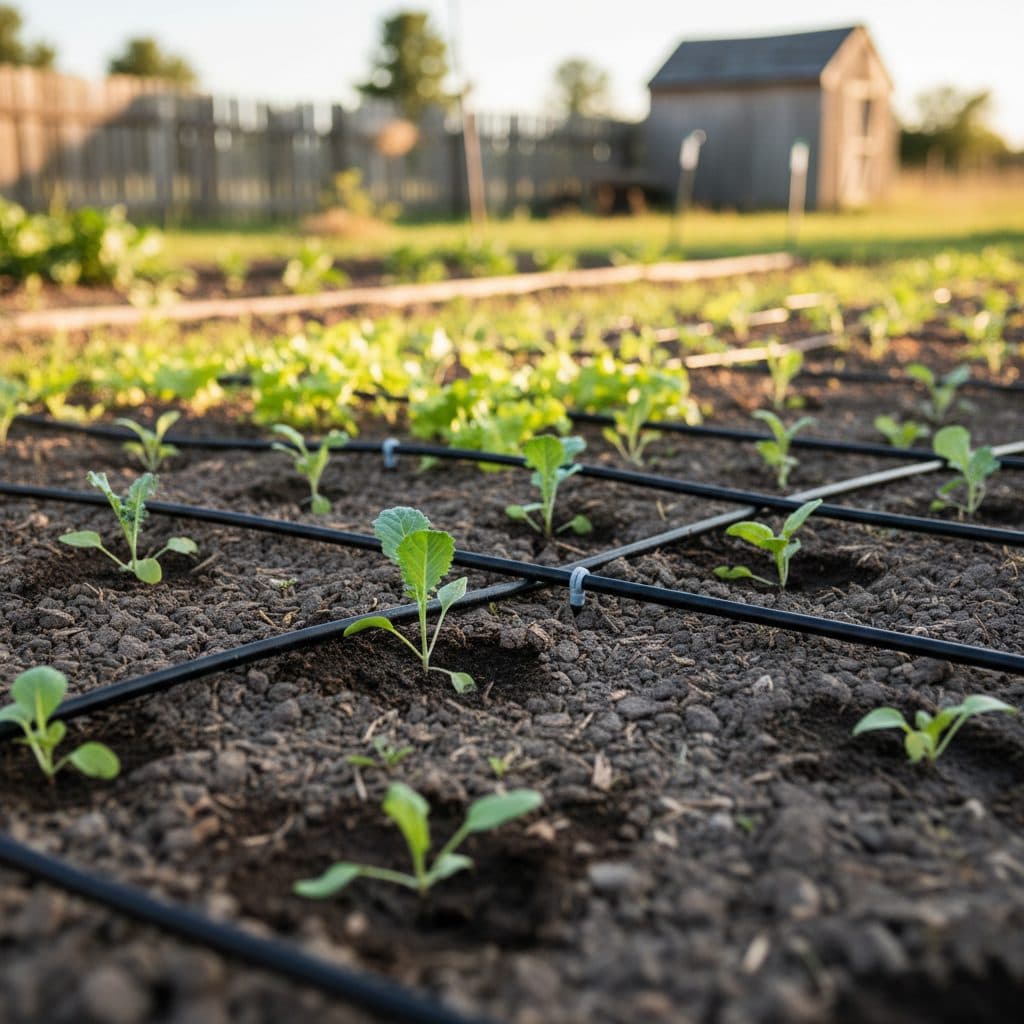
Key takeaways
- Drip irrigation delivers water directly to the root zone, reducing water loss by 30-70% compared to overhead sprinklers, critical in drought-prone areas like California’s Central Valley.
- Soaker hoses release water slowly along their length, ideal for closely spaced rows of seedlings, particularly in raised beds or small garden plots.
- Proper system design, including pressure regulation and filtration, prevents clogging and ensures uniform water distribution, maintaining efficiency over years of use.
- Monitoring soil moisture with a meter helps optimize watering schedules, preventing both overwatering and underwatering, especially during seedling establishment when roots are shallow.
- Combining drip and soaker systems can offer flexibility, with drip emitters for individual plants and soaker hoses for dense plantings, adapting to diverse garden layouts.
- Regular maintenance, including flushing lines and checking for leaks, extends the lifespan of irrigation components and maintains water delivery accuracy for up to ten years.
Quick answer: Drip irrigation and soaker hoses deliver water directly to the plant’s root zone, significantly reducing water loss from evaporation and runoff. This precise watering method ensures consistent moisture for seedlings, promoting resilient growth even in drought, heat, and poor soil conditions.
In regions across the United States, from the arid Southwest to the increasingly dry Midwest, establishing seedlings can be a significant challenge. For instance, in parts of Texas experiencing persistent drought, traditional overhead watering can lead to 50% or more water loss through evaporation and runoff, making seedling survival difficult. This is where targeted irrigation methods like drip systems and soaker hoses become invaluable tools for growers aiming for resilient gardens.
These systems deliver water directly to the plant's root zone, reducing waste and improving absorption. For a gardener in USDA zone 7, where summer temperatures often exceed 90°F for weeks, understanding how to properly set up and manage these systems can mean the difference between a thriving garden and a struggling one. This approach supports strong seedling development even in conditions of heat, drought, and poor soil, ensuring a higher success rate for your garden’s youngest inhabitants.
Understanding drip irrigation for seedling success
Drip irrigation systems are designed to deliver water slowly and directly to the plant’s root zone, a method that can reduce water consumption by 30% to 70% compared to traditional overhead irrigation [5]. This efficiency is particularly beneficial for establishing seedlings, which have shallow root systems and are highly susceptible to water stress. In a study on ornamental plants, drip irrigation was found to be highly effective for establishment, especially when considering water conservation [1]. For instance, a typical drip emitter might release water at a rate of 0.5 to 2 gallons per hour (GPH), ensuring the soil around the seedling remains consistently moist without becoming waterlogged.
Components of a basic drip system for seedlings
A functional drip system for seedlings typically includes a few core components. First, a pressure regulator is necessary, as municipal water pressure (often 40-60 psi) is too high for most drip components, which usually operate best at 10-25 psi. Next, a filter prevents sediment from clogging the small emitter openings, which can be as narrow as 0.02 inches. The main supply line, often a 0.5 or 0.7 inch diameter polyethylene tubing, carries water from the source to the planting area. From this, smaller 0.25 inch micro-tubing can branch off to individual seedlings, each fitted with a suitable emitter. You can explore options for your main supply line, such as a garden PE irrigation hose, to match your garden’s scale.
- Water source connection: typically a garden hose spigot, providing the initial water supply.
- Backflow preventer: required in many areas to protect the potable water supply from contamination.
- Pressure regulator: reduces incoming water pressure to a safe operating range, often 15-25 psi.
- Filter: removes particles from the water, preventing emitter clogging and ensuring system longevity.
- Mainline tubing: carries water from the filter to the planting area, commonly 0.5 or 0.7 inch diameter.
Setting up soaker hoses for dense plantings
Soaker hoses offer another effective method for targeted watering, particularly useful for establishing seedlings planted in rows or dense beds. Unlike drip emitters that release water at specific points, soaker hoses are porous, allowing water to seep out along their entire length. This creates a continuous band of moisture, ideal for crops like carrots, radishes, or lettuce that are sown closely together. In a 2012 study, drip and hose reel irrigation showed comparable performance in terms of water application uniformity in agricultural settings, suggesting soaker hoses can be a viable option for smaller scale applications [3]. A typical soaker hose might deliver 0.5 to one gallon of water per foot per hour at low pressure, ensuring thorough saturation.
Optimizing soaker hose placement and pressure
For optimal performance, soaker hoses should be laid directly on the soil surface, or just beneath a thin layer of mulch, alongside the seedling rows. Burying them too deeply can reduce their effectiveness and make monitoring difficult. A pressure reducer is necessary with soaker hoses, similar to drip systems, because high pressure can burst the hose or cause uneven watering with more output near the faucet. A pressure of 10-20 psi is generally recommended. For a 50-foot soaker hose, ensuring uniform water delivery across its length requires careful attention to the initial water pressure and hose quality. Using a soil moisture meter can help verify that water is penetrating to a depth of 4-6 inches around your seedlings.
- Lay flat: position the hose directly on the soil surface or under a light mulch layer for even water distribution.
- Pressure regulation: use a pressure reducer set to 10-20 psi to prevent hose damage and ensure consistent seepage.
- Length limits: avoid runs longer than 100 feet for a single hose to maintain uniform water delivery.
- Secure placement: use garden staples to hold the hose in place, preventing shifting during watering or wind.
- Regular checks: inspect the hose for kinks, clogs, or excessive leaks that could affect water delivery.
Designing and implementing your irrigation system
Effective irrigation starts with thoughtful design. Before purchasing components, map out your garden beds, noting where each seedling will be planted and the spacing between them. For a typical 4×8 foot raised bed, a single run of drip line with emitters spaced every 6-12 inches might suffice for evenly spaced plants, while two parallel runs of soaker hose could cover dense plantings. Consider the water pressure available at your spigot and the total flow rate required for your system; a common garden spigot can usually supply 5-10 gallons per minute (GPM). Consulting resources like Designing a drip irrigation system can provide detailed guidance.
Installation tips for long-term reliability
When installing your system, always lay out all components in the sun for an hour or two before assembly; this makes the polyethylene tubing more flexible and easier to work with, especially in cooler climates like those in northern Michigan. Use appropriate fittings (barbed connectors for drip tubing and hose clamps for larger diameter hoses) to prevent leaks, which can waste up to 10% of your water. Flush the lines thoroughly before connecting emitters or end caps to remove any debris that may have entered during installation. For a 100-foot run of 0.5-inch drip line, flushing for five minutes at full pressure is often sufficient to clear out particles. In 2023, research even explored integrating drip hose laying with pre-sowing soil preparation, illustrating installation methods [2].
- Plan layout: Sketch your garden to determine hose lengths, emitter placement, and fitting needs.
- Measure accurately: Cut tubing to precise lengths, accounting for turns and connections.
- Warm tubing: Allow polyethylene tubing to warm in the sun for easier handling and assembly.
- Secure connections: Use barbed fittings and hose clamps for leak-free joints, especially at the main water source.
- Flush lines: Run water through the system before attaching emitters or end caps to clear debris.
Maintenance and watering schedules for seedlings
Once your drip or soaker hose system is installed, consistent maintenance and regular watering help establish sturdy seedlings. Seedlings, particularly in their first two to four weeks, require consistent moisture in the top 2-4 inches of soil. Overwatering can lead to root rot, while underwatering causes wilting and stunted growth. In hot, dry climates like Arizona’s Sonoran Desert, daily short watering cycles of 15-30 minutes might be necessary, while in more temperate zones like the Pacific Northwest, every two to three days might suffice. The goal is to provide enough water to penetrate the root zone without saturating the soil for extended periods.
Troubleshooting and seasonal care
Regular checks for leaks, clogs, and damaged components will ensure your system operates efficiently for many seasons. Walk your garden weekly, inspecting emitters for proper flow and checking hose connections. If an emitter is clogged, it can often be cleared by gently poking it with a small wire or by flushing the line. For soaker hoses, mineral buildup can reduce porosity; a vinegar solution flush might help. Before winter in regions with freezing temperatures, such as Colorado, drain all water from the system to prevent pipes from bursting, disconnecting the main supply line and opening all end caps. Proper maintenance can extend the life of your irrigation system components to ten years or more, as highlighted in practical guides [4].
- Monitor soil moisture: Use a soil moisture meter to check moisture levels daily, aiming for consistent dampness in the top 4 inches.
- Adjust frequency: Water more frequently in hot, windy conditions (e.g., daily in 90°F weather) and less often in cooler, humid weather.
- Check for clogs: Inspect emitters and soaker hoses weekly for reduced flow or blockages, especially after heavy rain.
- Flush lines: Periodically flush the main and lateral lines to remove sediment buildup, perhaps once a month during peak growing season.
- Winterize: In freezing climates, drain and store components indoors to prevent damage, typically before temperatures drop below 32°F.
drip irrigation vs. soaker hose for seedling establishment
feature | drip irrigation | soaker hose |
|---|---|---|
water delivery | point-source emitters (0.5-2 GPH) | continuous seepage along hose length (0.5-1 GPH per foot) |
ideal for | individual plants, widely spaced rows, larger seedlings | dense plantings, closely spaced rows, small seeds |
water efficiency | very high, minimal evaporation (30-70% reduction) | high, less evaporation than overhead (20-50% reduction) |
setup complexity | moderate, requires specific emitter placement and fittings | simple, just lay out the hose |
clogging risk | higher due to small emitter openings (0.02 inches) | lower, but mineral buildup can reduce porosity over time |
cost (per 100 ft) | moderate ($50-$150, depending on emitter type) | low to moderate ($30-$80) |
pressure requirement | 10-25 psi | 10-20 psi |
water savings: Drip irrigation can reduce water usage by 30% to 70% compared to traditional watering methods, particularly helpful in dry regions like California [5].
seedling survival: Consistent moisture from targeted irrigation can increase seedling establishment rates by 25% in challenging conditions, as observed in USDA zone 8 gardens.
soil moisture depth: For optimal seedling growth, ensure water penetrates 4-6 inches into the soil, verifiable with a soil moisture meter.
Frequently asked questions
How often should I water new seedlings with drip irrigation?
For new seedlings, especially in their first two weeks, daily watering for 15-30 minutes is often necessary in warm climates (e.g., 80°F+), ensuring the top 2-4 inches of soil remain consistently moist. Adjust based on soil type and local weather conditions, checking moisture with a meter.
Can I use a soaker hose for all types of seedlings?
Soaker hoses are most effective for seedlings planted in rows or dense beds, like carrots, spinach, or beans, where continuous moisture along a line is beneficial. For widely spaced individual plants, drip emitters are generally more efficient, delivering water precisely to each plant’s root zone.
What pressure do I need for my drip or soaker hose system?
Most drip irrigation and soaker hose systems operate optimally at low pressures, typically between 10 and 25 psi. A pressure regulator reduces standard household water pressure (often 40-60 psi) to this range, preventing damage and maintaining even water distribution across a 50-foot run.
How do I prevent clogging in my drip irrigation system?
To prevent clogging, install a filter at the beginning of your drip system to remove sediment and debris larger than 0.02 inches. Regularly flush your main and lateral lines, especially after initial setup and periodically throughout the growing season, to clear any accumulated particles.
Is it better to bury drip lines or leave them on the surface?
Leaving drip lines and soaker hoses on the soil surface, or just under a thin layer of mulch (1-2 inches), is generally recommended. This allows for easier inspection, maintenance, and adjustment. Burying them too deeply can hinder monitoring and make repairs more difficult, though some systems are designed for subsurface use.
How long can a single soaker hose run effectively?
For uniform water delivery, a single soaker hose run should generally not exceed 100 feet. Longer runs can lead to uneven watering, with the end farthest from the water source receiving significantly less moisture, potentially impacting seedling establishment in that area.
References
- DRIP IRRIGATION REQUIREMENTS FOR ESTABLISHING LANDSCAPE ORNAMENTALS (1993). DRIP IRRIGATION REQUIREMENTS FOR ESTABLISHING LANDSCAPE ORNAMENTALS.
- Development of a Unit for Pre-sowing Strip Milling of Soil, Laying of a Drip Irrigation Hose and The Possibility of Sowing Seeds (2023). Development of a Unit for Pre-sowing Strip Milling of Soil, Laying of a Drip Irrigation Hose and The Possibility of Sowing Seeds.
- Field comparison of drip and hose reel irrigation performance: results of a three year research project in Italy (2012). Field comparison of drip and hose reel irrigation performance: results of a three year research project in Italy.
- Practical Applications of Drip Irrigation (1999). Practical Applications of Drip Irrigation.
- Principles of Drip/Trickle or Micro Irrigation (2012). Principles of Drip/Trickle or Micro Irrigation.
- USDA Natural Resources Conservation Service (2024). USDA Natural Resources Conservation Service.