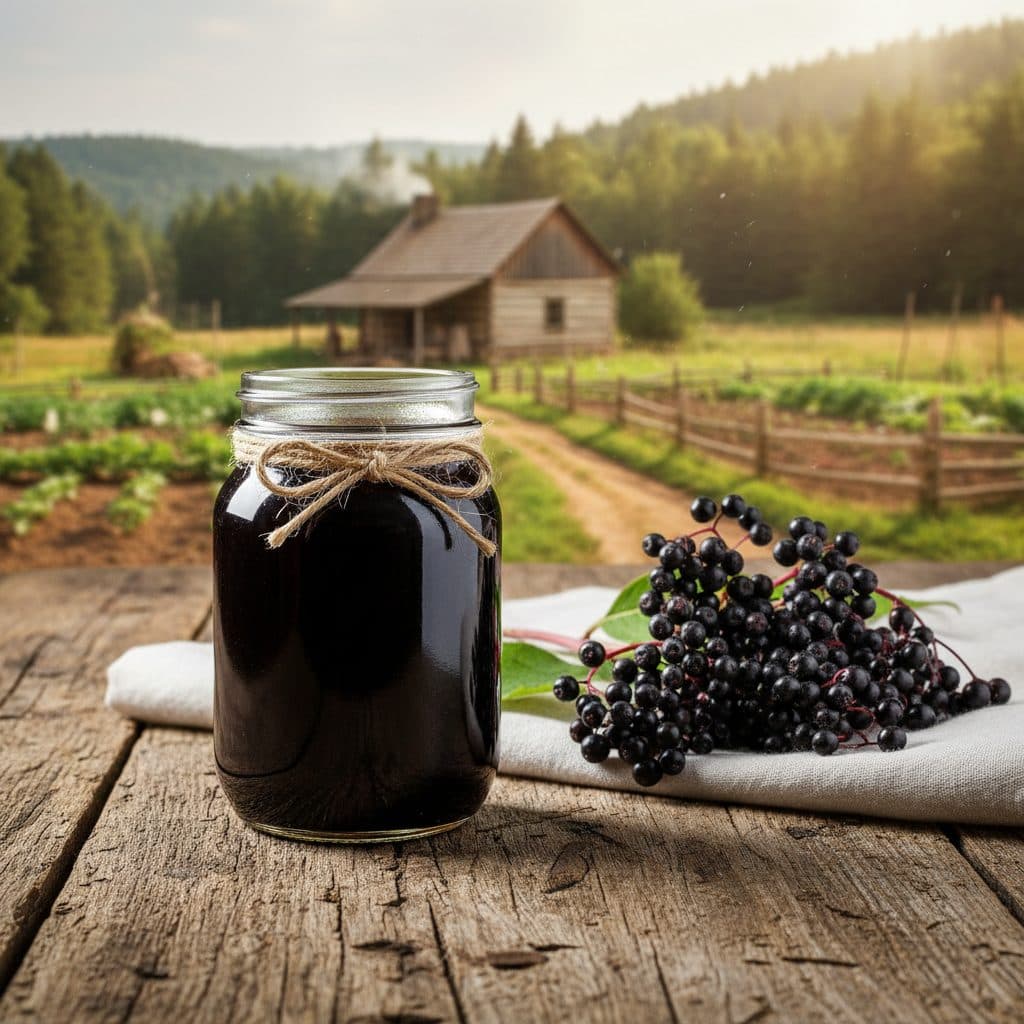
Key takeaways
- Elderberries (Sambucus nigra) thrive in USDA zones 3 to 9, preferring well-drained soil with a pH between 5.5 and 6.5.
- A standard elderberry syrup recipe involves a 2:1 water-to-berry ratio, simmered for 45 minutes to extract beneficial compounds.
- Adding warming spices like cinnamon and ginger improves flavor, typically using one teaspoon of spice per cup of berries.
- Store homemade elderberry syrup in the refrigerator for up to three months, or freeze it for six months to extend its shelf life.
- Sourcing elderberries ethically involves knowing local wild patches or planting your own for a harvest of 10 to 15 pounds per mature bush.
- Always use cooked elderberries for syrup, as raw berries contain compounds that can cause digestive upset if consumed in significant quantities.
Quick answer: To make elderberry syrup, grow or ethically source Sambucus nigra berries, then simmer them with water and spices before straining and adding honey. Store the homemade syrup in the refrigerator for up to three months or freeze for longer preservation.
Across the United States, from the humid southern states to the cooler northern regions, many growers are turning to their own backyards for medicinal plants. In USDA zone 6, for instance, a well-established elderberry bush can provide a substantial harvest each year, often yielding 10 to 15 pounds of berries. This bounty offers a tangible way to prepare for the cold and flu season, moving beyond store-bought remedies to something made with your own hands and local resources.
Making elderberry syrup is a time-honored practice, rooted in generations of home-based care. The process includes sourcing berries, simmering the fruit with water and spices, and storing the finished syrup safely.
Understanding elderberries and their season
Elderberries are deciduous shrubs or small trees. The species US growers plant is American elderberry, Sambucus canadensis (treated by some authorities as Sambucus nigra subsp. canadensis); European black elder, Sambucus nigra, is the species most supplement research uses. Cultivars such as ‘Adams’ and ‘York’ are American elderberry. In the US, they are hardy across a broad range of climates, thriving particularly well in USDA zones 3 to 9. These plants prefer full sun to partial shade and moist, well-drained soil with a pH level between 5.5 and 6.5. A mature elderberry bush can grow to 10 or 12 feet tall and wide, becoming a significant feature in a home garden or a productive part of a hedgerow.
Identifying and harvesting ripe elderberries
Correctly identifying ripe elderberries is necessary for safety. The berries typically mature from late July through September, depending on your specific region and local weather patterns. They should be a deep purple or black color, plump, and soft to the touch. Unripe green berries should be avoided, as they contain higher concentrations of the compounds that cause digestive upset. Red berries are not unripe black elderberries at all: they are a different species, red elderberry (Sambucus racemosa), whose seeds are toxic and which stays red when fully ripe. Never treat a red-fruited cluster as an immature one that will darken later. When harvesting, cut the entire cyme (the berry cluster) instead of picking individual berries, which makes de-stemming easier. A single mature bush can produce a substantial harvest, often between 10 and 15 pounds of berries in a good year, providing enough for several batches of syrup and other preparations. Elderberry can also be grown alongside other medicinal perennials in a home garden.
- Look for deep purple or black berries, not green or red.
- Harvest from late July to September in most US regions.
- Cut entire cymes for easier processing.
- Expect 10 to 15 pounds of berries from a mature bush.
- Avoid any berries that appear unripe or damaged.
Sourcing quality elderberries in the US
For many home apothecaries, sourcing high-quality elderberries is the first crucial step. You have a few options: cultivating your own plants, foraging responsibly, or purchasing from reputable suppliers. If you’re growing your own, selecting a variety suited to your local climate, such as ‘Adams’ or ‘York’ for colder USDA zones like 4 or 5, can significantly improve your yield. These varieties are known to produce larger berries and more abundant harvests, often reaching 12 to 15 pounds per mature plant after three to four years of growth.
Ethical foraging and cultivation practices
When foraging wild elderberries, it’s essential to practice sustainable harvesting. Always leave at least 25% of the berries on the bush for wildlife and to allow the plant to regenerate. Be absolutely certain of your identification. The lookalikes that send people to hospital are pokeweed (Phytolacca americana), whose purple berries hang in a single unbranched raceme from a thick magenta stem rather than a flat-topped branched cyme, and water hemlock (Cicuta spp.), which shares elder's compound leaves and umbel-shaped flower heads and is among the most poisonous plants in North America. Elder has opposite leaves and pithy, not hollow, stems. The USDA Natural Resources Conservation Service provides excellent resources for identifying native plants in your region [6]. If you’re planting elderberries, ensure your soil conditions are optimal. A soil test can help monitor pH levels to maintain the 5.5 to 6.5 range, ensuring adequate moisture during dry spells. Planting two different varieties near each other improves pollination and fruit set; elderberry is partially self-fertile but crops noticeably better with a second cultivar within about 60 feet.
- Cultivate your own elderberry bushes for consistent harvests.
- Forage responsibly, leaving at least 25% of berries for wildlife.
- Always positively identify plants before harvesting any wild berries.
- Consider purchasing dried berries from certified organic suppliers.
- Ensure proper soil pH and moisture for optimal growth.
The elderberry syrup recipe: step-by-step
Crafting elderberry syrup at home is a straightforward process. Treat the result as a traditional comfort preparation rather than a treatment: clinical evidence for elderberry against colds and flu is limited and mixed, it is no substitute for vaccination or medical care, and a high fever or any difficulty breathing needs a doctor. The basic recipe requires just a few ingredients and about one hour of active preparation time. For a standard batch, you’ll need two cups of fresh or one cup of dried elderberries, four cups of filtered water, and one cup of raw local honey. The ratio of water to berries is typically 2:1, ensuring proper extraction of beneficial compounds without over-diluting the syrup.
Preparing your elderberry syrup
First, de-stem the elderberries thoroughly. This step is necessary because stems contain compounds that can cause stomach upset. A fork can be helpful for this task, gently raking the berries off their stems. Once de-stemmed, combine the berries and water in a non-reactive pot, like stainless steel, and bring to a boil. Reduce the heat and simmer for 45 minutes to one hour, or until the liquid has reduced by about one-third. The berries should be soft and slightly mushy. After simmering, remove the pot from the heat and mash the berries gently with a potato masher or the back of a spoon to extract more juice. Strain the mixture through a fine-mesh sieve or cheesecloth into a clean bowl, pressing down on the solids to extract as much liquid as possible. Discard the solids. Allow the liquid to cool to below 110°F (about 43°C) before stirring in the honey. Adding honey at a lower temperature preserves its beneficial enzymes and properties. You can also add complementary herbs like garden sage for flavor, typically one tablespoon of dried herb per batch, though sage contains thujone and is traditionally avoided during pregnancy and while breastfeeding, where it can suppress milk supply.
- Use a 2:1 water-to-berry ratio for optimal extraction.
- Simmer for 45 minutes to one hour, reducing liquid by one-third.
- Mash berries gently after simmering to release more juice.
- Strain thoroughly through a fine-mesh sieve or cheesecloth.
- Cool liquid to below 110°F before adding honey to preserve enzymes.
Storage, safety, and variations
Proper storage is key to maximizing the shelf life and potency of your homemade elderberry syrup. Once prepared, pour the cooled syrup into sterilized glass jars with tight-fitting lids. Store the syrup in the refrigerator. Two to three months is commonly quoted, but a honey-and-water syrup has no validated home shelf life, so date the jar, inspect it each time you open it, and discard it at the first sign of mold, fizzing or a fermented smell. For longer preservation, elderberry syrup can be frozen in ice cube trays or freezer-safe containers for up to six months. Thaw individual portions as needed, which can be particularly convenient during the peak cold and flu season from October to March.
Important safety considerations and recipe variations
Never consume raw elderberries or any part of the elderberry plant other than the cooked, ripe berries. It is equally important that this syrup contains raw honey: never give it to a child under 12 months old. Raw honey can carry Clostridium botulinum spores, which cause infant botulism. For that age group, use a maple-syrup base and speak to a pediatrician first. Raw berries, leaves, stems, and bark contain compounds called cyanogenic glycosides, which can cause nausea, vomiting, and diarrhea if ingested in large quantities. Cooking the berries neutralizes these compounds, making them safe for consumption. When considering variations, many growers like to add warming spices during the simmering process. Common additions include one stick of cinnamon, five whole cloves, or one tablespoon of grated fresh ginger per two cups of berries. These spices improve the flavor and are traditional additions to the syrup. For a thicker syrup, you can reduce the liquid further during simmering, aiming for a 50% reduction in volume instead of 33%. Honey is the traditional choice. Work from the volumes in the recipe above rather than a fixed ratio (one cup of honey to the reduced liquid from two cups of berries), and bear in mind that a thinner syrup keeps for less time.
- Store refrigerated syrup for up to three months.
- Freeze syrup for longer storage, up to six months.
- Always cook elderberries thoroughly to neutralize harmful compounds.
- Add warming spices like cinnamon, cloves, or ginger for flavor.
- Consider reducing liquid further for a thicker consistency.
Harvest Time: Elderberries are typically ready for harvest from late July to September across much of the US, yielding up to 15 pounds per mature bush in good conditions.
Storage Life: Properly stored elderberry syrup can last for three months in the refrigerator or six months when frozen at 0°F, providing sustained access through winter.
Frequently asked questions
Are raw elderberries safe to eat?
No, raw elderberries are not safe to eat. They contain cyanogenic glycosides that can cause digestive issues. Always cook elderberries thoroughly before consumption, such as simmering them for at least 45 minutes when making syrup.
How long does homemade elderberry syrup last?
Homemade elderberry syrup, when stored in a sealed container in the refrigerator, typically lasts for up to three months. For longer storage, it can be frozen for up to six months, maintaining its potency.
What is the best way to harvest elderberries?
The best way to harvest elderberries is to cut the entire cyme, or berry cluster, when the berries are deep purple or black. This method makes de-stemming easier and helps ensure you only pick ripe berries, with a mature bush yielding 10 to 15 pounds.
Can I use dried elderberries for syrup?
Yes, you can use dried elderberries for syrup. Generally, use half the amount of dried berries as you would fresh berries. For example, if a recipe calls for two cups of fresh berries, use one cup of dried elderberries.
What USDA zones do elderberries grow in?
Elderberries (Sambucus nigra) are remarkably adaptable and can thrive in a wide range of climates across the United States. They are typically hardy in USDA zones 3 to 9, tolerating winter temperatures down to -30°F.
References
- Comparative Study for Acute Oral Toxicity of Elderberry Extract and Elderberry Propolis Syrup in Murine Model (2025). Comparative Study for Acute Oral Toxicity of Elderberry Extract and Elderberry Propolis Syrup in Murine Model.
- To Make 5 Elements Theory Elderberry Syrup (2018). To Make 5 Elements Theory Elderberry Syrup.
- Elderberry Season (2026). Elderberry Season.
- THE DESIGNING A RECIPE FOR YOGURT ENRICHED WITH HEMP FLOUR, JERUSALEM ARTICHOKE SYRUP AND AGAVE SYRUP (2022). THE DESIGNING A RECIPE FOR YOGURT ENRICHED WITH HEMP FLOUR, JERUSALEM ARTICHOKE SYRUP AND AGAVE SYRUP.
- Elderberry Season (2026). Elderberry Season.
- USDA Natural Resources Conservation Service (2024). USDA Natural Resources Conservation Service.