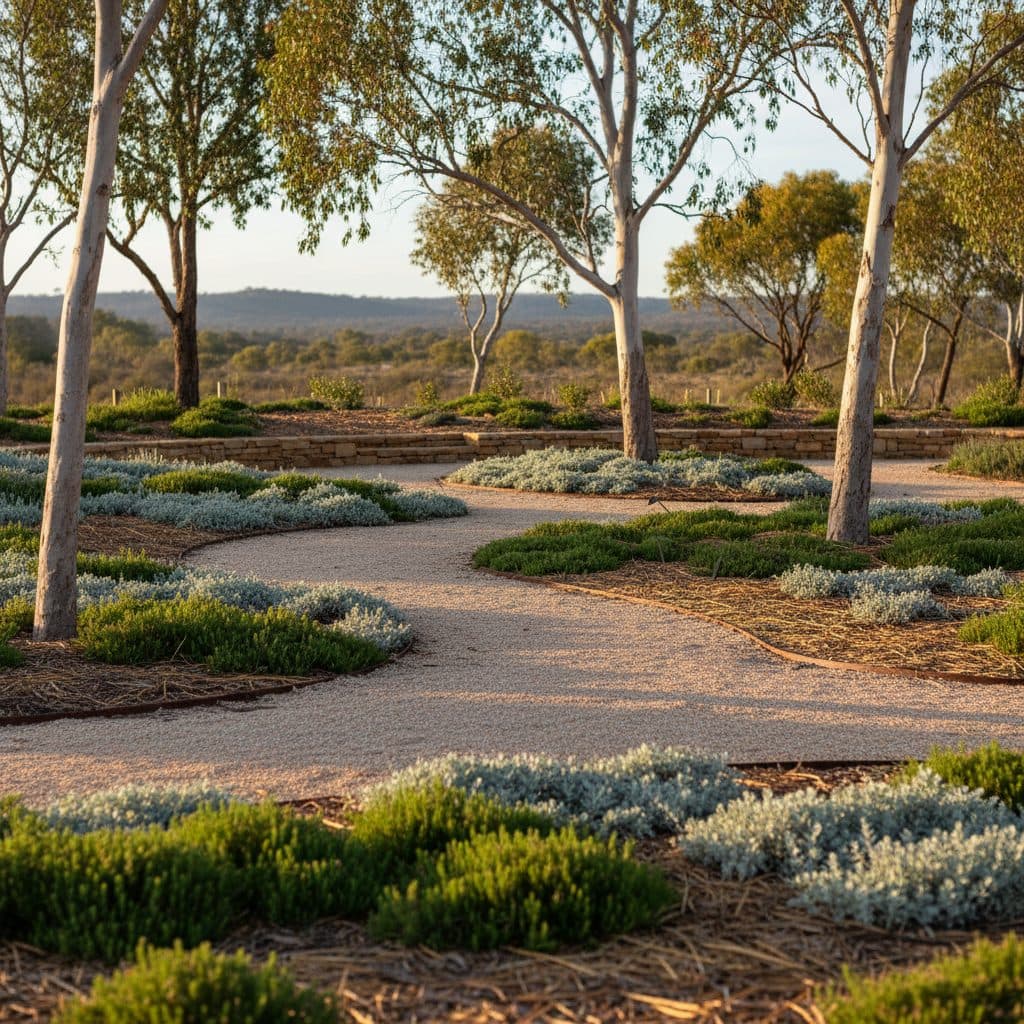
Key takeaways
- No plant is fireproof; under extreme bushfire conditions with high radiant heat, all vegetation will burn.
- Select slower-to-ignite plants with high foliage moisture content, low volatile oil levels, and smooth tight bark.
- Avoid highly flammable species near buildings, especially those with loose ribbon bark, fine needle foliage, or high terpene content.
- Structure your property around defendable space zones to create fuel breaks and trap flying embers away from the house.
- Consult your state or territory fire authority for local landscaping guidelines, council vegetation overlays, and clearance rules.
Quick answer: No plant is fireproof, but selecting slower-to-ignite species with high leaf moisture and low volatile oil content reduces fuel loads around homes. When integrated into defendable space zones following state fire authority guidelines, fire-retardant landscaping slows fire spread, reduces radiant heat, and catches flying embers.
Living in the Australian landscape means sharing an environment shaped by fire. For property owners in peri-urban fringes, regional towns, and rural acreages, garden design is an essential element of property protection. Searching for fire retardant plants in australia is a common starting point for home gardeners seeking to reduce bushfire risk around their dwellings.
However, a fundamental safety rule must be stated clearly: no plant is completely fireproof. Given enough heat, dry winds, and direct flame contact, every plant will ignite and burn. The objective of bushfire-wise landscaping is not to create an indestructible garden, but rather to select lower-flammability plants that are slower to ignite, produce less radiant heat, and act as physical shields against wind-blown burning embers.
By understanding plant flammability traits, establishing structured defendable space zones, and consulting official state fire authority guidelines, you can design a productive garden that also protects your property.
Understanding plant flammability: what makes a plant slower to ignite?
How a plant behaves during a bushfire depends on its physical and chemical properties. Recognizing these characteristics helps you evaluate both native and exotic species for your garden:
High-flammability traits to avoid near homes
- High volatile essential oils: Leaves containing high levels of terpenes, eucalyptus oils, and resins (such as many Eucalyptus, Melaleuca, Leptospermum, and Callistemon species) volatilise under extreme radiant heat, so the foliage ignites faster and burns hotter than low-oil leaves.
- Loose, stringy, or ribbon bark: Trees with peeling, fibrous bark (Eucalyptus obliqua, Eucalyptus globulus) provide ladder fuels that carry ground fires straight into the canopy, while shedding burning embers that blow kilometres ahead.
- Fine, needle-like foliage: Narrow, dry needles (such as pines and certain casuarinas) have high surface-area-to-volume ratios, drying out and catching fire almost instantly.
- Retention of dead twigs and litter: Plants that hold dead leaves and dry twigs within their inner canopy act as pre-packaged kindling.
Lower-flammability (slower-to-ignite) traits
- High leaf moisture and salt content: Fleshy, broad, succulent leaves require immense radiant energy to boil off internal moisture before ignition can occur.
- Low volatile oil content: Plants with watery sap rather than volatile resins burn far more slowly.
- Smooth, tight bark: Trees with non-fibrous bark (Angophora costata, deciduous fruit trees) do not hold embers or allow flames to climb trunks easily. Bark type is only one trait: smooth-barked eucalypts such as Corymbia citriodora still carry high volatile leaf oils and shed litter, so smooth bark alone does not make a tree suitable near buildings.
- Open, sparse crowns: Foliage that does not form dense, continuous fuel ladders reduces radiant heat transmission.
+-------------------------------------------------------------+
|               PLANT FLAMMABILITY CHARACTERISTICS            |
|                                                             |
| Lower Flammability (Slower to Ignite)  High Flammability    |
| ------------------------------------   -----------------    |
| High leaf moisture & salt content      High essential oils  |
| Watery sap (Low resin / terpene)       Resins and terpenes  |
| Smooth, tight, non-fibrous bark        Stringy, ribbon bark |
| Broad, fleshy, succulent leaves        Fine needle foliage  |
| Sheds dead twigs cleanly               Retains dead twigs   |
+-------------------------------------------------------------+
Structuring defendable space landscaping around the home
Plant selection alone cannot protect a home; spatial arrangement and fuel separation are equally critical. Bushfire agencies recommend dividing your landscape into managed defendable space zones:
Inner zone: the ground immediately around the house
The immediate perimeter must prevent direct flame contact and minimize radiant heat:
- Maintain non-combustible pathways using gravel, crushed stone, concrete, or paving stones directly against exterior walls.
- Avoid planting shrubs directly beneath windows, timber decks, or under eaves.
- Use green lawns, irrigated vegetable patches, or low-growing succulent ground covers rather than dry wood mulches.
- Ensure tree canopies do not overhang rooflines or touch gutters.
Outer zone: beyond the inner zone, out to your assessed defendable space boundary
The outer garden acts as an ember shield and windbreak:
- Group plants into separated garden beds or clumping islands rather than continuous vegetation corridors.
- Prune lower tree branches up to 2 metres from the ground to eliminate fuel ladders.
- Separate tree crowns so fire cannot travel canopy to canopy. The required separation differs between the inner and outer zone and between states — take the figure from your state fire authority's defendable space standard and your property's BAL assessment, not from a generic guide.
- Plant broadleaf windbreaks perpendicular to prevailing fire winds to filter wind speed and trap flying embers.
+-------------------------------------------------------------+
|             DEFENDABLE SPACE LANDSCAPE ZONING               |
|                                                             |
|   [ OUTER DEFENDABLE ZONE: 10m to 30m+ ]                    |
|   - Separated plant clumps and windbreak screens            |
|   - Pruned lower tree limbs (2m ground clearance)           |
|   - Crown separation between mature trees                   |
|                                                             |
|       [ INNER DEFENDABLE ZONE: 0m to 10m ]                  |
|       - Gravel paths, paving, irrigated lawn                |
|       - Low succulent ground covers (Pigface, Saltbush)     |
|       - Zero overhanging branches or shrubs under eaves     |
|                                                             |
|             +-------------------------------+               |
|             |        RESIDENTIAL HOME       |               |
|             +-------------------------------+               |
+-------------------------------------------------------------+
Lower-flammability native and exotic plants for Australian gardens
When planning your landscape, select species suited to your local climate and soil conditions:
1. Ground covers and succulents (Inner and Outer Zones)
- Pigface (Carpobrotus glaucescens / Disphyma crassifolium subsp. clavellatum): Native coastal succulents with fleshy, moisture-laden leaves that carpet bare earth and resist ignition.
- Creeping Saltbush (Atriplex semibaccata): Native saltbush with high mineral and salt content in its foliage, making it exceptionally slow to burn.
- Creeping Boobialla (Myoporum parvifolium): A dense native ground cover with succulent green foliage that suppresses weeds and retains soil moisture.
- Kidney Weed (Dichondra repens): Low-growing native ground cover suitable for shaded and irrigated zones around paths.
2. Shrubs and hedging (Outer Zone)
- Coastal Rosemary (Westringia fruticosa): A hardy native shrub with relatively low oil content compared to other coastal species; useful for formal hedging when pruned cleanly.
- White Correa (Correa alba): Drought-hardy native shrub with thick, leathery leaves and low flammability.
- Lilly Pilly (Syzygium australe / Syzygium smithii, formerly Acmena smithii): Fleshy-leaved rainforest natives that serve as dense, moisture-rich hedge screens in well-watered zones.
- Sweet Viburnum (Viburnum odoratissimum): A broadleaved exotic evergreen with high leaf moisture and low flammability. Viburnum tinus (laurustinus) has similar fire behaviour but is a bird-spread environmental weed in south-eastern Australia — do not plant it near bushland; check your council's weed list first.
3. Canopy and windbreak trees (Outer Zone)
- Blackwood (Acacia melanoxylon): A native tree with broad phyllodes and higher leaf moisture than eucalypts, useful in the outer zone as a screen that intercepts wind-borne embers. Note that mature trunks develop rough fissured bark, that it suckers vigorously from disturbed roots, and that it is an environmental weed outside its natural south-eastern range — plant it only where it is locally indigenous.
- Native Frangipani (Hymenosporum flavum): Rainforest tree with glossy, non-resinous leaves and smooth bark.
- Deciduous fruit trees (Apples, Pears, Figs, Mulberries): When well-irrigated in orchards or home gardens, broadleaf deciduous fruit trees have high moisture content and low flammability during peak summer fire season.
Reviewing xeriscape productive garden design and plants and amendments for clay soil assists with selecting drought-resilient species.
+-------------------------------------------------------------+
|        LOWER-FLAMMABILITY SPECIES FOR AU DEFENDABLE SPACE   |
|                                                             |
| Species Name          Plant Type     Zone Position  Origin  |
| ------------          ----------     -------------  ------  |
| Pigface               Ground Cover   Inner Zone     Native  |
| Creeping Saltbush     Ground Cover   Inner Zone     Native  |
| Creeping Boobialla    Ground Cover   Inner Zone     Native  |
| Coastal Rosemary      Medium Shrub   Outer Zone     Native  |
| Lilly Pilly           Hedging Shrub  Outer Zone     Native  |
| Blackwood Acacia      Canopy Tree    Outer Zone     Native  |
| Native Frangipani     Small Tree     Outer Zone     Native  |
| Deciduous Fig / Apple Fruit Tree     Outer Zone     Exotic  |
+-------------------------------------------------------------+
Practical garden maintenance to reduce bushfire hazards
Even lower-flammability plants become fire hazards if allowed to accumulate dead wood and dry debris. Routine maintenance before and during fire season is essential:
- Clear leaf litter and dead twigs: Rake up dry leaves, fallen bark, and dead twigs from beneath garden beds, especially in the inner defendable zone.
- Mulch management: As discussed in organic mulches and fire considerations, replace fine, dry wood chips and pine bark with gravel, crushed rock, or living ground covers near buildings.
- Pruning dead growth: Regularly prune dead branches, spent flower spikes, and dry under-foliage from shrubs and hedges in spring before hot summer conditions arrive.
- Maintain emergency water access: Ensure garden irrigation systems, such as drip irrigation system design, and rainwater harvesting barrels and storage are fitted with standardized fittings (such as Storz couplings where required by local fire brigades) so firefighters can access water reserves.
Consulting your state fire authority for local guidelines
Bushfire behavior, vegetation clearing laws, and planning overlays vary significantly across different states, territories, and local councils in Australia. Never rely solely on generic plant lists. Always consult official guidance from your state fire service:
- Victoria: Country Fire Authority (CFA), Landscaping for Bushfire guidelines.
- New South Wales: NSW Rural Fire Service (RFS), Standards for Asset Protection Zones.
- South Australia: South Australian Country Fire Service (CFS), Fire and Garden Design guides.
- Queensland: Queensland Fire Department (QFD), Bushfire safety and property preparation.
- Western Australia: Department of Fire and Emergency Services (DFES), Bushfire protection planning.
- Tasmania: Tasmania Fire Service (TFS), Bushfire-ready gardening resources.
Check with your local council regarding municipal vegetation protection overlays before removing mature trees, and determine your property's Bushfire Attack Level (BAL) rating to ensure your building and landscaping comply with relevant Australian standards.