Key takeaways
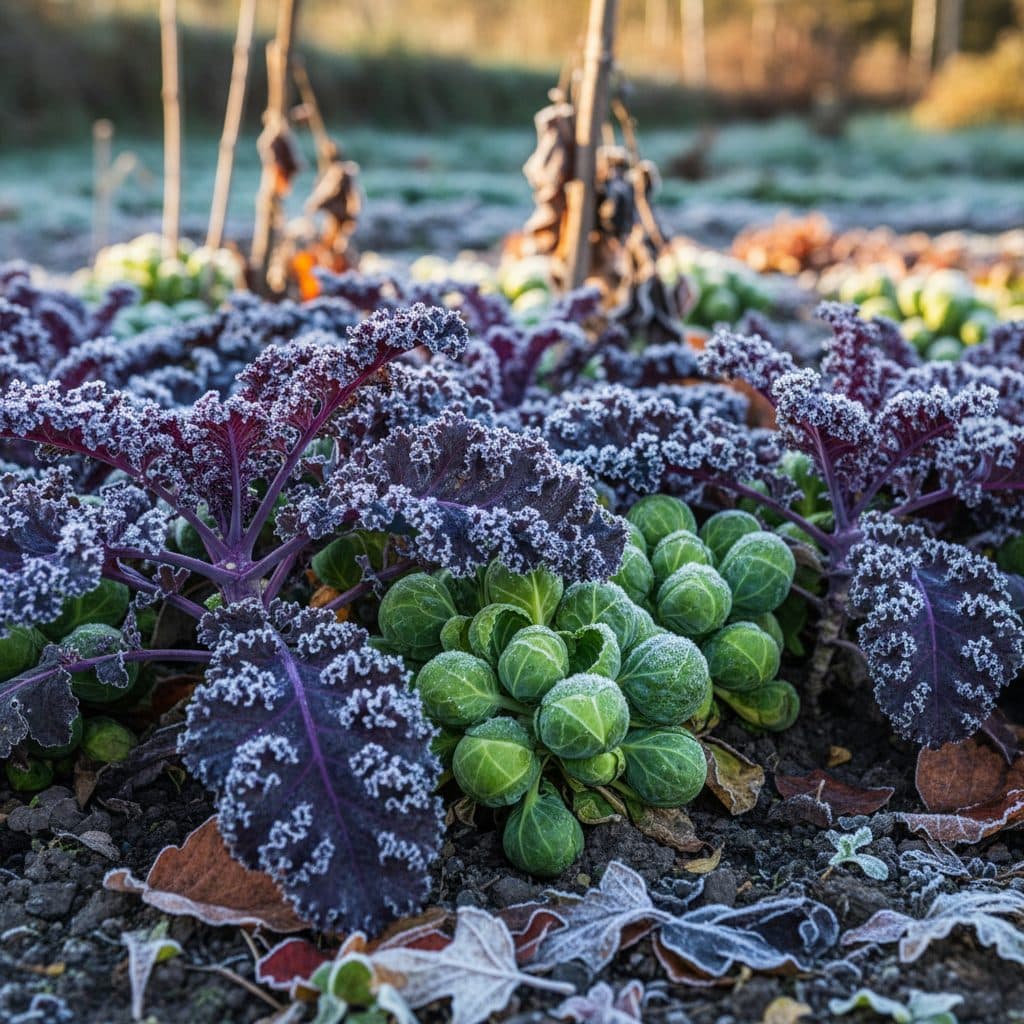
- Frost-tolerant vegetables survive light frosts (28°F to 32°F) and hard freezes (down to 15°F to 20°F) by concentrating cell sugars that act as natural antifreeze.
- Cold-hardy greens like kale, spinach, collards, and mâche develop noticeable sweetness and tender texture after exposure to multiple autumn frosts.
- Root crops like carrots, parsnips, rutabagas, and turnips can be stored directly in frozen garden soil under a thick 8 to 12-inch layer of straw mulch.
- Planting schedules must be calculated backward from your local average first fall frost date to ensure crops mature before day length drops below ten hours.
- Adding low tunnels, cold frames, or floating row covers elevates ambient temperatures by 4°F to 8°F, allowing continuous winter harvesting.
Quick answer: The best frost-tolerant vegetables are super-hardy greens (kale, spinach, collards, mâche), Brussels sprouts, cold-tolerant roots (carrots, parsnips, rutabagas, turnips), and alliums (leeks, garlic). These crops convert complex starches into protective natural sugars after freezing, which increases their sweetness and flavor throughout late fall and winter.
When autumn arrives and the first frost blackens tender summer crops like tomatoes, peppers, and squash, many gardeners assume the growing season has ended. However, planting frost-tolerant vegetables opens a second harvest window that extends through late fall, winter, and into early spring.
Many cold-hardy vegetables improve in eating quality after sub-freezing weather. When temperatures drop below freezing, biennial and perennial vegetable species trigger biological defenses that concentrate dissolved sugars in their cells. This internal antifreeze protects cell membranes from ice damage while turning bitter greens sweet and tender.
By categorizing cold-tolerant crops by their specific freeze thresholds and deploying simple season-extension techniques, you can harvest fresh, nutrient-dense produce straight from the garden all winter long.
+-------------------------------------------------------------+
|              COLD HARDINESS TIERS SUMMARY                   |
|                                                             |
|   TIER             TEMP THRESHOLD       REPRESENTATIVE CROPS|
|   ----             --------------       --------------------|
|   Semi-Hardy       28°F to 32°F (-2°C)  Chard, Beets, Radish|
|   Hardy            20°F to 28°F (-6°C)  Broccoli, Cabbage   |
|   Super-Hardy      10°F to 20°F (-12°C) Kale, Spinach, Mâche|
|   Overwintering    Below 0°F (-18°C)    Parsnips, Garlic    |
+-------------------------------------------------------------+
Why do vegetables become sweeter after a frost?
Each plant cell sits inside a rigid cellulose wall, and the living contents inside that wall are mostly water. When temperatures drop below 32°F (0°C), water outside plant cells begins to crystallize into ice. If ice forms inside the cells, the sharp crystals puncture cell membranes, causing the plant to turn to mush when thawed.
To survive, frost-tolerant plants initiate cold acclimation:
- Starch-to-sugar conversion: The plant activates enzymes that rapidly break down stored complex starches into simple soluble sugars (glucose, fructose, and sucrose).
- Freezing point depression: High concentrations of dissolved sugars lower the freezing point of water inside the cell cytoplasm, preventing intracellular ice crystallization.
- Flavor transformation: These concentrated sugars mask natural sulfur compounds and bitterness in brassicas and root vegetables, producing sweet, rich flavor profiles that summer-harvested produce cannot match.
To schedule your late-summer seed sowings for optimal autumn sugar accumulation, review our guide to fall and winter gardening from midsummer sowing.
+-------------------------------------------------------------+
|              PHYSIOLOGY OF FROST SWEETENING                 |
|                                                             |
|   Cold Temperature Trigger (<32°F / 0°C)                    |
|        |                                                    |
|        v                                                    |
|   Enzymes break down complex starches into simple sugars    |
|        |                                                    |
|        v                                                    |
|   Cytoplasm sugar density increases -> Antifreeze effect    |
|        |                                                    |
|        v                                                    |
|   Result: Prevents cell rupture & enhances culinary sweet   |
+-------------------------------------------------------------+
What are the four tiers of frost-hardy vegetables?
Selecting vegetables based on their precise temperature tolerance prevents unexpected crop loss as winter deepens.
Tier 1: semi-hardy crops (tolerates light frost: 28°F to 32°F / -2°C to 0°C)
These crops handle light autumn morning frosts but should be harvested before sustained temperatures drop into the mid-20s:
- Leaf lettuce and endive: Looseleaf varieties tolerate light frost if sheltered beneath a row cover.
- Swiss chard and beet greens: Foliage softens under freezing temperatures but quickly recovers once thawed by morning sun.
- Radishes and celery: Crisp roots and stems remain edible through light frosts.
Tier 2: hardy crops (tolerates moderate freezes: 20°F to 28°F / -6°C to -2°C)
These vegetables easily survive repeated freezing nights without structural damage:
- Broccoli and cabbage: Tightly formed heads and thick, waxy leaves resist moderate frosts.
- Kohlrabi and rutabagas: Bulbing stems and dense roots remain firm in cold soil.
- Bok choy and tatsoi: Asian greens with spoon-shaped leaves that form low-growing, cold-resistant rosettes.
Tier 3: super-hardy crops (tolerates hard freezes: 10°F to 20°F / -12°C to -6°C)
These winter crops continue providing fresh harvests through freezing conditions:
- Kale (Curly, Dinosaur/Lacinato, and Siberian): Plants freeze solid at night and thaw back to life the following afternoon without damage.
- Spinach: Extremely cold-hardy; established plants overwinter under snow cover and burst into rapid growth in early spring. Under a low tunnel or reliable snow cover, established spinach survives considerably colder nights than bare-ground plants.
- Brussels sprouts: Flavor improves dramatically after several heavy freezes; harvest sprouts from the bottom of the stalk upward.
- Mâche (Corn Salad) and Claytonia (Miner's Lettuce): Delicate winter salad greens that grow through freezing temperatures.
Tier 4: fully overwintering crops (survives below 0°F / -18°C)
- Parsnips: Can be left directly in the ground throughout winter and harvested in early spring when they reach maximum sweetness.
- Garlic and multiplier onions: Cloves planted in fall develop hardy root systems that survive deep frozen ground under snow.
+-------------------------------------------------------------+
|              FROST-TOLERANT CROP SELECTION MATRIX           |
|                                                             |
|   CROP            HARDINESS LIMIT    BEST HARVEST WINDOW    |
|   ----            ---------------    -------------------    |
|   Swiss Chard     28°F (-2°C)        Late Fall              |
|   Cabbage         20°F (-6°C)        Early Winter           |
|   Curly Kale      10°F (-12°C)       All Winter             |
|   Spinach         10°F (-12°C)       All Winter & Spring    |
|   Parsnips        Below 0°F (-18°C)  Late Winter & Spring   |
+-------------------------------------------------------------+
How do you protect winter crops from severe freezing and snow?
While cold-hardy vegetables tolerate freezing air temperatures, extreme wind desiccation and alternating freeze-thaw cycles can damage foliage. Simple season-extension techniques keep plants in prime harvesting condition:
- Heavy straw mulching for root crops: For carrots, parsnips, turnips, and rutabagas, cover the entire bed with an 8 to 12-inch layer of clean straw or shredded dry leaves before the ground freezes solid. Avoid hay, which carries weed seed. Set mousetraps or hardware-cloth collars if voles are active in your garden: a deep dry mulch over roots is ideal vole habitat and they can clear a carrot bed under the cover. The mulch insulates the soil, preventing hard freezes and allowing you to shovel back mulch and dig crisp roots in January and February. Beets are less hardy than these and are best lifted and stored in a cool, humid place; in mild-winter areas they can be mulched over, but expect losses after a hard freeze.
- Floating row covers (spunbond polyester): Draping medium or heavy-weight row covers (1.5 to 2.0 oz/sq yard) over garden hoops raises ambient air temperatures by 4°F to 8°F and prevents wind chill from dehydrating outer leaves.
- Cold frames and low tunnels: Clear greenhouse-grade poly sheeting or glass sash frames create a sheltered microclimate that traps solar daytime heat. For winter propagation strategies, explore winter sowing in milk jugs.
+-------------------------------------------------------------+
|              WINTER GROUND STORAGE BED                      |
|                                                             |
|   [ 8-12 Inch Dry Straw / Leaf Mulch Insulation Layer     ] |
|   ========================================================= |
|   [ Carrots ]      [ Parsnips ]        Turnips  |
|   ................ Living Subsoil Biology ................. |
+-------------------------------------------------------------+
To manage cold-climate root biology and prevent nutrient deficiencies in damp winter soils, review our analysis of cold wet soil nutrient deficiency. If managing container peppers alongside cold-hardy greens, follow our step-by-step instructions on overwintering pepper plants.