Key takeaways
- Common brushtail and ringtail possums are protected native wildlife across all Australian states; harming, trapping without a permit, or relocating them is illegal.
- Physical exclusion netting with mesh apertures of 5 mm or smaller is the only reliable, permanent defence against nocturnal browsing.
- Install 60 cm wide sheet metal or polycarbonate collars on fruit tree trunks at least 1.5 metres above ground to stop possums climbing.
- Prune overhanging branches at least 2 to 2.5 metres away from rooflines, fences, and structures to eliminate aerial jumping bridges.
- Apply taste deterrents like quassia bark or garlic-chilli sprays and deploy motion-activated water sprinklers to reinforce perimeter boundaries.
Quick answer: To keep possums out of Australian gardens humanely and legally, install physical exclusion netting over vegetable beds using wildlife-safe mesh under 5 mm. Fit smooth metal collars around fruit tree trunks, prune overhanging access branches, and apply organic taste deterrents like quassia bark sprays.
Discovering how to keep possums out of the garden is a top priority for Australian growers. Suburban backyards and urban fruit trees provide an irresistible feeding ground for two primary native marsupials: the Common Brushtail Possum (Trichosurus vulpecula) and the Common Ringtail Possum (Pseudocheirus peregrinus).
Gardeners frequently wake up to find prized stone fruit stripped bare, rose buds decapitated, and tender tomato vines grazed down to naked stalks overnight. If you have ever wondered what is eating my plants at night australia, nocturnal marsupials are almost always the culprits.
However, possums are integral native fauna adapting to urban sprawl. Controlling their browsing requires working within strict state wildlife conservation laws. By deploying physical barriers, tree collars, and humane deterrents, you can protect your harvest while living alongside native wildlife.
Legal protections and why trapping or relocation is illegal
Before taking any management action, every Australian gardener must understand the legal status of native possums:
1. Protected native wildlife status
Under state wildlife and environmental protection legislation (such as the NSW Biodiversity Conservation Act 2016, the Victorian Wildlife Act 1975, and the Queensland Nature Conservation Act 1992), possums are protected native species:
- It is strictly illegal to harm, poison, shoot, or capture possums without a specific government authority permit.
- Relocating a captured possum to a distant bushland or park is illegal in every state. Scientific studies demonstrate that relocated possums experience extreme stress, struggle to locate water, and are usually killed by territorial resident possums or predators within weeks.
- If a possum has colonised a house roof cavity, consult your state wildlife authority or a licensed wildlife controller to install one-way exit flaps and seal entry points after the animal departs.
2. The solution: exclusion and deterrence
Because removal is unlawful, successful garden management focuses entirely on protecting plants from possums through physical exclusion, barrier collars, and taste deterrents.
For broader vertebrate pest management concepts, review our overview of organic vertebrate pest control.
Physical exclusion: building a possum proof vegetable garden
Physical exclusion is the one method that keeps possums out for good, provided every edge is fastened down:
+---------------------------------------------------------+
|                [Possum-Proof Enclosed Bed]              |
|                                                         |
|         .-------------------------------------.         |
|        /  Wildlife-Safe Mesh (< 5 mm Aperture) \        |
|       |                                        |        |
|       |    [Tender Veggies, Herbs & Fruit]     |        |
|       |                                        |        |
|       _**_______**____/        |
|       |=== Solid Timber / Colorbond Bed Frame ===|      |
|                                                         |
+---------------------------------------------------------+
1. Building a possum proof vegetable garden frame
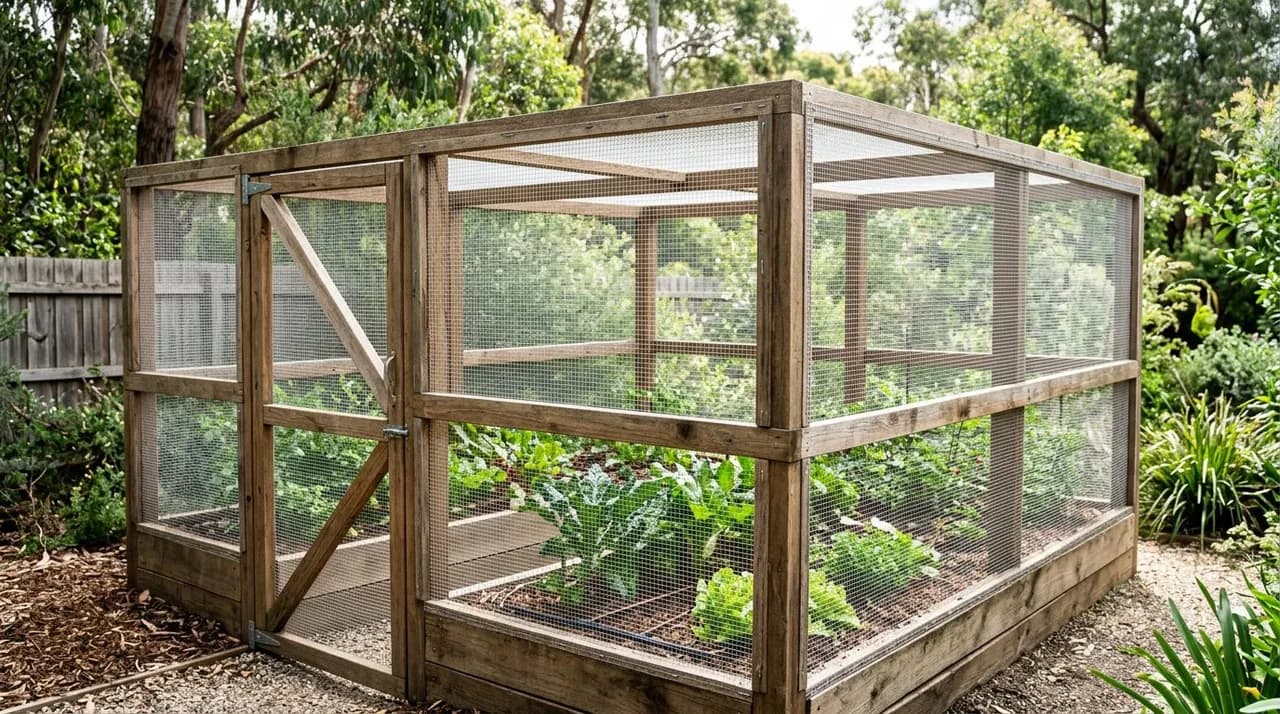
- Timber or poly-pipe cages: Build a rigid timber box frame or erect heavy-duty polypipe arches over your raised vegetable beds.
- Wildlife-safe exclusion netting: Cover the frame with white UV-stabilised horticultural exclusion mesh with an aperture size of 5 mm or smaller (such as fine insect mesh or woven diamond net).
- The finger test: Never use old-fashioned black monofilament bird netting where you can push your finger through the holes. Large loose netting entangles possums, flying foxes, birds, and native reptiles, leading to horrific injuries. Tight, fine mesh is completely safe and impassable.
- Securing edges: Fasten the netting securely to the timber base frame with batten screws or heavy-duty staples. Possums are agile climbers with strong claws and will push beneath loose netting edges.
Integrate protective frames during initial bed construction as detailed in our guide to starting an Australian veggie patch.
2. Protecting individual vegetable trusses
For standalone container plants or sprawling crops:
- Enclose wire tomato cages in fine wire mesh (such as 13 mm galvanised aviary wire; 13 mm rigid welded aviary wire is safe here: the entanglement risk comes from loose, flexible netting, not from rigid mesh).
- Fasten a removable wire lid over the top of the cage to block overhead entry.
Protecting fruit trees: sheet metal collars and canopy isolation
Fruit trees present vertical climbing pathways for possums. Isolating the tree canopy stops them from reaching maturing stone fruit, apples, and citrus:
1. Installing sheet metal or polycarbonate trunk collars
- Collar dimensions: Wrap a 60 cm wide strip of smooth galvanised sheet metal, aluminium flashing, or clear polycarbonate sheet around the main trunk.
- Installation height: Fasten the collar at least 1.5 metres above the ground. Possums are powerful jumpers and clear a low collar easily, so fit it well above head height.
- Trunk growth allowance: Secure the collar with springs or overlapping ties that expand as the tree trunk thickens, preventing ringbarking.
+---------------------------------------------------------+
|                  [Isolated Fruit Tree]                  |
|                                                         |
|                    (Tree Canopy)                        |
|                         \  /                            |
|                          ||                             |
|             +--------------------------+                |
|             | 60 cm Smooth Metal Collar| (1.5 m High)   |
|             +--------------------------+                |
|                          ||                             |
|             =============||============= (Ground)       |
|                                                         |
|   <-- 2.5 m Clear Air Gap from Fences / Rooflines -->   |
+---------------------------------------------------------+
2. Pruning access bridges
A trunk collar is useless if a possum can jump into the tree from a nearby structure:
- Prune all side branches so that tree canopies sit at least 2 to 2.5 metres away from adjacent fences, house gutters, shed roofs, and neighbouring trees.
- If a power or telephone line runs straight into your orchard canopy, do not touch it or attach anything to it; contact your electricity network provider, who installs line guards where they judge it appropriate.
To coordinate orchard maintenance with feeding schedules, see when to fertilise fruit trees in Australia.
Organic sprays, taste deterrents, and sensor devices
Where full physical netting is impractical, combining sensory deterrents creates an effective behavioural barrier:
1. Homemade and commercial taste deterrents
Possums possess sensitive palates and dislike bitter or pungent flavours:
- Quassia bark spray: Boil 100 g of natural quassia wood chips in 2 litres of water for 30 minutes. Strain, dilute with equal parts water, add a few drops of dishwashing liquid as a sticker, and spray onto ornamental foliage and non-edible plant parts.
- Garlic and chilli spray: Puree 2 whole garlic bulbs and 3 hot chillies in 1 litre of water. Strain through cheesecloth and spray onto vulnerable foliage.
- Lapsang Souchong tea: Brew strong smoky Lapsang Souchong and spray it over foliage. Many gardeners find the smoky residue puts possums off; it washes off in rain and results vary between animals.
- Reapplication: Taste deterrents wash off in rain. Reapply weekly and immediately following rain showers or heavy morning dew.
2. Motion-activated water sprayers
- Motion-detecting sprinklers (such as the ScareCrow water deterrent) connect to a standard garden hose.
- When an animal triggers the infrared sensor, the device releases a sudden 3-second burst of pressurised water accompanied by a sharp clattering sound.
- Possums dislike getting wet and quickly learn to avoid the sensor zone.
3. Motion-sensor floodlights
Installing bright solar LED sensor lights near bed perimeters temporarily startles browsing possums, discouraging extended foraging in well-lit areas.
Designing a wildlife-resilient garden: repellent plants and sacrificial buffers
Strategic planting choices reduce nighttime browsing pressure naturally:
1. Possum repellent plants and unpalatable species
Possums generally avoid plants with thick aromatic essential oils, prickly foliage, or tough textures:
- Herbs and ornamentals: Lavender, rosemary, mint, sage, oregano, marigolds, and scented geraniums.
- Native shrubs: Prickly grevilleas, hakeas, Westringia (native rosemary), and leptospermums (tea trees).
- Plant aromatic herbs around the outer perimeter of your vegetable beds to mask the tempting scent of sweet lettuces and strawberries.
2. Sowing winter and spring vegetables strategically
Protect your seasonal vegetable patch across changing months with our planting schedules in winter vegetables in Australia and what to plant in September in Australia. Combine possum netting with fine fruit fly mesh to solve multiple orchard pests simultaneously, as detailed in Queensland fruit fly control.