Key takeaways
- Black locust (Robinia pseudoacacia) belongs to the Fabaceae subfamily Faboideae and fixes substantial atmospheric nitrogen via root nodules.
- Honey locust (Gleditsia triacanthos) belongs to Caesalpinioideae and does not form root nodules or fix atmospheric nitrogen.
- Wild honey locust features formidable, branched trunk thorns (up to 20 cm / 8 in long), while black locust bears short, paired unbranched spines (1–2 cm / 0.5–1 in) at leaf nodes.
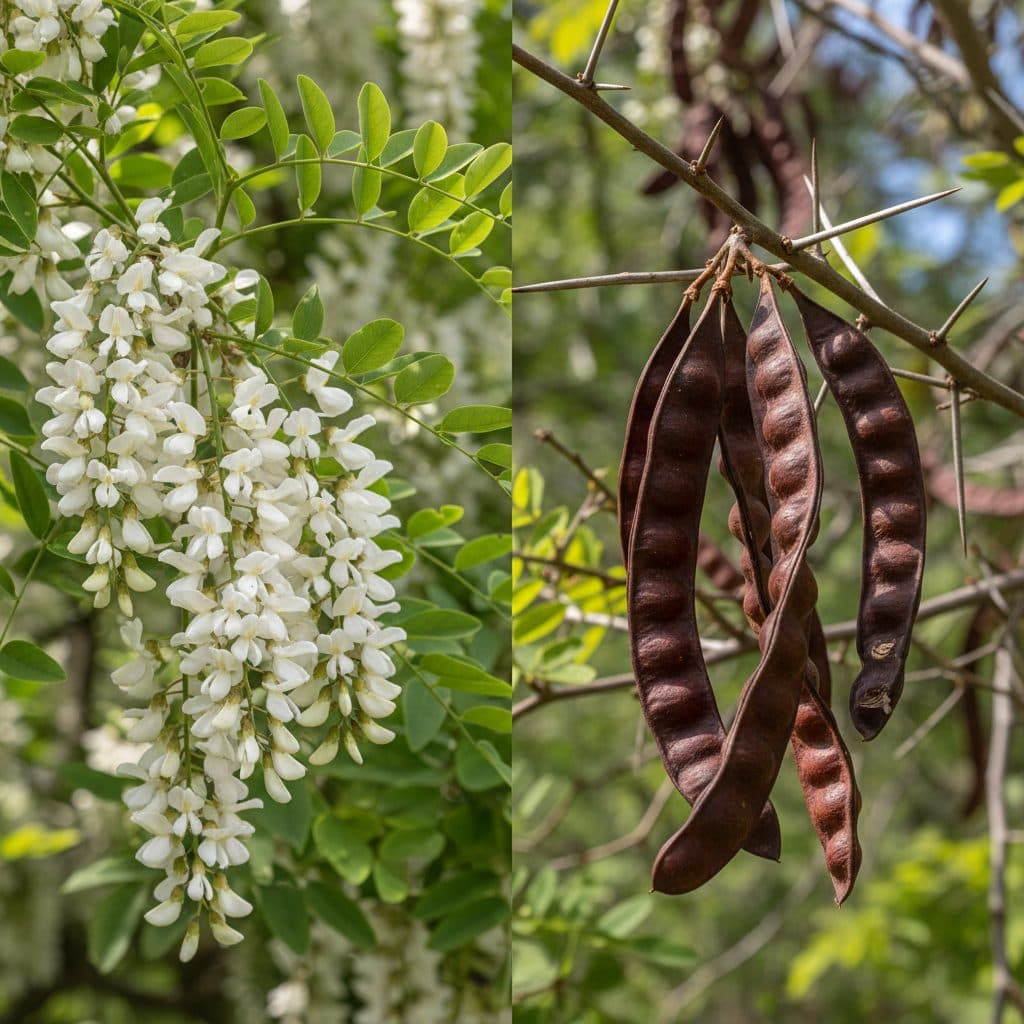
- Black locust produces drooping clusters of fragrant white pea-like blossoms in spring, whereas honey locust produces inconspicuous greenish flower spikes.
- Honey locust pods contain sweet, edible pulp consumed by livestock and wildlife; black locust bark, leaves, and seeds contain toxic lectins.
- Black locust timber is exceptionally rot-resistant and dense, and it is widely used for fence posts and high-BTU firewood.
Quick answer: Black locust (Robinia pseudoacacia) is a true nitrogen-fixing legume with fragrant white pea-like blossoms, short paired spines, and toxic foliage, prized for rot-resistant timber. Honey locust (Gleditsia triacanthos) has large branched thorns, non-nitrogen-fixing roots, and long pods with sweet, edible pulp.
Locust trees are among the most fast-growing, resilient, and utilitarian deciduous trees found across temperate and subtropical landscapes worldwide. Prized by permaculturists, farmers, and woodworkers, both honey locust and black locust provide erosion control, dappled canopy shade, high-density timber, and livestock forage.
However, despite sharing the common name "locust" and belonging to the broader legume family, these two species exhibit profound differences in botany, nitrogen fixation biology, thorn anatomy, toxicity, and agroforestry utility. Understanding how to distinguish honey locust from black locust ensures you select the correct species for your homestead, timber lot, or agroforestry system.
Botanical taxonomy and nitrogen fixation reality
The most common misconception in agroforestry is the belief that all legume trees fix atmospheric nitrogen into the soil.
+-------------------------------------------------------------+
|                BOTANICAL CLASSIFICATION & NITROGEN          |
|                                                             |
|   BLACK LOCUST (Robinia pseudoacacia):                      |
|   - Subfamily: Faboideae (Papilionaceae)                    |
|   - Root Nodules: Active Rhizobium bacteria symbiosis       |
|   - Nitrogen Fixation: Yes (rates vary with stand and site) |
|                                                             |
|   HONEY LOCUST (Gleditsia triacanthos):                     |
|   - Subfamily: Caesalpinioideae                             |
|   - Root Nodules: ABSENT (Does not form Rhizobium nodules)  |
|   - Nitrogen Fixation: NONE / NEGLIGIBLE                    |
+-------------------------------------------------------------+- Black locust (Robinia pseudoacacia): A member of the pea subfamily (Faboideae). Its root system forms active symbiotic relationships with Rhizobium bacteria, producing visible pink-centered nodules that fix atmospheric nitrogen (rates reported in the literature vary widely with stand age and site), enriching surrounding topsoil.
- Honey locust (Gleditsia triacanthos): A member of the Caesalpinioideae subfamily. Extensive botanical and forestry research confirms that honey locust roots do not nodulate or fix atmospheric nitrogen. It functions as a nutrient accumulator through deep taproots but does not add newly fixed biological nitrogen to the soil.
For broader species selections, review our guide to cold hardy nitrogen fixers and best nitrogen fixing trees by zone.
Identifying features: leaves, flowers, and thorns
Accurate identification is straightforward when examining foliage structure, flower morphology, and thorn arrangements.
+-------------------------------------------------------------+
|                BOTANICAL FEATURE COMPARISON                 |
|                                                             |
|   FEATURE           BLACK LOCUST            HONEY LOCUST    |
|   ---------------   ---------------------   --------------- |
|   Leaves            Once-pinnate            Pinnate AND     |
|                     (7-21 round leaflets)   Bipinnate       |
|                                             (30-50 leaflets)|
|                                                             |
|   Flowers           Showy, fragrant white   Inconspicuous,  |
|                     hanging pea racemes     greenish-yellow |
|                                                             |
|   Thorns            Short paired spines     Massive, woody, |
|                     at petiole base (1 cm)  branched thorns |
|                                             (10-20 cm long) |
|                                                             |
|   Seed Pods         Small flat pods         Long twisted    |
|                     (5-10 cm / 2-4 in)      pods (20-40 cm) |
|                     Thin, dry               Sweet, sticky   |
+-------------------------------------------------------------+
+-------------------------------------------------------------+
| THORN ANATOMY COMPARISON |
| |
| Black Locust: Short Paired Nodal Spines (1-2 cm / 0.5 in) |
| \ / |
| _/ |
| =========== Stem Node =========== |
| |
| Honey Locust: Large Branched Trunk Thorns (10-20 cm / 8 in|
| | |
| --/ -- |
| / | \ |
| =========== Tree Trunk =========== |
+-------------------------------------------------------------+1. Leaf morphology
- Black locust: Exclusively once-pinnately compound, measuring 20 cm to 35 cm (8 to 14 in) long, with 7 to 21 oval, rounded leaflets with smooth margins.
- Honey locust: Displays both once-pinnate and bipinnately compound leaves on the same tree, featuring 30 to 50 significantly smaller, narrower leaflets that create fine, feathery canopy shade.
2. Flowers and honey production
- Black locust: Blooms in late spring (May to June in the Northern Hemisphere, October to November in the Southern Hemisphere), producing drooping 15 cm to 20 cm (6 to 8 in) racemes of intensely fragrant, creamy-white pea-like flowers. It is the source of prized "Acacia honey" in Europe and North America.
- Honey locust: Blooms in late spring with small, inconspicuous greenish-yellow flower clusters hidden amongst foliage. While nectar-rich, they lack the showy ornamental display of black locust.
3. Thorn structure
- Black locust: Has pairs of short, sharp, unbranched spines (1 cm to 2 cm / 0.5 to 1 in long) situated on young twigs at the base of each leaf petiole. Older trunks generally become furrowed and spineless.
- Honey locust (Wild type): Armed with formidable, branched woody thorns (10 cm to 20 cm / 4 to 8 in long) that emerge directly from the main trunk and primary branches in dense, menacing clusters. Thornless plants (var. inermis) occur naturally in wild populations; the named clones sold for street planting were selected from them.
Toxicity versus edibility: pods and foliage
Understanding the biochemical composition of each tree is essential when planting around livestock, children, or food forests.
+-------------------------------------------------------------+
|                 TOXICITY & EDIBILITY PROFILE                |
|                                                             |
|   BLACK LOCUST (Robinia pseudoacacia):                      |
|   - Leaves, Bark, Seeds, Roots: TOXIC to horses & livestock |
|   - Contains toxalbumins (robin & robitin)                  |
|   - Cooked blossoms: Edible (fritters, syrups, honey)       |
|                                                             |
|   HONEY LOCUST (Gleditsia triacanthos):                     |
|   - Leaves & Pods: NON-TOXIC to livestock & humans          |
|   - Pod Pulp: Sweet, sugary, edible pulp                    |
|   - Premier winter livestock fodder & silvopasture crop     |
+-------------------------------------------------------------+
Black locust toxicity:
All parts of the black locust tree—except for the fully opened blossoms—contain toxic phytotoxins (robin, robitin, and robinin). Horses are particularly sensitive; chewing on black locust bark or browsing foliage causes colic, weakness, cardiac arrhythmia, and potential death. Cattle and sheep are slightly more tolerant but can still suffer poisoning.
Honey locust edibility and silvopasture:
Honey locust earns its common name from the sweet, honey-flavored, gummy pulp found inside its long, reddish-brown seed pods. Pod pulp is sugary — reported sugar content varies a great deal between trees, which is why named pod selections exist — and pods are eagerly consumed by cattle, sheep, goats, and wildlife in autumn and winter. It is widely planted in silvopasture systems as a high-energy winter fodder crop.
For integrating trees with livestock systems, see swale berm planting with nitrogen fixers and fruit trees.
Timber quality, rot resistance, and firewood value
Both species yield valuable hardwood, but their physical properties dictate distinct uses.
Wood Property | Black Locust (Robinia pseudoacacia) | Honey Locust (Gleditsia triacanthos) |
|---|---|---|
Rot Resistance | Very durable in ground contact; heartwood posts commonly outlast pressure-treated softwood by decades, with service life depending on soil, climate and how much sapwood is left on | Heartwood rated durable, but far less consistent than black locust and usually cut with a wide band of non-durable sapwood |
Janka Hardness | ~1,700 lbf (Extremely dense) | ~1,580 lbf (Dense and hard) |
Firewood Energy | 27.9 Million BTU / Cord (Coals like coal) | 26.7 Million BTU / Cord (Hot, clean burning) |
Primary Uses | Fence posts, vineyard stakes, decking, tool handles | Furniture, pallets, timber framing, firewood |
Black locust is considered a gold standard for chemical-free, rot-resistant fence posts. Heartwood posts cut from mature black locust commonly outlast pressure-treated softwood by decades in damp ground without chemical treatments.
Agroforestry applications: which locust should you plant?
Choosing between black locust and honey locust depends on your primary land management goals and your geographic region:
Check its status where you live first. Black locust is native to a limited part of eastern North America and is listed as invasive or regulated across much of Europe, parts of Australia and South Africa, and in several US states outside its native range. It also suckers hard from the roots, and cutting or damaging roots triggers more suckers — do not plant it near neighbouring land or remnant vegetation. Additionally, locust borer (Megacyllene robiniae) can riddle trunks on poor or stressed sites and ruin timber quality.
- Plant Black Locust if your goals are:
- Biological nitrogen fixation and soil rehabilitation on degraded slopes (where not invasive).
- Producing rot-resistant wooden fence posts on a short coppice rotation (10 to 15 years).
- High-BTU winter firewood production.
- Spring honeybee forage.
Honey locust is a declared weed in parts of Australia and a listed invader in South Africa and Argentina; check your state or national weed list before planting, and note that seedlings from thornless parents frequently revert to thorny.
- Plant Honey Locust (Thornless inermis) if your goals are:
- Silvopasture livestock fodder pods: for fodder you need a thornless, heavy-podding selection from the honey locust pod-breeding work (such as Millwood, Calhoun or Hershey) — not the podless thornless clones sold as street trees.
- Dappled canopy shade that allows grass or crops to grow underneath.
- Non-toxic windbreaks near horse paddocks.
To explore field intercropping systems, consult our guide on alley cropping.
By recognizing the distinct nitrogen fixation capabilities, thorn anatomy, toxicity profiles, and timber values of honey locust versus black locust, land managers can deploy the right tree for their specific landscape and homestead needs.