Key takeaways
- Some seeds need light to sprout and a few are inhibited by it, but most common vegetables are indifferent to light and are sown by seed size instead.
- Light germinators, like lettuce and some herbs, should be sown on the soil surface or covered with a very thin layer, often less than 1/8 inch.
- Large-seeded vegetables like beans and corn are buried 1/2 to 2 inches deep for steady moisture and anchorage, not because they need darkness.
- Optimal soil temperature, consistent moisture, and good air circulation are as critical as light conditions for successful germination.
- Using a sterile seed-starting mix and appropriate containers can significantly increase germination rates, sometimes by 20-30%.
- Proper seed-starting techniques can improve crop yields and reduce the need for replanting, saving time and resources for growers in regions like the Midwest.
Quick answer: Many common garden seeds require specific light conditions—either light or darkness—to germinate successfully, impacting sprouting rates significantly. Understanding these needs, along with consistent moisture and temperature, is important for optimal growth.
For home gardeners across the United States, from USDA zone 3 in Minnesota to zone 10 in Florida, starting seeds indoors can be a rewarding way to get a jump on the growing season. However, understanding the specific needs of each seed type matters for success. Many new growers find that some seeds sprout readily, while others seem to refuse to grow, even with careful watering and warmth. This often comes down to one critical factor: light.
The difference between light-requiring and dark-requiring seeds can mean the difference between a full tray of seedlings and an empty one. For instance, some lettuce varieties show nearly 100% germination when exposed to light, but less than 10% in darkness. Knowing whether to sow a seed on the surface or bury it under an inch of soil is a fundamental skill that can dramatically improve your germination rates by 50% or more, directly impacting your garden’s productivity.
understanding seed germination basics
Seed germination is the process by which a dormant seed begins to sprout and grow into a seedling. This biological process requires a specific set of environmental conditions to be met. Primarily, seeds need adequate moisture, appropriate temperature, and sufficient oxygen to break dormancy and begin cellular division. For many plant species, these three factors are enough to initiate growth, but for others, light also plays a significant role, affecting up to 30% of common garden seeds.
the essential conditions for sprouting
Beyond light, maintaining a consistent environment matters most. Most vegetable seeds germinate best when soil temperatures are between 65°F and 75°F, though some cool-season crops prefer temperatures closer to 60°F. Consistent moisture is also vital; the seed must take up a substantial amount of water to activate its enzymes and begin growth. However, too much water can lead to oxygen deprivation and fungal issues like damping-off, which can wipe out 100% of a tray of seedlings in a single day. Good air circulation around your seed trays, especially in humid environments, helps prevent these problems and supports healthy seedling development. For more detailed guidance, consider reviewing our article on seed starting for beginners: mix, timing, and transplanting.
- adequate moisture for imbibition
- optimal temperature range (e.g., 65-75°F)
- sufficient oxygen for respiration
- sometimes, specific light exposure
- protection from pathogens
light germinators — the surface dwellers
Light germinators, also known as positively photoblastic seeds, require some exposure to light to break dormancy and sprout. This mechanism often involves a pigment called phytochrome, which senses red light. For example, many varieties of lettuce (Lactuca sativa), particularly in regions like California’s Salinas Valley, will not germinate well—or at all—if buried too deeply. Light-sensitive lettuce cultivars germinate far better with light exposure than in complete darkness, and the effect is strongest when the seed is also warm enough to be entering thermodormancy.
how to sow light-requiring seeds
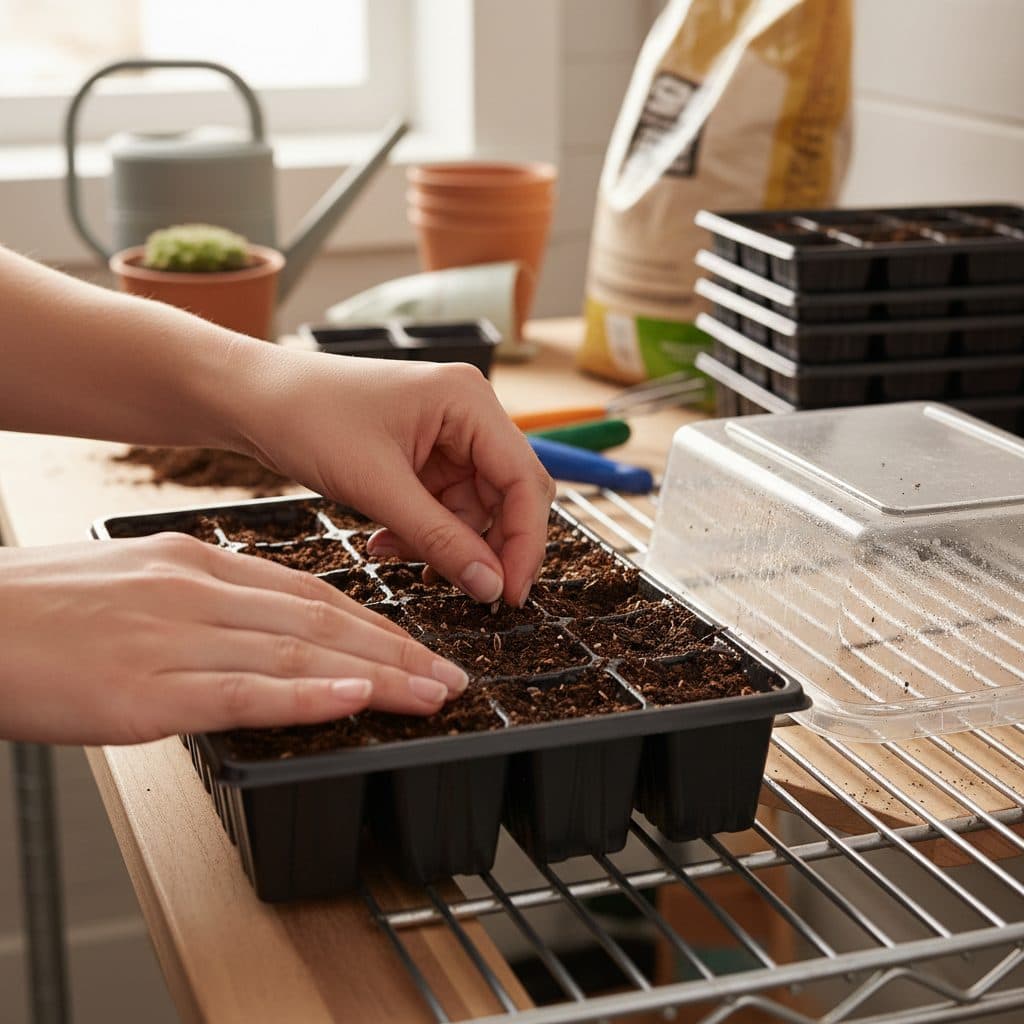
When working with light germinators, the key is to sow them on the surface of your seed-starting mix. After placing the seeds, you can gently press them into the soil to ensure good seed-to-soil contact. A very thin layer of fine vermiculite or sand, no more than 1/8 inch deep, can be sprinkled over them to help maintain moisture without blocking light. Consistent moisture is paramount, so use a fine mist sprayer to water or bottom-water your trays to avoid dislodging the tiny seeds. Placing your trays under grow lights for 12-16 hours a day, or in a bright window, will provide the necessary light. Herbs like basil (Ocimum basilicum) and dill (Anethum graveolens) are also commonly surface-sown. For tips on growing these, check out our guide on starting a herb garden: the easiest herbs to grow.
- lettuce (Lactuca sativa)
- basil (Ocimum basilicum)
- dill (Anethum graveolens)
- celery (Apium graveolens)
- some varieties of impatiens and petunias
dark germinators — the buried treasures
Most of the common vegetable seeds that gardeners plant are simply indifferent to light. Beans, corn, squash, tomatoes and cucumbers germinate equally well in light or in darkness, and are buried for steady moisture and anchorage rather than for darkness. A much smaller group is genuinely light-inhibited, or negatively photoblastic — calendula, borage, nigella, larkspur and phacelia among them — and those are the ones that actually need covering. This evolutionary trait often helps prevent seeds from sprouting on the soil surface where they might dry out quickly or be more vulnerable to predation. Beans (Phaseolus vulgaris), corn (Zea mays), and squash (Cucurbita pepo) are large seeds that need depth for moisture and anchorage rather than for darkness.
proper depth for darkness-requiring seeds
The general rule of thumb for dark germinators is to plant them at a depth roughly two to three times their diameter. For instance, many medium-sized vegetable seeds, such as tomatoes (Solanum lycopersicum) and peppers (Capsicum annuum), are typically planted 1/4 to 1/2 inch deep. Larger seeds, like corn, often require a depth of 1.5 to 2 inches, especially in regions with warmer spring temperatures like the southern Midwest [1]. After placing the seed, cover it completely with soil or seed-starting mix, gently firming the soil to remove air pockets. Water thoroughly after planting and keep the trays warm. Check them daily and move them under light as soon as the first seedlings break the surface — even a day or two in the dark after emergence gives stretched, pale stems. A heat mat can be particularly beneficial for these seeds, keeping soil temperature consistent at 70-80°F. You can monitor soil conditions with a 3-in-1 soil pH, moisture & light meter.
- beans (Phaseolus vulgaris)
- corn (Zea mays)
- squash (Cucurbita pepo)
- tomatoes (Solanum lycopersicum)
- cucumbers (Cucumis sativus)
the ‘sow on the surface or bury it’ cheat sheet
Knowing the specific light requirements for each seed can save you considerable time and frustration. This quick reference guide covers some of the most common garden plants grown across US regions, from the humid Southeast to the arid Southwest. For instance, carrots (Daucus carota) are sown shallowly, about 1/4 inch deep, mainly because the seedling is small and cannot push through a deep cover. Burying them too deeply significantly reduces emergence.
common seeds and their depth requirements
When in doubt, it’s always best to consult the seed packet, as specific varieties can have unique needs. For example, while most **celery (Apium graveolens)** varieties are light germinators and should be sown on the surface, some older heirloom types might be less sensitive. Generally, large seeds like peas (Pisum sativum) and pumpkins (Cucurbita maxima) need to be buried deeper, often 1 to 2 inches, to keep them in consistent moisture. Conversely, tiny seeds like those of many herbs or some ornamental flowers often require light. Using a 24-cell seedling propagation tray with dome can help maintain the high humidity needed for surface-sown seeds.
- Surface/Light: Lettuce, Celery, Basil, Dill, Petunia, Nicotiana
- 1/8-1/4 inch deep: Carrots, Onions, Spinach, Cabbage, Broccoli
- 1/4-1/2 inch deep: Tomatoes, Peppers, Eggplant, Marigolds; 1/2-1 inch deep: Okra
- 1-2 inches deep: Beans, Peas, Corn, Squash, Cucumbers, Pumpkins
beyond light — other key factors for seed success
While light requirements are critical, they are just one piece of the puzzle for successful seed starting. Several other environmental factors must be carefully managed to ensure high germination rates, often impacting 70% or more of your seeds. For example, soil temperature is paramount; many warm-season crops like tomatoes and peppers require soil temperatures consistently above 70°F for optimal sprouting, which can be 10-15°F warmer than ambient air temperature in a typical home. Using a seedling heat mat can significantly boost germination rates and speed up the process by several days.
optimizing your seed starting environment
Consistent moisture is another non-negotiable factor. The soil mix should remain evenly moist, similar to a wrung-out sponge, but never waterlogged. Overwatering can lead to fungal diseases like damping-off, which can decimate young seedlings within 24 hours. A good seed-starting mix should be light, sterile, and well-draining, often composed of peat moss, vermiculite, and perlite in a 1:1:1 ratio. Air circulation is also important, especially when growing many seedlings in a confined space. A small fan can help strengthen stems and prevent fungal issues, reducing seedling loss by up to 25%. Finally, nutrient availability in the starting mix is usually minimal, so plan to fertilize with a diluted liquid feed (e.g., 1/4 strength) once true leaves appear, typically 2-3 weeks after germination. Sustainable agriculture practices emphasize proper soil health for long-term plant vigor [3].
- consistent soil temperature (e.g., 65-75°F)
- even, not excessive, moisture
- sterile, well-draining seed-starting mix
- adequate air circulation
- gentle, diluted fertilization post-germination
Light vs. Dark Germinators: A Quick Comparison
Characteristic | Light Germinators | Dark Germinators |
|---|---|---|
Sowing Depth | Surface or barely covered (less than 1/8 inch) | Buried (1/4 inch to 2 inches deep) |
Light Exposure | Requires light to sprout | Buried for moisture; only a few species are genuinely light-inhibited |
Examples | Lettuce, Celery, Basil, Petunia | Beans, Corn, Tomatoes, Squash, Peas |
Moisture Management | Fine misting, consistent surface moisture | Thorough watering, consistent moisture at depth |
Typical Germination Rate | Can be 90%+ with light, <10% without | Largely unaffected by light; depth matters for moisture, not darkness |
Temperature Matters: Many warm-season vegetable seeds, like tomatoes, achieve optimal germination rates of 85-95% when soil temperatures are consistently between 70°F and 80°F.
Moisture Balance: Keep the mix evenly damp, like a wrung-out sponge. Waterlogged mix drives out the oxygen seeds need to respire, and germination falls off sharply.
Depth Impact: In dry spring soil, corn planted around 1.5 inches deep reaches steadier moisture and emerges more evenly than corn planted at half an inch.
Frequently asked questions
What happens if I plant a light germinator too deep?
If you plant a light germinator, such as lettuce, too deep—say, more than 1/4 inch—it may fail to germinate or have a significantly reduced germination rate, sometimes dropping from 90% to less than 20%. The seed won’t receive the necessary light signal to break dormancy, leading to wasted effort and seeds.
What happens if I don’t cover a dark germinator?
Leaving a large seed like a bean or squash uncovered is a moisture problem, not a light problem. On the surface it dries out between waterings, has too little soil contact to draw water from, and is easy prey for birds and mice, so emergence falls off sharply.
Can I use regular garden soil for seed starting?
It’s generally not recommended to use regular garden soil for seed starting. Garden soil is often too heavy, can compact easily, and may contain weed seeds or pathogens that can harm delicate seedlings, potentially causing 100% loss due to damping-off. A sterile, light seed-starting mix provides better drainage and aeration.
How important is consistent moisture for germination?
Consistent moisture is extremely important for germination. Seeds need to absorb a significant amount of water to activate the enzymes needed for growth. Fluctuations in moisture — drying out and then re-wetting — stress the seed and can kill a partly germinated embryo outright.
Do all seeds need a heat mat?
Not all seeds need a heat mat, but many warm-season crops like tomatoes, peppers, and eggplants benefit greatly from one, as they prefer soil temperatures between 70°F and 85°F. Cool-season crops such as peas and spinach germinate well at cooler temperatures, often 50-65°F, and do not require supplemental heat.
References
- USDA Natural Resources Conservation Service (2024). USDA Natural Resources Conservation Service.
- EPA — Soak Up the Rain (2024). EPA — Soak Up the Rain.
- SARE — Sustainable Agriculture Research & Education (2023). SARE — Sustainable Agriculture Research & Education.
- ATTRA / NCAT Sustainable Agriculture (2023). ATTRA / NCAT Sustainable Agriculture.
- USDA National Agroforestry Center (2023). USDA National Agroforestry Center.