Key takeaways
- Plant hazelnuts and Kentish cobnuts as the most reliable and productive nut crop for UK gardens of all sizes.
- Choose grafted walnut cultivars for a first crop in about four to five years, rather than the decade-plus a seedling needs.
- Grow sweet chestnuts on deep, acidic to neutral soils, avoiding shallow chalk or waterlogged clay.
- Plant at least two compatible hazel cultivars to guarantee cross-pollination during February winds.
- Guard ripening nut crops against grey squirrels using physical trunk guards and timely autumn harvesting.
Quick answer: The most reliable nut trees to grow in the UK are hazelnuts (Kentish Cob, Cosford), grafted common walnuts (Broadview, Franquette), and sweet chestnuts (Marron de Lyon). Hazelnuts suit small gardens and provide early yields, while grafted walnuts and sweet chestnuts create productive canopy layers in larger plots.
When British gardeners and smallholders plan perennial orchards and food forests, they almost universally gravitate toward apples, pears, and plums. Yet cultivating nut trees uk growers can rely on provides some of the most nutrient-dense, calorie-rich, and easily stored protein crops possible in our temperate maritime climate.
Historically, Kentish cobnut plats and wild hazel coppices supplied British tables with abundant winter nourishment. Today, modern grafted cultivars allow home gardeners to harvest generous crops of walnuts, cobnuts, and sweet chestnuts without waiting decades for seedling trees to mature.
Whether you have space for a compact hedge of cobnuts along an allotment fence or a magnificent specimen walnut tree in a paddock, selecting the right cultivars, understanding pollination biology, and managing squirrel protection ensures abundant autumnal harvests.
Hazelnuts and Kentish cobnuts: the #1 choice for UK gardens
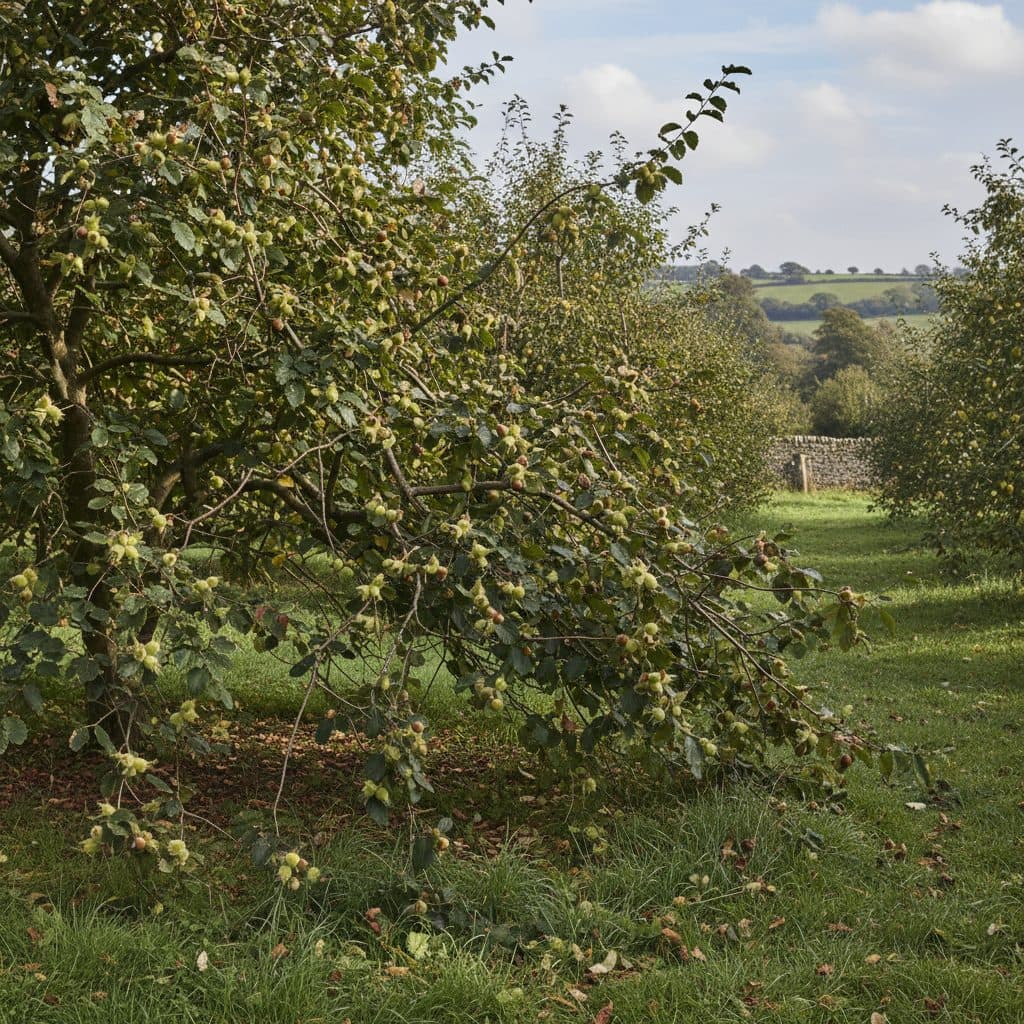
Hazel (Corylus avellana) is native to Britain; the cultivated filbert (Corylus maxima), from which many cobnut cultivars derive, was introduced from south-east Europe and Asia Minor. Both are among the easiest nut crops for gardens and smallholdings.
+-------------------------------------------------------------------------------+
|                       HAZELNUT POLLINATION MECHANISM                          |
|                                                                               |
|   1. MALE CATKINS (Yellow 'Lambs' Tails'): Shed pollen in Jan–March winds     |
|   2. FEMALE FLOWERS (Tiny Red Tufted Buds): Emerge on one-year-old wood       |
|   3. SELF-INCOMPATIBILITY: Most hazels cannot pollinate their own flowers     |
|   --> MUST PLANT 2 COMPATIBLE VARIETIES (e.g. Kentish Cob + Cosford)          |
+-------------------------------------------------------------------------------+
+-------------------+---------------------------+-------------------+-------------------------------------------+
| Hazel Cultivar | Nut Type & Flavour | Pollination Group | Key Garden Attributes |
+-------------------+---------------------------+-------------------+-------------------------------------------+
| Kentish Cob | Long, sweet, rich flavour | Mid (Low pollen) | Needs Cosford, Gunslebert, or Merveille |
| Cosford | Thin-shelled, sweet nut | Early / Mid | Outstanding pollinator; easy to crack |
| Pearson's Prolific| Round, plump, buttery | Mid Season | Compact bush habit; reliable cold crop |
| Webbs Prize Cob | Large, high-oil filbert | Late Season | Ornamental long husks; excellent storage |
| Gunslebert | Medium, rich nutty taste | Mid / Late | Heavy commercial yield; disease resistant |
+-------------------+---------------------------+-------------------+-------------------------------------------+Growing and training hazels
Left unmanaged, hazels grow as multi-stemmed shrubs of 6 m or more (occasionally to 12 m). In cobnut plats they are pruned and 'brutted' to keep them at roughly 2 to 2.5 m for easy picking. They can be grown as:
- Single-Stem Goblet Trees: Pruned to a short trunk with 4 to 6 open framework branches, making weed management and nut harvesting straightforward.
- Traditional Coppice: Cut back to ground level every 7 to 10 years, yielding straight hazel poles for garden bean poles and wattle hurdles alongside nuts.
- Productive Boundary Hedges: Planted 1.5 to 2 metres apart along allotment boundaries to serve as living windbreaks.
When establishing new nut trees, planting them as bare root fruit trees between November and March ensures rapid root settlement in native soil.
Walnuts: grafted cultivars for early harvesting
Common walnuts (Juglans regia) make magnificent canopy specimen trees. Historically, growing walnuts required immense patience because seedling trees took 12 to 15 years to produce their first nut.
Modern named cultivars are grafted onto vigorous rootstocks, reducing the time to a first crop to roughly four to five years, with worthwhile yields from around year seven.
+-------------------+-------------------+-------------------+-------------------------------------------+
| Walnut Cultivar   | Size at ~15 years | Precocity         | Why It Excels in Britain                  |
+-------------------+-------------------+-------------------+-------------------------------------------+
| Broadview         | Semi-dwarf (6-8 m)| Bears in 3-4 yrs  | Heavy, reliable cropper; partially self   |
| Fernor            | Medium (8-10 m)   | Bears in 4-5 yrs  | Late leafing avoids late spring frosts    |
| Franquette        | Large (10-12 m)   | Slow (6-8 yrs)    | French heirloom; late leafing avoids frost|
| Buccaneer         | Medium (8-10 m)   | Bears in 3-4 yrs  | Outstanding pollinator; delicious nuts    |
+-------------------+-------------------+-------------------+-------------------------------------------+
These are sizes at roughly 15 years; a mature common walnut can reach 15 to 20 m, so allow that spread when siting one.
The juglone allelopathy factor
Walnut trees produce a natural biochemical compound called juglone in their leaves, roots, and nut hulls. Juglone acts as a natural growth inhibitor that suppresses certain sensitive plants growing directly beneath the tree canopy drip line (notably nightshades like tomatoes and potatoes, and certain ericaceous shrubs). However, grass, pasture legumes, and many forest garden companions grow happily beneath mature walnuts.
For structural pruning frameworks and formative branch selection across young nut and fruit trees, review formative pruning young fruit trees.
Sweet chestnuts: grand forest canopy producers
Sweet chestnuts (Castanea sativa) produce large, glossy, starchy nuts prized for winter roasting, stuffing, and gluten-free chestnut flour.
Before buying, check current Forestry Commission guidance — sweet chestnut blight (Cryphonectria parasitica) is a notifiable disease found in England, and oriental chestnut gall wasp (Dryocosmus kuriphilus) is established in the south-east. Source trees from a UK nursery under the plant passport scheme and report suspected blight cankers via TreeAlert.
- Soil Requirements: Sweet chestnuts require deep, well-drained, acidic or neutral soil (pH 4.5 to 6.5). Never plant sweet chestnuts on shallow chalk or heavy, alkaline clays, where they develop severe iron chlorosis and die.
- Grafted Selections: Plant named cultivars like Marron de Lyon or Marigoule, a European-Japanese hybrid selected for tolerance to ink disease (Phytophthora).
- Pollination: Sweet chestnuts are largely self-incompatible; plant two trees to ensure full burrs packed with two or three plump nuts rather than empty shells.
To learn how sweet chestnuts and walnuts form the emergent canopy layer in multi-tier agroforestry systems, explore what is a food forest.
Sweet almonds for sheltered UK microclimates
Sweet almonds (Prunus dulcis) are closely related to peaches and can be grown successfully across southern and central Britain.
- Early Blossom Vulnerability: Almonds flower in February and early March, making delicate blossoms vulnerable to late frosts. Plant against a warm south-facing brick wall or in a sheltered courtyard.
- Peach Leaf Curl Resistance: Choose cultivars like Ingrid or Robijn, which feature natural field tolerance to peach leaf curl fungus (Taphrina deformans).
For small gardens where full-sized nut trees are too large, consider pairing compact cobnuts with space-saving trained dessert fruits, as detailed in our guide on fruit trees for small gardens.
Protecting your nut harvest from grey squirrels
In the UK, the non-native grey squirrel (Sciurus carolinensis) is the primary competitor for your nut crop. Squirrels frequently strip entire hazel and walnut trees in August while nuts are still green and soft.
+-------------------------------------------------------------------------------+
|                       INTEGRATED SQUIRREL PROTECTION                          |
|                                                                               |
|   1. TRUNK BAFFLES:    Smooth metal or plastic collars 1.5 m above ground     |
|   2. CANOPY CLEARANCE: Keep branches pruned 3 m away from adjacent fences/shed|
|   3. TIMELY HARVEST:   Pick cobnuts green ('in the milk') in late August      |
|   4. TREE GUARDS:      Sturdy wire weldmesh cylinders around young trunks     |
+-------------------------------------------------------------------------------+- Trunk Baffles: On single-stem walnuts and chestnuts, install a 60 cm wide sheet-metal baffle around the trunk at a height of 1.5 metres to prevent squirrels from climbing up. Ensure surrounding canopies are pruned back so squirrels cannot jump from nearby buildings or fences.
- Early Green Harvest: You can harvest Kentish cobnuts "in the milk" in late August when the husks are green and the kernels are juicy and crisp, beating squirrels to the prize before nuts mature in late September.