Key takeaways
- Self-watering globes and spikes offer localized, slow-release watering for container plants, typically holding 7 to 16 oz of water.
- DIY drip bottles can be a low-cost solution, potentially reducing water use by 30% compared to hand watering in small plots.
- Ollas, buried clay pots, provide efficient subsurface irrigation, saving up to 50% of water for crops like tomatoes.
- Wicking beds use a water reservoir at the bottom, delivering consistent moisture and reducing surface evaporation by 40% or more.
- Combining passive irrigation methods with rainwater harvesting can significantly improve water resilience for US growers.
- Proper system design and maintenance matter for the effectiveness and longevity of any irrigation method, from simple spikes to complex drip lines.
Quick answer: Passive irrigation systems deliver water slowly and directly to plant root zones, minimizing evaporation and runoff. Techniques like ollas, wicking beds, and DIY drip bottles can reduce water use by 30-50% compared to conventional methods.
In many parts of the United States, particularly in arid regions like the Southwest, water conservation is not just a good idea—it is a necessity. Growers in USDA zone 9b, for example, face long, hot summers where conventional watering can lead to significant evaporation and runoff, wasting precious resources. The average American household uses about 300 gallons of water per day, with roughly 30% dedicated to outdoor irrigation, a figure that can climb to 60% in drier climates.
This article explores various passive irrigation techniques, from simple self-watering globes and DIY drip bottles to more established methods like ollas and wicking beds. We will compare their effectiveness, ease of implementation, and suitability for different garden sizes and plant types. Understanding these options can help you reduce your garden’s water footprint, potentially saving hundreds of gallons over a single growing season, and contribute to more resilient food systems in your local area.
Understanding the need for water efficiency in US agriculture
Water is a finite resource, and its availability directly impacts agricultural productivity across the United States. In states like California, which produces over one-third of the country’s vegetables and two-thirds of its fruits and nuts, prolonged droughts have shown the need for efficient water management practices. For instance, the California Department of Water Resources reported that agricultural water use accounts for about 80% of the state’s human water consumption. This reality drives many growers, from large farms to backyard gardeners, to seek methods that deliver water directly to plant roots with minimal loss.
the principles of passive irrigation
Passive irrigation systems work by delivering water slowly and directly to the plant’s root zone, minimizing evaporation and runoff. This approach contrasts sharply with overhead sprinklers, which can lose 30% or more of their water to evaporation, especially on hot, windy days. Techniques like water harvesting, where rainwater is collected and stored, or earthworks like swales and berms, which direct and hold water in the landscape, complement passive irrigation by increasing the available water supply. The goal is to build soil moisture reserves, reduce water waste, and promote plant health through consistent, deep watering. For example, a properly designed rainwater harvesting system can capture thousands of gallons from a typical 1,000 sq ft roof during a single storm event, providing a valuable resource for passive irrigation. You can learn more about collecting rainwater at Rainwater harvesting: catch the free water on your roof.
- Reduces water evaporation by targeting roots.
- Minimizes runoff and nutrient leaching.
- Supports consistent soil moisture levels.
- Decreases manual watering frequency.
- Can integrate with rainwater harvesting systems.
Self-watering globes and spikes: simple solutions for containers
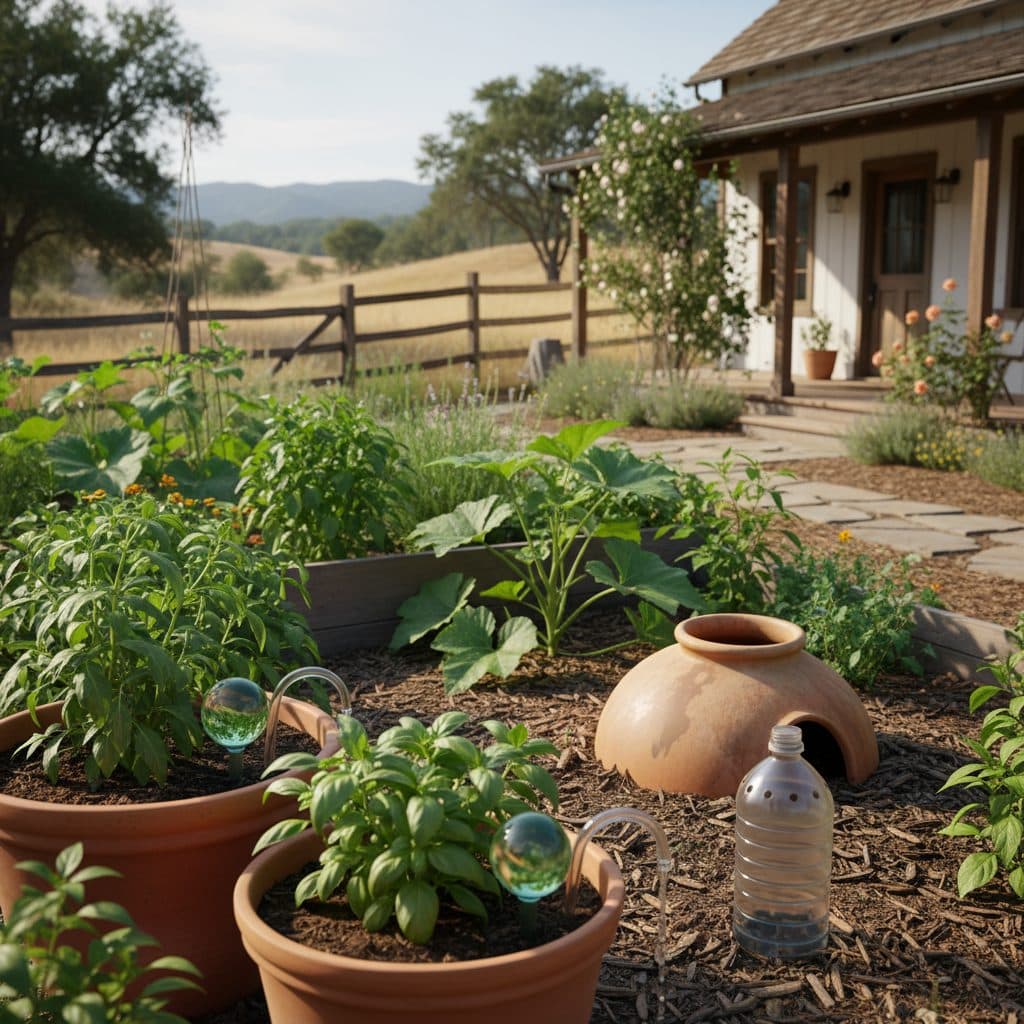
Self-watering globes and spikes are popular, straightforward tools for keeping container plants hydrated, particularly useful for vacation watering or for plants that require consistent moisture. These devices typically consist of a glass or plastic bulb with a long stem that is filled with water and then inserted into the soil. As the soil dries, it creates a vacuum that draws water from the globe into the root zone. A standard globe holds about 7 to 16 oz of water, providing a slow drip over several days, depending on plant size, temperature, and soil type. For example, a 10 in potted tomato plant in USDA zone 7 might stay adequately watered for three to five days with one 12 oz globe.
how they work and their limitations
The effectiveness of these devices relies on the capillary action of the soil and the atmospheric pressure within the globe. When the soil around the stem dries, it releases air bubbles into the globe, allowing water to escape. This self-regulating mechanism means water is only released as needed, reducing the risk of overwatering. However, their small capacity limits their use to individual container plants or small garden beds. For larger areas or plants with extensive root systems, multiple globes might be needed, which can become impractical. They are most effective for small plants, herbs, and indoor containers where consistent, gentle watering is beneficial. While convenient, they are not a substitute for a comprehensive irrigation strategy in a large garden, as their water delivery can be inconsistent if the soil becomes too compacted or too loose around the stem [4].
- Ideal for small potted plants and herbs.
- Provides consistent moisture for several days.
- Reduces the frequency of manual watering.
- Simple to use and install.
- Limited capacity requires frequent refilling for larger plants.
DIY drip bottles: a low-cost alternative for targeted watering
For growers seeking an extremely budget-friendly and customizable passive irrigation method, DIY drip bottles offer a practical solution. These systems typically involve repurposing plastic bottles, often 1-liter or 2-liter soda bottles, by puncturing small holes in their caps or bottoms and burying or placing them near plants. This method can significantly reduce water usage, especially in areas where water is scarce or expensive. Studies in Nepal showed that low-cost drip irrigation, which shares principles with DIY bottles, used 30% less water for tomatoes compared to conventional hand watering, while increasing crop yields by 20% [1].
constructing and deploying your own drip bottles
To create a DIY drip bottle, you will need a clean plastic bottle and a small nail or drill bit. Puncture one to three tiny holes in the bottle cap or along the lower side of the bottle. For a slower drip, use a smaller nail (e.g., 1/16 in diameter); for faster release, use a slightly larger one. You can either bury the bottle neck-down near the plant, leaving the bottom exposed for refilling, or place it upright with holes near the base. Burying helps reduce evaporation and delivers water directly to the root zone, making it particularly effective for thirsty plants like squash or corn in USDA zone 6. This method is particularly useful for newly planted seedlings, individual thirsty plants, or small raised beds where a full drip system is overkill. While simple, these systems require regular refilling, typically every one to three days for a 2-liter bottle, depending on plant needs and weather conditions. For more advanced drip systems, consider exploring Designing a drip irrigation system.
- Extremely low cost, using repurposed materials.
- Reduces water consumption for individual plants.
- Delivers water directly to the root zone.
- Simple to construct and deploy.
- Requires frequent manual refilling.
Ollas and wicking beds: advanced passive irrigation techniques
Moving beyond simple globes and bottles, ollas and wicking beds represent more sophisticated passive irrigation strategies that offer significant water savings and consistent moisture delivery. Ollas, pronounced ‘oy-yahs,’ are unglazed clay pots buried in the soil with only their neck exposed. Water seeps slowly through the porous clay directly into the soil, providing a constant supply to plant roots. This method can save up to 50% of water compared to surface irrigation, as evaporation is greatly reduced. For example, a 1-gallon olla can effectively water a 2 ft diameter area for several days, making it ideal for crops like tomatoes, peppers, or corn in USDA zone 8 gardens.
designing and implementing ollas and wicking beds
Wicking beds, on the other hand, utilize a water reservoir at the bottom of the planting bed, from which water is drawn upwards into the soil via capillary action. This system ensures that plants always have access to moisture, preventing drought stress and promoting vigorous growth. A typical wicking bed might have a 6 in deep water reservoir, covered by a wicking layer and then the growing medium. They are particularly effective in raised beds or containers and can reduce surface evaporation by 40% or more, especially in windy areas. Both ollas and wicking beds are excellent for long-term water efficiency and reduced maintenance. Ollas are best for individual plants or small clusters, while wicking beds are suited for larger, contained growing areas. While the initial setup for a wicking bed is more involved, requiring materials like pond liner and an overflow pipe, the long-term benefits in water savings and plant health are substantial. For larger scale water distribution, consider using Garden PE Irrigation Hose.
- Ollas reduce water use by up to 50% through subsurface delivery.
- Wicking beds provide consistent moisture via capillary action.
- Both methods minimize evaporation and runoff.
- Ideal for drought-prone regions and container gardening.
- Require more initial setup than globes or bottles.
Integrating passive irrigation with broader water harvesting strategies
The effectiveness of self-watering globes, DIY drip bottles, ollas, and wicking beds can be significantly amplified when integrated with broader water harvesting strategies. Rainwater harvesting, for example, captures precipitation from rooftops and stores it in cisterns or rain barrels. A 1,000 sq ft roof can collect approximately 620 gallons of water from just one inch of rainfall. This collected water can then be used to refill passive irrigation systems, reducing reliance on municipal or well water, especially during dry spells in USDA zone 9. The USDA Natural Resources Conservation Service (NRCS) promotes these practices as part of sustainable land management [6].
earthworks and landscape design for water retention
Beyond simple collection, earthworks like swales, berms, and keyline designs can transform a landscape into a more water-retentive environment. Swales, which are shallow ditches dug along contours, slow down runoff and allow water to infiltrate the soil, recharging groundwater and providing moisture for nearby plants. A 100 ft long swale, 2 ft deep, can hold hundreds of gallons of water after a significant rain event, making it a valuable resource for surrounding garden beds. These techniques are particularly beneficial in larger gardens or small farms in regions with seasonal rainfall, like the Pacific Northwest or the Southeast. By combining on-site water collection with efficient delivery systems like ollas, growers can create resilient, low-input gardens that thrive even under challenging conditions. This approach helps growers make better use of available water while supporting plant growth. For areas where grid power is unreliable for pumping water, consider solutions like Drip irrigation when the grid is unreliable — a Pakistan reality manual.
- Rainwater harvesting provides a free, sustainable water source.
- Earthworks like swales improve soil water infiltration.
- Reduces reliance on external water sources.
- Enhances garden resilience during dry periods.
- Supports a more sustainable growing environment.
Comparison of Passive Irrigation Methods
Method | Cost | Ease of Setup | Water Savings Potential | Best Use Case |
|---|---|---|---|---|
Self-watering Globes/Spikes | Low ($5-15 each) | Very Easy | Moderate (10-20%) | Small container plants, vacation watering |
DIY Drip Bottles | Very Low (repurposed) | Easy | Good (20-30%) | Individual thirsty plants, small garden beds |
Ollas (Unglazed Clay Pots) | Medium ($15-40 each) | Medium | High (40-50%) | Individual plants, small clusters in garden beds |
Wicking Beds | High (materials) | Complex | Very High (50% +) | Raised beds, contained growing areas |
Conventional Drip System | Medium to High | Medium to Complex | High (30-60%) | Row crops, orchards, larger garden areas |
Water Savings: Low-cost drip irrigation systems, similar in principle to DIY bottles, have been shown to reduce water use by 30% for tomatoes in Nepal [1].
Olla Efficiency: Ollas can save up to 50% of water compared to surface irrigation, making them highly efficient for crops like peppers and squash.
Rainwater Collection: A 1,000 sq ft roof can collect approximately 620 gallons of water from just one inch of rainfall, a significant resource for passive irrigation.
Frequently asked questions
How much water can self-watering globes save?
Self-watering globes primarily help maintain consistent moisture and reduce the frequency of manual watering for container plants. While they don’t offer massive bulk water savings, they prevent overwatering and can extend watering intervals by several days for a 10 in pot, reducing overall consumption for small setups.
Are DIY drip bottles effective for large gardens?
DIY drip bottles are most effective for individual plants or small garden beds, providing targeted watering. For larger gardens or row crops, a more comprehensive low-cost drip irrigation system, which can save 30% of water, would be more practical and efficient than managing dozens of individual bottles [1].
What are ollas, and how do they work?
Ollas are unglazed clay pots buried in the soil, with their necks exposed for refilling. Water seeps slowly through the porous clay directly into the surrounding soil, where plant roots can access it. This method significantly reduces evaporation and can save up to 50% of water for crops like corn or beans.
What is a wicking bed, and what are its benefits?
A wicking bed is a raised garden bed with a waterproof liner and a water reservoir at the bottom. Water is drawn upwards into the soil via capillary action, providing consistent moisture to plant roots. This system can reduce surface evaporation by over 40% and minimizes watering frequency, making it ideal for arid climates in USDA zone 9.
Can passive irrigation systems be used with rainwater?
Yes, passive irrigation systems are an excellent complement to rainwater harvesting. Collected rainwater, which can amount to 620 gallons from a 1,000 sq ft roof with one inch of rain, can be used to refill ollas, DIY drip bottles, or the reservoirs of wicking beds, further reducing reliance on municipal water sources.
Do these methods work in all soil types?
While most passive irrigation methods work in various soil types, their efficiency can vary. For example, ollas work best in loamy or sandy soils where water can spread easily. In heavy clay soils, water may not diffuse as effectively, requiring adjustments to olla size or placement, often needing more frequent refills for a 2-gallon olla.
References
- A comparison between low-cost drip irrigation, conventional drip irrigation, and hand watering in Nepal (2004). [A comparison between low-cost drip irrigation, conventional drip irrigation, and hand watering in Nepal](https://doi.org/10.1016/s0378-3774(03)00206-3).
- DRIP WATERING OF GRAPES (2024). DRIP WATERING OF GRAPES.
- Voice Activated Drip Irrigation: Merging Technology and Agriculture for Smart Watering (2025). Voice Activated Drip Irrigation: Merging Technology and Agriculture for Smart Watering.
- XII. Globes / Globen / Globes (2023). XII. Globes / Globen / Globes.
- On Farm Evaluation of Low-Cost Drip Irrigation on Water and Crop Productivity Compared to Conventional Hand Watering System (2023). On Farm Evaluation of Low-Cost Drip Irrigation on Water and Crop Productivity Compared to Conventional Hand Watering System.
- USDA Natural Resources Conservation Service (2024). USDA Natural Resources Conservation Service.