Key takeaways
- Queensland fruit fly (Bactrocera tryoni) is Australia's most destructive home orchard and garden pest, attacking almost every soft-skinned fruit and many fruiting vegetables grown in home gardens.
- Install fine insect exclusion netting (mesh aperture 2 mm or smaller) over tree canopies or individual fruit clusters immediately after petal fall and fruit set.
- Deploy male lure monitoring traps in early spring (September) to detect the first emergence of overwintering adult flies.
- Apply targeted organic protein-bait sprays to tree trunks and lower foliage to eliminate protein-seeking egg-bearing female flies without spraying fruit directly.
- Practice strict orchard hygiene by collecting all fallen fruit and solarising infested produce in sealed black plastic bags before disposal.
Quick answer: Effective organic control of Queensland fruit fly relies on a multi-tiered Integrated Pest Management approach: early spring monitoring traps, fine 2 mm exclusion netting over trees, targeted protein bait sprays, and solarising all fallen fruit in sealed plastic bags to break the breeding cycle.
The queensland fruit fly (Bactrocera tryoni), commonly known among Australian gardeners as Qfly, is the single most destructive pest affecting domestic fruit trees and home veggie patches. Native to the rainforests of eastern Australia, this tephritid has spread far beyond its original range and is now established across Queensland, New South Wales, Victoria, and the ACT, causing devastating losses in stone fruit, citrus, apples, pears, berries, tomatoes, and capsicums.
Unlike minor garden nuisances that cause superficial leaf chewing, female fruit flies inject eggs directly beneath the skin of developing fruit. The hatching larvae (maggots) feed internally on the fruit pulp, introducing bacteria that cause rapid internal liquefaction, rotting, and premature fruit drop. A single unmanaged tree can host thousands of maggots, accelerating pest populations across entire residential neighbourhoods.
Managing this pest requires understanding its life cycle and applying disciplined fruit fly control australia practices that protect your harvest without relying on hazardous broad-spectrum chemical sprays.
Understanding the life cycle and biosecurity regulations
Successful management begins with understanding the pest's seasonal biology and the biosecurity obligations governing Australian home growers.
Life cycle of Bactrocera tryoni
- Adult emergence: Adult flies overwinter in sheltered evergreen foliage, becoming active in spring when ambient temperatures consistently exceed 16°C to 18°C.
- Mating and protein feeding: Newly emerged female flies require a protein meal to mature their ovaries before mating and laying eggs.
- Oviposition: Using a sharp ovipositor, a mated female punctures the skin of maturing fruit, depositing 10 to 20 eggs per sting, and several hundred eggs over her lifespan.
- Larval feeding: Eggs hatch within 1 to 3 days into white, legless maggots that burrow toward the core.
- Pupation in soil: Mature larvae exit the decaying fruit and burrow 2 cm to 5 cm into the surrounding topsoil to pupate, emerging as new adults 10 to 14 days later during warm weather. Multiple generations can overlap throughout spring, summer, and autumn.
Queensland fruit fly vs. Mediterranean fruit fly
While eastern and south-eastern Australia primarily battle the queensland fruit fly, gardeners in Western Australia encounter the introduced mediterranean fruit fly (Ceratitis capitata or Medfly). Medfly prefers drier conditions and has distinct yellowish-brown body banding with mottled wing patterns, whereas Qfly is slightly larger with a reddish-brown body and yellow shoulder markings. Control methods (netting, sanitation, and protein baits) are equally effective against both species.
Australian biosecurity rules and fruit movement
Fruit flies are serious agricultural biosecurity pests. The movement of host fruits and fruiting vegetables is legally regulated across state borders and dedicated pest-free production zones (such as the Riverland, Tasmania, and specific agricultural exclusion areas). Never transport homegrown stone fruit, citrus, or fruiting vegetables into protected biosecurity zones without verifying requirements with your state Department of Primary Industries or biosecurity authority.
For general ecological pest principles, see our primer on integrated pest management for home gardens.
Physical protection: fruit fly netting and bagging methods
Physical exclusion is the most reliable, 100% pesticide-free method to protect your harvest from fruit fly stings.
1. Whole-tree and canopy netting
Covering fruit trees with dedicated fruit fly netting creates an impenetrable physical barrier:
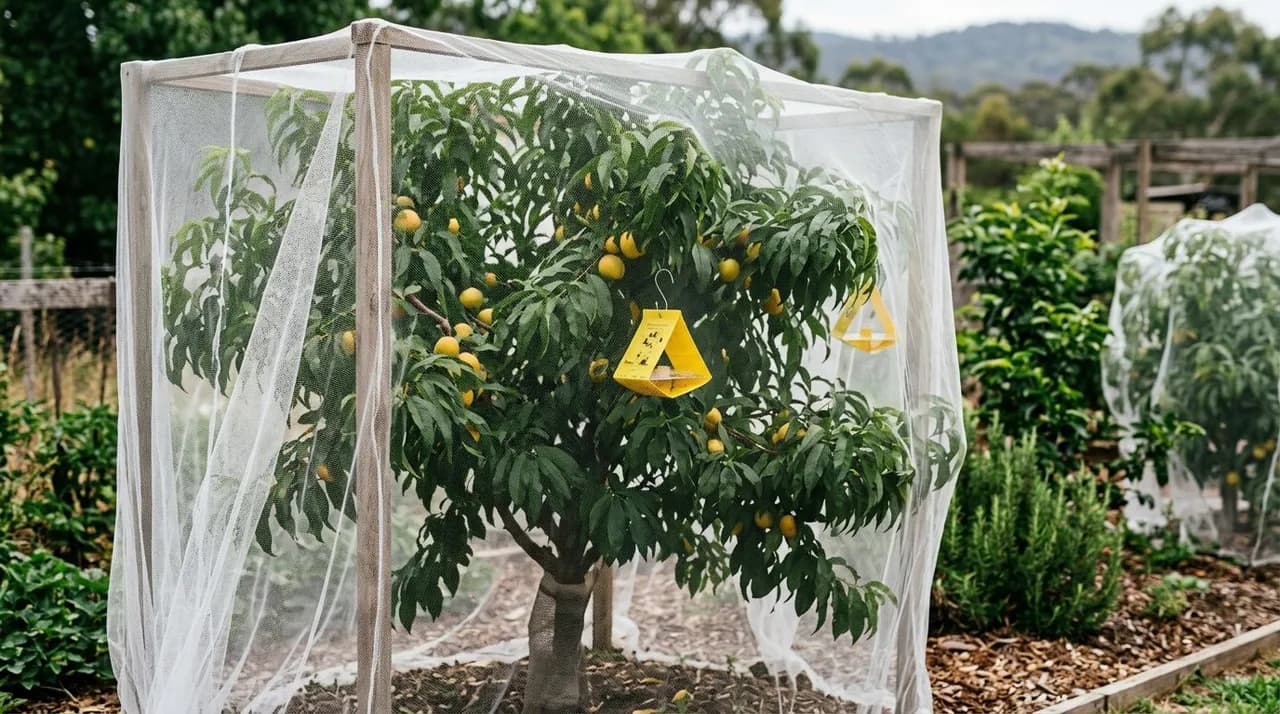
- Mesh size: Choose UV-stabilised horticultural exclusion netting with a mesh aperture of 2 mm or smaller (such as 1.5 mm to 2 mm woven netting). Standard 10 mm bird netting will not exclude fruit flies.
- Timing: Install netting immediately after petal drop, once flowers have been pollinated by bees and young fruitlets reach pea size.
- Frame support: Construct a simple frame over the tree using polypipe hoops or timber stakes so the net does not rest directly against fruit or outer foliage where flies could sting through the mesh.
- Base securing: Gather the netting tightly around the base of the trunk or weigh it securely to the ground using bricks, timber sleepers, or soil. A loose gap at the bottom allows wandering flies to enter.
+---------------------------------------------------------+
|                [Polypipe Support Frame]                 |
|       ...........................................       |
|      :       (Fine 2mm UV Exclusion Mesh)        :      |
|      :                                           :      |
|      :     [Tree Canopy with Unstung Fruit]      :      |
|      :                                           :      |
|      :...........................................:      |
|           | | Base Gathered & Weighted to Ground | |    |
+---------------------------------------------------------+
2. Individual fruit bagging and tomato sleeves
For large trees where full canopy netting is impractical, or for protecting vulnerable crops in the vegetable patch:
- Enclose individual fruit trusses in commercial spun-bond polyester fruit bags or reusable organza mesh bags fitted with drawstrings.
- Knowing how to protect tomatoes from fruit fly is critical in suburban patches: enclose entire tomato cages in fine mesh or slip individual breathable mesh sleeves over heavy ripening trusses as soon as green tomatoes reach mature size.
Coordinate spring netting alongside your seasonal sowing calendar using our guide on what to plant in September in Australia.
Monitoring traps and protein bait spraying
Integrating fruit fly traps for fruit trees with targeted biological sprays dramatically reduces adult fly populations in your garden.
1. Male lure monitoring traps
Male traps combine a parapheromone lure (Cuelure for Qfly, Capilure for Medfly) with a small amount of insecticide, usually maldison. The insecticide is contained inside the trap and never touches the fruit. Note that these traps are not organically certified: they are used for monitoring instead of control:
- Purpose: Male lure traps do not protect fruit on their own; their primary function is early detection.
- Placement: Hang traps at head height in dense, shaded evergreen foliage (such as citrus or ornamental shrubs) on the eastern or south-eastern side of the tree in early September.
- Action threshold: Inspect traps weekly. Catching a single male fly indicates that adult flies are actively flying and that physical netting and bait sprays must begin immediately.
2. Protein baiting (splash baits)
Female flies require protein before laying eggs. Commercial fruit fly bait sprays blend a yeast autolysate or protein hydrolysate attractant with an organic insecticide, such as spinosad:
- Application technique: Splash coarse droplets (spot spray) onto a 1-metre square patch of lower canopy foliage, tree trunks, or nearby non-fruiting windbreak shrubs instead of spraying entire trees or coating edible fruit.
- Frequency: Apply fresh bait once a week from early spring through autumn, and reapply immediately following heavy rainfall. Attracted by the protein scent, both male and female flies feed on the droplets and perish before reaching maturing fruit.
- For safety precautions regarding beneficial insects, review spinosad pest control and pollinators.
Orchard sanitation and solarising infested fruit
The most common mistake home gardeners make is leaving stung, rotting fruit on the ground. Uncollected windfall allows thousands of larvae to pupate into the garden soil, guaranteeing a massive infestation the following season.
1. Routine windfall collection
- Inspect trees every 2 to 3 days throughout summer and autumn.
- Pick off any fruit displaying puncture stings, dark oviposition spots, or weeping sap, and immediately rake up all fallen fruit from beneath the tree canopy.
2. Solarising and safe disposal
Never discard fruit fly-infested fruit directly into your compost heap, worm farm, or council green-waste bin, as larvae easily survive normal decomposition temperatures:
- Solarisation method: Seal infested fruit inside thick black plastic garbage bags. Place the sealed bags in direct, full sunlight on hot concrete or corrugated iron for at least 7 to 10 days. The intense heat destroys all internal eggs, larvae, and pupae.
- Freezing or boiling: Alternatively, submerge small quantities of stung fruit in a pot of boiling water for 15 minutes or freeze solid for 48 hours.
- Once completely sterilised, the treated fruit pulp can be safely composted or buried deep in the garden.
Complement your orchard pest routine with comprehensive feeding schedules from our guide on when to fertilise fruit trees in Australia, and protect your boundaries against nocturnal wildlife with how to keep possums out of the garden.