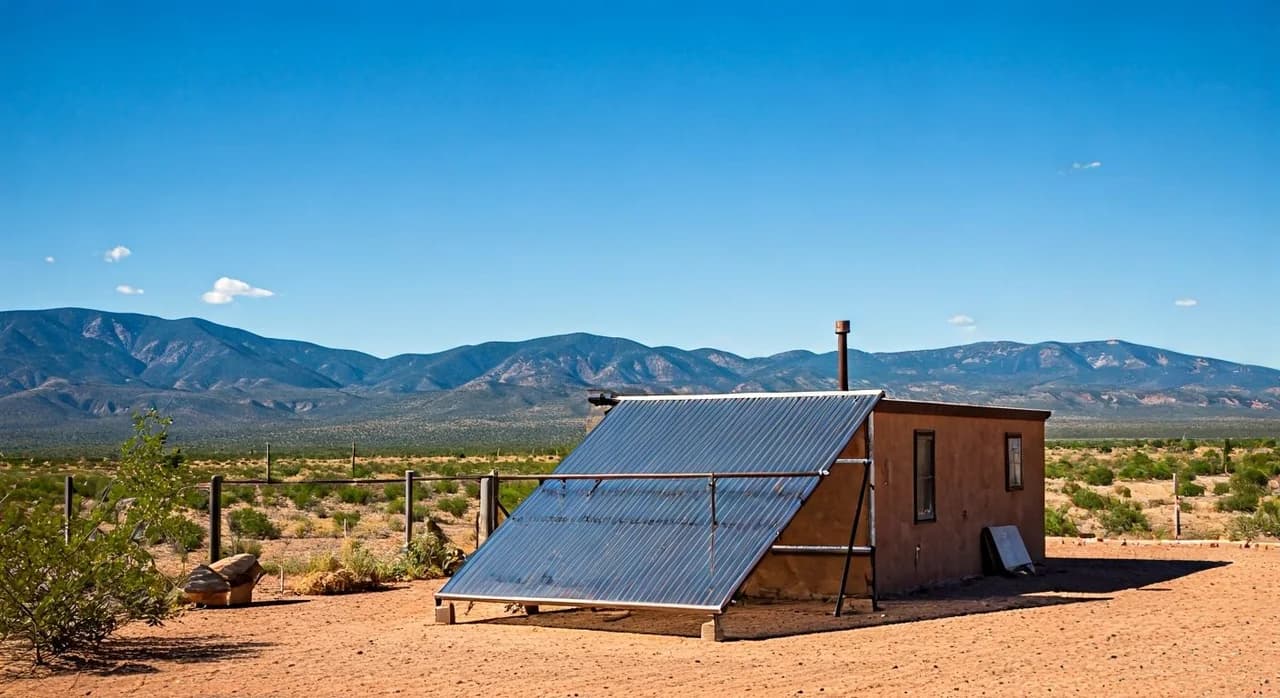
Key takeaways
- The arid Southwest, with its low humidity and high solar irradiance, offers ideal conditions for efficient solar drying, often reaching 150°F.
- Homesteaders can build direct or indirect solar dryers using common materials like polycarbonate, achieving moisture content below 15% for long-term storage.
- Proper airflow, temperature management between 120-160°F, and adequate surface area support rapid dehydration and prevent spoilage.
- Pre-treatment steps like blanching or slicing to 1/4 inch thickness can significantly improve drying speed and preserve food quality.
- Monitoring moisture levels and storing dried produce in airtight containers in a cool, dark place ensures a shelf life of one to two years.
Quick answer: Solar drying in the arid Southwest leverages high solar irradiance and low humidity to efficiently preserve food, reducing moisture content below 15% for long-term storage. This method helps homesteaders in USDA zones 7-10 minimize food waste and extend harvests without grid power.
In the vast, sun-drenched landscapes of the American Southwest, from the high desert plains of New Mexico to the Sonoran Desert in Arizona, homesteaders face unique challenges and opportunities. Water scarcity is a persistent concern, with average annual rainfall often below 10 inches in many areas, making efficient food preservation methods essential for self-sufficiency [2]. Solar drying, a time-honored technique, offers a practical and energy-independent way to extend the harvest, leveraging the region’s abundant sunshine to dehydrate produce without relying on grid power.
For those living off the grid in USDA zones 7 through 10, harnessing solar energy for food preservation can significantly reduce reliance on external resources and minimize food waste. A well-designed solar dryer can reach internal temperatures of 120°F to 160°F, quickly reducing the moisture content of fruits, vegetables, and herbs to below 15%, suitable for long-term storage [1]. This method preserves crop nutritional value while taking advantage of the 300-plus sunny days common across the Southwest each year.
The arid advantage for solar drying
The arid and semi-arid regions of the American Southwest present favorable conditions for solar drying, relying on strong solar radiation, elevated temperatures, and low relative humidity. In areas like Southern Arizona or the Mojave Desert, summer daytime temperatures frequently exceed 100°F, while relative humidity can drop below 20% for extended periods [6]. These environmental factors combine to create an efficient drying environment, allowing moisture to evaporate quickly from produce and be carried away by dry air currents. This natural advantage means that crops like tomatoes, chilies, and apricots can dry significantly faster here than in more humid climates, often reducing drying times by 30% or more compared to coastal regions.
Optimizing regional conditions
To maximize the benefits of the Southwest’s climate, homesteaders should consider the specific microclimates of their land. A site with good sun exposure for at least eight hours daily and protection from strong, dust-laden winds is ideal. For instance, in USDA zone 9b, common in central Arizona, a solar dryer can operate effectively from early spring through late fall, preserving a wide range of crops. The high solar irradiance, often exceeding 6 kWh per square meter per day, provides ample energy for dehydration .. Understanding these regional specifics allows for the selection of appropriate crops and dryer designs, ensuring a successful harvest preservation strategy.
- High solar irradiance: Many regions receive over 300 sunny days annually.
- Low relative humidity: Often below 20%, accelerating moisture removal.
- Elevated ambient temperatures: Frequently above 90°F, aiding heat absorption.
- Reduced risk of mold: Dry air naturally inhibits fungal growth.
- Extended drying season: Effective from spring through late autumn in many zones.
Types of solar dryers for homesteads
Matching the solar dryer design to your homestead’s harvest volume determines operating efficiency. Broadly, dryers fall into two categories: direct and indirect. Direct dryers, like simple cabinet dryers, expose produce directly to sunlight, absorbing solar radiation and heating the air within the drying chamber. These are straightforward to build, often using a wooden frame and clear polycarbonate sheets, and can reach temperatures of 140°F on a clear day. For a small family, a dryer with a 10 square foot drying area might be sufficient, accommodating about 15 pounds of sliced produce per batch.
Building an efficient indirect dryer
Indirect solar dryers, conversely, separate the solar collector from the drying chamber. Air is heated in a collector, often a black-painted box with a clear cover, and then circulated through a separate chamber containing the produce. This method protects food from direct UV exposure, preserving color and some nutrients, and offers more controlled drying. A well-designed indirect dryer can achieve internal temperatures of 150°F to 160°F, providing consistent heat even with fluctuating cloud cover. For off-grid homesteads, integrating a small solar panel system to power a small fan for forced air circulation can significantly speed up drying times..
- Direct dryers: Simple, cost-effective, expose food directly to sun.
- Indirect dryers: Protect food from UV, better temperature control, often require a fan.
- Hybrid dryers: Combine solar with a small electric heater or fan for cloudy days.
- Cabinet dryers: Compact, ideal for smaller batches of fruits and herbs.
- Tunnel dryers: Larger scale, continuous operation, suitable for greater yields.
Design principles for efficient dehydration
Effective solar drying hinges on three primary principles: maximizing solar heat gain, ensuring adequate airflow, and controlling moisture removal. A well-designed dryer in the Southwest should have a collector surface angled to receive maximum sunlight, typically between 30 and 45 degrees from horizontal for year-round use, or steeper for winter sun. The interior surfaces of the collector should be painted a matte black to absorb up to 95% of incoming solar radiation, converting it to heat. This heat raises the air temperature inside the dryer to between 120°F and 160°F, which is ideal for rapid dehydration without cooking the food [1].
Optimizing airflow and moisture removal
Airflow is critical for carrying away the moisture released from the produce. Natural convection, where hot, moist air rises and exits through upper vents while cooler, drier air enters through lower vents, is often sufficient for small dryers. For larger units or to speed up the process, a small, low-power fan (often powered by a dedicated solar panel) creates forced convection, increasing airflow by 50% or more. The ratio of collector area to drying area should be carefully considered; a 1:1 ratio is a good starting point for many designs, but a higher ratio can improve performance in cooler conditions. Proper ventilation openings, typically 2 to 4 square inches per square foot of drying tray area, are necessary to prevent humidity buildup inside the chamber, which could lead to mold growth.
- Collector angle: 30-45 degrees for optimal year-round sun exposure.
- Absorber color: Matte black surfaces absorb up to 95% of solar radiation.
- Airflow: Natural convection or forced air with a small fan.
- Ventilation: 2-4 square inches of vent per square foot of tray area.
- Temperature range: Maintain 120°F to 160°F for efficient drying.
Preparing produce for solar drying
Proper preparation is paramount for successful solar drying, influencing both the speed of dehydration and the quality of the final product. Begin by selecting fresh, ripe produce free from blemishes or spoilage. Washing fruits and vegetables thoroughly removes dirt and surface debris before slicing. For many items, such as apples or peaches, slicing them into uniform pieces, typically 1/4 to 3/8 inch thick, ensures even drying. Thicker pieces, like those 1/2 inch or more, will take significantly longer to dry, potentially increasing drying time by 50% or more and risking spoilage.
Pre-treatment and arrangement
Some vegetables, particularly those with a tough skin or waxy coating like carrots or green beans, benefit from blanching: a dip in boiling water for one to three minutes, followed by an ice bath. This process helps to inactivate enzymes that can cause discoloration and flavor loss during drying and storage. For fruits prone to browning, such as apples or pears, a quick dip in a lemon juice solution (one part lemon juice to four parts water) can help preserve their color. Arrange prepared produce in a single layer on drying trays, leaving about 1/2 inch of space between pieces for airflow. Overcrowding trays can extend drying times and lead to uneven drying, increasing the risk of mold.
- Select fresh produce: Choose ripe, blemish-free items.
- Wash thoroughly: Remove dirt and contaminants.
- Slice uniformly: Aim for 1/4 to 3/8 inch thickness for even drying.
- Blanch certain vegetables: Inactivates enzymes, preserves color.
- Pre-treat fruits: Use lemon juice to prevent browning.
- Arrange in single layer: Ensure adequate spacing for airflow.
Monitoring and storage for quality
Monitoring the drying process is essential to achieve the desired moisture content and prevent spoilage. Depending on the produce, ambient conditions, and dryer design, drying times can range from one to five days in the arid Southwest. Tomatoes, for instance, can often dry in three to four days in the intense sun of Adrar, Algeria, a region with a climate similar to parts of the American Southwest .. It is important to check the produce daily, rotating trays if necessary to ensure even exposure. The goal is to reach a moisture content of 10% to 15% for most items, which is low enough to inhibit microbial growth and enzyme activity.
Testing for dryness and proper storage
To test for dryness, allow a piece of produce to cool to room temperature. Fruits should be leathery and pliable, with no visible moisture when squeezed, but not brittle. Vegetables should be brittle and snap when bent. If any moisture is present, continue drying for another 12 to 24 hours. Once adequately dried, condition the produce by placing it in an airtight container for seven to ten days, shaking it daily. This allows any residual moisture to equalize throughout the batch. Store conditioned dried foods in airtight containers (such as glass jars with tight lids or vacuum-sealed bags) in a cool, dark place, ideally below 60°F. Properly stored solar-dried produce can maintain its quality for one to two years, providing a reliable food source for your homestead even during periods of low yield or inclement weather.
- Daily checks: Monitor produce and rotate trays for even drying.
- Target moisture: Aim for 10-15% moisture content.
- Dryness test: Fruits should be leathery, vegetables brittle.
- Conditioning: Equalize moisture in airtight containers for 7-10 days.
- Storage: Airtight containers, cool, dark place, below 60°F.
- Shelf life: One to two years for properly stored items.
Comparison of solar drying methods
Feature | Direct solar dryer | Indirect solar dryer |
|---|---|---|
Construction complexity | Low | Medium to High |
Cost to build | Low (under $100) | Medium ($100-$300) |
UV exposure to food | High | Low |
Temperature control | Basic (variable) | Better (more stable) |
Drying time | Fast (3-5 days) | Fast (2-4 days) |
Best for | Fruits, herbs, chilies | Vegetables, delicate fruits, herbs |
Typical capacity | 5-15 lbs per batch | 10-30 lbs per batch |
Efficiency Boost: Adding a small solar-powered fan to an indirect dryer can reduce drying times by 25% to 40% [1].
Shelf Life: Properly stored solar-dried produce can last one to two years when kept in airtight containers below 60°F.
References
- Solar Drying of Tropical Agricultural Crops: A Caribbean Perspective (2016). Solar Drying of Tropical Agricultural Crops: A Caribbean Perspective.
- Rethinking Water Relationships in the Arid Southwest (2025). Rethinking Water Relationships in the Arid Southwest.
- 5. Rethinking Water Relationships in the Arid Southwest (2025). 5. Rethinking Water Relationships in the Arid Southwest.
- Solar Drying of Tomato in the Arid Area of TOUAT (Adrar, Algeria) (2013). Solar Drying of Tomato in the Arid Area of TOUAT (Adrar, Algeria).
- Comparative study on the effect of drying methods on the plant Punica granatum using shade, solar, and convective drying in the southwest of Algeria (2024). Comparative study on the effect of drying methods on the plant Punica granatum using shade, solar, and convective drying in the southwest of Algeria.
- USDA Natural Resources Conservation Service (2024). USDA Natural Resources Conservation Service.