Key takeaways
- Select late-harvest, thick-skinned, firm varieties such as ‘GoldRush’ and ‘Fuji’ apples or ‘Bosc’ pears for optimal long-term storage; ‘Honeycrisp’ also keeps well, but it needs conditioning and warmer storage than the rest.
- Maintain storage temperatures between 30°F and 35°F with 90-95% relative humidity to prevent spoilage and moisture loss.
- Harvest fruit at peak maturity, handle gently to avoid bruising, and pre-cool quickly to 35°F within 24 hours.
- Utilize root cellars or dedicated cold storage with good ventilation, separating apples from pears due to ethylene production.
- Regularly inspect stored fruit every 10-14 days, removing any damaged or spoiled pieces to prevent spread of decay.
- Consider additional preservation methods like dehydrating or fermenting for varieties not suited for extended fresh storage.
Quick answer: To store apples and pears for months, maintain temperatures between 30-35°F and 90-95% humidity, select late-harvest varieties, and ensure good ventilation while separating apples from pears.
In many parts of the United States, particularly across the Midwest and Northeast in USDA zones 5-7, a successful apple and pear harvest can yield hundreds of pounds of fruit. For a small orchard or even a few backyard trees, managing this bounty means thinking beyond fresh eating and into long-term preservation. Historically, growers have sought methods to extend the season, allowing fruit picked in September or October to last well into the following spring, sometimes for six months or more, significantly reducing waste and providing fresh produce through the colder months [1].
Achieving this kind of extended storage isn’t about luck; it demands a precise understanding of fruit physiology and environmental control. From selecting the right cultivars to managing temperature, humidity, and even atmospheric composition, every step plays a role in keeping apples and pears crisp and flavorful. This article will guide you through the practical considerations for storing your harvest, drawing on decades of experience and research to help you maximize your yield’s shelf life.
The basics of long-term fruit storage
Effective long-term storage of apples and pears hinges on controlling the fruit’s respiration rate and preventing moisture loss. The ideal storage environment typically involves a combination of low temperature, high humidity, and adequate ventilation. For most apple and pear varieties, a temperature range of 30°F to 35°F is optimal, slowing down metabolic processes by as much as 50% compared to room temperature [1].
Maintaining a relative humidity of 90-95% is equally critical to prevent the fruit from shriveling, a common issue that costs both quality and weight over several months. Good air circulation, whether through natural convection in a root cellar or forced air in a refrigerated space, helps distribute temperature and humidity evenly, preventing pockets of warm, moist air that can encourage mold growth. Commercial operations often use controlled atmosphere (CA) storage, reducing oxygen levels to 1-2% and increasing carbon dioxide to 2-5% to further inhibit ripening and spoilage, extending storage life considerably beyond what conventional cold storage achieves. While home growers rarely achieve commercial CA conditions, understanding these principles informs best practices for smaller-scale storage.
Key environmental factors for fruit storage
Controlling the storage environment is paramount for extending the life of your harvest. Even a few degrees above the optimal temperature noticeably shortens storage time. Consider these factors:
- Temperature stability: Aim for a consistent 30-35°F, ideally without fluctuations exceeding 2°F.
- High humidity: Maintain 90-95% relative humidity to prevent desiccation.
- Adequate ventilation: Ensure air movement to dissipate heat and ethylene gas.
- Darkness: Store fruit in the dark to help maintain quality.
- Ethylene management: Separate apples from most other produce, as apples produce significant ethylene, accelerating ripening in other fruits [2].
Choosing the right varieties for storage
Not all apples and pears are created equal when it comes to long-term storage. Selecting the right varieties is perhaps the most significant factor in determining how long your harvest will last. Generally, late-season varieties with thick skins and firm flesh tend to store best, often retaining quality for three to six months, or even longer under ideal conditions [1]. Early-season varieties, while delicious fresh, typically have a shorter shelf life, often only lasting a few weeks.
For apples, varieties like ‘Honeycrisp’, ‘Fuji’, ‘Granny Smith’, ‘Rome Beauty’, and ‘GoldRush’ are known for their excellent keeping qualities, often lasting 4-8 months in cold storage. ‘Enterprise’ and ‘Liberty’ are also good choices for growers in USDA zones 4-7, showing good disease resistance and storage potential. Pears, particularly European varieties, also offer good storage options. ‘Bosc’, ‘Anjou’, and ‘Comice’ pears can be stored for 2-5 months, but unlike apples, they often need to be ripened at room temperature after cold storage for optimal flavor and texture. Asian pears, such as ‘Hosui’ or ‘Shinseiki’, have a crisper texture and generally store well for 1-3 months [2].
Apple varieties for extended storage
When planning your orchard or selecting fruit at a farmer’s market, prioritize varieties known for their strong keeping qualities. These often have a denser cell structure and lower respiration rates.
- Honeycrisp: Stores well for 4-7 months, but it is chilling-sensitive. Condition the fruit at around 50°F for five to seven days after harvest, then hold it at about 37°F rather than 30-32°F, or it develops soft scald — brown, sunken ribbons of dead skin that ruin the fruit.
- Fuji: Known to last 5-8 months, often improving in flavor after a period of storage.
- Granny Smith: A classic for storage, lasting 6-9 months, though it can develop scald if not managed properly.
- GoldRush: An exceptional keeper, often lasting 7-10 months, developing richer flavor over time.
- Rome Beauty: Stores for 4-6 months, a good baking apple that holds its shape.
Preparing fruit for storage
The journey to long-term storage begins even before the fruit leaves the tree. Proper harvesting techniques and immediate post-harvest handling matter. Fruit intended for storage should be picked at optimum maturity – not under-ripe, which can lead to poor flavor development, nor over-ripe, which accelerates softening and decay. For apples, this usually means a slight change in ground color from green to yellow, and for pears, a firmer texture than eating ripe, judged commercially by a flesh-firmness pressure test rather than by eye.
Handle each piece of fruit with extreme care to avoid bruising, punctures, or stem pulls, as damaged areas are entry points for pathogens and sharply reduce storage life. After harvest, rapid pre-cooling to the target storage temperature of 30-35°F within 24 hours is vital to remove field heat and slow respiration. This can be done in a walk-in cooler, a cool basement, or even by circulating cold air from outside during autumn nights. Inspect each fruit thoroughly, discarding any with visible blemishes, insect damage, or signs of disease; one bad apple can indeed spoil the barrel, because rot spreads by contact to the fruit packed around it.
Steps for pre-storage preparation
A methodical approach to preparing your harvest will pay dividends in extending its shelf life. Don’t skip these critical steps, which can add weeks or months to your storage duration.
- Harvest at peak maturity: Pick when color, firmness, and starch levels are optimal for storage, not for immediate eating.
- Handle gently: Avoid dropping or squeezing fruit; use gloves if necessary to prevent skin abrasions.
- Sort carefully: Remove any fruit with cuts, bruises, or signs of disease to prevent spoilage spread.
- Pre-cool rapidly: Bring fruit temperature down to 35°F as quickly as possible after harvest.
- Clean storage containers: Use clean, food-grade bins or boxes to minimize contamination risks.
Storage methods: from root cellars to modern solutions
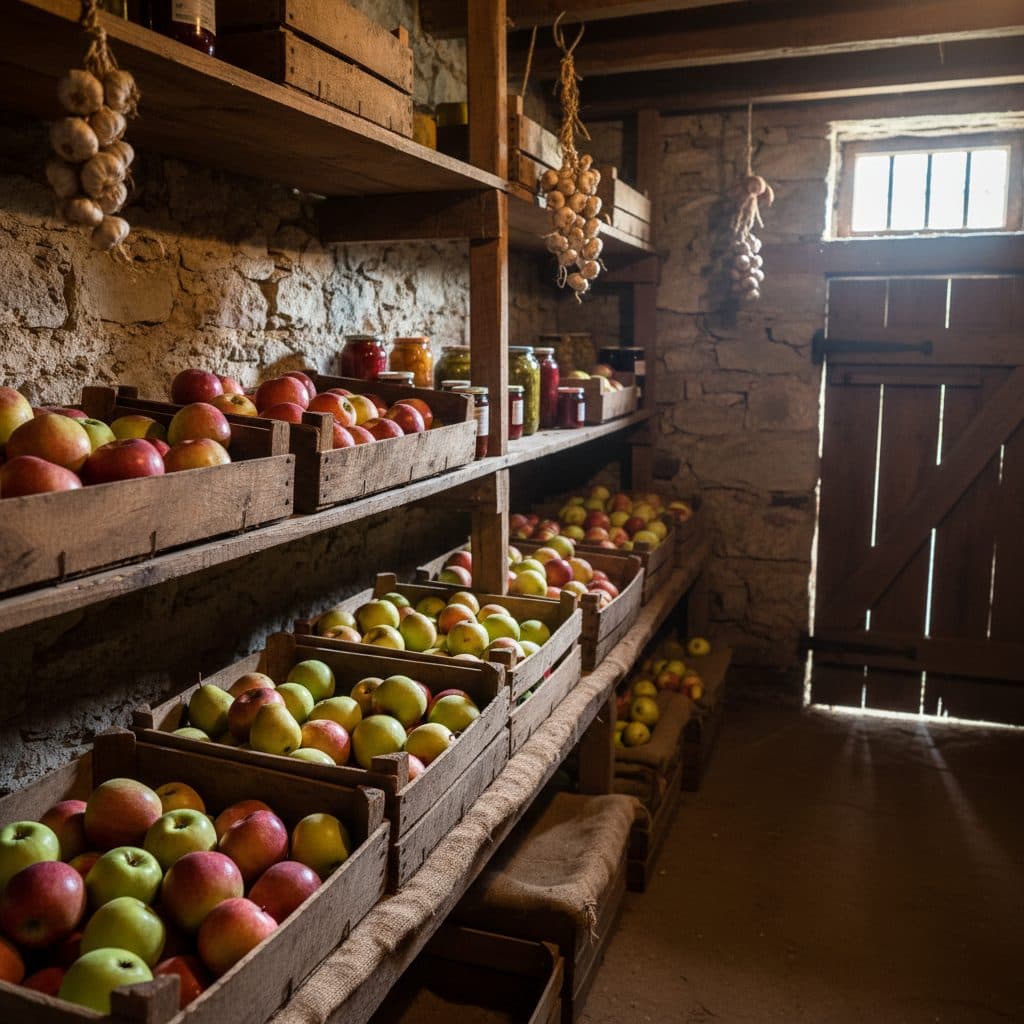
Once prepared, fruit needs a suitable environment for its long rest. For many homesteaders and small-scale growers in USDA zones 4-8, a root cellar remains an excellent, low-cost option for storing apples and pears. A well-designed root cellar maintains a stable temperature of 35-45°F and 85-95% humidity, often without any electricity. That is warmer than the 30-35°F optimum, so expect the shorter end of the storage ranges above — a root cellar running at 45°F will not hold apples for six months. For more on building and managing these structures, refer to our article on root cellaring: storing the harvest without electricity. In a root cellar, fruit can be stored in slatted wooden crates, shallow boxes, or even wrapped individually in newspaper to slow moisture loss and prevent contact spread of decay, extending shelf life by 2-4 months compared to pantry storage.
For those with access to refrigeration, a dedicated cold room or an extra refrigerator set to 30-32°F offers more precise control. This method can extend the storage life of apples to 6-10 months and pears to 3-5 months. Ensure the refrigerator is not overloaded, allowing for proper air circulation, and avoid storing fruit near strong-smelling foods, as apples and pears can absorb odors. For larger operations, commercial controlled atmosphere (CA) storage facilities use advanced technology to precisely regulate temperature, humidity, and atmospheric gases, typically holding fruit for 8-12 months. While out of reach for most home growers, understanding these methods can inform smaller-scale efforts. If you have excess fruit not suitable for long-term fresh storage, consider alternative preservation methods like dehydrating food or fermenting and pickling vegetables, which can extend usability by over a year.
Different storage environments and their benefits
The choice of storage method often depends on scale, available resources, and desired duration. Each option offers distinct advantages for preserving your harvest for varying lengths of time.
- Root cellar: Economical, passive cooling, ideal for 3-6 months storage in temperate climates.
- Refrigerated room: Precise temperature control, extends storage to 6-10 months for apples.
- Dedicated cold storage unit: Offers consistent conditions, often with humidity control, for 5-9 months.
- Commercial CA facility: Sophisticated gas and temperature management, allowing for 8-12 months or more.
- Shed/garage (unheated): Short-term storage (2-4 weeks) during cool weather, prone to temperature fluctuations.
Common storage challenges and solutions
Even with the best preparation, challenges can arise during long-term storage. One of the most significant issues is ethylene gas production. Apples, in particular, produce ethylene, a natural plant hormone that accelerates ripening and senescence in themselves and other fruits [2]. Storing apples and pears together can cause pears to ripen too quickly, reducing their storage life by 20-30%. To mitigate this, store apples and pears in separate areas if possible, or ensure excellent ventilation if they must share a space. Some commercial growers use ethylene scrubbers, but for home use, good air circulation and separating fruit types are the most practical solutions.
Pests and diseases are another concern. Mold and fungal rots can spread rapidly if conditions are too warm or humid, or if damaged fruit is introduced into storage. Regular inspection, every 10-14 days, matters. Remove any fruit showing signs of decay, as one rotten apple can quickly affect 5-10 adjacent fruits. Common physiological disorders like storage scald (brown or black patches on the skin) and bitter pit (small, sunken, dark spots with bitter flesh) can also occur, especially in certain apple varieties like ‘Granny Smith’ or ‘Honeycrisp’ if calcium levels are low [4]. Ensuring proper nutrient balance in the orchard soil, particularly calcium, can help prevent bitter pit, which can affect a large share of the crop in susceptible varieties. Maintaining consistent storage temperatures also helps reduce the incidence of scald.
Signs of spoilage and common issues
Vigilance is key to successful long-term storage. Knowing what to look for can help you address issues before they compromise your entire harvest.
- Soft spots or mushy texture: Indicates over-ripening or internal breakdown, often due to high temperatures.
- Visible mold or fungal growth: A sign of high humidity or damaged fruit, requiring immediate removal.
- Off-odors: Fermentation or decay can produce unpleasant smells, signaling widespread spoilage.
- Shriveling or wrinkling: Caused by excessive moisture loss, usually due to low humidity.
- Brown or black skin patches (scald): A physiological disorder, especially in certain apple varieties, often linked to ethylene and temperature fluctuations.
Comparison of Apple and Pear Storage Characteristics
Characteristic | Apples | Pears |
|---|---|---|
Optimal Temp. | 30-32°F | 30-32°F |
Optimal Humidity | 90-95% | 90-95% |
Ethylene Production | High | Low to Moderate |
Ripening in Storage | Slows significantly | Slows, but often requires post-storage ripening at 60-70°F |
Typical Storage Life | 3-10 months (variety dependent) | 2-5 months (variety dependent) |
Best Varieties | Honeycrisp, Fuji, Granny Smith | Bosc, Anjou, Comice |
Temperature Control: Maintaining a consistent storage temperature between 30°F and 35°F extends the shelf life of many apple varieties by months compared to room temperature storage.
Humidity Levels: A relative humidity of 90-95% prevents the moisture loss that shrivels fruit over several months of storage.
Ethylene Impact: Storing apples and pears separately keeps apples’ ethylene from ripening the pears prematurely.
Frequently asked questions
What is the ideal temperature for storing apples and pears?
The ideal temperature range for storing most apples and pears is between 30°F and 35°F. Maintaining this cold temperature significantly slows down the fruit’s respiration rate, extending its shelf life by several months compared to warmer conditions [1].
How important is humidity for fruit storage?
Humidity is extremely important; a relative humidity of 90-95% is recommended. This high humidity prevents the fruit from losing moisture and shriveling, which can reduce its quality and weight by 10% or more during storage [1].
Should apples and pears be stored together?
It’s best to store apples and pears separately if possible. Apples produce significant amounts of ethylene gas, which can accelerate the ripening and spoilage of pears and other fruits by 20-30% [2].
What are some of the best apple varieties for long-term storage?
Excellent apple varieties for long-term storage include ‘Honeycrisp’, ‘Fuji’, ‘Granny Smith’, and ‘GoldRush’. These varieties can often last 4-10 months under proper cold storage conditions [1].
How often should I check my stored fruit for spoilage?
You should inspect your stored fruit regularly, ideally every 10-14 days. This allows you to quickly identify and remove any fruit showing signs of decay, preventing the spread of mold or rot to other healthy pieces, potentially saving 5-10 pounds of fruit [5].
Can I store fruit in an unheated garage or shed?
An unheated garage or shed can work for short-term storage (2-4 weeks) during cool weather in USDA zones 5-7, but temperature fluctuations can significantly reduce storage life. For longer periods, a more stable environment like a root cellar or refrigerator is needed to maintain consistent temperatures below 40°F [1].
References
- Storing Apples and Pears (1966). Storing Apples and Pears.
- Apples and pears and their relatives (2003). Apples and pears and their relatives.
- Biotechnology of apples and pears (2003). Biotechnology of apples and pears.
- The growing of apples and pears (2003). The growing of apples and pears.
- Apples & pears (1911). Apples & pears.