Key takeaways
- Allotment paths require different surface solutions depending on whether they are main shared tracks or narrow internal bed paths.
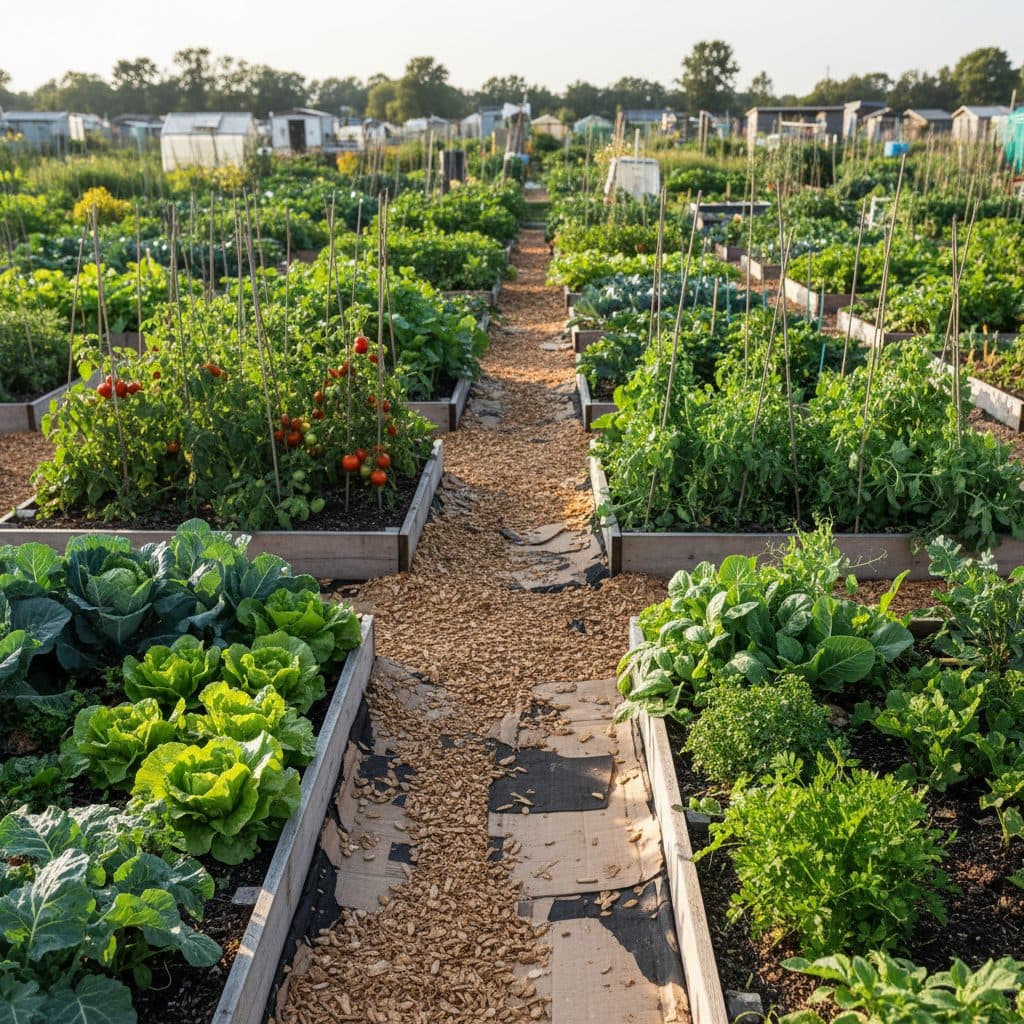
- Arborist wood chips laid over thick, overlapping cardboard provide a practical surface for UK plots. Cardboard and chips will clear annual weeds and weaken most perennials, but bindweed, couch grass, ground elder and horsetail will come through — expect to pull regrowth and re-lay cardboard in year two.
- Wood chips rot down into a dark, fungal-rich humus — spread it as a surface mulch rather than digging it in, since part-rotted chips lock up nitrogen.
- Grass paths provide a green surface but demand weekly mowing and continuous edging to prevent couch grass from invading vegetable beds.
- Avoid synthetic woven plastic weed fabric, as it degrades into microplastics and traps perennial weed roots in an unmanageable tangle.
Quick answer: The best low-maintenance surface for allotment paths is an 8 to 10 cm layer of fresh arborist wood chips laid directly over overlapping corrugated cardboard. Cardboard and chips will clear annual weeds and weaken most perennials, but bindweed, couch grass, ground elder and horsetail will come through — expect to pull regrowth and re-lay cardboard in year two. Chips absorb British winter mud and rot down over two years into dark humus that can be recycled as surface mulch.
Designing an efficient allotment plot involves more than planning vegetable rows and composting bays. Navigating muddy terrain during damp British winters requires durable, well-planned allotment paths that provide safe wheelbarrow access while keeping invasive weeds under control.
Allotment holders often inherit neglected pathways overrun by creeping buttercup, bindweed, and stubborn couch grass. Without a clear path strategy, valuable gardening hours are wasted strimming pathways, battling mud, and weeding path edges rather than tending crops.
Choosing the right path material depends on local council rules, tenancy agreements, and maintenance commitments. Proven surface options range from recycled wood chips and managed turf to reclaimed timber planks, and the right choice builds a clean, long-lasting path that suits your plot.
Main communal pathways vs internal bed access paths
Path planning on a UK allotment requires distinguishing between shared boundary tracks and internal plot walkways:
+-------------------------------------------------------------+
|               ALLOTMENT PATHWAY DIMENSIONS                  |
|                                                             |
|  MAIN COMMUNAL / SHARED PATHS:                              |
|  - Width: 90 cm to 120 cm (3 to 4 feet)                     |
|  - Must accommodate wide wheelbarrows & machinery           |
|  - Regulated by council/allotment tenancy agreements        |
|                                                             |
|  INTERNAL BED ACCESS PATHS:                                 |
|  - Width: 45 cm to 60 cm (18 to 24 inches)                  |
|  - Sized for single-file walking, kneeling, and harvest bins|
|   - Separates permanent no-dig or raised vegetable beds     |
+-------------------------------------------------------------+
Main boundary and communal paths
Shared paths run between neighbouring plots or lead from site entrance gates to water troughs and manure bays. Many tenancy agreements set a minimum width for shared paths (commonly around 90 cm) and require them to be kept clear; check your own agreement. Tenancy agreements often prohibit permanent structures, concrete foundations, or loose gravel along communal boundaries.
Internal bed access paths
Internal paths divide your growing areas into manageable beds. Restricting foot traffic strictly to permanent access paths prevents soil compaction in growing beds, allowing earthworms and plant roots to thrive in loose, un-trodden soil.
Wood chips over cardboard: the permaculture standard
Laying coarse arborist wood chips over thick corrugated cardboard is widely regarded by organic growers as the premier allotment path system.
+-------------------------------------------------------------+
|             WOOD CHIP OVER CARDBOARD INSTALLATION           |
|                                                             |
|  STEP 1: Strim weeds flat to ground level (do not dig)      |
|  STEP 2: Lay 2 layers plain corrugated cardboard            |
|          (Overlap edges by at least 15 cm to block light)   |
|  STEP 3: Soak cardboard thoroughly with water               |
|  STEP 4: Shovel 8-10 cm fresh coarse wood chips on top      |
|  STEP 5: Tamp down firmly with boots or shovel back         |
+-------------------------------------------------------------+
Sourcing and benefits
Local tree surgeons and council arborists often deliver wood chips free or for a nominal tipping fee when pruning municipal trees. Unlike fine bark nuggets sold in garden centres, coarse arborist wood chips contain a mix of wood shreds, twigs, and crushed leaves:
- Low-cost weed suppression: Cardboard and chips will clear annual weeds and weaken most perennials, but bindweed, couch grass, ground elder and horsetail will come through — expect to pull regrowth and re-lay cardboard in year two.
- Excellent winter drainage: Coarse wood chips create an elevated, springy walking surface that stays clean and mud-free even during heavy downpours.
- Soil building cycle: Over 18 to 24 months, saprophytic fungi rot down the lower wood chip layers into a dark, fungal-rich humus — spread it as a surface mulch rather than digging it in, since part-rotted chips lock up nitrogen. Gardeners can top pathways with fresh chips as needed.
Reviewing our step-by-step techniques on sheet mulching cardboard weed control and selecting materials from organic mulches straw wood leaves ensures your mulch layers perform effectively.
Grass paths: pros, cons, and maintenance realities
Grass paths are common on traditional UK allotment sites, offering a pleasant, natural aesthetic that blends seamlessly into the allotment landscape.
+-------------------------------------------------------------+
|               GRASS PATH EVALUATION                         |
|                                                             |
|  ADVANTAGES:                                                |
|  - Cheap to establish from lawn seed or turf scraps         |
|  - Tolerates ordinary foot traffic                          |
|  - Cool and pleasant underfoot during summer                |
|                                                             |
|  DISADVANTAGES:                                             |
|  - Requires weekly mowing or strimming from April to October|
|   - Wears into ruts and bare mud under repeated barrow runs |
|  - Couch grass rhizomes and meadow grass stolons invade beds|
|  - Turns to slippery, worn mud during wet winter months     |
+-------------------------------------------------------------+
Managing grass pathways
If you maintain grass paths, bury timber edging 20–25 cm BELOW soil level (not merely 10 cm proud) to intercept couch grass rhizomes, which travel underground; rough meadow grass (Poa trivialis) is the one that runs on the surface by stolons. Use a half-moon edging iron twice a year to slice a clean 5 cm gap between the turf edge and growing beds. Avoid letting grass grow tall along the edges of brassica netting, as long grass harbors slugs and snails.
Alternative path surfaces: paving slabs, gravel, and timber
Depending on your site rules and budget, several alternative materials can be used for high-traffic zones.
- Paving slabs and concrete council flags: Excellent for laying a solid, level pad outside plot sheds, tool stores, and greenhouse entrances. Slabs provide a clean, non-slip base for washing muddy root vegetables. Lay slabs onto a 3 cm compacted sand bed rather than wet cement so they can be lifted easily if plot boundaries change.
- Reclaimed timber scaffolding boards: Thick scaffolding planks laid along main paths provide immediate mud-free access. Secure planks with wooden stakes driven into the ground. In wet weather, timber can become slippery with algae; staple wire mesh or roofing felt over the wood surface to provide grip.
- Gravel and crushed stone: While gravel provides clean drainage, many sites discourage or prohibit loose gravel — check your tenancy agreement before laying any. Over time, loose gravel inevitably spills into garden beds, damaging rotovators, dulling hoe blades, and permanently contaminating arable topsoil.
Why you should avoid plastic weed membrane
Many beginners attempt to suppress weeds by rolling synthetic woven plastic membrane (weed-suppression fabric) along their paths and pinning it down with metal staples. While effective for the first three months, plastic weed fabric creates severe long-term problems on UK allotment plots:
+-------------------------------------------------------------+
|               THE DANGERS OF PLASTIC WEED FABRIC            |
|                                                             |
|  - Trapped Weed Roots: Couch grass, bindweed, and thistles  |
|    grow directly through the woven fibers, cementing the    |
|    fabric to the subsoil so it cannot be lifted             |
|  - Microplastic Shedding: UV radiation and foot traffic     |
|    shred the plastic edges into thousands of plastic fibers |
|  - Soil Compaction: Creates an impenetrable barrier that    |
|    prevents earthworms from aerating the underlying ground  |
|  - Tenancy Violations: Some sites now ask tenants to lift   |
|    degrading plastic membrane — check your own site rules   |
+-------------------------------------------------------------+
Instead of synthetic plastic fabric, stick with biodegradable cardboard, hessian coffee sacks, or thick layers of newspaper under wood chips. These organic barriers break down naturally into soil carbon, leaving zero toxic residues behind.
As you finalize your allotment layout, consult our winter planning recommendations in what to plant in december uk. If your allotment site has shared orchard areas, studying community orchard provides inspiration for communal pathway design and fruit tree guilds. At agripure, practical allotment wisdom helps you create low-maintenance, productive growing spaces that thrive year after year.