secondary
Black currant
Ribes nigrum
International hardiness
- USDA 3-7
- RHS H6
- AU: Cool temperate
Where it grows — regional guide
| Zones / rating | Regional notes |
|---|---|
USDA 3-7 | Hardy across USDA Zones 3 to 7; check state regulations prior to planting because historical white pine blister rust quarantines still restrict certain counties. |
| Zones / rating | Regional notes |
|---|---|
H6 (-20 to -15C) | A quintessential British garden staple; thrives in cool, damp summers across England and Scotland, providing exceptional yields for jams, cordials, and pies. |
| Zones / rating | Regional notes |
|---|---|
Cool temperate | Restricted to cool-temperate valleys of Tasmania and the Victorian high country where sufficient winter chilling breaks winter bud dormancy. |
| Zones / rating | Regional notes |
|---|---|
USDA 3-7 (USDA scale) Canada uses its own zone system; Canadian zones run roughly one lower than USDA. | Widely cultivated across Ontario, Quebec, and British Columbia; select rust-immune Canadian cultivars like 'Consort' or 'Titania' for reliable vigour. |
| Zones / rating | Regional notes |
|---|---|
No region-specific data yet | No region-specific data yet |
The black currant (Ribes nigrum) is a multi-stemmed deciduous fruiting shrub in the gooseberry family (Grossulariaceae). Native to northern and central Europe and northern Asia, black currant has been cultivated in European kitchen gardens for centuries as a dual-purpose culinary and medicinal crop. In temperate permaculture systems and smallholdings, it occupies a valuable understory or secondary shrub niche, yielding heavy annual crops of dark, aromatic berries while tolerating partial shade beneath orchard canopies of apple and sour cherry.
A defining characteristic of the black currant is the distinctive, pungent herbal fragrance emitted by its foliage and stems. The undersides of the leaves are dotted with microscopic yellow resin glands that release a sharp, musky perfume when brushed. This aromatic quality immediately distinguishes Ribes nigrum from the odourless red currant (Ribes rubrum). Black currant also has high nutritional density: the berries contain up to four times the vitamin C concentration of oranges by weight, along with high levels of anthocyanins and fruit polyphenols.
While beloved across Britain and continental Europe, black currant has a complicated agricultural history in North America. During the early twentieth century, commercial cultivation was banned across the United States to protect timber reserves of eastern white pine (Pinus strobus) from white pine blister rust (Cronartium ribicola), an introduced fungal disease that requires Ribes species to complete its complex lifecycle. Although federal bans were lifted in 1966, several states maintain local planting restrictions. Today, the development of modern rust-immune cultivars has sparked a resurgence of interest among homestead and commercial growers alike.
Growing black currants
Black currants thrive in cool, temperate climates and require cold winter dormancy to break bud dormancy. Mature bushes are hardy to USDA Zones 3 to 7, requiring approximately 800 to 1,200 hours of winter chilling below 7 °C (45 °F) to produce uniform blossom and fruit set. In warm-temperate regions or areas with mild winters, bushes produce sporadic foliage and poor berry yields.
The plant performs best in moisture-retentive, fertile soils rich in organic matter. Heavy clay loams and silt loams are ideal, provided surface drainage is adequate to prevent winter waterlogging. Black currants dislike dry, shallow, or gravelly soils; in light ground, incorporate liberal quantities of compost or well-rotted manure before planting, and maintain a thick organic mulch to conserve root-zone moisture and suppress weeds. The ideal soil pH ranges from 6.0 to 6.8, though plants tolerate slightly acidic to neutral ground.
Bushes produce the highest yields and sweetest fruit when sited in full sun, but they tolerate partial shade and perform better in cool, northern-facing aspects than many other soft fruits. In regions with warm summer temperatures, partial afternoon shade protects foliage from scorching heat stress. Maintain steady soil moisture throughout the growing season, providing approximately 25 to 30 mm (1 to 1.2 in) of water per week from early blossom until harvest.
Plant bare-root or containerised bushes during late autumn or winter dormancy. Unlike gooseberries and red currants, which are trained on a clear short stem, black currants should be planted as a low "stool". Set bushes 5 cm (2 in) deeper than their nursery soil line, burying the lower buds beneath the soil surface. This deep planting stimulates the root crown to send up vigorous new basal shoots from below ground each spring. Space bushes 1.2 to 1.5 m (4 to 5 ft) apart within rows, allowing 1.8 to 2.4 m (6 to 8 ft) between rows.
Pruning differs fundamentally from red currants and gooseberries. Black currants produce their highest-quality fruit predominantly on strong, one-year-old wood produced the previous summer, followed by two-year-old wood. Older branches rapidly lose vigour and produce smaller berries. Prune annually in winter during full dormancy: on established bushes over three years old, remove approximately one-third of the oldest, darkest, thickest stems back to ground level. This annual stool renewal encourages a continuous succession of vigorous young basal canes that maintain heavy annual production.
Harvest and uses
Black currants ripen in midsummer, typically between early July and August depending on cultivar and latitude. The fruit matures on dangling racemes, known botanically as strigs, containing eight to thirty individual berries. Because the berries within an individual strig do not always ripen simultaneously, wait until the lowest berries at the tip of the cluster turn dark purple-black before picking.
Harvest entire strigs by snipping the main stem with shears, or gently strip individual ripe berries from the clusters into clean buckets. Freshly picked fruit stores under refrigeration at 2 °C to 4 °C (36 °F to 39 °F) for up to five days. For winter storage, black currants freeze exceptionally well; simply freeze unwashed dry berries on flat trays before transferring them into bags, as whole berries do not clump together.
In the kitchen, the high acidity and rich pectin content of black currants make them supreme preserving fruit. When simmered with sugar, they yield thick jams, jellies, and tart pie fillings without requiring commercial gelling agents. Simmered and strained, the juice produces traditional black currant cordial, fruit syrup, and the classic French cassis liqueur. The tender young spring leaves can be steeped in hot water to produce an aromatic herbal infusion.
Identifying black currants
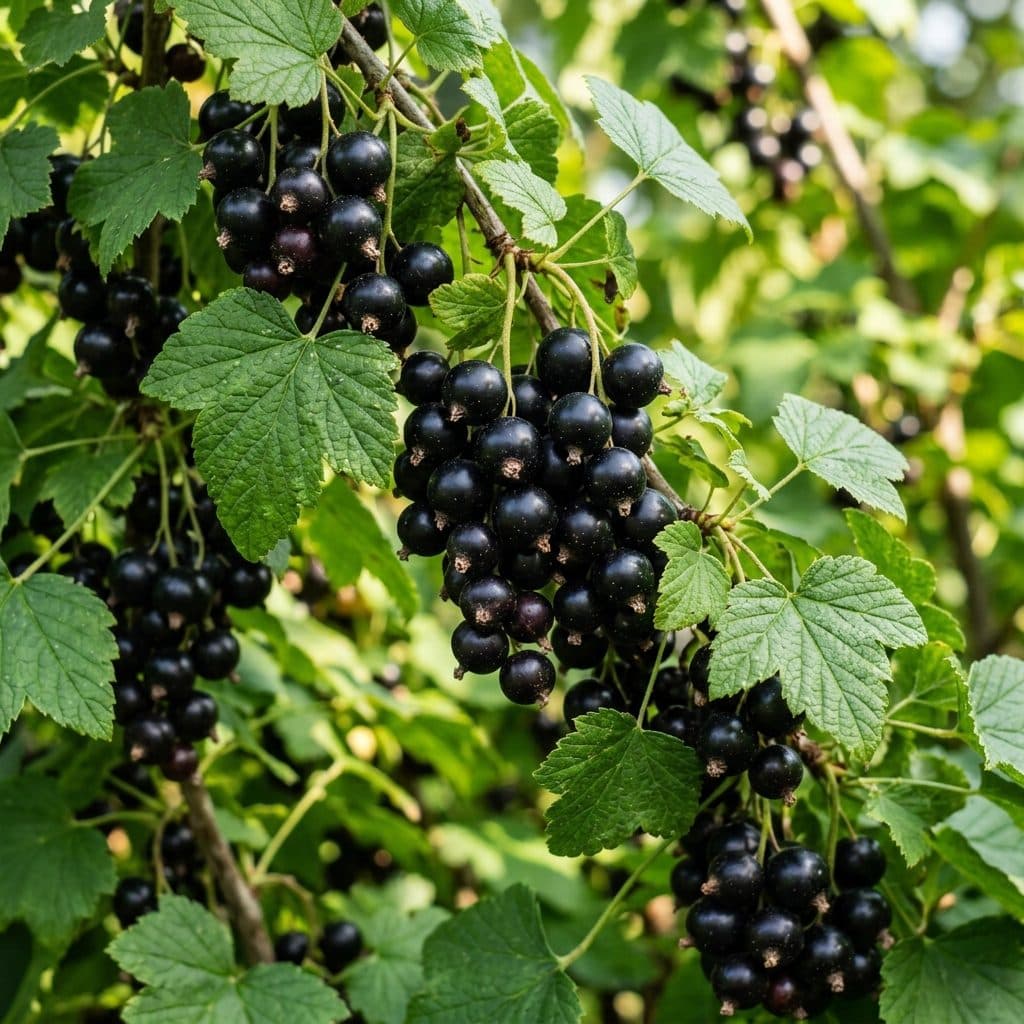
Ribes nigrum is identifiable in the field by several distinct morphological features:
- Habit: A multi-stemmed, spreading deciduous shrub reaching 1.2 to 1.8 m (4 to 6 ft) in height and spread, lacking thorns or prickles.
- Foliage: Alternate, palmately three- to five-lobed leaves measuring 4 to 10 cm (1.6 to 4 in) broad, with coarsely toothed margins and a heart-shaped base.
- Scent glands: Undersides of leaves and young stems are dotted with microscopic yellow or amber resin glands that emit a strong, pungent herbal aroma when crushed or touched.
- Flowers: Drooping racemes (strigs) measuring 4 to 8 cm (1.6 to 3.1 in) long, carrying ten to twenty small, bell-shaped flowers of greenish-brown to pale pinkish-purple, appearing in mid-spring.
- Fruit: Globose, glossy brownish-black berries measuring 8 to 12 mm (0.3 to 0.5 in) in diameter, crowned by the dried, persistent remains of the calyx at the apex.
Black currant is readily distinguished from red currant (Ribes rubrum) and white mulberry by its pungent aromatic leaf glands and dark fruit. It differs from European gooseberry (Ribes uva-crispa) by its completely thornless stems and multi-fruited pendulous racemes (gooseberries bear sharp nodal spines and carry solitary or paired larger berries).
Cautions
Growers managing black currants must observe specific legal quarantines, disease susceptibilities, and pest controls:
- White pine blister rust (Cronartium ribicola): Black currant is the primary alternate host for the white pine blister rust fungus, which causes devastating mortality in valuable five-needle pines (Pinus strobus, Pinus monticola). Before ordering plants in the United States, verify state and county regulations, as several jurisdictions prohibit planting or mandate the use of immune cultivars such as 'Titania', 'Consort', or 'Crusader'. Never plant susceptible cultivars in proximity to commercial pine timber stands.
- Reversion disease and big bud mite: The black currant gall mite (Cecidophyopsis ribis) infests dormant buds in winter, causing them to swell into abnormally large, rounded, sterile "big buds" that fail to leaf out. The mite also vectors Blackcurrant reversion virus, an incurable infection that causes distorted leaves, flower sterility, and permanent crop failure. Inspect dormant bushes annually; hand-pick and destroy swollen buds, and immediately rogue out and burn bushes exhibiting viral reversion symptoms.
- Currant clearwing borer (Synanthedon tipuliformis): The larvae of this clearwing moth bore into the pith of older stems, causing branches to suddenly wilt and snap under crop load. Prune out hollow, infested canes flush with the ground during winter maintenance.
- Bird netting: Like most soft fruits, ripening black currants are targeted by blackbirds, starlings, and thrushes. Netting bushes with fine mesh supported on stakes before the fruit turns black ensures a complete harvest.
Sources
- Royal Botanic Gardens, Kew. Ribes nigrum L. Plants of the World Online.
- Royal Horticultural Society. Blackcurrants: grow your own
- Plants For A Future. Ribes nigrum - L.
- USDA PLANTS Database. Ribes nigrum L.