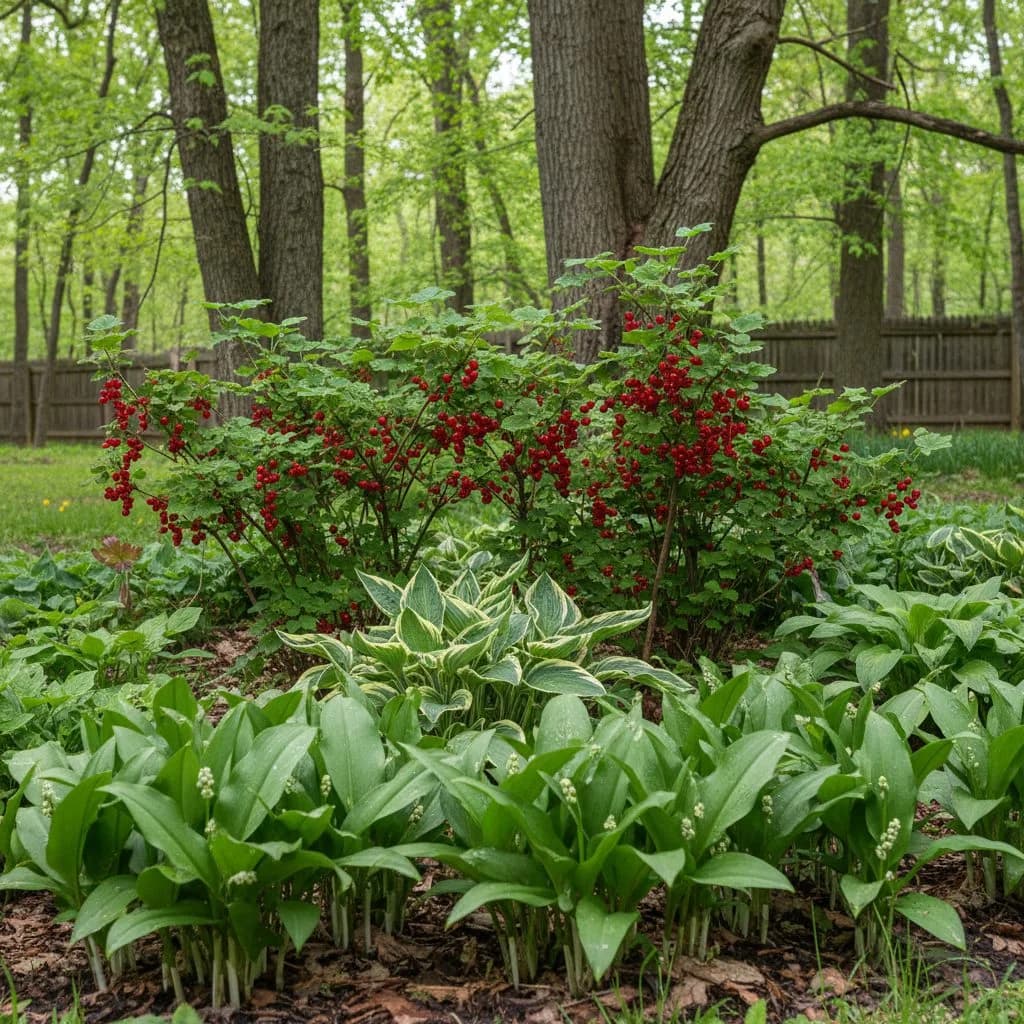
Key takeaways
- Part shade (3–6 hours of direct sun, especially morning sun) suits leafy shoots, spring ephemerals, and woodland-edge berries better than baking afternoon heat in Zones 6–9.
- Layering 3 canopy tiers—berry shrubs, herbaceous shoots, and spring ephemerals—lets one shaded bed yield continuously from March through October.
- Verify every single ramp leaf by crushing a corner for garlic odor; lethal lookalikes (Lily of the Valley, Autumn Crocus, False Hellebore, Death Camas) share the same woodland habitat.
- Check state White Pine Blister Rust laws before planting black currants (Ribes nigrum); choose rust-immune cultivars like 'Consort', 'Titania', or 'Crusader' where permitted.
- Observe three kitchen and yard safety rules: never eat rhubarb leaves (toxic oxalic acid), boil or steam ostrich fern fiddleheads for 10–15 minutes, and fence hostas away from dogs and cats (toxic saponins).
- Mature trees steal water and nitrogen from understory beds; top-dress with 2–3 inches of compost and shredded leaf mold each autumn and run drip lines at 1 inch per week.
Quick answer: Part-shade beds receiving 3–6 hours of direct sun (ideally morning sun with afternoon shade) reliably produce perennial food when you choose woodland-edge species bred for leaves, shoots, or tart berries. Across US Zones 3–9, combine a shrub layer of currants, gooseberries, and black chokeberry (aronia) with a mid-layer of rhubarb, edible hostas, and ostrich fern fiddleheads, plus a spring-ephemeral ground layer of ramps and alpine strawberries. Amend soil to 5%–8% organic matter at pH 6.0–6.8, mulch with 2–3 inches of shredded leaves, and follow strict safety checks for ramp lookalikes and state Ribes blister-rust laws.
Why Part Shade Works for Perennial Food Crops
Most backyard vegetable advice assumes 8 hours of blazing full sun, which leaves north-facing slopes, fence lines, and mature oak or maple yards sitting idle as turfgrass. Yet Iowa State University Extension and forest-farming trials show a clear physiological split: while heat-loving fruiting annuals like tomatoes and peppers stall below 6 hours of sun, woodland-edge perennials grown for tender shoots, leaves, or tart berries evolved specifically under deciduous canopies.
In horticultural terms, part shade means 3 to 6 hours of direct sunlight daily, ideally cool morning sun paired with dappled or full shade during the 2 PM to 5 PM heat peak. That light profile lowers soil evaporation, prevents leaf scorch on cool-climate crops like currants and rhubarb in Zones 6–8, and extends the tender harvest window of spring greens. If you are mapping an entire yard, combine these perennials with our food forest layers design guide and shade-tolerant annual vegetables and herbs.
Before laying out beds, track sun movement across your yard at 9 AM, noon, and 3 PM during late spring when overhead deciduous trees have fully leafed out. Site your berry shrubs along the sunniest southern or eastern edge where they capture 4 to 6 hours of direct light, tuck herbaceous shoots like rhubarb and hostas in the 3-to-5-hour middle tier, and reserve the deepest 2-to-4-hour dappled zone beneath high branches for spring-ephemeral ramps and ostrich ferns. Testing soil pH and organic matter through your county cooperative extension office ($15–$25 per sample) takes the guesswork out of lime or sulfur amendments before planting perennials that will stay in place for two decades.
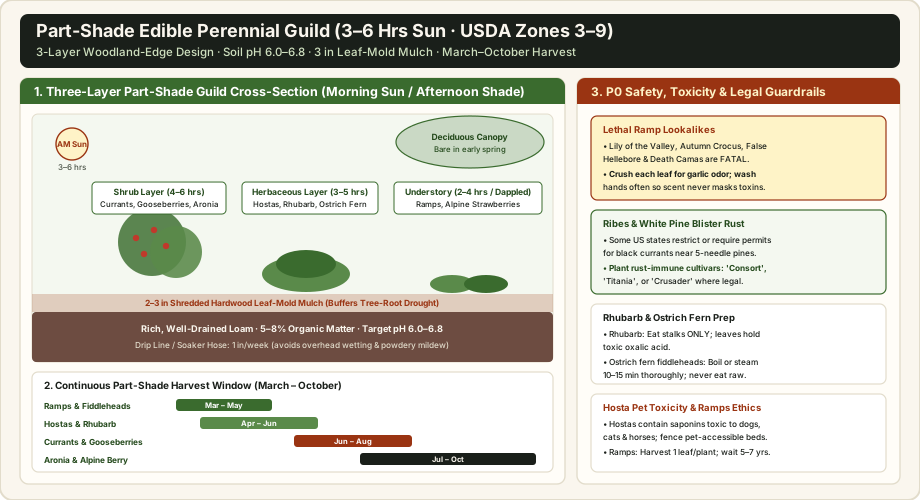
Master Comparison: 8 Reliable US Part-Shade Edible Perennials
Before digging a single hole, match each species to your USDA Hardiness Zone, exact sun hours, and soil pH. All eight perennials below produce for 10 to 25+ years once established.
Part-Shade Edible Perennial Master Matrix (US Zones 3–9)
Species | USDA Zones | Sun Hours & Layer | Soil pH & Spacing | Edible Part & Mature Yield | Harvest Window |
|---|---|---|---|---|---|
Ramps / Wild Leeks (Allium tricoccum) | 3–7 | 2–4 hrs (spring ephemeral understory) | pH 6.0–7.0 · 4–6 in | 1 leaf/plant; 5–7 yrs from seed | Early spring (Mar–May) |
Red Currant (Ribes rubrum) | 3–8 | 4–6 hrs (shrub canopy edge) | pH 6.0–6.8 · 3–5 ft | Berries · 5–10 lb/bush | Summer (Jun–Jul) |
Black Currant (Ribes nigrum) | 3–7 | 4–6 hrs (shrub canopy edge) | pH 6.0–6.8 · 4–5 ft | Berries · 4–8 lb/bush | Mid-summer (Jul) |
Gooseberry (Ribes uva-crispa) | 3–8 | 4–6 hrs (shrub canopy edge) | pH 6.0–6.8 · 3–5 ft | Berries · 6–10 lb/bush | Summer (Jun–Aug) |
Black Chokeberry (Aronia melanocarpa) | 3–8 | 3–6 hrs (native shrub layer) | pH 5.5–7.0 · 4–6 ft | Tart berries · 8–15 lb/bush | Late summer (Aug–Sep) |
Edible Hosta (Hosta sieboldiana, H. plantaginea) | 3–9 | 2–5 hrs (herbaceous mid-layer) | pH 6.0–7.0 · 18–36 in | Young shoots (4–8 in) · 10–15/clump | Early spring (Apr–May) |
Rhubarb (Rheum rhabarbarum) | 3–8 | 4–6 hrs (herbaceous mid-layer) | pH 6.0–6.8 · 3–4 ft | Stalks ONLY · 4–8 lb/crown | Spring–early summer (Apr–Jun) |
Ostrich Fern (Matteuccia struthiopteris) | 3–7 | 2–4 hrs (damp woodland floor) | pH 5.5–6.8 · 24–36 in | Cooked fiddleheads · 3–4/crown | Early spring (Apr–May) |
For an additional low-growing berry edge that thrives in dappled light, tuck alpine strawberries or native serviceberry along the sunniest margin of the bed, or contain vigorous spearmint in sunken pots so its runners cannot overtake slower perennials.
Spring-Ephemeral Understory: Ramps & Lethal Lookalike Safety
Ramps (Allium tricoccum) are the signature edible of eastern North American deciduous woodlands. Because they emerge in late March through May—while overhead maples, oaks, and beeches are still leafless—they soak up bright spring sun, store energy in their bulbs, and go completely dormant by June. That phenology makes them the ideal understory beneath late-leafing berry shrubs and hostas.
P0 Deadly Lookalike Warning for Ramps & Wild Alliums: Fatal poisonings occur every spring when Lily of the Valley (Convallaria majalis, cardiac glycosides), Autumn Crocus (Colchicum autumnale, lethal colchicine), False Hellebore (Veratrum viride, pleated leaves with steroidal alkaloids), or Death Camas (Toxicoscordion spp.) are harvested alongside ramps. Never grab leaves by the handful: inspect every single leaf individually, crush a corner to confirm an unmistakable garlic-onion odor, and wash your hands frequently so lingering garlic scent on your fingers never masks a scentless lethal lookalike. Never plant toxic ornamentals like bloodroot (Sanguinaria canadensis) or Lily of the Valley inside an edible ramp bed.
NC State and Penn State Extension forest-farming trials emphasize patience: ramp seeds require 18–24 months of double dormancy to germinate and 5–7 years to reach harvestable size. Starting from ethically sourced nursery bulbs cuts establishment to 3–4 years. Plant bulbs 2–3 inches deep and 4–6 inches apart in rich, moist soil (pH 6.0–7.0) under 2–3 inches of shredded deciduous leaf litter. Once established, harvest only one leaf per plant (leaving the bulb and second leaf intact) or take no more than 5%–10% of a mature colony. Review our poisonous foraging look-alike cheat sheet before harvesting any wild spring greens.
Shrub Canopy Layer: Currants, Gooseberries & White Pine Blister Rust Laws
Red currants, black currants, and gooseberries (Ribes spp.) are among the highest-yielding perennial fruits for part shade across Zones 3–8. Unlike blueberries—which demand acidic pH 4.5–5.2 soil—Ribes shrubs thrive in standard garden loam at pH 6.0–6.8 and often produce cleaner foliage in afternoon shade than in hot full sun. A single mature bush yields 5–10 pounds of berries annually for 15–20 years.
White Pine Blister Rust & Ribes Cultivar Selection Guide
Ribes Type | Blister Rust Susceptibility | Recommended Resistant Cultivars | Annual Pruning Rule |
|---|---|---|---|
Black Currant (Ribes nigrum) | High (restricted or permit-required in several US states) | 'Consort', 'Titania', 'Crusader' (immune/highly resistant) | Remove 1/3 of oldest dark canes (>3 yrs) in late winter |
Red & White Currant (Ribes rubrum) | Low to Moderate (check local county buffers) | 'Red Lake', 'Rovada', 'Jonkheer van Tets', 'Blanka' | Keep 9–12 stems (equal mix of 1-, 2-, and 3-year wood) |
Gooseberry (Ribes uva-crispa) | Low to Moderate (powdery mildew is the main issue) | 'Pixwell', 'Hinnomaki Red', 'Invicta', 'Jeanne' | Open the center vase for airflow; thin oldest 1/3 canes |
P0 State Quarantine Check (White Pine Blister Rust): Ribes species serve as the alternate host for Cronartium ribicola, the fungus that causes lethal cankers on five-needle pines (Eastern and Western White Pine). Although the federal ban ended in 1966, states including Michigan, Maine, New Hampshire, Massachusetts, New York, North Carolina, West Virginia, and others still restrict black currants or require permits in pine control districts. Verify your state department of agriculture rules before ordering plants, and choose rust-immune cultivars like 'Consort' or 'Titania' where legal.
If your county prohibits Ribes entirely, substitute native black chokeberry (Aronia melanocarpa) or black elderberry. Both handle 3–6 hours of sun, require zero blister-rust permits, and pair naturally with native berry living fences.
Herbaceous Mid-Layer: Edible Hostas, Rhubarb & Ostrich Fern Fiddleheads
Between your berry shrubs and ground-level ramps, three vigorous herbaceous perennials deliver pounds of crisp spring vegetables with almost zero annual replanting.
Edible hosta shoots ('hostons' or urui)
Grown across Zones 3–9 as shade ornamentals, hostas—especially Hosta sieboldiana, H. plantaginea, 'Sum and Substance', and 'Francee'—produce tender spring shoots prized as urui in Japanese cuisine. Slice tightly furled shoots at soil level with a clean knife when they reach 4–8 inches tall before leaves unfurl and turn fibrous. Taking 30%–40% of emerging shoots from a mature clump (roughly 10–15 shoots) does not weaken the plant. P0 Pet Safety Warning: Hostas contain steroidal saponins that are toxic to dogs, cats, and horses (causing vomiting and diarrhea); fence pet-accessible yards or choose rhubarb-free/hosta-free beds where pets graze.
Rhubarb (Rheum rhabarbarum)
Rhubarb is a cold-hardy perennial (Zones 3–8) that actually prefers light afternoon shade in Zones 6–8, where full midday heat stunts summer crowns. Space divisions 3–4 feet apart in deeply composted loam, wait until Year 2 to harvest lightly, and pull stalks by twisting from the base rather than cutting. P0 Toxicity Rule: Eat only the leaf stalks (petioles); rhubarb leaf blades contain high concentrations of toxic oxalic acid and must go straight to the compost pile, never the kitchen.
Ostrich fern fiddleheads (Matteuccia struthiopteris)
In damp, 2–4 hour shade corners (Zones 3–7), ostrich fern produces tightly coiled bright-green spring fiddleheads with a deep U-shaped groove along the inside of the stem and papery brown scales that rub off easily. Harvest no more than 3–4 fronds per crown so the fern stays vigorous. P0 Food Safety Rule: Never eat fiddleheads raw or lightly sautéed; boil or steam them thoroughly for 10–15 minutes (discarding the cooking water) to prevent acute gastrointestinal illness, and never confuse ostrich fern with toxic bracken fern (Pteridium aquilinum).
Soil Prep, Tree-Root Competition & Seasonal Care Calendar
The biggest hidden obstacle in a part-shade garden is not low light—it is dry shade caused by shallow feeder roots of mature maples, oaks, and elms drinking up every drop of rain. Avoid rototilling under established trees, which severs structural roots. Instead, build a raised 4-to-6-inch layer of compost and shredded leaf mold on top of the soil, plant small nursery starts between major roots, and lay a dedicated drip line delivering 1 inch of water per week during dry spells. Drip irrigation keeps foliage dry, which cuts powdery mildew on gooseberries and currants dramatically.
Seasonal Part-Shade Perennial Maintenance & Harvest Calendar
Season | Primary Harvests | Soil, Water & Mulch Tasks | Pest & Pruning Actions |
|---|---|---|---|
Early Spring (Mar–Apr) | Ramps (1 leaf/plant), ostrich fern fiddleheads, early hosta shoots | Check drip lines; avoid walking on wet woodland beds to prevent compaction | Finish dormant Ribes pruning before budbreak; set iron-phosphate slug traps around hostas |
Late Spring (May–Jun) | Rhubarb stalks, late hosta shoots, early red currants | Water 1 in/week under tree canopies; side-dress rhubarb and Ribes with 1 in compost | Scout Ribes undersides for imported currantworm; hand-pick or spray Bt/insecticidal soap |
Summer (Jul–Aug) | Red/black currants, gooseberries, alpine strawberries | Maintain 2–3 in mulch; keep soil evenly moist during berry swell | Net berry shrubs against cedar waxwings and robins; stop rhubarb harvest by late June |
Autumn (Sep–Nov) | Black chokeberry (aronia), late alpine berries | Top-dress entire bed with 2–3 in shredded hardwood leaf mold; test soil pH every 2–3 yrs | Plant ramp bulbs and bare-root Ribes; divide overcrowded hostas every 3–5 years |
Because cool, damp shade beds attract slugs and snails, surround emerging hosta shoots with sharp crushed eggshells, copper tape, or OMRI-listed iron phosphate bait rather than toxic metaldehyde pellets. For broader shade design and low-input ground covers, explore our food forest design guide, edible ground cover guide, and food forest plants overview. If deer browse your woodland edge, pair these beds with strategies from our deer-resistant plants guide and companion planting guide.