Key takeaways
- Dehydration reduces berry weight by 80-90%, concentrating flavor and extending shelf life for up to 12 months.
- Fermenting berries into wine or vinegar uses natural processes to preserve the harvest, with elderberry wine often reaching 10-14% alcohol by volume.
- Sugar preserves like jams and jellies require a minimum 60-65% sugar concentration to prevent spoilage and can store for 1-2 years.
- Canning berries or berry products in a water bath can create shelf-stable goods for 18-24 months when stored below 70°F.
- Mulberries, elderberries, blueberries, and raspberries each offer unique characteristics for various non-freezer preservation methods; elderberries must be stripped from their stems and heated before use, as the raw fruit and stems contain cyanogenic glycosides.
- Proper storage conditions, including cool, dark, and dry environments, matter for all non-freezer preserved berry products.
Quick answer: In USDA Zone 6, berries can be preserved without a freezer using methods like dehydration, fermentation into wines or vinegars, and sugar preservation for jams, jellies, and syrups. These techniques extend shelf life for months to years by removing water, adding alcohol, or increasing sugar content.
In the humid summers of the American South, from Georgia to Missouri, a bountiful berry harvest can quickly overwhelm a household. When the mulberry trees drop their fruit by the gallon, or the elderberry bushes are heavy with dark clusters, a freezer might not be enough — or even available. Many growers in USDA zone 6, for instance, face this challenge annually, needing reliable methods to store their hard-won produce.
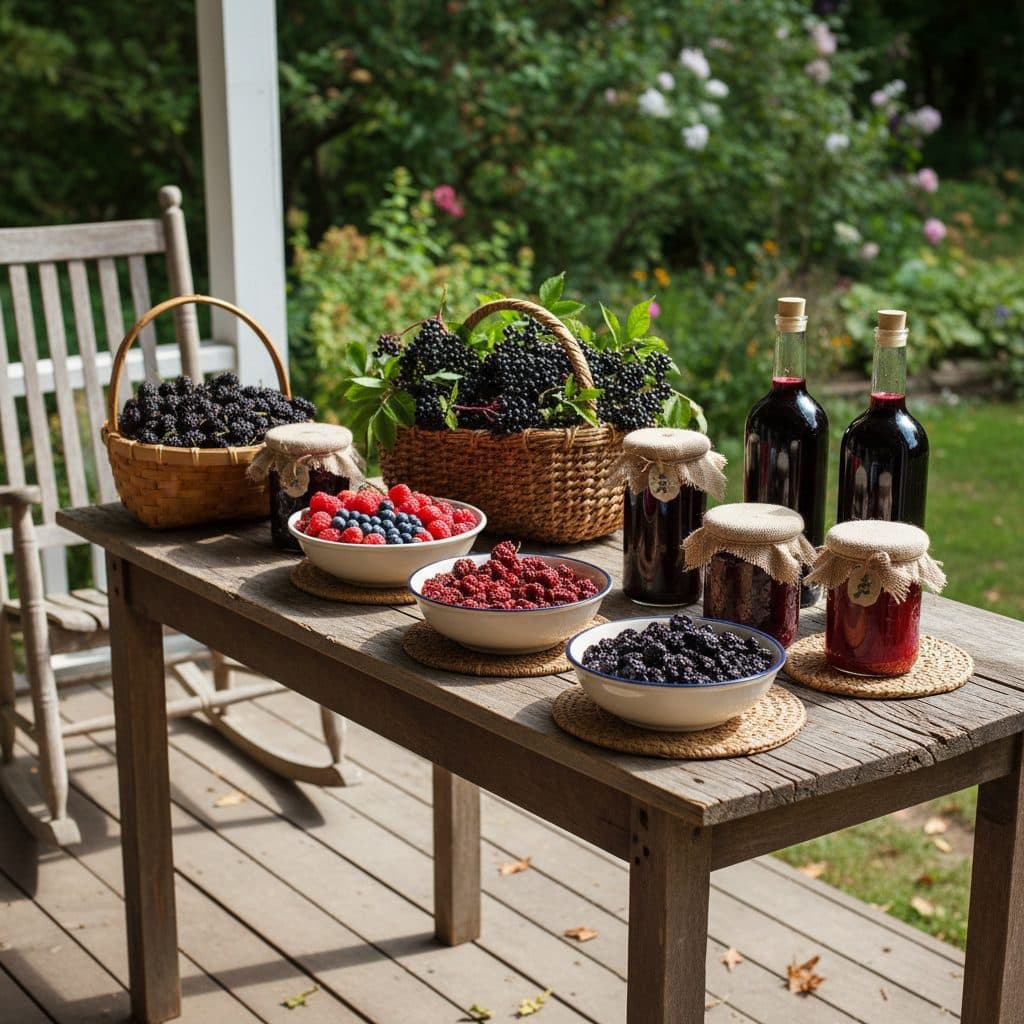
This guide explores practical, time-tested approaches to preserving mulberries, elderberries, blueberries, and raspberries without relying on refrigeration. We will cover dehydration, fermentation, and sugar preservation, strategies that extend the life of your harvest for months, sometimes even years, so the flavors of summer keep through the cold winter months.
Dehydrating berries for long-term storage
Dehydration is one of the most straightforward and effective methods for preserving berries without a freezer. It removes 80-90% of the water content, inhibiting microbial growth and concentrating the fruit’s natural sugars and flavors. For mulberries, blueberries, and raspberries, a dehydrator or even a low-temperature oven can work. Spread berries in a single layer on trays, ensuring good air circulation. For blueberries, a quick blanch in boiling water for 30 seconds, followed by an ice bath, can help crack their skins, speeding up the drying process significantly. Drying temperatures typically range from 125°F to 135°F, taking anywhere from 8 to 24 hours depending on the berry type and humidity.
preparing and drying specific berry types
Mulberries, particularly the red mulberry (Morus rubra) common in the Eastern US, dry well whole. Raspberries, being delicate, benefit from careful handling to avoid crushing. Blueberries, especially highbush varieties (Vaccinium corymbosum) grown in states like Michigan, can be dried whole or halved. Once fully dry, berries should be leathery and pliable, not sticky or brittle. Store them in airtight containers, such as glass jars or vacuum-sealed bags, in a cool, dark pantry. Properly dried berries can last for 6 to 12 months and hold a concentrated source of nutrients. For more detailed instructions on drying various produce, consult resources like Dehydrating food: how to dry produce, herbs, and jerky.
- Wash berries thoroughly before drying to remove debris.
- Blanch blueberries for 30 seconds to speed drying.
- Spread in a single layer on dehydrator trays.
- Dry at 125°F to 135°F until leathery.
- Condition dried berries by shaking jars daily for one week.
Fermenting berries into wines and vinegars
Fermentation preserves the intense flavors of berries, transforming them into shelf-stable wines or vinegars. Elderberries (Sambucus canadensis), widely found across the Eastern and Central US, are particularly well-suited for wine making due to their robust flavor. Strip the berries fully off the stems first and use only fully ripe fruit: elderberry stems, leaves, unripe berries and raw ripe berries all contain cyanogenic glycosides that cause nausea, vomiting and diarrhea. Heat the crushed fruit before fermenting, and never use elderberries in a preparation that leaves them raw. A typical elderberry wine recipe might use 3-5 pounds of berries per gallon of water, yielding a wine with 10-14% alcohol by volume. Raspberries also make excellent wines, often with a brighter, more tart profile, while mulberries can produce a rich, dark wine similar to a light red grape wine.
crafting berry wines and vinegars
For berry wine, the process involves crushing the fruit, adding sugar (typically 2-3 pounds per gallon to reach desired alcohol levels), yeast, and nutrients, then allowing it to ferment for several weeks. After primary fermentation, the wine is racked to remove sediment and aged for several months, or even a year, in a cool, dark place. Berry vinegars are made in two stages: ferment the sweetened juice to alcohol with a wine yeast first, then add a vinegar mother and let it convert to acetic acid over several weeks. Use raspberries or mulberries for this, not elderberries — nothing in the vinegar process heats the fruit. Home vinegar's acid strength cannot be known without titration, so treat it as a table condiment and never as the acid in a pickling or canning recipe.
- Sanitize all equipment thoroughly to prevent spoilage.
- Use 3-5 pounds of berries per gallon for wine.
- Add 2-3 pounds of sugar per gallon for 10-14% ABV.
- Ferment at 65°F to 75°F for optimal yeast activity.
- Age wine for 6-12 months for best flavor development.
Making sugar preserves: jams, jellies, and syrups
Sugar is a powerful preservative, and turning berries into jams, jellies, or syrups is a classic non-freezer method. The high sugar content (typically 60-65% of the total weight) prevents microbial growth by binding water, making it unavailable to spoilage organisms. Blueberries, mulberries, raspberries, and elderberries all lend themselves beautifully to these preparations. For instance, a batch of blueberry jam might require 4 cups of crushed berries to 3-4 cups of sugar, plus pectin for proper setting. Elderberry jelly is particularly popular, often using the juice of 5-6 pounds of berries per batch.
recipes for shelf-stable berry preserves
To make jam, combine crushed berries, sugar, and pectin (if needed) in a large pot, bringing it to a rolling boil that cannot be stirred down. Cook until it reaches the gelling point, usually 220°F. For syrups, simply cook berries with sugar and water, then strain. These preserves are then poured into sterilized jars, leaving 0.25 inch headspace, and processed in a boiling water bath for 10-15 minutes, depending on altitude and jar size. Properly sealed jars can be stored in a cool, dark pantry for 1-2 years.
- Use ripe, unblemished berries for best flavor and set.
- Ensure a 60-65% sugar concentration for proper preservation.
- Sterilize jars and lids before filling to prevent contamination.
- Process in a boiling water bath for 10-15 minutes.
- Store in a cool, dark pantry below 70°F for optimal shelf life.
Canning and cool storage for processed berry products
While fresh berries don’t typically do well in a root cellar, processed berry products — like canned pie fillings, whole canned berries in syrup, or even bottled berry juices — can be stored effectively in a cool, dark environment. Canning involves sealing food in jars and heating them to a temperature that destroys spoilage microorganisms and creates a vacuum seal. For high-acid foods like berries, a boiling water bath canner is sufficient. This method allows you to preserve the berries in a form ready for immediate use, whether for baking, sauces, or beverages.
optimizing storage for canned goods
When canning whole blueberries or raspberries, you might pack them in a light syrup (1 cup sugar to 2 cups water) or their own juice. Process pint jars for 15 minutes and quart jars for 20 minutes in a boiling water bath at up to 1,000 feet, adding 5 minutes at 1,001-3,000 feet, 10 minutes at 3,001-6,000 feet, and 15 minutes at 6,001-8,000 feet. After processing, jars should be left undisturbed for 12-24 hours to cool and seal properly. Store these canned goods in a root cellaring environment, or a cool pantry, where temperatures remain consistently between 40°F and 70°F. Such conditions keep quality up and spoilage down. The USDA Complete Guide to Home Canning and the National Center for Home Food Preservation publish the tested processing times and altitude adjustments for home canning.
- Use only sound, ripe berries for canning.
- Pack berries hot or cold into sterilized jars.
- Ensure 0.5 inch headspace for expansion during processing.
- Process pint jars for 15 minutes in a boiling water bath.
- Store canned goods below 70°F for up to 18-24 months.
Comparison of Non-Freezer Berry Preservation Methods
Method | Typical Shelf Life | Primary Preservative | Best for Berries |
|---|---|---|---|
Dehydration | 6-12 months | Moisture Removal | Mulberry, Blueberry, Raspberry |
Fermentation (Wine) | 1-5+ years | Alcohol | Elderberry, Raspberry, Mulberry |
Fermentation (Vinegar) | Indefinite | Acetic Acid | Raspberry, Elderberry |
Sugar Preserves (Jam/Jelly) | 1-2 years | High Sugar Content | Blueberry, Mulberry, Raspberry, Elderberry |
Canning (Water Bath) | 18-24 months | Heat & Vacuum Seal | Blueberry, Raspberry, Elderberry |
Elderberry Yields: Some American elderberry genotypes can yield 2 to 3 tons of berries per acre, requiring preservation strategies [1].
Drying Efficiency: Dehydration drives off most of the water in berries, making them far lighter to store.
Frequently asked questions
Can I store fresh berries in a root cellar?
Fresh berries generally do not store well in a root cellar due to their high moisture content and delicate nature, typically lasting only a few days. Root cellars are better suited for processed berry products like jams or canned goods, which can last 18-24 months when stored properly below 70°F.
What is the ideal temperature for dehydrating berries?
The ideal temperature for dehydrating most berries is between 125°F and 135°F. This range allows for efficient moisture removal without cooking the fruit, typically taking 8 to 24 hours depending on the berry size and dehydrator model.
How much sugar is needed for berry jams to be shelf-stable?
For berry jams to be shelf-stable without refrigeration, they typically require a minimum sugar concentration of 60-65% of the total weight. This high sugar content acts as a preservative, allowing jams to be stored for 1-2 years in a cool, dark pantry.
Are there specific elderberry varieties best for wine making?
American elderberry (Sambucus canadensis) genotypes are generally excellent for wine making due to their robust flavor and good sugar content. Cultivated selections generally crop more heavily and ripen more evenly than wild stands.
How long do home-canned berries last?
Home-canned berries, when properly processed in a boiling water bath and stored in a cool, dark place below 70°F, can maintain their quality for 18-24 months. Always check for proper seals before consumption.
References
- Flower production and effect of flower harvest on berry yields within six American elderberry genotypes (2023). Flower production and effect of flower harvest on berry yields within six American elderberry genotypes.
- Physicochemical properties and bioactive compounds content in encapsulated freeze-dried powders obtained from blueberry, elderberry, blackcurrant and maqui berr (2019). Physicochemical properties and bioactive compounds content in encapsulated freeze-dried powders obtained from blueberry, elderberry, blackcurrant and maqui berr.
- Pruning Severity Affects Yield, Berry Weight, and Hand Harvest Efficiency of Highbush Blueberry (2003). Pruning Severity Affects Yield, Berry Weight, and Hand Harvest Efficiency of Highbush Blueberry.