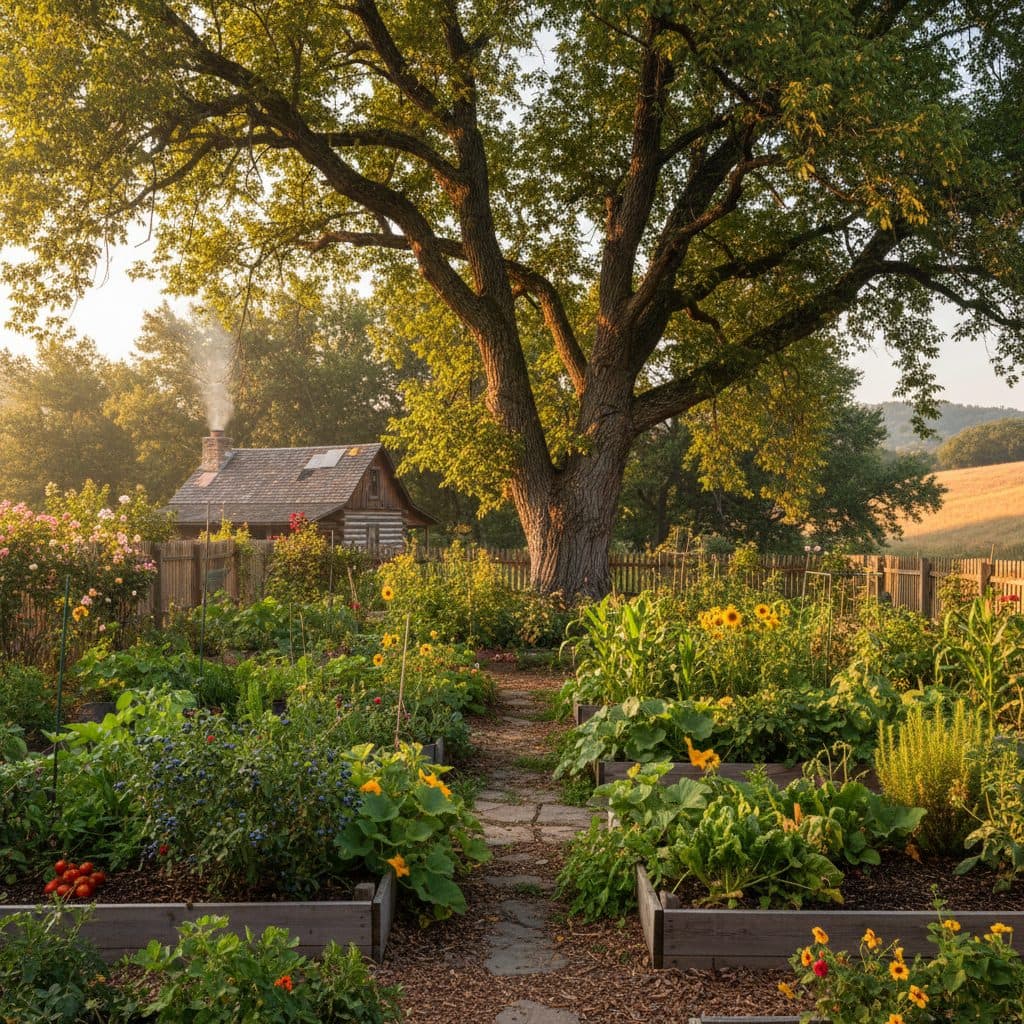
Key takeaways
- Juglone, a chemical produced by black walnuts, inhibits the growth of many sensitive plants within a 50-foot radius.
- Identifying black walnut trees by their bark, leaves, and fruit is essential for proper site assessment in USDA zones 4-9.
- Strategies like planting at a distance, using raised beds 18-24 inches deep, and installing root barriers can mitigate juglone’s effects.
- Many common fruit trees, shrubs, vegetables, and herbs exhibit tolerance to juglone, allowing for diverse guilds.
- Designing a multi-layered guild with tolerant plants (including nitrogen fixers and dynamic accumulators) can create a productive food forest.
- Soil health improvement through compost and mulching can help reduce juglone concentration over 2-3 years.
Quick answer: To design plant guilds around black walnut trees despite juglone, identify tolerant species, use raised beds or root barriers, and improve soil health. This allows for productive food forests even within the tree’s toxic zone.
In the Ozark Mountains of Missouri, where black walnut trees (Juglans nigra) grow abundantly, gardeners often face a specific challenge: juglone toxicity. This natural chemical, exuded primarily from walnut roots, can stunt or kill many common garden plants. With careful site assessment and plant selection, productive guilds are possible within the influence of a black walnut.
This article will guide you through identifying black walnuts, understanding juglone’s impact, and selecting a wide array of tolerant plants. We will explore practical strategies for designing resilient, productive food forest guilds around these trees to ensure your efforts yield results in your USDA zone 4-9 landscape. By focusing on species known for their tolerance, you can transform a challenging site into a flourishing part of your homestead, often within 30-50 feet of a mature walnut tree.
Understanding juglone: a natural defense mechanism
Juglone is a potent allelochemical, or natural herbicide, produced by trees in the Juglandaceae family, notably black walnuts (Juglans nigra), but also to a lesser extent by English walnuts, pecans, and hickories [4]. This compound is found in the roots, leaves, bark, and fruit husks of the tree, with the highest concentrations typically in the root zone [5]. When juglone enters the soil, it inhibits cellular respiration in sensitive plants, effectively preventing them from absorbing water and nutrients, leading to wilting, yellowing, and eventual death. The toxic zone around a mature black walnut can extend up to 50 feet from the trunk, depending on soil type and drainage, and the roots themselves can spread horizontally even further, well beyond the tree's drip line.
The impact of juglone is most severe within the drip line of the tree, which is generally the area directly beneath the canopy, but active root growth can push the toxic zone much wider. Juglone can persist in the soil for 2-3 years after a walnut tree has been removed, making immediate replanting with sensitive species a risky endeavor [3]. Soil microorganisms do break down juglone over time, but the rate of decomposition varies greatly with soil conditions, moisture, and temperature. For instance, in a well-drained, organically rich soil, juglone may dissipate more quickly than in heavy clay soils. Understanding this chemical’s reach and persistence is the first step in successful guild design.
how juglone affects sensitive plants
Juglone interrupts plant metabolism, particularly affecting enzyme activity and respiration. This leads to symptoms such as stunted growth, wilting, yellowing leaves, and eventual plant death. While some plants show immediate signs of stress within days or weeks of exposure, others may decline slowly over several months, especially if they are borderline tolerant. For example, tomatoes, peppers, and blueberries are highly sensitive and can die within a few weeks when planted too close to a black walnut [3].
- Wilting: Plants struggle to absorb water, even when soil is moist.
- Yellowing leaves: Chlorosis, indicating nutrient deficiencies.
- Stunted growth: Overall reduction in plant size and vigor.
- Root damage: Roots may appear blackened or rotted.
- Reduced yields: Even if plants survive, fruit or vegetable production is significantly lowered.
Identifying black walnuts and their reach
That work on understanding juglone sets up what follows here.
Accurate identification of black walnut trees (Juglans nigra) is paramount before planning any planting. These deciduous trees are native to a large portion of the eastern and central United States, thriving across USDA hardiness zones 4 through 9. A mature black walnut can reach impressive heights of 50-80 feet, with a trunk diameter often exceeding 2 feet [1]. Its bark is deeply furrowed, dark gray to black, and forms a distinctive diamond-patterned ridge. The leaves are compound, typically 12-24 inches long, with 15-23 finely toothed leaflets arranged alternately along the stem. When crushed, the leaves emit a pungent, citrusy aroma.
Perhaps the most definitive identifier is the fruit: a round, green husk, 1.5-2.5 inches in diameter, which drops in the fall. Inside the husk is a hard, dark brown nut with a deeply ridged shell. The roots of a black walnut are extensive, often spreading horizontally 50 feet or more from the trunk, and can grow 10-15 feet deep. It is this vast root system that is the primary source of juglone in the soil, making the area far beyond the tree’s drip line potentially toxic. Understanding the tree’s physical characteristics and its typical growth patterns in your specific region, like the humid summers of the Midwest, helps in accurately assessing the juglone impact zone.
key identification features
Beyond the visual cues, consider the tree’s growth habit and location. Black walnuts prefer deep, rich, well-drained soils, often found along stream banks and in fertile bottomlands. They are fast-growing, sometimes adding 2-3 feet in height per year in optimal conditions. Observing nearby undergrowth can also provide clues; if the area beneath a large tree is sparse or contains only specific types of plants, it might indicate the presence of juglone. Always confirm identification before making planting decisions.
- Bark: Dark gray to black, deeply furrowed with diamond-shaped ridges.
- Leaves: Compound, 12-24 inches long, 15-23 leaflets, alternate arrangement.
- Fruit: Round, green husk (1.5-2.5 inches), containing a hard, ridged nut, dropping in fall.
- Twigs: Chambered pith (visible when a twig is cut lengthwise).
- Growth habit: Large, upright deciduous tree, 50-80 feet tall.
- Root system: Extensive, spreading 50 feet or more horizontally.
Strategies for planting near walnuts
This builds directly on identifying black walnuts.
Successfully planting near black walnuts requires a multi-pronged approach, combining distance, physical barriers, and soil amendments. The most straightforward strategy is to plant sensitive species beyond the typical 50-foot root zone of a mature walnut. However, if space is limited, or if you wish to integrate tolerant plants closer, several techniques can be employed. Raised garden beds are highly effective, provided they are at least 18-24 inches deep and the sides are lined with a root barrier. Do not seal the base with unperforated pond liner or sheet plastic: with nowhere for water to drain, 18-24 inches of soil becomes a bathtub and the roots rot. Perforate the base barrier, or line the sides only and set the bed on ground that drains. This barrier prevents walnut roots from penetrating the bed and releasing juglone into the contained soil. Filling these beds with imported, juglone-free soil and compost is essential for success.
Another method involves installing physical root barriers directly into the ground. These barriers, typically made of high-density polyethylene or metal, should extend at least 2-3 feet deep and surround the planting area. While effective, this can be labor-intensive to install, particularly in rocky soils common in parts of New England. Improving soil health through generous applications of compost and organic matter can also help. Organic matter binds with juglone, aiding in its breakdown by soil microbes and reducing its overall concentration. Regular compost applications will improve soil conditions near a walnut over several seasons. For more on site assessment, see our article on permaculture design.
best practices for mitigating juglone
When selecting a site, consider the prevailing wind direction, as fallen leaves and husks also contain juglone and can be blown into planting areas. Regularly raking and removing these materials, especially in the fall, can reduce juglone accumulation in the topsoil. For trees that are not yet mature, consider planting them with a future juglone zone in mind, allowing for 30-40 feet of clear space around the eventual drip line. Utilizing a hugelkultur bed, which incorporates large amounts of woody debris, can also help, as the decomposition process and fungal activity can assist in breaking down juglone compounds.
- Distance: Plant sensitive species at least 50 feet from the walnut trunk.
- Raised beds: Construct beds 18-24 inches deep with root barriers.
- Root barriers: Install physical barriers 2-3 feet deep around planting zones.
- Soil amendment: Top-dress with compost annually to improve microbial breakdown.
- Mulching: Use wood chips (not walnut) or straw to suppress weeds and improve soil structure.
- Drainage: Ensure good soil drainage to prevent juglone accumulation in saturated areas.
Juglone-tolerant plants for your guild
The good news for growers in areas like the Ohio River Valley is that a significant number of edible and beneficial plants exhibit tolerance to juglone, making diverse and productive guilds possible. When designing a food forest, consider the various layers: canopy, understory, shrub, herbaceous, groundcover, rhizome, and fungal. Each layer can be filled with juglone-tolerant species, creating a resilient ecosystem. For example, many oak species (Quercus spp.) and maples (Acer spp.) are tolerant canopy trees, offering shade and additional yields like acorns or syrup. Pawpaws (Asimina triloba) and persimmons (Diospyros virginiana) are excellent understory fruit trees that thrive near walnuts, producing delicious fruit in USDA zones 5-9 [3].
For the shrub layer, consider elderberry (Sambucus canadensis), serviceberry (Amelanchier spp.), and currants (Ribes spp.), all of which are known for their tolerance and provide berries for human or wildlife consumption. Note that Ribes are alternate hosts for white pine blister rust and their sale or planting is still restricted, or requires a permit, in several states — check your state rules before ordering currants or gooseberries. The herbaceous layer offers even more options: asparagus, beans, corn, and squash are often listed as tolerant vegetables. Sterile Bocking 14 comfrey is highly juglone-tolerant and excellent for chop-and-drop mulching close to a walnut. Choose Bocking 14 rather than seed-setting common comfrey (Symphytum officinale), which sows itself freely, and use the leaves as mulch only — comfrey's pyrrolizidine alkaloids are hepatotoxic, so it is not food or fodder. Groundcovers like creeping thyme or daffodils can fill the lowest layers, adding beauty and function. For more ideas on plant selection, explore our guide to drought tolerant plants, as many also exhibit juglone tolerance.
selecting tolerant species by layer
When planning your guild, think about the multiple functions each plant can serve—food production, nitrogen fixation, pest deterrence, or soil improvement. For example, nitrogen-fixing plants can be sited at the edge of the juglone zone to benefit the wider system, but choose the species carefully. Autumn olive (Elaeagnus umbellata) is a bird-dispersed invasive that is prohibited or regulated in a number of states and should not be planted. Black locust (Robinia pseudoacacia) suckers hard from the roots whenever it is cut or root-damaged — cutting is precisely what makes it run — and its bark, foliage and seeds are toxic to horses and other livestock. Clovers, vetch, or a nitrogen fixer native to your state are the safer choices; check your state invasive plant list first. Remember that ‘tolerant’ does not always mean ‘thriving directly under the drip line’; some plants may still perform better at the outer edges of the juglone zone, perhaps 20-30 feet from the trunk. Always observe your plants for signs of stress and adjust accordingly. Even within a tolerant species, individual plant vigor can vary.
- Canopy/Understory Trees: Pawpaw, Persimmon, Eastern Redbud, Oaks (Quercus spp.), Maples (Acer spp.).
- Shrubs: Elderberry, Serviceberry, Currants, Gooseberry, Red Raspberry, Black Raspberry.
- Herbaceous: Asparagus, Beans, Corn, Squash, Comfrey, Daylilies, Daffodils.
- Groundcovers: Creeping Thyme, Violets, wild ginger (Asarum canadense).
- Nitrogen Fixers (edge of zone): clovers, vetch, or a nitrogen fixer native to your region — check your state invasive plant list before considering Siberian pea shrub, autumn olive, or black locust, all of which are listed or prohibited somewhere in the US.
- Dynamic Accumulators: Comfrey, Dandelion, Chicory.
Designing a productive walnut guild
Those juglone-tolerant plants habits matter here as well.
A permaculture guild is a synergistic planting of species that support each other, mimicking natural ecosystems. Around a black walnut, this means carefully selecting tolerant plants that fulfill multiple functions: food production, nitrogen fixation, pest deterrence, and soil improvement. Begin by mapping out your juglone zone, which can extend 50 feet or more from the trunk, especially in areas with sandy loam soils. Within this zone, plan for a multi-layered system, starting with the largest plants and working down to groundcovers. For instance, a mature black walnut in USDA zone 6 might be surrounded by a guild featuring pawpaws as an understory tree, providing fruit and shade for smaller plants. These can be planted 20-30 feet from the walnut trunk.
The shrub layer could include elderberries and serviceberries, offering berries and attracting pollinators. In the herbaceous layer, consider planting asparagus beds, which are highly tolerant and provide early spring harvests. Nitrogen-fixing plants can be placed at the outer edges of the juglone zone, typically 30-40 feet from the trunk, to enrich the soil. Siberian pea shrub (Caragana arborescens) is the usual suggestion for this role, but it self-seeds freely and is listed as invasive across the upper Midwest and northern prairie states — check your state list before planting it. Comfrey, a dynamic accumulator, can be planted closer, within 10-15 feet, for chop-and-drop mulching to improve soil structure and nutrient cycling. For a deeper dive into permaculture design, including zones and guilds, check out permaculture gardening.
integrating functions into your guild
When designing your guild, aim for diversity. A typical guild might include 5-7 different species, each contributing to the overall health and productivity of the system. For example, planting beans or corn (both tolerant) can provide annual yields, while perennial asparagus and comfrey offer continuous benefits. Consider the timing of harvests and the aesthetic appeal of your plants. Daffodils and daylilies not only tolerate juglone but also provide early season blooms, adding beauty to the understory. Incorporating plants that attract beneficial insects, such as dill or cilantro (both tolerant), can help manage pests naturally. This range of functions makes the guild more resilient and productive.
- Canopy Layer: Black walnut (the central element).
- Understory Layer: Pawpaw, Persimmon, Redbud (planted 20-30 feet out).
- Shrub Layer: Elderberry, Serviceberry, Currants (providing berries and habitat).
- Herbaceous Layer: Asparagus, Beans, Corn, Comfrey (for food and soil health).
- Groundcover Layer: Creeping Thyme, Violets, wild ginger (suppressing weeds, retaining moisture).
- Rhizome Layer: Daylilies, Daffodils (tolerant bulbs).
- Support Species: a nitrogen fixer that is legal and non-invasive where you garden, 30-40 feet out; Bocking 14 comfrey (dynamic accumulator, 10-15 feet out).
Juglone persistence: Juglone can remain active in the soil for 2-3 years after a black walnut tree has been removed, impacting future planting decisions.
Root spread: The toxic root zone of a mature black walnut can extend up to 50 feet or more horizontally from the trunk, requiring careful planning for sensitive plants.
Raised bed depth: Raised garden beds should be at least 18-24 inches deep and lined with a root barrier to effectively protect sensitive plants from juglone.
Frequently asked questions
What is juglone and where does it come from?
Juglone is a chemical compound produced by black walnut trees and other members of the Juglandaceae family. It is primarily released from the tree’s roots, but also found in leaves, bark, and fruit husks, acting as a natural herbicide to inhibit the growth of competing plants within a 50-foot radius.
How far do black walnut roots spread?
The root system of a mature black walnut tree can spread extensively, often reaching 50 feet or more horizontally from the trunk. The highest concentration of toxic juglone is typically within this root zone, extending well beyond the tree’s canopy drip line.
Can I grow vegetables near a black walnut tree?
Yes, you can grow certain vegetables near a black walnut tree, provided they are juglone-tolerant. Examples include corn, beans, squash, and asparagus. Sensitive vegetables like tomatoes, peppers, and blueberries should be planted in raised beds with root barriers or at least 50 feet away.
How long does juglone toxicity last in the soil?
Juglone can persist in the soil for approximately 2-3 years after a black walnut tree has been removed. The exact duration depends on soil type, organic matter content, and microbial activity, with well-drained, organically rich soils breaking it down faster.
What are some tolerant fruit trees for a walnut guild?
Several fruit trees are known for their tolerance to juglone and can be successfully integrated into a walnut guild. Pawpaws (Asimina triloba) and American Persimmons (Diospyros virginiana) are excellent choices, thriving in USDA zones 5-9 and producing delicious fruit.
Are raised beds effective against juglone?
Yes, raised beds are a highly effective strategy against juglone toxicity. For optimal protection, they should be constructed at least 18-24 inches deep and lined with a sturdy root barrier material to prevent walnut roots from entering the bed and contaminating the soil within.
References
- walnut (2014). walnut.
- WALNUT, ARIZONA WALNUT, JUGLANS MAJOR (2022). WALNUT, ARIZONA WALNUT, JUGLANS MAJOR.
- Walnut to Wormwood (2011). Walnut to Wormwood.
- Juglandaceae (2022). Juglandaceae.
- JUGLANDACEAE: WALNUT FAMILY (2019). JUGLANDACEAE: WALNUT FAMILY.