secondary
Chaste tree vitex
Vitex agnus-castus
International hardiness
- USDA 6-9
- RHS H5
- AU: Warm temperate, Cool temperate, Arid / semi-arid
Where it grows — regional guide
| Zones / rating | Regional notes |
|---|---|
USDA 6-9 | Hardy across USDA Zones 6 to 9; classified as an invasive exotic along waterways and gravel bars in parts of Texas and the Southwest. |
| Zones / rating | Regional notes |
|---|---|
H5 (-15 to -10C) | Hardy in southern and coastal Britain rated RHS H5; demands a warm, sheltered, south-facing brick wall to bloom reliably in late summer. |
| Zones / rating | Regional notes |
|---|---|
Warm temperate, Cool temperate, Arid / semi-arid | Thrives across Mediterranean and arid regions of South Australia, Victoria, and Western Australia; provides exceptional nectar during late summer dry spells. |
| Zones / rating | Regional notes |
|---|---|
USDA 6-9 (USDA scale) Canada uses its own zone system; Canadian zones run roughly one lower than USDA. | No region-specific data yet |
| Zones / rating | Regional notes |
|---|---|
No region-specific data yet | No region-specific data yet |
Chaste tree vitex (Vitex agnus-castus), known variously as chaste tree, chasteberry, lilac chastetree, monk's pepper, or Abraham's balm, is a fast-growing, multi-stemmed deciduous large shrub or small spreading tree in the mint family (Lamiaceae), historically classified within Verbenaceae. Native across the Mediterranean basin, southern Europe, and western Asia eastward to central Asia, the species naturally inhabits rocky streambanks, dry riverbeds, coastal gullies, and sunny hillsides. Cultivated since classical antiquity, chaste tree has a long history in Greco-Roman and medieval European pharmacopoeias, where its peppery dried fruits were consumed by monastics to quell libido (giving rise to the names "chaste tree" and "monk's pepper"). In modern homestead agroforestry, Vitex agnus-castus is valued as an exceptional drought-hardy ornamental, a dependable late-summer pollinator sanctuary, and a source of herbal peppercorns.
Within permaculture guild designs and dryland food forests, chaste tree performs effectively as a secondary-canopy windbreak, hedgerow component, or edge-stratum shrub. Because it blossoms profusely on new wood from mid-summer into early autumn, a window when many temperate fruit trees have finished blooming, it is an invaluable nectar bridge for honeybees, native bumblebees, and butterflies. It pairs naturally with related species such as five-leaved chaste tree and thrives alongside sun-loving Mediterranean companions like fig and pomegranate. Its highly aromatic, terpene-rich foliage also repels grazing deer and rabbits, creating a protective barrier along exposed orchard borders.
Growing chaste tree vitex
Vitex agnus-castus is fundamentally adapted to Mediterranean and warm-temperate continental climates characterised by long, hot, dry summers and mild to moderate winters, flourishing across USDA Hardiness Zones 6 through 9 and holding an RHS rating of H5. Mature, well-ripened dormant wood easily withstands winter temperatures down to -15 °C (5 °F). In the colder boundaries of its range (USDA Zone 6), severe winter freezes frequently kill stems back to the soil line; however, because the deep root crown is remarkably hardy, the plant regenerates rapidly in spring and flowers heavily on new wood by late summer. The shrub requires abundant summer heat and sunshine to initiate flower buds and ripen seed. It should be planted in full sun receiving at least six to eight hours of direct solar exposure daily; shading results in loose, leggy growth and sparse flowering.
Soil adaptability is outstanding. Chaste tree thrives in lean, nutrient-poor, rocky, sandy, or gravelly soils with sharp drainage. It prospers across a wide soil pH spectrum from 6.0 to 8.0, displaying excellent tolerance to chalk, limestone, and moderately saline coastal environments. The single most critical cultural requirement is porous drainage: heavy, compacted, poorly drained clay soils that stay waterlogged in winter induce rapid root rot. Once established, Vitex agnus-castus possesses extraordinary drought tolerance, surviving on natural rainfall in arid environments receiving as little as 350 to 500 mm (14 to 20 in) of rain annually. It requires no synthetic fertiliser; excessive soil fertility stimulates weak, floppy vegetative growth at the expense of blossom spires.
Propagation is readily achieved through softwood cuttings taken in early summer, semi-ripe cuttings in late summer, or seed sown in spring. Softwood cuttings root within three to four weeks under mist or humidity domes with high success rates. Space shrubs 2.5 to 4 m (8 to 13 ft) apart for loose hedgerows or windbreaks, or 4 to 5 m (13 to 16 ft) apart for standalone specimen trees. Chaste tree responds vigorously to pruning; cutting plants back hard to a low framework in late winter or early spring stimulates dense, upright basal stems and produces dramatically larger terminal flower spikes. Young plants establish rapidly and commence flowering in their first or second year.
Harvest and uses
The harvested portion of Vitex agnus-castus is the small, dried berry, which ripens in mid to late autumn, typically from October through November. Botanically, the fruit is a dry, subglobose drupe measuring 3 to 5 mm (0.1 to 0.2 in) in diameter, containing four hard seeds.
Harvesting occurs when the berries transition from green to deep dark purplish-brown or black and feel firm and dry on the flower spires. Whole fruiting panicles can be clipped with shears, after which the berries are stripped from the stems by hand and spread on drying screens in a warm, dry, shaded room for one to two weeks. Once fully cured, berries are stored in airtight glass containers away from light.
In culinary applications, the dried berries have long served as a rustic spice. They possess an aromatic, warm, slightly bitter, and pungent flavour profile reminiscent of black pepper mixed with hints of sage and lavender. Coarsely ground in a spice mill, "monk's pepper" can be used as a black pepper substitute to season roasted vegetables, grilled meats, and rustic bean dishes.
In traditional and modern phytotherapy, standardised chasteberry extracts are widely utilised to address female reproductive health, including premenstrual syndrome (PMS), menstrual irregularities, and menopausal discomfort. The berries contain a complex suite of bioactive compounds, including clerodane diterpenes, iridoid glycosides (such as aucubin and agnuside), and flavonoids (including casticin). However, medicinal usage requires strict adherence to safety guidelines. A mature shrub produces an annual yield of 0.5 to 1.5 kg (1.1 to 3.3 lb) of dried berries.
Identifying chaste tree vitex
Vitex agnus-castus is distinguished by several definitive morphological characteristics:
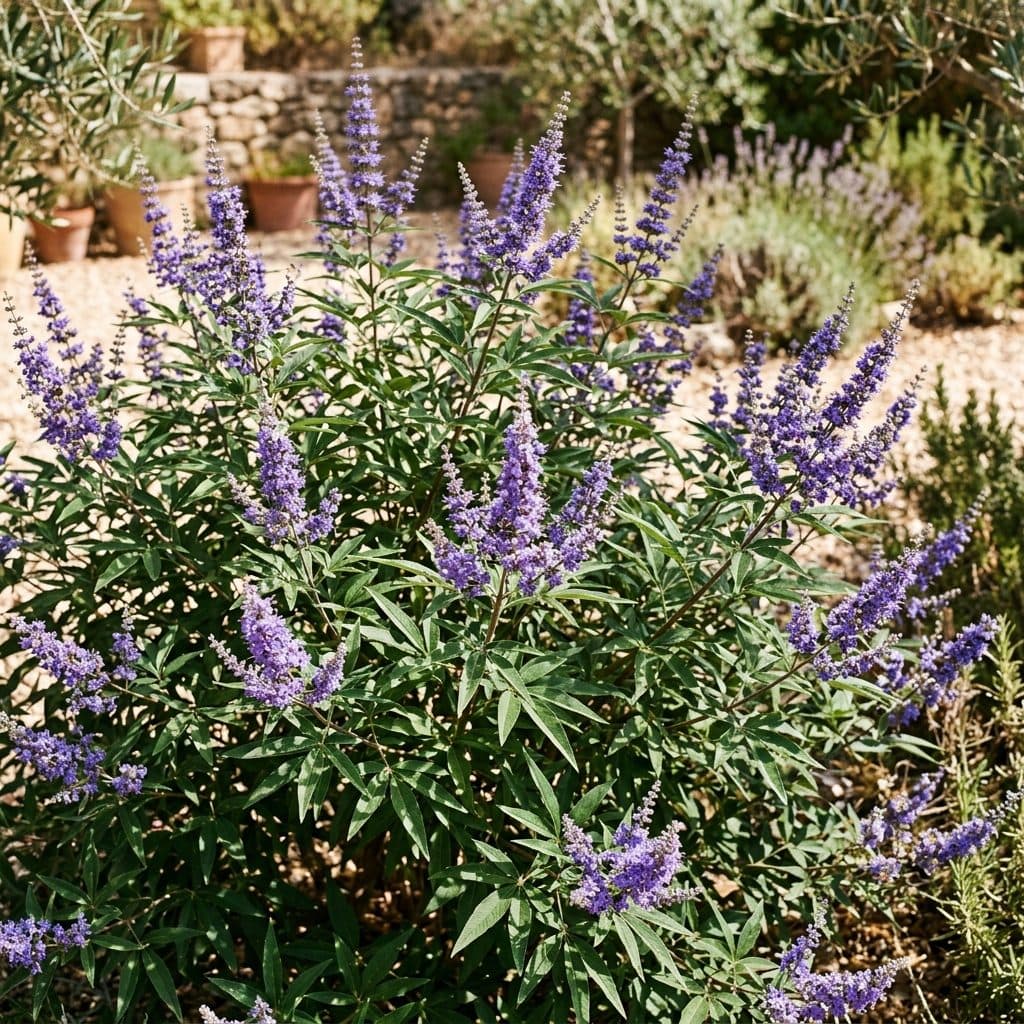
- Habit: A large, multi-stemmed deciduous shrub or small spreading tree reaching 3 to 5 m (10 to 16 ft) in height with an equal spread, forming an open, rounded, vase-like crown. Stems are four-angled when young, finely pubescent, and grey-brown.
- Leaves: Opposite, palmately compound leaves consisting of five to seven (rarely nine) narrow, lanceolate leaflets radiating from a central petiole. Leaflets measure 5 to 10 cm (2 to 4 in) long and 1 to 2 cm (0.4 to 0.8 in) wide, with entire or faintly toothed margins. The upper leaflet surface is dark greyish-green, while the underside is densely covered in a fine, whitish-grey velvety felt. When crushed or brushed, the foliage emits a powerful, spicy, sage-like herbal fragrance.
- Flowers: Borne in dramatic, dense, upright, terminal paniculate spikes measuring 15 to 30 cm (6 to 12 in) long. The small, fragrant, two-lipped blossoms measure about 8 mm (0.3 in) long, typically displaying a vibrant lilac, lavender, or violet-blue hue (white- and pink-flowering cultivars also exist), with four protruding stamens.
- Fruit: Small, hard, globose, peppercorn-like drupes measuring 3 to 5 mm (0.1 to 0.2 in) across, surrounded at the base by a persistent, grey-felted calyx.
Chaste tree is readily distinguished from butterfly bush (Buddleja davidii), which has simple, undivided leaves and four-petaled flowers, and from hemp (Cannabis sativa), which has alternate upper leaves with deeply serrated leaflet margins.
Cautions
Growers and consumers of Vitex agnus-castus should carefully observe several important endocrine, pharmacological, and ecological cautions:
- Powerful endocrine and hormonal interactions: Chasteberry extracts act on the anterior pituitary gland, exerting dopaminergic effects that suppress prolactin secretion while modulating follicle-stimulating hormone (FSH) and luteinising hormone (LH). Consequently, chasteberry is strictly contraindicated during pregnancy (due to risk of uterine stimulation) and during lactation. It must not be consumed by individuals with hormone-dependent conditions, including breast cancer, ovarian cancer, uterine cancer, endometriosis, or uterine fibroids. Furthermore, it interacts adversely with oral contraceptives, hormone replacement therapy (HRT), and dopamine agonists or antagonists (such as Parkinson's medications or antipsychotics).
- Invasiveness in riparian ecosystems: Vitex agnus-castus has escaped cultivation and is officially classified as an invasive exotic species in parts of the southern and southwestern United States, particularly Texas. Escaped shrubs colonise riparian gravel bars, limestone creekbeds, and native waterways, forming dense thickets that displace native willows and cottonwoods. Growers in riparian corridors or warm semi-arid zones should check local invasive species lists before planting and remove spent flowerheads to prevent riverine seed wash.
- Winter dieback: In USDA Zone 6, unseasonal autumn freezes or severe midwinter cold often cause complete stem dieback. While roots survive, trees require annual spring pruning to remove dead wood.
- Contact allergy: The resinous foliage and essential oils can cause mild contact dermatitis or itchy skin reactions in sensitive gardeners during heavy pruning.
Sources
- Royal Botanic Gardens, Kew. Vitex agnus-castus L. Plants of the World Online.
- USDA PLANTS Database. Vitex agnus-castus L.
- Plants For A Future. Vitex agnus-castus - L.
- North Carolina State Extension Gardener Plant Toolbox. Vitex agnus-castus
- Missouri Botanical Garden. Vitex agnus-castus