secondary
Feijoa pineapple guava
Acca sellowiana
International hardiness
- USDA 8-10
- RHS H4
- AU: Cool temperate, Warm temperate, Subtropical
Where it grows — regional guide
| Zones / rating | Regional notes |
|---|---|
USDA 8-10 | Grown throughout the Pacific Northwest, California, and the Gulf Coast across USDA Zones 8 to 10; requires summer heat to ripen fruit before winter frosts. |
| Zones / rating | Regional notes |
|---|---|
H4 (-10 to -5C) | Hardy in southern and coastal gardens rated RHS H4; best trained against a south-facing masonry wall to ensure sufficient summer warmth to ripen late autumn fruit. |
| Zones / rating | Regional notes |
|---|---|
Cool temperate, Warm temperate, Subtropical | Highly popular across Victoria, Tasmania, and southern New South Wales; irrigate during dry summer spells to avoid fruit drop and ensure juicy pulp. |
| Zones / rating | Regional notes |
|---|---|
USDA 8-10 (USDA scale) Canada uses its own zone system; Canadian zones run roughly one lower than USDA. | No region-specific data yet |
| Zones / rating | Regional notes |
|---|---|
No region-specific data yet | No region-specific data yet |
Feijoa pineapple guava (Acca sellowiana), historically known as Feijoa sellowiana and commonly called guavasteen or pineapple guava, is an evergreen shrub or small spreading tree in the myrtle family (Myrtaceae). Indigenous to the subtropical highlands of southern Brazil, northern Argentina, western Paraguay, and Uruguay, the species was introduced to European horticulture in the late nineteenth century by French botanist Édouard André. The plant has achieved widespread cultivation across New Zealand, Australia, coastal North America, and warm-temperate regions worldwide. It is treasured dual-purpose flora: an ornamental hedging shrub with striking bicoloured foliage and exotic edible blossoms, paired with aromatic, late-autumn fruit that evokes flavours of pineapple, guava, and spearmint.
In permaculture guilds and syntropic polycultures, feijoa is a sturdy secondary-stratum fruit shrub and windbreak barrier. Its dense evergreen canopy filters prevailing winds, while its tolerance for coastal salt breezes and moderate frosts makes it an ideal buffer along orchard perimeters. Integrated into mixed guilds alongside fruit trees like apple and nitrogen-fixing support shrubs like pigeon pea, feijoa thrives without heavy fertiliser demands. However, growers must provide cross-pollination partners and manage summer soil moisture to ensure heavy yields of juicy fruit.
Growing feijoa pineapple guava
Acca sellowiana adapts to warm-temperate, maritime, and subtropical highland climates, hardy across USDA Zones 8 through 10 and rated RHS H4. The species exhibits notable cold hardiness for a member of the myrtle family. Established specimens endure short-lived winter lows down to -10 °C (14 °F) with minimal foliar scorch, though prolonged freezes below -12 °C (10 °F) kill flower buds and damage wood. The shrub benefits from 100 to 200 chill hours between 2 and 7 °C (36 and 45 °F) to stimulate uniform spring floral bud break. While tolerant of high summer temperatures up to 35 °C (95 °F), intense dry heat can scorch developing fruit and induce premature drop; mulch and supplementary irrigation are vital in hot inland summers.
Soil tolerance is broad. Feijoa prospers in sandy loams, silty loams, and weathered clays across a pH range of 5.5 to 7.0. While capable of enduring poor, stony soils, optimal fruit quality demands fertile, organically rich substrates with excellent drainage. Feijoa tolerates short winter saturation but suffers in stagnant, waterlogged soils. Its shallow, fibrous feeder roots reside in the top 30 cm (12 in) of soil, making the plant sensitive to root disturbance and surface desiccation. Apply a 7 to 10 cm (3 to 4 in) layer of coarse organic mulch over the root zone, keeping it clear of the main trunk.
Pollination biology is critical for fruit production. While certain cultivars (such as 'Unique' and 'Coolidge') are partially self-fertile, the vast majority (including 'Apollo', 'Mammoth', and 'Triumph') are strictly self-incompatible. Planting at least two distinct cultivars within 5 m (16 ft) of each other facilitates cross-pollination by honeybees and birds, significantly increasing fruit set, size, and seed count.
Propagation is achieved through seed, cuttings, or layering. Seed-grown plants germinate readily within three to five weeks at 20 to 25 °C (68 to 77 °F), but seedlings are genetically variable and require five to seven years to bear. To preserve superior fruit genetics, commercial growers take semi-ripe cuttings in late summer or employ whip-and-tongue grafting onto seedling rootstocks. Vegetatively propagated plants begin bearing in their second or third year. Space shrubs 3 to 4 m (10 to 13 ft) apart for open orchard canopies, or 1.5 to 2 m (5 to 6.6 ft) apart for dense edible windbreak hedges.
Harvest and uses
Feijoa provides two distinct edible harvests across the growing season: sweet floral petals in late spring and aromatic fruit in late autumn.
The flowers feature thick, fleshy, incurved petals that taste remarkably sweet with notes of cinnamon, mint, and marshmallow. Pluck the white and pink petals carefully, leaving the central upright cluster of crimson stamens intact so that pollination and fruit development proceed undisturbed. The petals make a delightful addition to salads and desserts.
The oval green fruit matures five to six months after pollination, ripening in late autumn. Visual determination of ripeness is notoriously challenging because the peel remains dull green. Fruit is ripe when it softens slightly to gentle thumb pressure and drops naturally from the branch onto grass. Collect windfalls daily; bruised fruit resting on bare soil decays and ferments rapidly.
To eat, slice the fruit in half horizontally and scoop out the pulp with a spoon. The interior consists of four clear, jelly-like seed pockets surrounded by a slightly granular, cream-coloured flesh. The flavour is a complex, fragrant blend of pineapple, quince, and strawberry with a cool mint finish. Feijoas are eaten fresh, blended into smoothies, stewed with apples, or preserved into aromatic jams, chutneys, and fermented fruit wines. The bitter, resinous peel is typically discarded, though fine zest is sometimes added to chutneys. A mature shrub yields 15 to 30 kg (33 to 66 lb) of fruit annually.
Identifying feijoa pineapple guava
Acca sellowiana is recognised by distinct vegetative, floral, and fruiting traits:
- Form and bark: A dense, bushy evergreen shrub or small tree reaching 3 to 5 m (10 to 16 ft) in height and width, often multi-stemmed from the base. The bark is smooth, pale greyish-brown, and lightly peeling in paper-thin scales on older limbs.
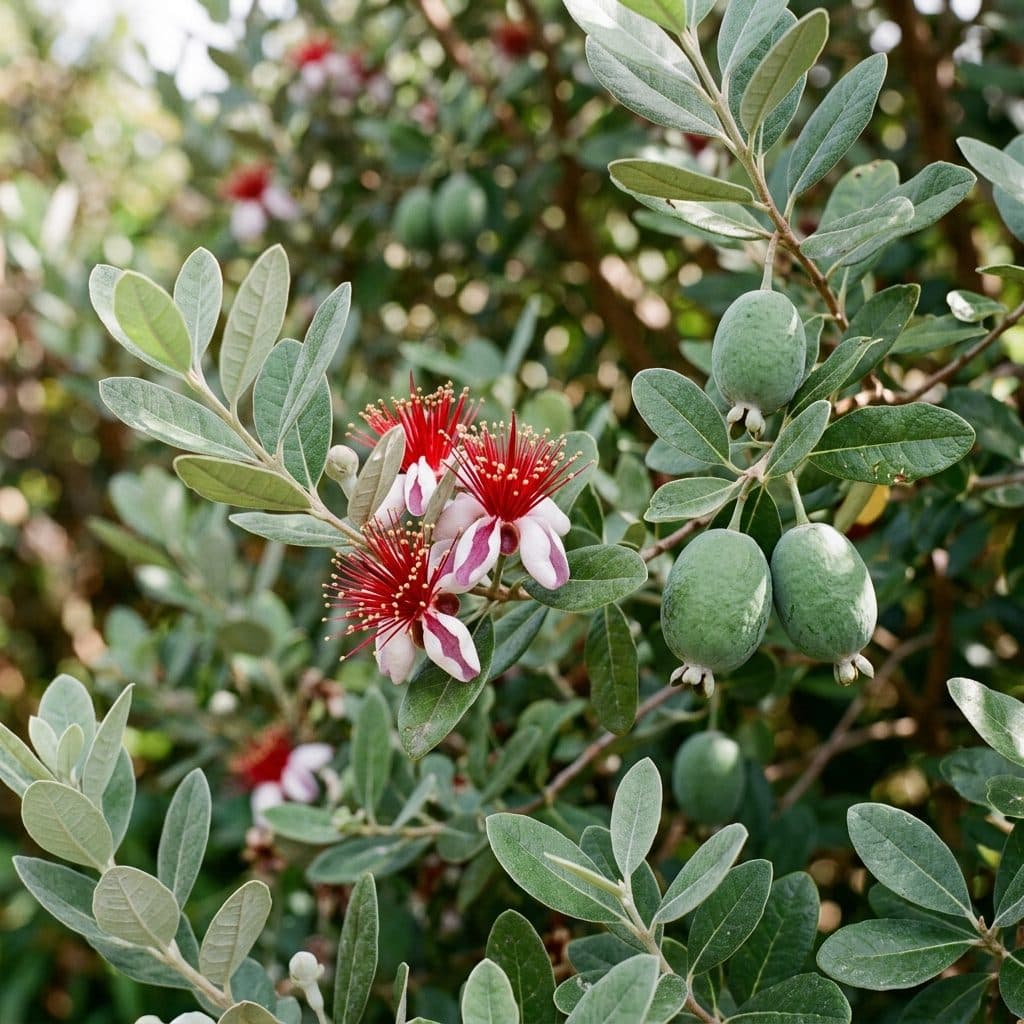
- Leaves: Opposite, simple, leathery, elliptic to oblong leaves measuring 4 to 7 cm (1.6 to 2.8 in) long and 2.5 to 4 cm (1 to 1.6 in) wide. The upper surface is glossy olive-green, while the underside is densely felted with silvery-white hairs, creating a striking two-toned visual effect in breezes.
- Flowers: Solitary or clustered in leaf axils, measuring 3 to 4 cm (1.2 to 1.6 in) across. Each flower features four to six thick, cupped petals that are white on the exterior and rich purplish-pink within, surrounding a prominent, upright brush of 50 to 100 stiff, bright crimson stamens tipped with golden-yellow anthers.
- Fruit: An oblong to ovoid green berry measuring 5 to 8 cm (2 to 3.1 in) in length and 3 to 5 cm (1.2 to 2 in) in diameter, crowned by four stiff, persistent calyx lobes. The skin is dull green, often slightly waxy or pebbled, enclosing fragrant translucent jelly and granular white flesh.
The species is readily distinguished from common guava (Psidium guajava) by its silvery felted leaf undersides and brilliant crimson flower stamens, and from cotoneasters by its thick leathery leaves and edible green berries.
Cautions
Growers cultivating Acca sellowiana should observe several cultural and physiological cautions:
- Shallow root vulnerability: Feijoa feeder roots form a fibrous network concentrated in the upper 30 cm (12 in) of soil. Mechanical cultivating, rototilling, or heavy weeding under the canopy severs these roots, inducing sudden water stress and leaf drop. Maintain a weed-free zone using thick mulch and hand-pulling only.
- Water stress and fruit shedding: While the evergreen foliage tolerates moderate drought, midsummer water deficits cause severe fruit drop or produce small, dry, unpalatable fruits with hollow cavities. Maintain regular deep watering during fruit development.
- Rapid bruising and post-harvest decay: Ripe fruit that drops onto hard or rocky ground bruises deeply. Damaged fruit develops unpleasant turpentine off-flavours and ferments within forty-eight hours. Maintain a soft grass or mulch landing zone, or harvest by gently touching fruit to see if it dislodges into the hand.
- Pest susceptibility: In warm subtropical areas, fruit flies (such as Queensland fruit fly Bactrocera tryoni) and guava moth (Coscinoptycha improbana) sting ripening fruit, depositing larvae that ruin internal pulp. Deploy pheromone traps or insect exclusion netting where these pests are prevalent.
Sources
- Royal Botanic Gardens, Kew. Acca sellowiana (O.Berg) Burret Plants of the World Online.
- Missouri Botanical Garden. Acca sellowiana
- Plants For A Future. Feijoa sellowiana - (Berg.)Berg.
- USDA PLANTS Database. Acca sellowiana (O. Berg) Burret