pioneer
Chaya tree spinach
Cnidoscolus aconitifolius
International hardiness
- USDA 9-11
- RHS H1c
- AU: Tropical, Subtropical, Warm temperate
Where it grows — regional guide
| Zones / rating | Regional notes |
|---|---|
USDA 9-11 | Perennial across southern Florida, the Gulf Coast, and southern Texas (Zones 9 to 11); killed to the ground by light frosts but resprouts from root crowns. |
| Zones / rating | Regional notes |
|---|---|
H1c (5 to 10C) | Restricted to frost-free microclimates in southern Spain and the Canary Islands; must be overwintered in heated glasshouses across temperate Europe. |
| Zones / rating | Regional notes |
|---|---|
Tropical, Subtropical, Warm temperate | Thrives across tropical and subtropical regions of Queensland and the Northern Territory; exceptional drought resilience once established in sandy loams. |
| Zones / rating | Regional notes |
|---|---|
USDA 9-11 (USDA scale) Canada uses its own zone system; Canadian zones run roughly one lower than USDA. | No region-specific data yet |
| Zones / rating | Regional notes |
|---|---|
No region-specific data yet | No region-specific data yet |
Chaya tree spinach (Cnidoscolus aconitifolius), commonly known across Mesoamerica as chaya, Mayan spinach, tree spinach, or chay, is a fast-growing, large perennial shrub belonging to the spurge family (Euphorbiaceae). Indigenous to the Yucatán Peninsula of Mexico, Guatemala, and Belize, chaya was domesticated millennia ago by the ancient Maya, who planted it extensively in home gardens (solars) as an indispensable staple leafy green. Chaya leaves surpass ordinary annual spinach in protein, calcium, iron, potassium, and vitamin C concentrations. For warm-climate homesteaders and tropical food-forest practitioners, Cnidoscolus aconitifolius represents a drought-hardy, semi-woody perennial green that yields continuously through searing summer heat where delicate annual greens immediately bolt and perish.
Within tropical and subtropical agroforestry systems, chaya occupies a dynamic pioneer and secondary-stratum support niche. Its rapid growth, sturdy upright architecture, and deep rooting network let it work as a living hedge, poultry forage bank, or wind-buffering edge shrub. It thrives in polycultures alongside other nutrient-dense perennials like moringa and under the light canopy of banana mats, while producing continuous greens that compare favourably with traditional annual spinach. In addition, its small white flowers bloom throughout the year in frost-free regions, offering a steady nectar reservoir to local honeybees and butterflies.
Growing chaya tree spinach
Cnidoscolus aconitifolius is adapted to lowland tropical and warm subtropical climates characterised by high temperatures and distinct wet and dry seasons, growing reliably outdoors in USDA Hardiness Zones 9b through 11 and rated RHS H1c. Being native to the Caribbean basin, chaya possesses zero tolerance to sub-zero freezing temperatures. Foliage and succulent green stems suffer severe damage when temperatures drop to 0 °C (32 °F); however, mature root crowns insulated beneath mulch easily withstand brief light frosts down to -3 °C (27 °F), sending up vigorous new shoots as soon as the soil warms in spring. The species thrives under blistering heat exceeding 38 °C (100 °F) and requires full sun exposure for optimal leaf production, although it tolerates light, high-canopy shade.
Soil requirements are extraordinarily forgiving. Chaya prospers in almost any soil texture, from shallow, porous limestone soils and infertile beach sands to heavy clays, provided drainage is sound. It tolerates an expansive soil pH range between 5.5 and 8.0. Outstanding drought tolerance is a hallmark of the species: once rooted, mature bushes survive six months of severe dry-season drought without irrigation by dropping older leaves and conserving water within thick, semi-succulent stems. However, applying supplemental moisture during prolonged dry spells maintains tender, rapid leaf flush. Waterlogged or swampy ground must be avoided, as stagnant moisture quickly causes root and stem rot.
Because cultivated varieties of chaya rarely produce viable seed, the plant is propagated almost exclusively by woody stem cuttings. Select mature, grey, pencil-thick to thumb-thick hardwood stems measuring 20 to 40 cm (8 to 16 in) in length. Cuttings should be cured in a dry, shaded area for two to three days to allow the cut ends to callus, preventing fungal rot upon planting. Cuttings can then be pushed vertically into well-drained potting mix or directly into garden beds, burying one-half to two-thirds of the stem. Roots and fresh leaf buds emerge within two to four weeks. Space plants 1 to 1.5 m (3.3 to 5 ft) apart in hedgerows. Stems can be pruned back to 1 to 1.5 m (3.3 to 5 ft) annually to maintain an accessible, bushy plucking height. Harvest begins four to six months after planting.
Harvest and uses
Chaya foliage is harvested on an ongoing basis throughout the warm growing season. Using clean shears, growers harvest young to medium-aged, fully expanded leaves along with tender petioles (leaf stems), taking no more than 30 to 50 percent of the total canopy at one time to preserve bush vigour.
Harvesting must always be approached with strict food safety awareness. Raw chaya leaves contain dangerous levels of cyanogenic glycosides and must never be eaten raw in salads, juices, or smoothies. Boiling leaves in water for 15 to 20 minutes completely neutralises these compounds, converting the foliage into a safe, delicious, dark green vegetable with a rich, nutty flavour and firm, pleasant texture superior to cooked spinach.
In culinary traditions, boiled chaya is versatile. After boiling, the cooking water is drained and discarded. The cooked leaves are chopped and sautéed with onions, garlic, and tomatoes, folded into scrambled eggs, blended into hearty vegetable soups, baked into grain casseroles, or wrapped around seasoned fillings as a nutritious tamale wrapper. In the Yucatán, boiled chaya is blended with fresh pineapple or citrus juices to create the famous regional beverage agua de chaya. Beyond human nourishment, dried chaya leaf meal serves as an exceptional, high-protein feed supplement for backyard chickens, goats, and rabbits. A single mature chaya bush yields 5 to 12 kg (11 to 26 lb) of edible foliage annually.
Identifying chaya tree spinach
Cnidoscolus aconitifolius can be identified by several distinct botanical characteristics:
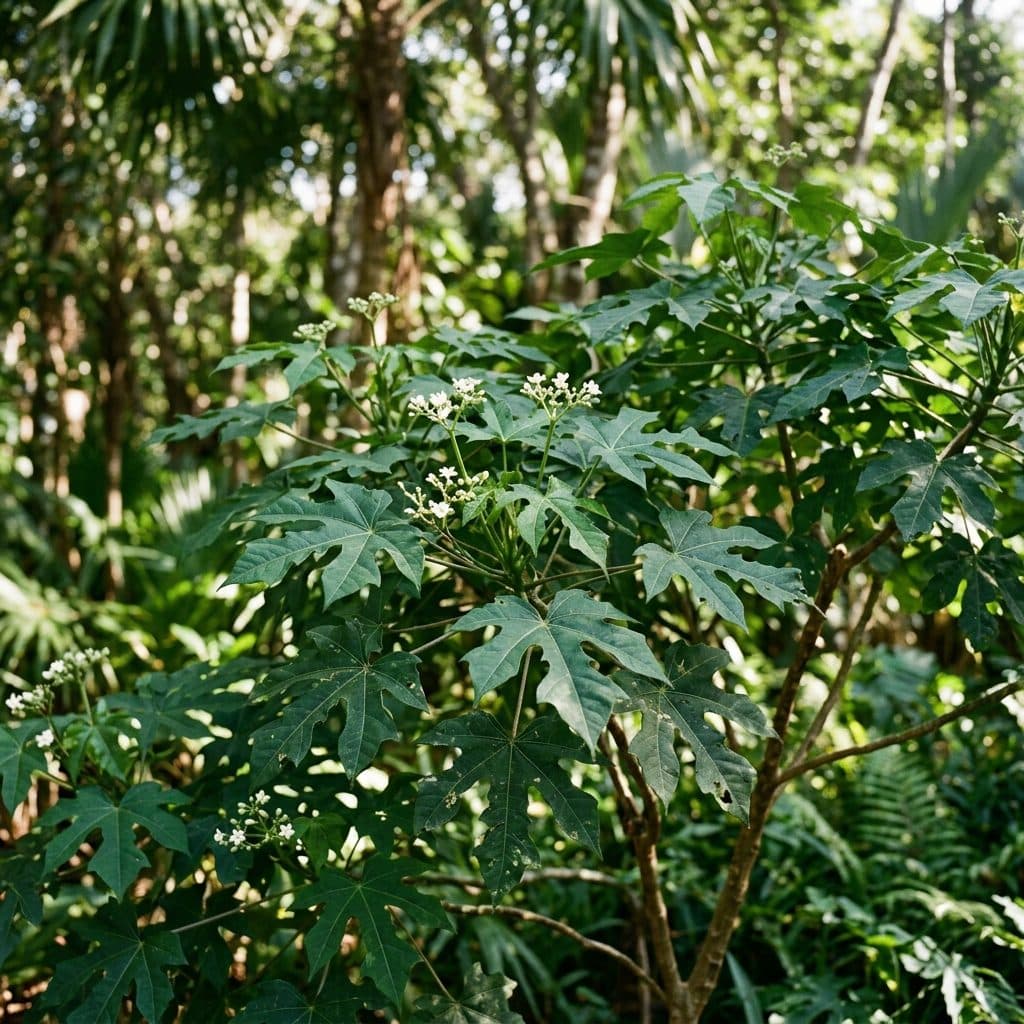
- Habit: A large, fast-growing, semi-woody perennial shrub growing 2 to 4 m (6.6 to 13 ft) in height with an open, spreading crown and thick, pale greyish-green, fleshy, succulent branches. When bruised, broken, or pruned, stems and petioles exude a copious, sticky, milky white latex sap.
- Leaves: Alternate, large, simple, palmately three- to five-lobed leaves measuring 15 to 30 cm (6 to 12 in) long and wide, closely resembling the leaves of sugar maple or papaya. Margins of the lobes are irregularly toothed or coarsely lobed. The leaf surface is deep vibrant green above, paler beneath, supported by an elongated fleshy petiole measuring 10 to 25 cm (4 to 10 in) long.
- Cultivar distinction: The cultivated non-stinging form, often classified as Cnidoscolus aconitifolius subsp. aconitifolius 'Chayamansa', possesses smooth or sparsely hairy leaves without stinging hairs. In contrast, wild or primitive forms (C. aconitifolius subsp. aconitifolius) bear stiff, sharp, urticating stinging hairs along stems and leaf veins.
- Flowers: Small, star-shaped, fragrant white blossoms borne in long-stalked, dichotomously branched cymes held above the foliage. Flowers lack true petals, consisting of a white five-lobed calyx.
- Fruit: A small, three-seeded prickly capsule that is rarely observed in domestic garden cultivars.
Chaya is easily distinguished from true spinach (Spinacia oleracea), which is a small annual rosette herb with soft, unlobed leaves, and from cassava (Manihot esculenta), whose leaves are divided to the very base into five to seven distinct, narrow leaflets.
Cautions
Cultivating and preparing Cnidoscolus aconitifolius requires strict attention to several biochemical and culinary safety rules:
- Severe toxicity of raw foliage (cyanogenic glycosides): Fresh, raw chaya leaves and stems contain high levels of the cyanogenic glycosides linamarin and lotaustralin. When plant tissues are chewed, crushed, or damaged, cellular enzymes hydrolyse these compounds into toxic hydrogen cyanide (prussic acid). Ingestion of raw chaya can provoke acute cyanide intoxication, presenting as dizziness, headache, nausea, vomiting, abdominal cramps, tachycardia, and in extreme cases, respiratory arrest. Consuming raw chaya leaves in green juices or raw salads is strictly prohibited.
- Mandatory cooking protocol: To render chaya completely safe, leaves must be boiled in bubbling water for at least 15 to 20 minutes. Heat inactivates the hydrolytic enzymes and completely volatilises hydrogen cyanide gas into the atmosphere. Never consume undercooked chaya, and always drain and discard the boil water.
- Cookware prohibition (no aluminium): Never cook chaya in aluminium pots or pans. A toxic chemical reaction occurs between the residual cyanide compounds and aluminium metal, which leaches aluminium ions into the food, causes severe discolouration of the greens, and can provoke severe stomach cramping and diarrhoea. Always cook chaya exclusively in stainless steel, glass, ceramic, or enamel-coated cookware.
- Caustic latex and stinging hairs: The milky white latex exuded by cut stems contains irritant diterpenes that cause contact dermatitis, redness, and itching on sensitive skin, and can cause severe chemical conjunctivitis if rubbed into the eyes. Primitive varieties also possess stinging hairs that cause intense burning sensations upon contact. Always wear gloves when harvesting and handling fresh chaya.
- Frost sensitivity: Stems are killed to the ground at 0 °C (32 °F). In regions prone to winter freezes, mulch root crowns heavily to ensure spring regeneration.
Sources
- Royal Botanic Gardens, Kew. Cnidoscolus aconitifolius (Mill.) I.M.Johnst. Plants of the World Online.
- USDA PLANTS Database. Cnidoscolus aconitifolius (Mill.) I.M. Johnst.
- Plants For A Future. Cnidoscolus aconitifolius - (Mill.)I.M.Johnst.
- Feedipedia. Cnidoscolus aconitifolius (chaya)