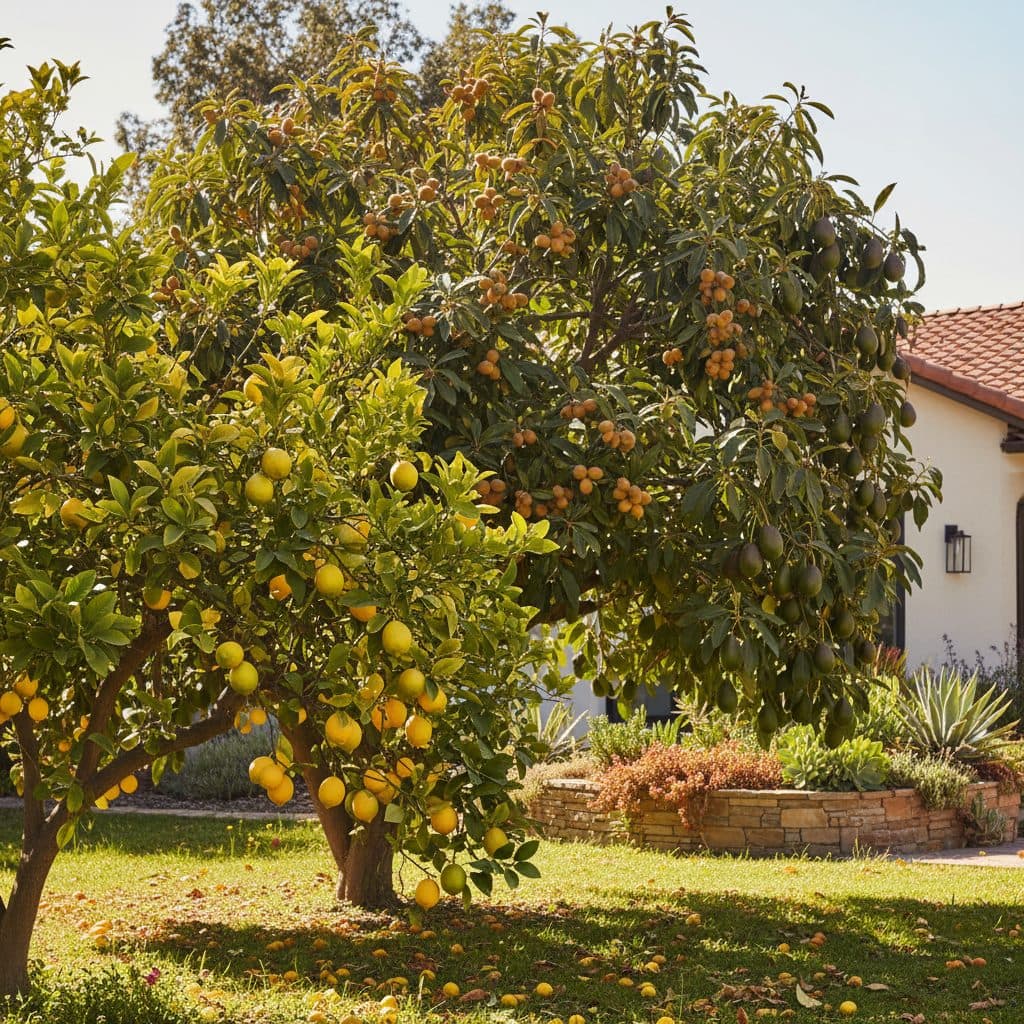
Key takeaways
- USDA Zones 9 and 10 offer long growing seasons and mild winters, allowing growers across Florida, California, Texas, and the Gulf Coast to harvest subtropical fruits year-round.
- In Zone 9, select cold-hardy subtropicals such as Satsuma mandarins, Mexican-race avocados ('Bacon', 'Mexicola'), loquats, and strawberry guavas.
- In Zone 10, expand orchard selections to include true tropicals like mangoes, carambola (starfruit), papayas, and West Indian avocado cultivars.
- Microclimate placement (such as planting on south-facing thermal brick walls or high elevation slopes) protects tender trees from occasional radiative winter freezes.
- Protect young subtropical fruit tree trunks from summer bark splitting and sunscald by applying diluted white latex paint or breathable trunk guards.
- Deep, infrequent irrigation combined with heavy organic woodchip mulching insulates shallow root systems from intense summer soil heating.
Quick answer: The best subtropical fruit trees for USDA Zones 9 and 10 include cold-tolerant citrus (Satsuma mandarins, Meyer lemons), cold-hardy Mexican avocados ('Bacon', 'Mexicola'), loquats, figs, white sapotes, and strawberry guavas. In virtually frost-free Zone 10, you can also cultivate mangoes, carambola (starfruit), and longans.
Gardeners across the American Sun Belt (spanning central and southern Florida, the Gulf Coast, the Texas lowlands, southern Arizona, and coastal California) enjoy some of the most versatile fruit-growing climates in the United States. With long, warm summers and short, mild winters, USDA Hardiness Zones 9 (minimum winter temperatures of 20°F to 30°F / -6.7°C to -1.1°C) and Zone 10 (30°F to 40°F / -1.1°C to 4.4°C) provide an ideal environment for growing exotic fruits that northern orchards cannot support.
Selecting the right subtropical fruit trees requires matching each species' cold threshold and chilling hour requirements to your specific regional microclimate. While a mature loquat or Satsuma orange easily shrugs off a 24°F (-4.4°C) light freeze, a young tropical mango or lime tree can suffer severe canopy dieback if left unprotected.
This guide details the highest-performing subtropical and semi-tropical fruit trees for Zones 9 and 10, outlining cold thresholds, variety selections, and practical orchard establishment strategies.
+-------------------------------------------------------------+
|              ZONE 9 & 10 SUBTROPICAL HARDINESS MATRIX       |
|                                                             |
|   SPECIES             COLD THRESHOLD      PRIMARY ZONE      |
|   -------             --------------      ------------      |
|   Loquat              10°F to 15°F (-10°C)Zone 8b - 10      |
|   Satsuma Mandarin    15°F to 18°F (-8°C) Zone 8b - 10      |
|   Meyer Lemon         22°F to 24°F (-5°C) Zone 9a - 10      |
|   Mexican Avocado     20°F to 24°F (-5°C) Zone 9a - 10      |
|   Strawberry Guava    22°F to 24°F (-5°C) Zone 9a - 10      |
|   White Sapote        22°F to 26°F (-4°C) Zone 9b - 10      |
|   Mango               28°F to 30°F (-1°C) Zone 10 (9b micro)|
|   Starfruit           28°F to 30°F (-1°C) Zone 10 (9b micro)|
+-------------------------------------------------------------+
Which cold-hardy citrus varieties thrive in Zone 9?
Citrus trees are the classic foundation of the subtropical home orchard. While true tropical citrus like Key limes and pummelos demand Zone 10 warmth, several outstanding cold-hardy varieties thrive throughout Zone 9.
1. Satsuma mandarin (Citrus unshiu)
- Cold tolerance: Mature trees withstand temperatures as low as 15°F to 18°F (-9°C to -8°C) when grafted onto Poncirus trifoliata (Trifoliate orange) or 'Flying Dragon' rootstock.
- Fruit qualities: Easy to peel, seedless, and exceptionally sweet. Cultivars like 'Owari' and 'Brown Select' ripen in late autumn (October through December), allowing harvest before winter freezes arrive.
- Regional performance: A staple across north Florida, southern Georgia, the Gulf Coast, and Louisiana.
2. Improved Meyer lemon (Citrus x limon 'Meyer')
- Cold tolerance: Hardy down to 22°F (-5.5°C).
- Fruit qualities: A naturally sweet cross between a true lemon and a mandarin orange. Produces thin-skinned, juicy, fragrant fruit nearly year-round.
- Tree habit: Naturally semi-dwarf (8 to 12 feet tall), making it exceptional for backyard espaliers and large patio containers.
3. Kumquats and calamondins
- Nagami Kumquat (Fortunella margarita): Hardy down to 18°F (-8°C). The oblong golden fruit is eaten whole, skin and all, providing a sweet-tart burst of flavor.
- Calamondin (Citrofortunella microcarpa): Cold-hardy down to 20°F (-6.7°C), bearing hundreds of miniature tart citrus fruits used like limes in cooking and marinades.
+-------------------------------------------------------------+
|              CITRUS ROOTSTOCK SELECTION FOR HARDINESS       |
|                                                             |
|   ROOTSTOCK TYPE      HARDINESS BOOST     SOIL ADAPTABILITY |
|   --------------      ---------------     ----------------- |
|   Trifoliata (Rubidoux)High (down to 15°F) Heavy clay, wet  |
|   Flying Dragon       High (Dwarfing 6ft) Heavy loam, pots  |
|   Carrizo Citrange    Moderate            Sandy Sun Belt    |
|   Sour Orange         Moderate            Alkaline & caliche|
+-------------------------------------------------------------+
What are the best avocado cultivars for Zones 9 and 10?
Avocados (Persea americana) are divided into three distinct botanical races: Mexican, Guatemalan, and West Indian. Choosing the correct race determines whether your tree survives winter freezes.
+-------------------------------------------------------------+
|              AVOCADO RACE & CLIMATE COMPARISON              |
|                                                             |
|   AVOCADO RACE        COLD HARDINESS      RECOMMENDED ZONES |
|   ------------        --------------      ----------------- |
|   Mexican Race        High (20°F - 24°F)  Zone 9a / 9b      |
|   Guatemalan Race     Moderate (26°F-30°F)Zone 9b / 10a     |
|   West Indian Race    Low (32°F - 34°F)   Zone 10b / 11     |
+-------------------------------------------------------------+
Cold-hardy Mexican-race avocados (Zone 9)
Mexican-race avocados originate from the cool highlands of central Mexico. Their leaves emit a distinctive anise scent when crushed:
- 'Bacon': Cold hardy down to 22°F to 24°F (-5°C). Produces medium-sized green fruit with smooth, creamy, medium-oil flesh. Upright, narrow growth habit. (Type B flower).
- 'Fuerte': Hardy down to 24°F to 26°F (-4°C). The classic heritage California green-skin avocado with rich, nutty flavor and a sprawling canopy. (Type B flower).
- 'Mexicola' & 'Mexicola Grande': Extremely cold hardy (down to 18°F to 20°F). Small purple-black fruit with rich, high-oil flesh and edible paper-thin skin. (Type A flower).
Commercial and hybrid avocados (Zone 10)
In Zone 10, virtually all avocado cultivars thrive without freeze risk:
- 'Hass': (Guatemalan-Mexican hybrid). The global commercial standard, prized for pebbly black skin, high oil content, and heavy bearing. Hardy to 28°F (-2°C). (Type A flower).
- 'Wurtz' (Little Cado): A true dwarf variety reaching only 8 to 10 feet at maturity. Heavy producer of medium-sized green fruit, ideal for small suburban yards. (Type A flower).
To structure proper canopy pruning across your orchard, follow guidelines in how to prune fruit trees.
Which exotic and unique subtropical fruit trees belong in your yard?
Beyond standard citrus and avocados, several resilient subtropical species provide exceptional yields with minimal pesticide or fertilizer inputs.
1. Loquat / Japanese plum (Eriobotrya japonica)
- Hardiness: The tree itself is exceptionally cold hardy, tolerating temperatures down to 10°F (-12°C) without leaf damage (USDA Zones 8a to 10).
- Fruiting habit: Blooms in late autumn with intensely fragrant white flowers. The clusters of succulent, sweet, apricot-like yellow-orange fruit ripen in early spring (March to May) before other orchard trees have even begun to leaf out.
- Pest caveat: Loquat ripens very early in spring, making it an early bridge host for fruit flies (such as Mediterranean fruit fly or Caribbean fruit fly in warm regions); bag developing fruit clusters or net trees thoroughly to protect harvests and prevent pest flare-ups.
- Landscape value: Large, dark green, tropical-looking serrated leaves make loquat an attractive ornamental shade tree.
2. Guavas (Psidium species)
- Strawberry Guava (Psidium cattleyanum, cattleley guava): Hardy down to 22°F (-5.5°C), producing abundant small red or yellow fruits on a tough, glossy bush, but check local biosecurity rules before planting. It is declared an invasive environmental weed in many subtropical jurisdictions (including Hawaii, parts of Florida, and coastal eastern Australia) where birds spread the seeds into native bushland, and its fallen fruit is a prime host for fruit fly.
- Tropical Pink Guava (Psidium guajava): Thrives in Zone 10 (hardy to 28°F). Produces large, musky, sweet pink-fleshed fruit rich in vitamin C.
3. White sapote (Casimiroa edulis)
- Hardiness: Hardy down to 22°F to 26°F (-4°C), performing exceptionally well across southern California and coastal Florida (Zones 9b and 10).
- Flavor profile & harvest: Fruit has soft, yellow-green skin and sweet, custard-like white flesh with notes of banana, vanilla, and pear. Harvest fruit when the skin turns yellowish-green and softens slightly; the skin and seeds contain bitter compounds and should not be eaten. Highly productive evergreen tree.
4. Starfruit / carambola (Averrhoa carambola)
- Hardiness: Recommended for Zone 10 (or protected Zone 9b microclimates); foliage damages at 30°F (-1°C).
- Yield: Produces multiple flushes of crisp, refreshing, star-shaped yellow fruits throughout late summer, autumn, and winter. Varieties like 'Arkin' and 'Kari' are exceptionally sweet.
+-------------------------------------------------------------+
|              EXOTIC SUBTROPICAL FRUIT ATTRIBUTES            |
|                                                             |
|   TREE SPECIES        MATURE HEIGHT    FRUITING SEASON      |
|   ------------        -------------    ---------------      |
|   Loquat              15 to 25 feet    Early Spring         |
|   Strawberry Guava    8 to 12 feet     Late Summer - Autumn |
|   White Sapote        20 to 30 feet    Summer to Autumn     |
|   Starfruit (Arkin)   15 to 20 feet    Autumn through Winter|
+-------------------------------------------------------------+
How do you design microclimates to protect tender subtropicals?
In Zone 9 and northern Zone 10, occasional radiative winter freezes occur when cold air settles on clear, windless nights. Designing smart microclimates allows you to push cold-sensitive species like starfruit and mango into Zone 9 yards.
+-------------------------------------------------------------+
|              THERMAL MICROCLIMATE SITE DESIGN               |
|                                                             |
|         [ North Windbreak Hedge / Dense Conifers ]          |
|                              |                              |
|                              v                              |
|       +---------------------------------------------+       |
|       | South-Facing Brick / Stucco Thermal Wall    |       |
|       |                                             |       |
|       |    (Tender Fruit Tree - Mango/Lime)         |       |
|       |                                             |       |
|       |       -  *  *  Heavy Woodchip Mulch Ring    |       |
|       +---------------------------------------------+       |
+-------------------------------------------------------------+- South and southeast wall planting: Plant your most cold-sensitive trees (such as limes or mangoes) 6 to 10 feet away from the south or southeast-facing brick or masonry wall of your home. The thermal mass absorbs solar heat during the day and re-radiates gentle warmth overnight, elevating local temperatures by 3°F to 5°F.
- Elevate on slopes: Cold air is dense and flows downhill like water, pooling in low-lying frost pockets. Plant subtropical fruit trees on the upper half of gentle slopes or on raised soil mounds to ensure cold air drains away from the canopy.
- Trunk protection and sunscald prevention: Young citrus and avocado trees have thin, tender bark susceptible to sunscald during scorching Sun Belt summers and bark splitting during winter freezes. Paint trunks from ground level up to the lowest branch with a 50/50 mix of water and white interior latex paint, or install breathable trunk wraps. Learn bark defense methods in preventing sunscald on trees and fruit.
- Extreme weather mitigation: For extreme heatwaves and sudden frost events, consult our guides on protecting fruit trees during a heatwave and shade netting for fruit trees.
By selecting locally adapted cultivars, pairing Mexican-race avocados with cold-hardy citrus, and planting in warm southern microclimates, your Sun Belt orchard will deliver abundant, year-round harvests of subtropical fruit.