pioneer
Goji berry
Lycium barbarum
International hardiness
- USDA 5-9
- RHS H6
- AU: Warm temperate, Arid / semi-arid
Where it grows — regional guide
| Zones / rating | Regional notes |
|---|---|
USDA 5-9 | Performs exceptionally well in western and midwestern states; requires trellising or heavy pruning to manage vigorous arching canes. |
| Zones / rating | Regional notes |
|---|---|
H6 (-20 to -15C) | Grows well along coastal and southern areas of Britain; needs full sun and lean soil to flower and set fruit reliably. |
| Zones / rating | Regional notes |
|---|---|
Warm temperate, Arid / semi-arid | Adapted to warm-temperate and semi-arid inland zones of South Australia, Victoria, and New South Wales; contain root suckers to prevent weedy spread. |
| Zones / rating | Regional notes |
|---|---|
USDA 5-9 (USDA scale) Canada uses its own zone system; Canadian zones run roughly one lower than USDA. | Hardy in southern interior British Columbia and southern Ontario; plant in elevated, well-drained soil to avoid root rot. |
| Zones / rating | Regional notes |
|---|---|
No region-specific data yet | No region-specific data yet |
Goji berry (Lycium barbarum), commonly known as wolfberry, is a sprawling, deciduous woody shrub in the nightshade family (Solanaceae). Indigenous to arid and semi-arid regions of southeastern Europe through central and eastern Asia, the plant is famously cultivated along the mineral-rich floodplains of the Yellow River valley in Ningxia, China. For centuries, traditional herbalists and homesteaders have cultivated this tough shrub for its oblong, scarlet-red fruits, which have high concentrations of carotenoids, zeaxanthin, vitamin C, and beneficial polysaccharides.
In an agroforestry or homestead system, the goji berry plant is a hardy pioneer species. Its deep taproot and extensive fibrous lateral roots stabilize erosion-prone banks, steep terraces, and dry perimeter borders. Like other nightshades, such as the potato, goji thrives across diverse climates, but unlike annual solanaceous vegetables, it produces a perennial framework that withstands severe winter freezes and summer droughts with minimal maintenance.
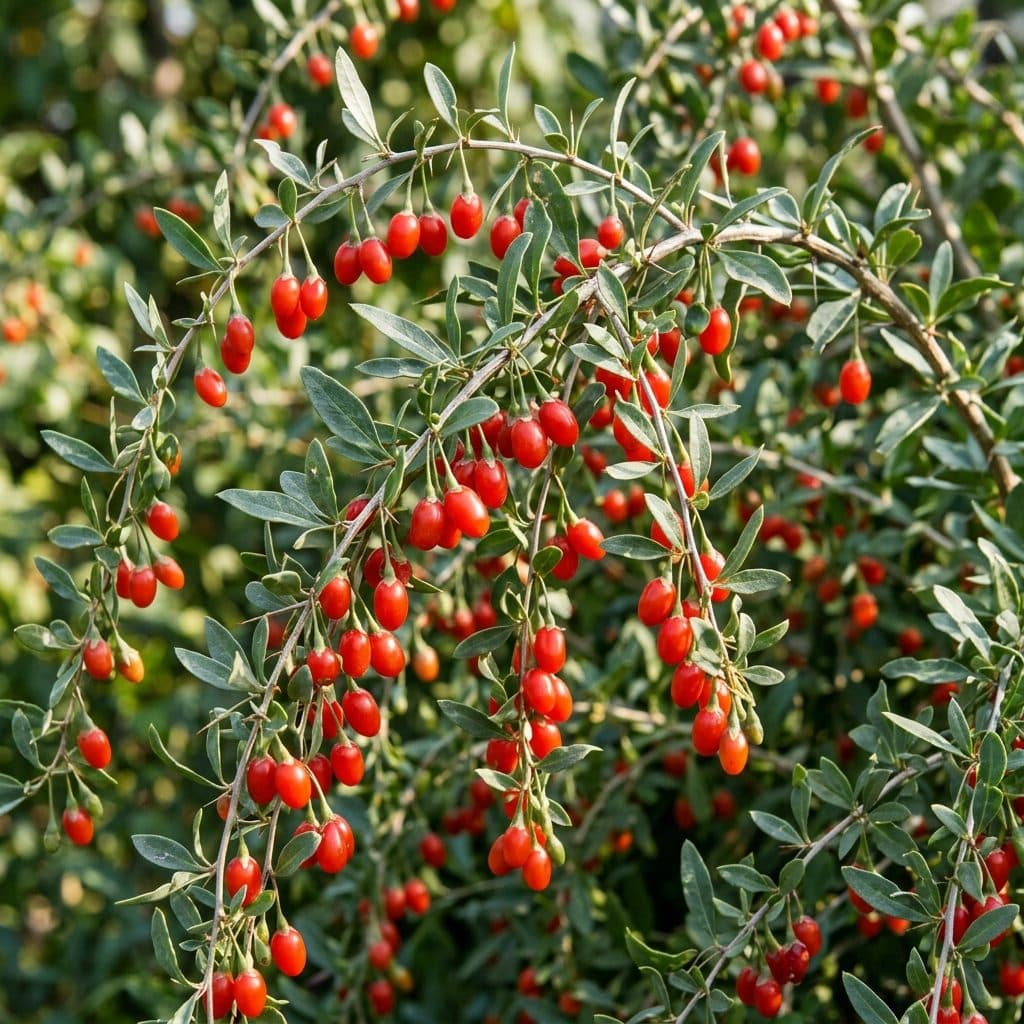
The shrub naturally adopts an arching, fountain-like habit, sending out long, flexible canes that can scramble over neighboring vegetation or form dense, spiny thickets. In cultivated settings, managing these vigorous canes through deliberate trellis training and annual pruning transforms a rambling wild bush into a neat, high-yielding homestead fruit producer.
Growing goji berry
Goji berry bushes display exceptional temperature resilience, enduring winter minimums of -29 °C (-20 °F) when fully dormant and summer heat exceeding 38 °C (100 °F). This wide environmental tolerance makes the species hardy across USDA Hardiness Zones 5 through 9. Its primary vulnerability is wet, humid weather during the summer growing season, which encourages fungal leaf spotting and limits fruit sweetness.
The plant excels in lean, well-drained, sandy loams, rocky soils, and even moderately saline soils with a soil pH between 6.8 and 8.2. It avoids waterlogged soils, heavy non-draining clays, and strongly acidic conditions. High soil fertility is counterproductive: excessive nitrogen fertilization induces rampant vegetative cane growth and dense foliage while drastically reducing blossom set and berry production. Once established, plants rarely require supplemental feeding beyond a light spring dressing of well-rotted compost.
Full sunlight is essential for productive cropping. Plant goji berries in an open location that receives at least six to eight hours of direct, unfiltered sun daily. While the shrub survives in partial shade, shading severely curtails flower initiation and leads to sparse berry yields. The plant is remarkably drought-tolerant due to its deep root architecture, but consistent soil moisture is vital during its first season after transplanting and while green berries are swelling in midsummer. Apply water at soil level via drip irrigation; overhead sprinkling wets the dense canopy and promotes foliar diseases.
Propagate goji berry from seed, semi-ripe softwood cuttings taken in early summer, or hardwood cuttings taken during winter dormancy. Hardwood cuttings 15 to 20 cm (6 to 8 in) long root readily when inserted into sandy potting media. Transplant bare-root or potted shrubs in early spring as soon as soil can be worked.
Space shrubs 1.5 to 2 m (5 to 6.5 ft) apart in rows spaced 2.5 to 3 m (8 to 10 ft) apart. A mature bush grows 1.8 to 3 m (6 to 10 ft) tall and up to 2.5 m (8 ft) wide. Because the canes arch downward when laden with fruit, installing a simple two-wire trellis or tying canes to a central wooden stake keeps the harvest off the ground, improves airflow, and facilitates weed control.
Prune annually in late winter while the bush is dormant. Goji berries fruit primarily on current season's shoots that emerge from two-year-old wood. Establish a central framework by heading main canes back to 1.2 to 1.5 m (4 to 5 ft) to encourage strong lateral branches. Remove old, unproductive four-year-old wood, thin out low canes trailing on the soil surface, and prune out vigorous vertical water sprouts that crowd the bush interior.
Harvest and uses
Goji berry shrubs produce their first modest crop in their second growing season, reaching full bearing capacity of 2 to 4 kg (4.4 to 8.8 lb) per plant by their fourth year. Flowering begins in late spring, followed by an extended fruiting period from mid-July until the first hard frosts in autumn.
The berries ripen to a bright red or orange-red color. Ripe fruit does not drop cleanly from the bush; harvest by plucking individual berries by hand or placing a clean cloth beneath the canopy and shaking the branches. Fresh berries bruise easily; rough handling causes the fruit skin to oxidize and turn black. For fresh consumption, eat or refrigerate berries immediately. Fresh fruit keeps under refrigeration at 0 to 2 °C (32 to 36 °F) for up to ten days.
The berries have a distinct, mildly sweet flavor with subtle herbal, savory undertones resembling a cross between a cranberry and a sweet cherry tomato. The traditional and most practical homestead storage method is drying. Spread unwashed fresh berries in a single layer on drying screens in a food dehydrator set to 45 to 50 °C (113 to 122 °F), or dry in full sun in low-humidity climates until the skins feel leathery and pliable. Dried goji berries store for over a year in airtight glass jars.
In the kitchen, rehydrated dried berries are added to soups, stews, herbal broths, porridge, baked goods, and trail mixes. Fresh berries blend smoothly into fruit smoothies and preserves. In Chinese culinary tradition, tender young spring shoot tips and leaves (gouqi tou) are harvested as a nutritious cooked green vegetable, lightly sautéed with garlic and oil.
Identifying goji berry
Goji berry is identified by its arching woody structure, gray-green leaves, and solanaceous floral features:
- Stems: Arching, ribbed, light gray-brown to yellowish branches that often develop short, blunt, spine-like branchlets along older wood.
- Leaves: Alternate along young shoots or arranged in tight clusters (fascicles) of two to six along older stems; lanceolate to elliptic, 2 to 6 cm (0.8 to 2.4 in) long, fleshy, dull gray-green, with entire margins.
- Flowers: Small, star- to funnel-shaped blossoms measuring 8 to 12 mm (0.3 to 0.5 in) across, with a pale purple to lavender corolla tube that flares into five spreading lobes, borne on short pedicels in the leaf axils.
- Fruit: Ellipsoid to oblong fleshy berries measuring 1 to 2 cm (0.4 to 0.8 in) long, ripening to bright scarlet or deep orange-red, containing 10 to 30 tiny, flattened, yellowish seeds.
The species is distinguished from Chinese boxthorn (Lycium chinense) by its narrower, lanceolate leaves, more pronounced spines on mature wood, and firmer, slightly less juicy berries. It is differentiated from common nightshades (Solanum species) by its woody shrub habit, arching spiny canes, and fascicled leaf arrangement.
Cautions
Before establishing goji berry, growers should note several ecological and health cautions:
- Root suckering and spread: The shrub spreads laterally through aggressive underground root suckers, which can form impenetrable, spiny thickets over several seasons if left unchecked. Mow regularly around the base of plantings or install a 30 cm (12 in) deep plastic root barrier to contain underground spread.
- Weedy and regulatory status: In arid rangelands and coastal dunes, naturalized Lycium species can displace native scrub habitat. African boxthorn (Lycium ferocissimum) is a major declared noxious weed, and while L. barbarum is less aggressive, it can establish along unmanaged roadsides. The plant is regulated in some jurisdictions; check your local list before planting.
- Alkaloid safety and interactions: All green vegetative parts, including stems, leaves, and unripe green berries, contain solanaceous steroidal alkaloids that can cause digestive irritation if consumed in raw, unmeasured quantities. Consume only fully ripe red berries or properly cooked young spring greens.
- Medical considerations: Ripe goji berries contain compounds that may interact with anticoagulant prescription medications such as warfarin, as well as drugs for diabetes and hypertension. Individuals taking prescription blood thinners should consult medical practitioners before consuming concentrated goji products.
- Pests: The goji gall mite (Aceria kuko) induces unsightly blister-like galls on leaves, which can stunt young plants. Prune and destroy infested shoots promptly.
Sources
- Royal Botanic Gardens, Kew. Lycium barbarum L. Plants of the World Online.
- Missouri Botanical Garden. Lycium barbarum
- Penn State Extension. Goji Berry Culture
- Utah State University Extension. Goji in the Garden
- Oregon State University Extension Service. Growing Goji Berries in the Pacific Northwest