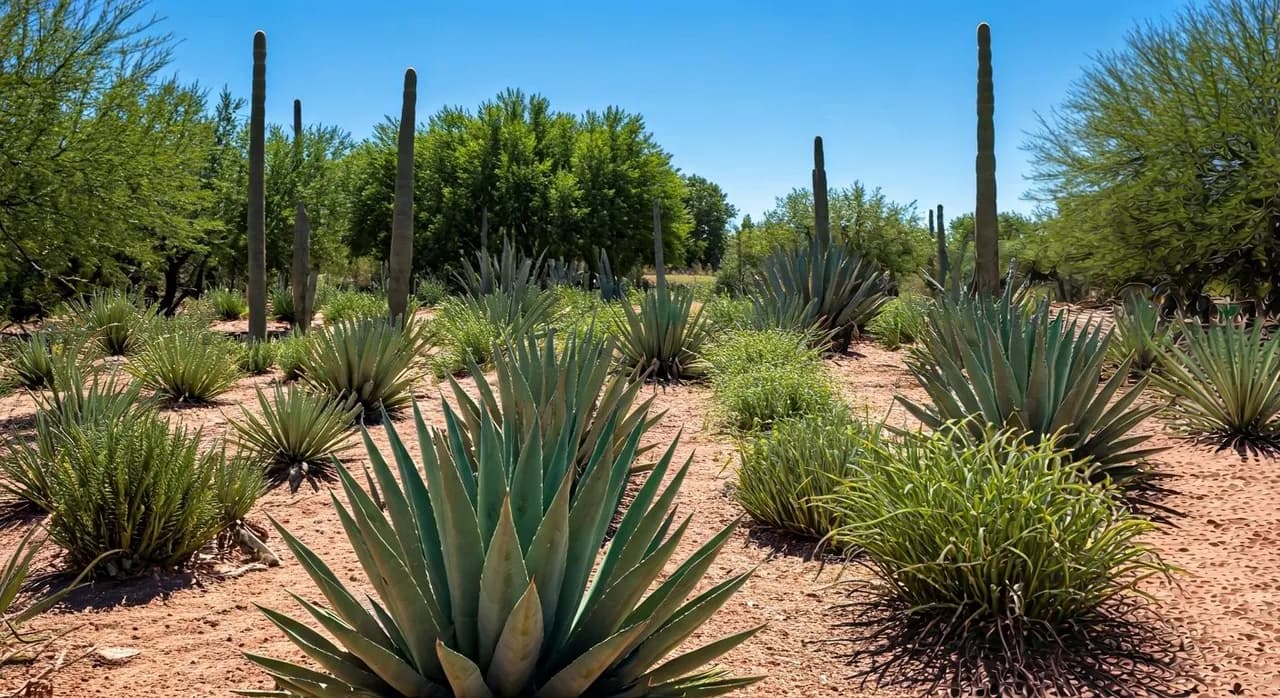
Key takeaways
- Prioritize water harvesting strategies like swales and berms, which slow runoff on sloped terrain and put more of it into the soil.
- Select drought-tolerant canopy trees such as honey mesquite (zones 7-9) or jujube (zones 6-9), which need little supplemental irrigation once established.
- Integrate nitrogen-fixing plants like desert ironwood or caragana into every layer to improve soil fertility in low-nutrient desert soils.
- Use plant guilds to create beneficial microclimates and share resources, for example, planting comfrey around fruit trees to accumulate nutrients.
- Focus on multi-functional plants that provide food, fodder, shade, and soil improvement, maximizing the output from limited water resources.
- Start small and observe your site’s specific conditions; even a 10 ft by 10 ft area can demonstrate successful arid food forest principles.
Quick answer: To establish a food forest in the arid Southwest, prioritize drought-tolerant canopy trees like honey mesquite and jujube, integrate nitrogen-fixing plants, and utilize water harvesting strategies such as swales and berms. Focus on multi-functional plants adapted to extreme temperatures and low rainfall in USDA Zones 6-9.
Establishing a productive food forest in the arid Southwest, particularly across USDA zones 6 through 9, presents unique challenges. Regions like central Arizona or New Mexico often receive less than 15 inches of annual rainfall, requiring a thoughtful approach to plant selection and water management. The aim is to create a resilient, low-water system that provides food and other resources for decades.
This means moving beyond traditional garden beds and embracing permaculture principles, including strategic plant guilds, efficient water harvesting, and careful zone planning. By selecting species adapted to drought and high desert conditions, such as those that thrive in 100°F summer temperatures and winter lows down to 0°F, we can cultivate a thriving ecosystem that supports itself with minimal external inputs after its initial establishment period.
Understanding your site: water and microclimates
Before planting anything, a thorough site assessment is essential. In arid environments, water is the most limiting factor, so understanding its flow and retention is essential. Observing water movement during a one-inch rain event can reveal natural collection points or areas of rapid runoff. Implementing passive water harvesting structures like swales and berms can dramatically improve water infiltration, slowing runoff so more of it soaks in instead of carrying topsoil away. These earthworks slow water so it can soak into the soil profile instead of eroding topsoil.
Designing for water retention and shade
Creating microclimates is another key method. A south-facing wall, for instance, can provide significant heat in winter, while a north-facing slope offers cooler, shadier conditions in summer. Planting a large canopy tree on the west side of a smaller, more sensitive plant cuts the worst of the afternoon sun and keeps the soil beneath it measurably cooler. Consider the orientation of your property and the path of the sun throughout the year to maximize these benefits. Even a small change in elevation of 6 inches can create a distinct microclimate for specific plants.
- Observe water flow during a rain event.
- Map sun and shade patterns throughout the day.
- Note existing wind patterns and cold air sinks.
- Test soil composition for drainage and fertility.
- Identify areas with natural water collection.
Canopy layer: drought-tolerant trees for shade and yield
The canopy layer forms the backbone of any food forest, providing shade, wind protection, and often the largest food yields. In arid regions, trees must withstand prolonged dry periods and extreme temperatures. Honey mesquite (Prosopis glandulosa) is an excellent choice for USDA zones 7-9, growing up to 30 ft tall and producing edible pods that can be ground into flour. Its deep taproot system allows it to access water far below the surface, making it highly drought-resistant once established after two to three years.
Selecting resilient fruit and nut trees
Other suitable canopy trees include jujube (Ziziphus jujuba), which tolerates temperatures from -20°F to 100°F and produces small, date-like fruits. It typically reaches 15 to 25 ft in height. Desert ironwood (Olneya tesota), native to the Sonoran Desert, is a slow-growing, nitrogen-fixing tree that can live for hundreds of years, reaching 20 to 30 ft tall. While its seeds are edible, its primary value in a food forest is its ability to improve soil fertility and provide dense shade. Consider planting these trees at a spacing of 20 to 30 ft apart to allow for mature canopy spread and adequate light penetration for understory plants. For more options, see drought tolerant shrubs that can also form a smaller canopy layer.
- Honey mesquite (Prosopis glandulosa) – edible pods, nitrogen fixer.
- Jujube (Ziziphus jujuba) – edible fruit, very cold hardy.
- Desert ironwood (Olneya tesota) – nitrogen fixer, dense shade.
- Pinyon pine (Pinus edulis) – edible nuts, high desert adapted; a very long-term planting, since seedlings take decades to begin bearing nuts.
- Arizona cypress (Cupressus arizonica) – windbreak and shelter; not a food plant.
Understory and shrub layer: diverse yields and support
The understory and shrub layer adds diversity, additional food sources, and essential ecosystem functions. These plants often fill the space between the canopy and groundcover, typically growing from three to 15 ft tall. Apache plume (Fallugia paradoxa) is a beautiful, drought-tolerant shrub that provides habitat and can reach 3 to 6 ft in height, though its primary value is ornamental and ecological. For edible yields, consider native currants like Golden currant (Ribes aureum), which produces tart, edible berries and grows 3 to 10 ft tall, thriving in USDA zones 2-8. It requires moderate water during establishment but is quite resilient afterward.
Selecting fruiting shrubs and nitrogen fixers
Other valuable shrubs include various species of elderberry (Sambucus spp.), particularly those native to drier regions, which can grow 6 to 12 ft tall and offer edible berries and flowers. Caragana (Caragana arborescens), or Siberian pea shrub, is a nitrogen-fixing plant that can withstand temperatures down to -40°F, making it suitable for higher desert elevations in zones 2-7. It self-seeds freely and is listed as invasive or watch-listed in parts of the upper Midwest and northern prairies, so check your state noxious weed list before planting it. When planting, aim for a spacing of 5 to 10 ft between shrubs, depending on their mature size, to ensure adequate air circulation and light. These plants also contribute to the overall structure of a food forest for chickens by offering cover and forage.
- Golden currant (Ribes aureum) – edible berries, adaptable.
- Elderberry (Sambucus spp.) – edible berries and flowers.
- Caragana (Caragana arborescens) – edible seeds, nitrogen fixer.
- Four-wing saltbush (Atriplex canescens) – edible seeds, very drought tolerant.
- Chokecherry (Prunus virginiana) – fruit edible cooked, hardy; pits, leaves and bark contain cyanogenic compounds, and wilted or frost-damaged prunings can kill livestock and poultry within hours, so dispose of clippings well away from any animals.
Herbaceous and groundcover layers: soil health and minor yields
The herbaceous and groundcover layers are vital for soil health, moisture retention, and suppressing weeds, while also providing smaller, consistent yields. In arid zones, these plants must be exceptionally drought-tolerant or benefit from the shade and moisture provided by upper layers. Olla irrigation, using unglazed clay pots buried in the soil, delivers water directly to the root zone with far less loss to evaporation than surface watering. For example, planting oregano (Origanum vulgare) or thyme (Thymus vulgaris) around an olla can keep the soil moist for a 12-inch radius, supporting these herbs in USDA zones 5-9.
Selecting dynamic accumulators and edible groundcovers
Dynamic accumulators like comfrey (buy Bocking 14, a sterile cultivar of Russian comfrey, Symphytum x uplandicum, not seed-setting common comfrey) draw nutrients from deep in the soil and return them when their leaves are cut and dropped as mulch. Comfrey contains hepatotoxic pyrrolizidine alkaloids, so use it as mulch only, never as food or fodder. While comfrey needs some moisture, it can thrive in partial shade in zones 3-9. Edible groundcovers such as purslane (Portulaca oleracea) or native strawberries (Fragaria virginiana) can spread across the forest floor, protecting soil from direct sun and slowing evaporation. Consider planting these under larger trees, where they benefit from filtered light and increased soil moisture. For more ideas on creating resilient systems, refer to permaculture gardening principles.
- Oregano (Origanum vulgare) – culinary herb, drought tolerant.
- Thyme (Thymus vulgaris) – culinary herb, low water needs.
- Comfrey (Bocking 14, a sterile Symphytum x uplandicum cultivar) – dynamic accumulator, mulch only; not food or fodder.
- Purslane (Portulaca oleracea) – edible succulent, groundcover.
- Native strawberries (Fragaria virginiana) – edible fruit, groundcover.
Plant guilds and integrated design for resilience
Designing with plant guilds (groups of plants that mutually benefit each other) is a cornerstone of permaculture design, especially in challenging environments like the arid Southwest. A well-designed guild can improve nutrient cycling, deter pests, and improve overall plant health without external inputs. For example, a common guild might include a central fruit tree (like a jujube), surrounded by nitrogen-fixing shrubs (such as caragana), dynamic accumulators (comfrey), pest-deterring herbs (oregano), and edible groundcovers (purslane). This multi-functional approach maximizes the productivity of each square foot of land.
Building productive guilds for arid conditions
Consider a guild built around a mature honey mesquite in USDA zone 8. Its deep roots and spreading canopy create a microclimate. Underneath, you could plant native perennial sunflowers (Helianthus maximiliani) for edible seeds and deep taproots that break up compacted soil, along with desert marigold (Baileya multiradiata) to attract beneficial insects. Nitrogen-fixing plants, such as various types of lupine (Lupinus spp.), add nitrogen to the soil as their roots and leaf litter break down, reducing the need for bought fertilizer. When planning your guilds, consider mature sizes and sunlight requirements for each plant to ensure they don’t compete excessively. For detailed planning, refer to resources on permaculture garden plans.
- Central tree (e.g., Jujube) for primary yield.
- Nitrogen fixers (e.g., Caragana) for soil fertility.
- Dynamic accumulators (e.g., Comfrey) for nutrient cycling.
- Pest deterrents (e.g., Garlic chives) for plant protection.
- Groundcovers (e.g., Wild strawberry) for soil moisture.
Drought-tolerant fruit and nut trees for arid zones 6-9
Plant Name | USDA Zones | Mature Height (ft) | Water Needs (after establishment) | Primary Yield |
|---|---|---|---|---|
Honey Mesquite (Prosopis glandulosa) | 7-9 | 20-30 | Very Low | Edible pods |
Jujube (Ziziphus jujuba) | 6-9 | 15-25 | Low | Edible fruit |
Pinyon Pine (Pinus edulis) | 4-8 | 10-20 | Very Low | Edible nuts |
Desert Willow (Chilopsis linearis) | 7-9 | 15-25 | Low | Ornamental, some edible flowers |
Pomegranate (Punica granatum) | 7-10 | 10-20 | Moderate | Edible fruit |
Water Savings: Passive water harvesting techniques like swales put more of each rain event into the root zone, cutting how much you need to irrigate.
Soil Improvement: Nitrogen-fixing plants steadily add nitrogen to the soil, improving fertility in low-nutrient desert ground.
Temperature Moderation: A dense food forest canopy keeps air and soil beneath it cooler on hot summer days, benefiting understory plants and wildlife.
Frequently asked questions
How much water does an arid food forest need after establishment?
After the initial two to three years of establishment, a well-designed arid food forest should require minimal supplemental irrigation, often less than 10 inches of additional water annually, especially if passive water harvesting systems are in place. Mature, drought-adapted trees like mesquite can often survive on natural rainfall alone in regions receiving 10-15 inches per year.
What is the best way to start a food forest in USDA zone 6 with cold winters?
In USDA zone 6, selecting cold-hardy, drought-tolerant plants is key. Focus on species like Siberian pea shrub (Caragana arborescens) for nitrogen fixation, and cold-hardy fruit trees such as certain varieties of jujube or pinyon pine. Incorporate deep mulching of 6 to 8 inches to protect roots from winter temperatures that can drop to -10°F.
Can I grow a food forest on a sloped property in the desert?
Yes, sloped properties are ideal for implementing water harvesting techniques like swales and berms, which are essential in arid food forests. These earthworks capture runoff and direct it into the soil where plants can take it up, instead of letting it erode the landscape. Design your swales along contour lines for maximum effectiveness.
How long does it take for a food forest to become productive in the Southwest?
A food forest in the Southwest can start yielding some produce within one to three years with fast-growing groundcovers and herbaceous plants. However, it typically takes five to seven years for the tree and shrub layers to mature sufficiently to provide significant yields and create a self-sustaining ecosystem with reduced water needs. Full maturity, with a dense canopy and understory, may take 10 to 15 years.
What are some good nitrogen-fixing plants for arid food forests?
Excellent nitrogen-fixing plants for arid food forests include honey mesquite (Prosopis glandulosa), desert ironwood (Olneya tesota), and Siberian pea shrub (Caragana arborescens). These plants, thriving in USDA zones 7-9, form symbiotic relationships with soil bacteria to convert atmospheric nitrogen into a usable form, enriching the soil for surrounding plants as their roots and litter break down.