secondary
Rhubarb
Rheum rhabarbarum
International hardiness
- USDA 3-8
- RHS H7
- AU: Cool temperate
Where it grows — regional guide
| Zones / rating | Regional notes |
|---|---|
USDA 3-8 | Performs exceptionally well across USDA Zones 3 to 8; struggles in hot southern states where summer temperatures consistently exceed 32 °C (90 °F). |
| Zones / rating | Regional notes |
|---|---|
H7 (below -20C) | An iconic British kitchen-garden perennial; celebrated for late-winter forced crowns in Yorkshire's Rhubarb Triangle and outdoor summer harvests. |
| Zones / rating | Regional notes |
|---|---|
Cool temperate | Grown in cool-temperate areas of Victoria, Tasmania, and the southern highlands of New South Wales where winter chilling satisfies bud dormancy. |
| Zones / rating | Regional notes |
|---|---|
USDA 3-8 (USDA scale) Canada uses its own zone system; Canadian zones run roughly one lower than USDA. | Extremely winter-hardy across Canada down to Zone 3; crowns survive deep winter freezing under snow cover and burst into growth in early spring. |
| Zones / rating | Regional notes |
|---|---|
No region-specific data yet | No region-specific data yet |
Rhubarb (Rheum rhabarbarum, often classified horticulturally as Rheum × hybridum) is a robust herbaceous perennial vegetable in the knotweed or buckwheat family (Polygonaceae). Native to the cold-temperate river valleys and mountain slopes of central and northern Asia, including Siberia and Mongolia, rhubarb has been cultivated for over two millennia. Originally prized in ancient Asian medicine for its purgative rhizomes, it transitioned into an iconic culinary crop in eighteenth-century Britain and northern Europe following the widespread availability of refined sugar.
In homestead garden design and temperate food forest assemblies, rhubarb is a long-lived, high-yielding perennial staple. Producing massive, architectural rosettes of crinkled leaves atop thick, succulent leaf stalks (petioles), a well-maintained crown can yield reliably for fifteen to twenty years from a single planting. Because it occupies ground permanently without requiring annual tillage, it integrates well alongside companion plantings of strawberry or along the sunny perimeter of orchard plots featuring apple.
Although botanically a vegetable, rhubarb is treated culinarily as a fruit. Its succulent, ribbed petioles contain high concentrations of malic and citric acids, delivering a brisk, mouth-watering tartness that softens into complex sweet-tart depth when gently stewed with sugar or baked into crumbles, pies, and fruit compotes. Beyond fresh summer cooking, the stalks yield ruby-tinted jellies, sauces, and fermented country wines.
Growing rhubarb
Rhubarb is fundamentally a cold-climate perennial that demands cold winter temperatures to perform. Crowns require approximately 500 to 900 hours of winter chilling between 0 °C and 5 °C (32 °F to 41 °F) to break winter dormancy and initiate vigorous spring petiole growth. Mature crowns are winter-hardy across USDA Zones 3 to 8, tolerating sub-zero soil freezes without injury. Conversely, rhubarb languishes in tropical and hot subtropical climates: when summer temperatures consistently exceed 32 °C (90 °F), crown growth stalls, foliage wilts, and plants succumb to fungal rot.
The crop is a voracious feeder that demands deep, fertile, moisture-retentive soil rich in decomposed organic matter. Light, hungry, or water-logged ground limits performance. Prepare the planting bed deeply, incorporating liberal amounts of well-rotted manure, compost, and leaf mould to create a loose rooting zone with a pH between 6.0 and 6.8. Excellent soil drainage is non-negotiable; while rhubarb demands ample moisture during active summer growth, stagnant winter water rotting the dormant crown is the leading cause of plant loss.
Plant in full sun to maximise petiole colour and yield. In warmer inland valleys, light afternoon shade shields foliage from summer heat stress. Water regularly during dry spells, supplying 25 to 35 mm (1 to 1.4 in) of water weekly to maintain active petiole production and prevent premature leaf senescence.
Rhubarb is best propagated by dividing dormant mature crowns in early spring before growth commences, or in late autumn. Seed propagation is possible but discouraged for culinary plantings, as seedlings exhibit wide genetic variability in stalk thickness, colour, and flavour. When dividing crowns, use a sharp spade to cut pieces containing at least one prominent, plump growth bud (eye) and a substantial section of thick taproot. Plant divisions with the eyes positioned 2.5 to 5 cm (1 to 2 in) beneath the soil surface. Space crowns 90 cm to 1.2 m (3 to 4 ft) apart to accommodate their mature leaf spread.
Forcing is a traditional British technique used to produce an early harvest of tender, sweet petioles during late winter. In January or February, invert a large terracotta forcing jar, deep wooden box, or dark bucket over an established crown, insulating the exterior with straw or dried leaves. Denied light, the plant expends root starch reserves to send up elongated, pale pink, almost stringless stalks that are harvested three to four weeks earlier than outdoor plants. Forcing exhausts crown reserves, so forced plants must be allowed to grow unharvested the following season to recover.
Harvest and uses
Restraint is critical during early establishment. Do not harvest any stalks during the first growing season; all photosynthetic energy must be channelled into building the fleshy storage root. During the second year, harvest lightly for three to four weeks. From the third year onward, crowns reach full maturity and sustain an eight- to ten-week harvest period from early spring through midsummer.
To harvest, grasp an individual stalk near its base and apply a firm downward and twisting pull. The petiole will detach cleanly from the crown with a satisfying pop. Never slice stalks off with a knife at ground level, as the remaining stub readily rots and admits fungal pathogens into the crown. Select thick, firm stalks that are at least 30 cm (12 in) long, leaving at least one-third of the central leaves intact to support ongoing photosynthesis. Cease harvesting by midsummer to allow the plant to store carbohydrates for winter survival.
Immediately upon harvesting, slice off and discard the toxic leaf blades. Stalks keep in a refrigerator wrapped in paper towels for up to two weeks. For long-term preservation, chop stalks into 2 cm (0.8 in) pieces and freeze them unblanched in airtight containers. Rhubarb pairs naturally with sweet fruits in jams, cobblers, and chutneys, and can be cooked with spinach in savoury Middle Eastern and Persian meat stews.
Identifying rhubarb
Rheum rhabarbarum is recognised by several distinctive vegetative characteristics:
- Crown and root: A massive, woody, dark brown rhizomatous crown producing thick, fleshy, yellow-fleshed storage roots that penetrate deeply into the subsoil.
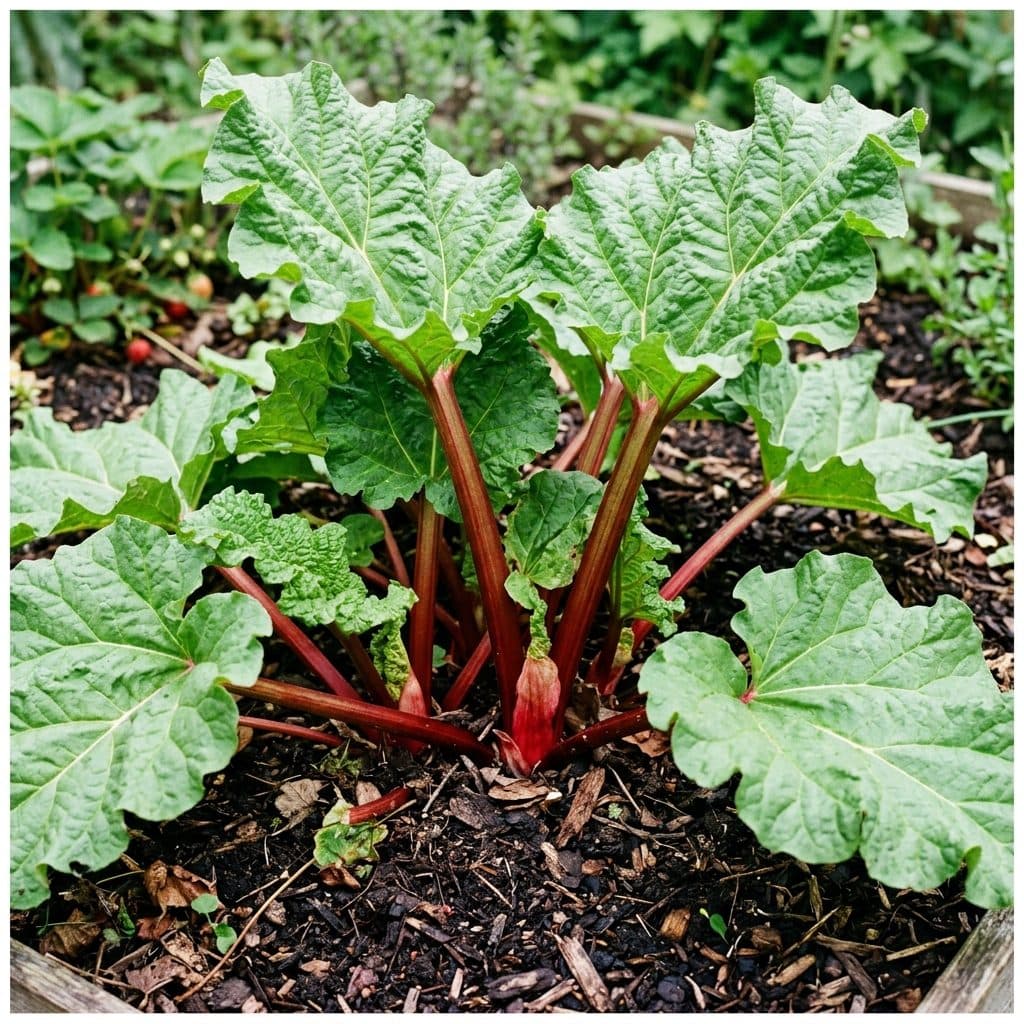
- Foliage: Huge, basal rosettes of simple, cordate-ovate to triangular leaves measuring 30 to 80 cm (12 to 31 in) in length and width, featuring crinkled or ruffled margins and prominent palmate venation.
- Petioles: Broad, succulent, semi-cylindrical grooved leaf stalks measuring 30 to 60 cm (12 to 24 in) long and 2.5 to 5 cm (1 to 2 in) thick, ranging from pale greenish-pink to deep ruby-red depending on cultivar.
- Flowering habit: Large, hollow, ribbed central flowering stalks reaching 1.5 to 2 m (5 to 6.5 ft) in height, topped by dense, branched panicles of minute greenish-white to pale cream flowers appearing in early summer.
Rhubarb is distinguished from ornamental garden dock (Rumex species) by its massive leaf surface area, succulent edible petioles, and lack of barbed fruit. It is distinguished from wild burdock (Arctium lappa) by its completely hairless, glossy upper leaf surfaces (burdock foliage is densely woolly and grey-felted beneath).
Cautions
Cultivating and harvesting rhubarb requires strict adherence to toxicological and plant-health guidelines:
- Lethal leaf toxicity: The leaf blades of rhubarb contain dangerously high levels of soluble oxalic acid and anthraquinone glycosides. Ingesting leaf tissue causes severe calcium oxalate crystal deposition in renal tubules, acute kidney damage, severe hypocalcemia, violent vomiting, and cardiac arrhythmias in humans, dogs, cats, and livestock. Never consume leaf blades under any circumstances, and never feed trimmings to household pets or poultry. Discard leaves as garden mulch or compost them safely, as soil microbes break down oxalic acid into harmless compounds.
- Frost-damaged stalks: If severe late spring frosts (temperatures dropping below -4 °C / 25 °F) cause standing stalks to freeze, oxalic acid can translocate from the damaged leaves down into the petioles. Freezing turns the stalks limp, mushy, and water-soaked. Stalks exhibiting frost-induced softening must be discarded, as they are unsafe for consumption.
- Crown rot (Phytophthora cactorum): In heavy, waterlogged soils or poorly drained beds, fungal pathogens attack the dormant crown, causing the base of the stalks to blacken, soften, and emit an unpleasant odour. Plant only in free-draining ground, elevate beds in clay areas, and avoid piling mulch directly over the growing crown eyes.
- Exhaustion through overharvesting: Removing too many leaves or continuing harvest into late summer starves the root system, causing crowns to diminish in vigour and eventually die. Always leave a healthy canopy of foliage on the plant throughout late summer and autumn.
Sources
- Royal Botanic Gardens, Kew. Rheum rhabarbarum L. Plants of the World Online.
- Royal Horticultural Society. Rhubarb: grow your own
- Plants For A Future. Rheum rhabarbarum - L.
- USDA PLANTS Database. Rheum rhabarbarum L.