secondary
Quince tree
bihi
Cydonia oblonga
- kpk hills
- balochistan highlands
International hardiness
- USDA 5-9
- RHS H5
- AU: Cool temperate, Warm temperate
Where it grows — regional guide
| Zones / rating | Regional notes |
|---|---|
USDA 5-9 | Hardy in USDA Zones 5 to 9; highly susceptible to bacterial fire blight in warm, humid regions, requiring vigilant sanitary spring branch pruning. |
| Zones / rating | Regional notes |
|---|---|
H5 (-15 to -10C) | Thrives across Britain rated RHS H5; plant in full sun and sheltered locations to reduce fungal quince leaf blight during humid, wet summer seasons. |
| Zones / rating | Regional notes |
|---|---|
Cool temperate, Warm temperate | Performs reliably across cool-temperate and Mediterranean regions of Victoria, South Australia, and New South Wales, ripening golden crops by April. |
| Zones / rating | Regional notes |
|---|---|
USDA 5-9 (USDA scale) Canada uses its own zone system; Canadian zones run roughly one lower than USDA. | No region-specific data yet |
| Zones / rating | Regional notes |
|---|---|
KPK hills, Balochistan highlands | Pakistan:Cultivated as bihi across the cooler valleys of Balochistan and Khyber Pakhtunkhwa; fruit and mucilaginous seeds are valued in traditional Unani medicine. |
Quince tree (Cydonia oblonga), the sole member of the monotypic genus Cydonia in the rose family (Rosaceae), is a small, slow-growing, picturesque deciduous fruit tree. Native to the rocky slopes, woodland margins, and foothills of the Caucasus and Central Asia—encompassing modern Iran, Armenia, Azerbaijan, Georgia, and Turkmenistan—the quince has been revered since deep antiquity. It was cultivated across the Fertile Crescent and Mediterranean basin long before the domestic apple, and historical botanists believe the celebrated "golden apples" of classical mythology were in fact fragrant quinces. Historically treasured for intoxicating floral fragrance, outstanding keeping quality, and culinary virtues, quince remains an aristocratic fixture of European, Middle Eastern, and Latin American horticulture. For permaculture growers, it represents a self-fertile, architectural orchard classic that yields lavish harvests of pectin-rich fruit for autumn processing.
Within multi-tier food forest designs, Cydonia oblonga occupies a prime middle-canopy role as a secondary-stratum fruiting tree. Its moderate stature, twisted sculptural branches, and relatively light leaf canopy allow dappled light to reach underlying companion shrubs and herb layers. Quince trees make excellent partners for core temperate pomes and stone fruits such as apple and pear, and they share cultural affinities with Mediterranean species like fig. In mid to late spring, after apple blossom has peaked, quince bursts into magnificent, large solitary flowers that offer a feast of nectar to honeybees, wild bumblebees, and hoverflies, thereby boosting overall orchard pollination dynamics.
Growing quince trees
Cydonia oblonga is well adapted to temperate and Mediterranean climates characterised by warm, sunny summers and distinct winters, performing reliably within USDA Hardiness Zones 5 through 9 and holding an RHS hardiness rating of H5. Dormant winter trees easily tolerate frosts down to -20 °C (-4 °F) without structural damage. The tree requires modest winter chilling—typically between 300 and 500 hours below 7 °C (45 °F)—which is significantly less than most apples and pears, permitting successful cultivation in regions with mild winters. Flowering occurs comparatively late in spring (usually May in the northern hemisphere), cleanly escaping early spring radiation frosts. However, trees require prolonged summer warmth and sunlight to ripen fruit fully, accumulate sugars, and develop floral aromatic oils in the peel.
Quinces thrive across a wide range of fertile, deep, moisture-retentive soils. They prefer rich, well-aerated sandy loams or clay loams with a slightly acidic to neutral pH between 6.0 and 7.0. While capable of enduring temporary winter saturation better than most stone fruits, trees perform poorly in chronically stagnant, anaerobic waterlogged ground. Conversely, dry sandy soils stunt vegetative growth and cause fruit to drop prematurely; applying a thick organic compost mulch each spring conserves essential soil moisture and nourishes surface feeder roots. Full sun is mandatory: plant in positions receiving at least six to eight hours of direct sunlight daily to encourage floral bud initiation and suppress fungal foliage pathogens.
Most cultivated quince varieties are completely self-fertile, meaning a solitary homestead tree will set a full, heavy crop without requiring a second pollinator tree nearby. Propagation of selected named cultivars—such as 'Vranja', 'Champion', 'Meech's Prolific', and 'Smyrna'—is carried out via budding or grafting onto clonal quince rootstocks (frequently Quince A for semi-vigorous trees or Quince C for compact trees) or through rooted hardwood cuttings taken in late autumn. Space standard trees 4 to 5 m (13 to 16 ft) apart, or 3 to 3.5 m (10 to 11.5 ft) apart for dwarfing selections. Young trees establish steadily and begin bearing fruit in their third or fourth year after planting.
Harvest and uses
Quince fruits ripen in late autumn, typically from October to November in the northern hemisphere, when the garden is largely winding down. The fruit is a substantial, fragrant pome measuring 8 to 15 cm (3.1 to 5.9 in) in length and weighing between 250 and 600 g (0.55 and 1.32 lb), displaying a globose, pear-shaped, or irregular ribbed contour.
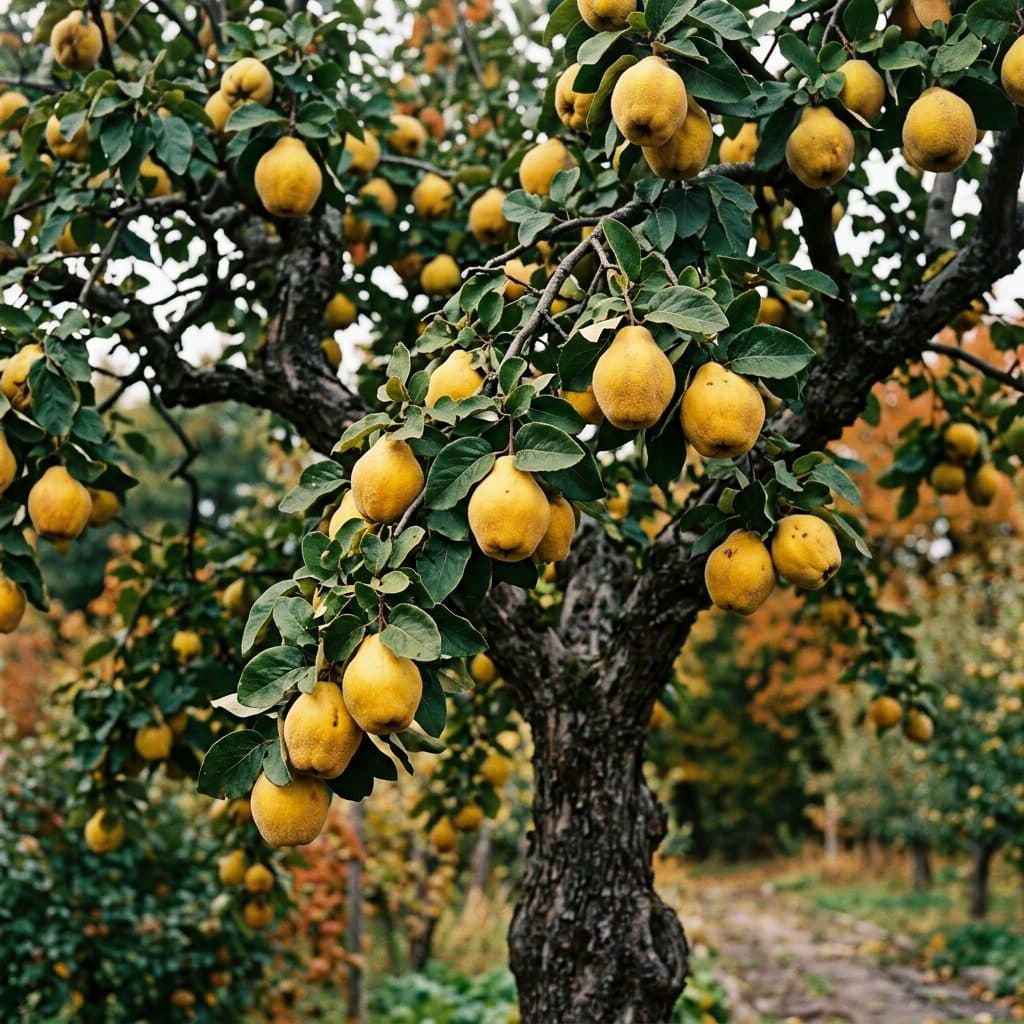
As maturity approaches, the peel transitions from dull pale green covered in a dense, velvety grey-brown fuzz (tomentum) to a brilliant, unblemished golden-yellow, releasing a captivating perfume evocative of ripe guava, pineapple, and wild roses. Harvest quinces carefully by hand before heavy freezing weather, gently rubbing away surface fuzz with a cloth. Stored in shallow wooden trays in a cool, dark cellar at 2 to 5 °C (36 to 41 °F), quinces keep soundly for two to three months.
In Western culinary traditions, quince is almost never eaten raw because uncooked flesh is hard, woody, astringent, and packed with gritty stone cells (sclereids). However, thermal cooking completely transforms this fruit: prolonged gentle poaching, baking, or stewing breaks down astringent tannins and converts colourless proanthocyanins into luminous ruby-red anthocyanin pigments, yielding a melting, velvety texture and sublime, musky-sweet flavour.
Owing to phenomenal concentrations of natural pectin and organic acids, quinces are legendary for processing into traditional preserves, thick jellies, and Iberian membrillo (quince paste), which slices cleanly to accompany robust cheeses. In Pakistan and South Asia, known as bihi, the fruit is stewed into invigorating winter preserves (murabba), while mucilaginous seeds are steeped into traditional soothing demulcent decoctions. A mature, well-managed quince tree produces an annual yield of 25 to 50 kg (55 to 110 lb) of fruit.
Identifying quince trees
Cydonia oblonga can be distinguished from related orchard trees by the following definitive morphological traits:
- Habit and structure: A small, spreading, deciduous tree or multi-stemmed large shrub growing 4 to 6 m (13 to 20 ft) in height with an equal spread, characterised by crooked, picturesque, low-branching limbs. The bark is smooth and greyish-brown on young branches, becoming scaly and peeling on mature trunks.
- Leaves: Alternate, simple, ovate to broadly elliptic leaves measuring 5 to 10 cm (2 to 4 in) long and 3 to 6 cm (1.2 to 2.4 in) wide. The margins are completely entire (smooth and untoothed), which readily separates quince from apples and pears that possess serrated leaf margins. The upper leaf surface is dull dark green, while the underside is densely blanketed with a soft, persistent, whitish-grey woolly pubescence.
- Flowers: Borne singly at the ends of leafy spring shoots, rather than in clusters. The blossoms are large and showy, measuring 4 to 5 cm (1.6 to 2.0 in) across, featuring five delicate petals of pure white or soft blush pink, surrounding numerous yellow-anthered stamens and five styles.
- Fruit: Large, pyriform (pear-shaped) or subglobose golden-yellow pomes, frequently bumpy, with a persistent open calyx at the apex and an oily skin covered when young in dense felted fuzz.
Quince is easily distinguished from ornamental flowering quince (Chaenomeles speciosa and Chaenomeles japonica), which are thorny, low-growing shrubs bearing toothed leaves and clusters of bright scarlet, coral, or orange blossoms directly on bare wood in early spring.
Cautions
Cultivators of Cydonia oblonga must manage several serious phytopathological liabilities and biochemical considerations:
- Cyanogenic glycosides in seeds: The seeds within the core of the quince contain significant amounts of amygdalin, a cyanogenic glycoside that releases toxic hydrogen cyanide when crushed and metabolised by gastrointestinal enzymes. When processing fruit for preserves, stewing, or baking, always core the fruit and discard seeds intact; never blend, mill, or grind raw quince seeds into purées or pastes.
- Severe fire blight susceptibility: Cydonia oblonga is exceptionally vulnerable to fire blight (Erwinia amylovora), a devastating bacterial pathogen that enters through blossoms during warm, humid spring weather. Infected shoots rapidly turn brown, wither, and blacken into a characteristic "shepherd's crook" shape, exuding bacterial slime and rapidly killing mature scaffold branches. Prune out blighted wood at least 30 cm (12 in) into healthy wood using shears disinfected between every cut with 70% alcohol.
- Quince leaf blight (Diplocarpon mespili): This pervasive fungal disease flourishes in warm, wet maritime summers, producing circular reddish-brown spots with dark margins across foliage, causing premature defoliation in late summer and spotted, cracked fruit. Rake and destroy fallen autumn foliage to disrupt the fungal overwintering cycle.
- Powerful ambient aroma: Ripe quinces exude an intense, penetrating fragrance that readily taints other produce; never store harvested quinces in the same closed room or refrigerator alongside dessert apples, pears, butter, or milk, as these items rapidly absorb the pungent perfume.
Sources
- Royal Botanic Gardens, Kew. Cydonia oblonga Mill. Plants of the World Online.
- USDA PLANTS Database. Cydonia oblonga Mill.
- Plants For A Future. Cydonia oblonga - Mill.
- Missouri Botanical Garden. Cydonia oblonga